A mining water truck is usually the last machine on the inspection schedule and the first one blamed when the dust monitor spikes or a haul road turns to soup. Yet that "ancillary" unit carries two of the most expensive jobs on site: respirable dust control that keeps crews under exposure limits, and haul road watering that decides how long your haul truck tires and suspensions last. A proper mining water truck inspection is not a quick walk-around with a hose running — it is a pump, spray bar, tank baffle and chassis check done every shift, with the same discipline you give the excavator. This guide breaks down the exact inspection points, the failure modes that cost real money, and how to run it digitally so nothing gets pencil-whipped. If you want to see how this runs on your own water carts, you can book a 30-minute walkthrough of the water truck workflow and test it against your current paper process.
Is your dust suppression truck inspected like the exposure-control equipment it actually is?
Most sites treat the water truck as a support unit. Then a packing gland fails mid-shift, three spray nozzles are blocked, and the safety team is explaining a respirable dust exceedance while the grader fixes an over-watered road. Here is the checklist that prevents both.
The water truck checklist that catches failures before the dust monitor does
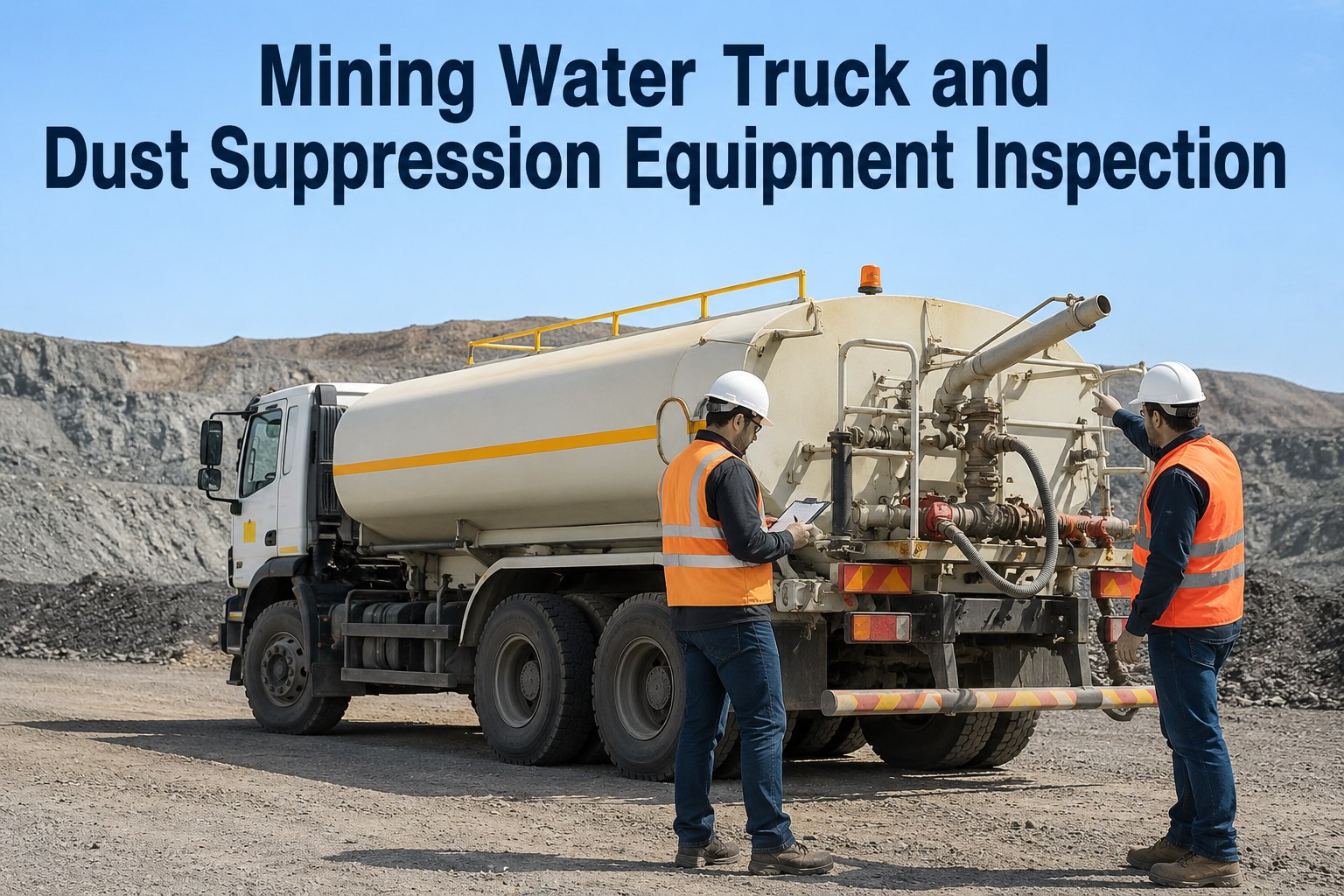
A water cart fails differently from a haul truck. The engine and transmission are rarely the problem — it is the pump, the plumbing, the tank and the chassis working under a live, moving load. These are the six zones your operators should hit every shift, in order, with photos.
Pump and packing gland
The pump is the number one failure point on any water truck. Check the packing gland for weep beyond a slow drip — a steady stream means the packing is spent and the shaft is scoring. Listen for cavitation on prime, check the mechanical seal weep hole, and verify the PTO engagement is clean. A gland ignored for a week becomes a pump rebuild; a pump rebuild on a Friday afternoon becomes a dusty weekend.
Spray bar and nozzles
Test every nozzle individually — never assume the bar is fine because water comes out somewhere. Partial blockage is the silent killer: three dead nozzles on a ten-nozzle bar leaves dry strips that read as dust exceedances downwind. Check spray pattern, pressure balance side to side, and the valve actuation for each section. Photo each zone firing so the record proves coverage, not just intent.
Tank and baffle integrity
A compromised baffle turns 30,000 litres of water into a battering ram. Inspect baffle welds for cracking, check the tank shell for weep at seams, and confirm the surge behaviour on a controlled brake test in the yard. Load surge from a failed baffle has rolled water carts on grades that a dry truck handles easily — this is a structural check, not a cosmetic one.
Fill system and hatch security
Check the fill stand coupling, the camlock seals, and the anti-siphon valve. A hatch that does not seal sloshes water onto the deck and the road behind you — and an open hatch at the fill stand is a fall and contamination hazard. Verify the overflow line is clear so a distracted fill does not pressurise the tank.
Chassis under a live load
Brakes, steering and tires behave differently with a shifting liquid load. Check brake stroke and air build times, look for tire sidewall scuffing from surge weight transfer, and inspect suspension bushings for the accelerated wear water carts are known for. Steering free-play that is acceptable on a dry service truck is dangerous with half a tank moving behind you.
Water cannon and remote monitors
If the truck runs a cannon for stockpile or blast dust, test the actuator sweep, the nozzle bore for wear, and the joystick or cab controls. A cannon that will not articulate mid-blast is a truck out of service at the worst possible moment. Log hours on the cannon separately — it wears faster than the bar.
What a skipped dust suppression inspection actually costs you
None of these failures announce themselves. They show up as a dust exceedance report, a tire bill, or a truck parked in the shop while the haul road bakes. Here is how the common ones translate into money.
| Failure | How it starts | What it becomes | Typical cost impact |
|---|---|---|---|
| Packing gland failure | Steady weep ignored for days | Scored shaft, full pump rebuild | Pump rebuild plus 2–3 days of truck downtime |
| Partial nozzle blockage | Dirty tank water, no individual test | Dry strips, dust exceedance downwind | Exposure investigation, possible stoppage, regulator attention |
| Cracked tank baffle | Fatigue at weld toes, never inspected | Load surge, brake fade, rollover risk on grades | Tank repair or replacement — and the incident you do not want |
| Over-watering habit | No watering schedule, operator guessing | Slippery roads, tire spin, rutting, grader rework | Tire wear, grader hours, lost cycle times across the fleet |
| Brake fade under surge | Chassis inspected like a dry truck | Longer stops with a moving load | The near-miss that ends a career — or worse |
A worked example: one water cart down for three days on a pump rebuild means the haul road goes unwatered on a hot, windy stretch. Haul trucks chew tires on the dry, rocky surface, cycle times stretch, and the safety team fields a dust complaint from the nearest boundary monitor. That single gland — a cheap wear part — just cost a pump, three truck-days, measurable tire life and a compliance headache. Catching the weep on a free digital inspection you can start today costs fifteen minutes.
Watering frequency: the schedule is part of the inspection
Dust control is not just a mechanical problem — it is an operational one. The best-maintained truck in the fleet fails the job if the watering schedule is wrong for the conditions.
The exposure link matters for your defence file. Respirable crystalline silica limits keep tightening across the US, UK, Australia and the UAE, and haul road dust is one of the biggest contributors on an open site. When a personal monitor or boundary station trips, the first question an investigator asks is: show me your watering records and the truck's inspection history. If those live in a binder in the cab, you are already behind. Sites that see the digital watering log in a short demo usually recognise their own gap within the first five minutes.
Run every water cart inspection from a phone, with proof attached
HVI turns the water truck from an afterthought into a managed asset — the same discipline your haul fleet gets, without the paper.
QR-scanned water truck templates
The operator scans the truck's QR code and the exact water cart checklist loads — pump, bar, baffles, chassis. No wrong form, no skipped sections, works on any phone at the fill stand.
Photo-verified spray function
Each spray zone requires a photo of it firing. Blocked nozzles get flagged as defects with the image attached — coverage is proven, not assumed, and dust investigations get answered in seconds.
Meter-based preventive maintenance
Pump packing, seal kits and cannon service schedule off engine hours and pump hours, with due and overdue alerts. The gland gets repacked on your schedule, not after the shaft is scored.
Defect routing to the workshop
A failed check becomes a work order automatically, with the photo and operator note attached. The shop sees the leaking gland before the truck even reaches the pad — parts get pulled, downtime shrinks.
See your own water truck checklist running in HVI
Bring your current paper form to a 30-minute demo and we will build it live — pump checks, nozzle photos, defect routing and all.
The binder in the cab vs a record that defends you
Most water carts still run on a laminated card and a pencil. Here is what changes when the inspection moves to a CMMS built for heavy fleets.
Paper and radio calls
- Checklist pencil-whipped at the fill stand in 90 seconds
- "Bar looks fine" — no proof any nozzle actually fired
- Defects radioed to the shop, half of them forgotten by smoko
- Watering passes unrecorded — nothing to show the dust investigator
- PM tracked on a whiteboard; the gland fails between services
HVI digital inspection
- QR scan opens the right template; every item needs a tap and a note
- Photo required per spray zone — coverage is timestamped evidence
- Defect auto-creates a work order with the photo attached
- Every watering pass logged with time and segment for the compliance file
- PM fires off engine hours with alerts before the packing is due
The shift usually takes one toolbox talk per crew. Operators already carry phones; the inspection takes less time than the paper version because there is no form to find and no defect to write up twice. If you want to test that claim, run one water cart through a guided demo setup and time it against your current card.
Water truck inspection, boiled down
The pump packing gland is your early-warning system. A weep caught on inspection is a cheap repack; ignored, it is a rebuild plus days of unwatered road.
Test nozzles individually, every shift. Partial blockage is invisible from the cab and shows up later as a dust exceedance you cannot explain.
Baffles are safety equipment. A cracked baffle turns the tank into a moving hammer — inspect welds and treat surge behaviour as a structural issue.
The watering schedule is part of dust compliance. Log every pass; when a monitor trips, your records are the first thing anyone asks for.
Digitise it like any other asset. A mining water truck inspection on HVI takes 15 minutes, proves itself with photos, and routes defects to the shop before the truck parks.
"I used to find out about blocked spray nozzles from the environmental coordinator, which is the worst possible way. Now I check the nozzle photos over coffee at 6am — if zone three looks weak, the shop has the part before the operator finishes his pre-start. The number I watch is unplanned water cart days: we were losing four or five a quarter, and last quarter it was one, and that one was scheduled."
Daniel Reeves — Maintenance Manager, open-pit aggregates operation
Mining water truck and dust suppression inspection FAQs
How often should a mining water truck be inspected?
Every shift, without exception — the same cadence as your haul trucks. The pump, spray bar and chassis work under a shifting liquid load, so wear accelerates faster than on a dry service vehicle. A full digital walk-around with photos takes about 15 minutes, and pump, baffle and chassis items should also roll into meter-based preventive maintenance.
What is the most common failure point on a water cart?
The pump packing gland. It starts as a weep that operators ignore, then scores the shaft and forces a full rebuild. Checking the gland weep rate daily and scheduling repacks off pump hours — which HVI does automatically with a quick demo of meter-based PM — turns an emergency into a planned 30-minute job.
Why do spray nozzles need to be tested individually?
Because partial blockage is invisible from the cab. Three dead nozzles on a ten-nozzle bar leave dry strips across the road, and those strips are what a downwind dust monitor reads as a site-wide control failure. Testing each zone with a photo proves coverage and gives you evidence if an exceedance is ever investigated.
Can over-watering a haul road really cause problems?
Yes — a slick road spins haul truck tires, accelerates rutting, and creates a genuine loss-of-control risk on grades. Watering should follow triggers like wind, temperature and traffic count rather than a fixed clock, and every pass should be logged so the schedule can be tuned and defended.
How do digital inspections help during a dust compliance investigation?
Investigators ask for two things: the truck's inspection history and your watering records. With HVI both are timestamped, photo-backed and exportable in seconds, instead of buried in cab binders. You can sign up free and digitise one water cart to see how the record builds from day one.
Give your water carts the same discipline as your haul fleet
QR-scanned checklists, photo-verified spray coverage, meter-based pump PM and instant defect-to-work-order — on any phone, at any fill stand. Book a demo and we will build your water truck template live.
Free to start - Works on any phone - No card needed