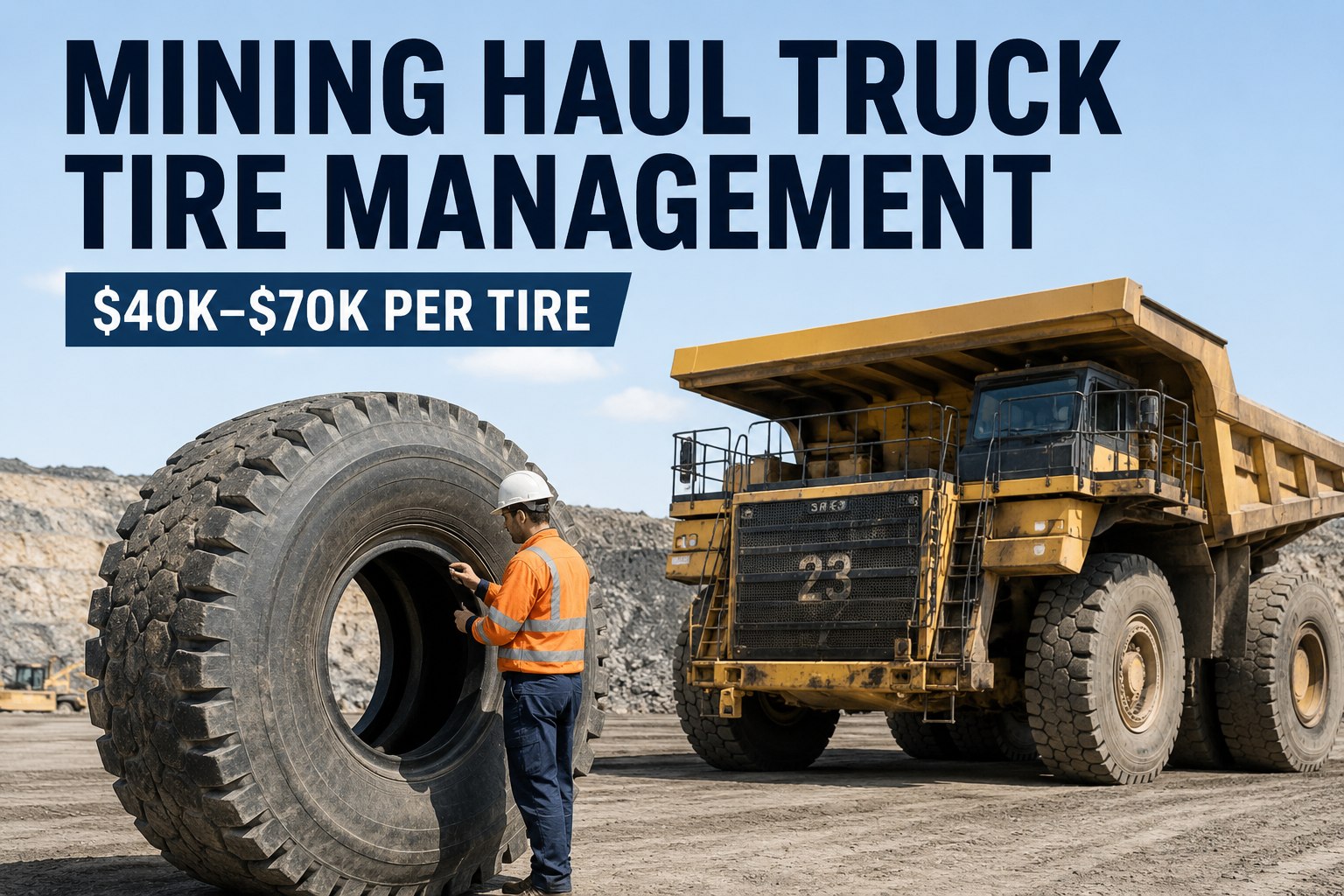
You walk past a 793 sitting in the pit with a left-rear shredded down to the cords, and you already know what the shift report is going to say: rock cut, heat separation, or "operator didn't notice." That tire cost somewhere between $40,000 and $70,000, and it just died at 2,100 hours when it should have run past 5,000. Mining tire management is one of the largest controllable cost lines on any surface mine, and on most sites it is still run from a clipboard, a pressure gauge that lives in the supervisor's truck, and whatever the operator remembers to mention at the end of shift. The gap between a managed tire and an abused one is roughly double the service life, which means the difference between a disciplined program and a neglected one is measured in hundreds of thousands of dollars per truck per year. This page breaks down where ultra-class tire life is actually won and lost — pressure, temperature, load, roads and operator habit — and how sites are closing the gap with digital inspections and live defect tracking. If you want to see what that looks like on your own fleet, you can book a 30-minute walkthrough of the tire module and judge it against your current process.
A $55,000 tire dies at half its rated life. Which of your trucks is next?
Ultra-class haul truck tires are built to run 4,000 to 6,000 hours under proper management. Under heat, pressure and load abuse they last roughly half that. The three killers are invisible until they are expensive — unless someone is measuring them every shift.
Haul truck tire cost, in numbers your CFO understands
Every figure below is per tire, per truck or per event — multiply by your fleet size and the budget line writes itself.
Replacement cost per ultra-class tire
One 59/80R63 or equivalent costs more than a highway tractor's annual tire budget. Losing even two a year early is a six-figure leak.
Service life under proper management
The realistic benchmark when pressure, temperature, load and roads are controlled. Abused tires reach roughly half of that.
The tag-out temperature threshold
Internal readings above roughly 185°F (85°C) mean heat separation is actively progressing. That tire comes out of service now, not at end of shift.
Acceptable pressure band around spec
Cold inflation held within about ten percent of specification. Outside that band, flex and heat build compound every loaded hour.
Why OTR tire life collapses: heat, inflation, overload
Almost every premature mining tire failure traces back to one of these three mechanisms — usually two of them working together.
Heat separation
Every loaded hour flexes the casing. Flex generates heat, and heat breaks the bond between rubber and steel cord. Sustained high speed, long hauls and under-inflation all raise internal temperature. Once separation starts, the tire is on a countdown — and from the outside it can still look fine.
Control: TPMS temperature monitoring on every wheel position, TKPH-rated haul profiles, and a hard tag-out rule above 185°F.
Under / over-inflation
Ten percent low doubles sidewall flex and sends temperature climbing. Over-inflation shrinks the contact patch, concentrates load in the crown and makes the tire a rock-cut magnet. Both conditions are invisible to the eye on a 4-metre tire — a gauge or sensor is the only way to know.
Control: cold pressure checks within ±10% of spec, logged per position, with slow-leak trends flagged before they become failures.
Overload
A truck loaded past its rated payload transfers the excess straight into the tire structure. Add a high centre of gravity from heaped loads and one side of the axle carries far more than its share. Overload multiplies the damage from heat and low pressure — it is the amplifier, not just a cause.
Control: payload monitoring, loader pass discipline, and load-distribution checks tied into the pre-shift routine.
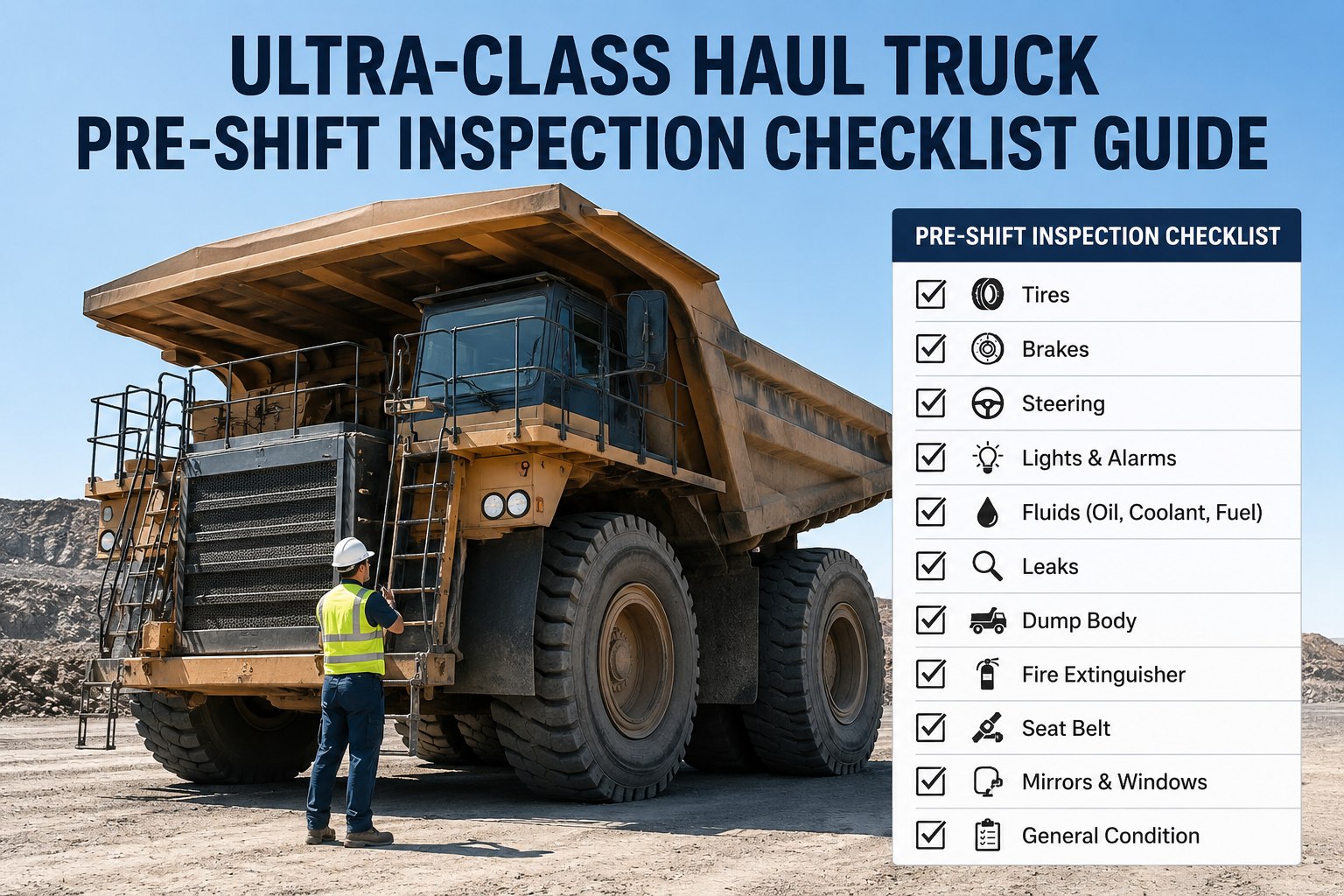
A tire inspection haul truck crews actually complete
Five checkpoints, under ten minutes, every shift. Miss them and you find out about the problem from the failure, not the inspection.
Cold pressure, every position
Check before the truck moves, against the spec for that axle and load. Log the number, not a tick. A position drifting down 2–3 psi per week is a slow leak — schedule the repair before the tire runs hot.
TPMS temperature review
Scan live or last-cycle temperatures by wheel position. Anything trending toward 185°F gets flagged; anything above it gets tagged out immediately. A hot inner dual that the driver cannot feel is exactly what sensors exist for.
Cuts, bulges and exposed cord
Walk every tire. Photograph any cut deeper than the tread, any sidewall bulge, any visible cord. A bulge is separated structure — that tire does not make another loaded trip. Photo evidence with a timestamp ends the "it looked fine this morning" argument.
Rim and hardware integrity
Check rim flanges for cracks, lock rings for seating, and valve stems for damage or leakage. A five-piece rim failure under mining inflation pressures is a fatality risk, not a maintenance ticket. Anything suspect goes to the tire bay, not back to the pit.
Tread depth and wear pattern
Measure remaining tread, note uneven wear by position, and feed the rotation plan. Shoulder wear on one side says cornering speed or alignment; centre wear says over-inflation. The pattern tells you which abuse mechanism to chase.
In HVI, these five points are a dedicated tire section inside the pre-shift inspection — with photo evidence required before the form can be submitted. Crews using it stop losing failures to "nobody wrote it down." You can start logging tire inspections free and have the first truck on digital forms this week.
Haul roads decide tire life as much as the tire does
You can run perfect pressure discipline and still burn tires if the road is working against you. Rock, spillage and grade are the largest external drivers of OTR tire life — and they are all manageable.
Rock and spillage
Spillage from overloaded or poorly spotted trucks becomes cutting debris for every truck behind. A single cleanup pass after each loading pattern change costs minutes; a rock-cut 63-inch tire costs $50,000. Tie spillage reports to the inspection app so the grader gets dispatched, not just mentioned at the pre-start meeting.
Grade and rolling resistance
Steep, long climbs under full load are where TKPH limits get exceeded and casing temperatures climb. If your haul profile outgrew the tire's TKPH rating two expansions ago, no amount of pressure discipline will save the tire. Recalculate TKPH whenever the pit plan changes — and log it.
Surface maintenance rhythm
Washboard and rutting force constant sidewall work and uneven loading across duals. Sites that grade on a schedule tied to traffic count — not "when the grader is free" — consistently report longer tire life. Road condition belongs in the same defect system as the trucks, because it is the same cost line.
Operator habit
Cornering speed and wheel spin shred tread and generate heat faster than any road defect. Spinning on loose ground cuts tires and wastes fuel in the same second. Sites that coach operators on tire-aware driving — and track repeat offenders by machine and position — see measurable life extension within a quarter.
The tire budget math for a 10-truck fleet
Run the numbers once and the case for a managed program makes itself.
That math does not include the catastrophic version: a high-speed tire failure on a loaded truck can take out the rim, the suspension, the truck frame and — in the worst case — the operator. Tire heat separation events are among the most dangerous failures on a mine site. If you want to pressure-test these numbers against your own fleet's history, walk through your tire data in a live demo and see what the trend view shows.
See every tire position, every pressure reading, every defect — in one dashboard
Book a 30-minute demo and we will load one of your truck models into HVI's Tire Management module so you can judge it on your own operation.
Mining tire management software that lives in the pre-shift routine
HVI (Heavy Vehicle Inspection & Maintenance, by JRS Innovation Inc.) is a cloud + mobile CMMS built for fleet-heavy operations. Four capabilities do the heavy lifting for tire life extension in mining.
Tires as a dedicated pre-shift section
Pressure, temperature, cuts, bulges, cord, rim — a forced-pass tire block inside the digital DVIR, with photo evidence required on defects. No photo, no submit. Paper binders and text-message photos disappear, and every inspection is timestamped and audit-ready.
Tire Management module
Track every tire by serial number, position, machine, hours and tread depth across the whole fleet. Rotation planning, retread decisions and warranty claims run off actual history instead of memory — and a slow-leak position gets a work order before it gets a failure.
Defect trend analytics by position and machine
When left-rear positions fail twice as often as right-rears, that is a road, cornering or loading pattern — and the analytics view shows it in seconds. You stop buying tires and start fixing causes. This is where tire budget mining programs are actually won.
Instant defect-to-work-order
A bulge photographed at 6:10 a.m. becomes a tagged work order with the photo attached before the truck reaches the go-line. The tire bay gets the serial, position and history automatically — no phone calls, no lost notes, no truck dispatched on a separated casing.
HVI runs on any phone or tablet already in the cab — pit, shop or remote site — and rolls out with minimal training. Most sites have their first trucks on digital tire inspections within days. If you would rather see it configured for a mixed fleet first, book a demo around your fleet list and we will show the tire module, work orders and analytics end to end.
What a mine tire program comes down to
Life is managed, not bought
The same tire model delivers 4,000–6,000 hours or half that depending on pressure discipline, temperature monitoring, load control and roads. The premium tire with no program loses to the standard tire with one.
Heat is the silent killer
You cannot see or feel heat separation from the cab. TPMS temperature data with a hard 185°F tag-out rule is the only reliable defence — and it only works if someone reviews it every shift.
The road is a tire cost
Spillage, rock, grade and rutting belong in the same defect system as the trucks. Sites that treat road condition as a tire budget line — and dispatch the grader from the inspection app — extend fleet-wide tire life measurably.
Trends beat memory
Mining tire management fails when knowledge lives in one supervisor's head. Position-level defect trends, serialised tire history and photo-backed inspections turn tire life extension mining-wide from a hope into a tracked number. That is the entire case for moving this into a CMMS like HVI.
"I used to find out about hot tires from the failure report. Now I check one screen at smoko and I can tell you which position on which truck is running warm, and whether the pressure trend says leak or overload. My personal number is cost per tire-hour across the fleet — since we started logging every inspection with photos, that number has dropped every quarter, and the arguments with operators about what they did or didn't check have basically stopped."
Dale Whitmore — Maintenance Manager, open-pit aggregates operation
Mining haul truck tire management — answered
How long should an ultra-class haul truck tire last?
Under proper management — pressure held within about ten percent of spec, temperatures monitored, loads controlled and roads maintained — 4,000 to 6,000 hours is the realistic benchmark. Under heat, inflation and overload abuse, expect roughly half that. The gap between those two numbers is the entire business case for a tire program.
At what temperature should a mining tire be taken out of service?
Internal readings above roughly 185°F (85°C) warrant immediate tag-out. At that point heat separation between rubber and steel cord is actively progressing, and the tire can fail without visible warning. Trending temperatures matter too — a position climbing week over week needs investigation before it hits the threshold.
What should a pre-shift haul truck tire inspection cover?
Five things: cold pressure per position against spec, TPMS temperature review, a walk-around for cuts, bulges and exposed cord, rim flange and lock ring integrity, and tread depth with wear-pattern notes. Photo evidence on any defect closes the loop — in HVI the tire section will not submit without it, and you can set that up free on your first trucks.
How much does haul road condition really affect tire life?
It is the largest external driver. Rock spillage cuts treads, steep grades push TKPH limits and casing temperatures up, and washboard surfaces work sidewalls constantly. Sites that grade on a traffic-based schedule and dispatch cleanup from inspection reports consistently see longer average tire life than sites that grade "when the grader is free."
Is TPMS enough on its own, or do you still need manual checks?
TPMS catches pressure and temperature continuously, but it cannot see a sidewall bulge, exposed cord or a cracked rim flange — those still need eyes and a camera every shift. The strongest programs combine both: sensors for the invisible, inspections for the visible, and one system to trend it all. If you want to see how that combined view works, book a short demo and we will show it on a haul truck profile.
Stop buying tires early. Start managing the ones you have.
Put every position, pressure reading, temperature alert and defect photo in one system — and watch cost per tire-hour drop quarter after quarter.
Free to start — Works on any phone — No card needed