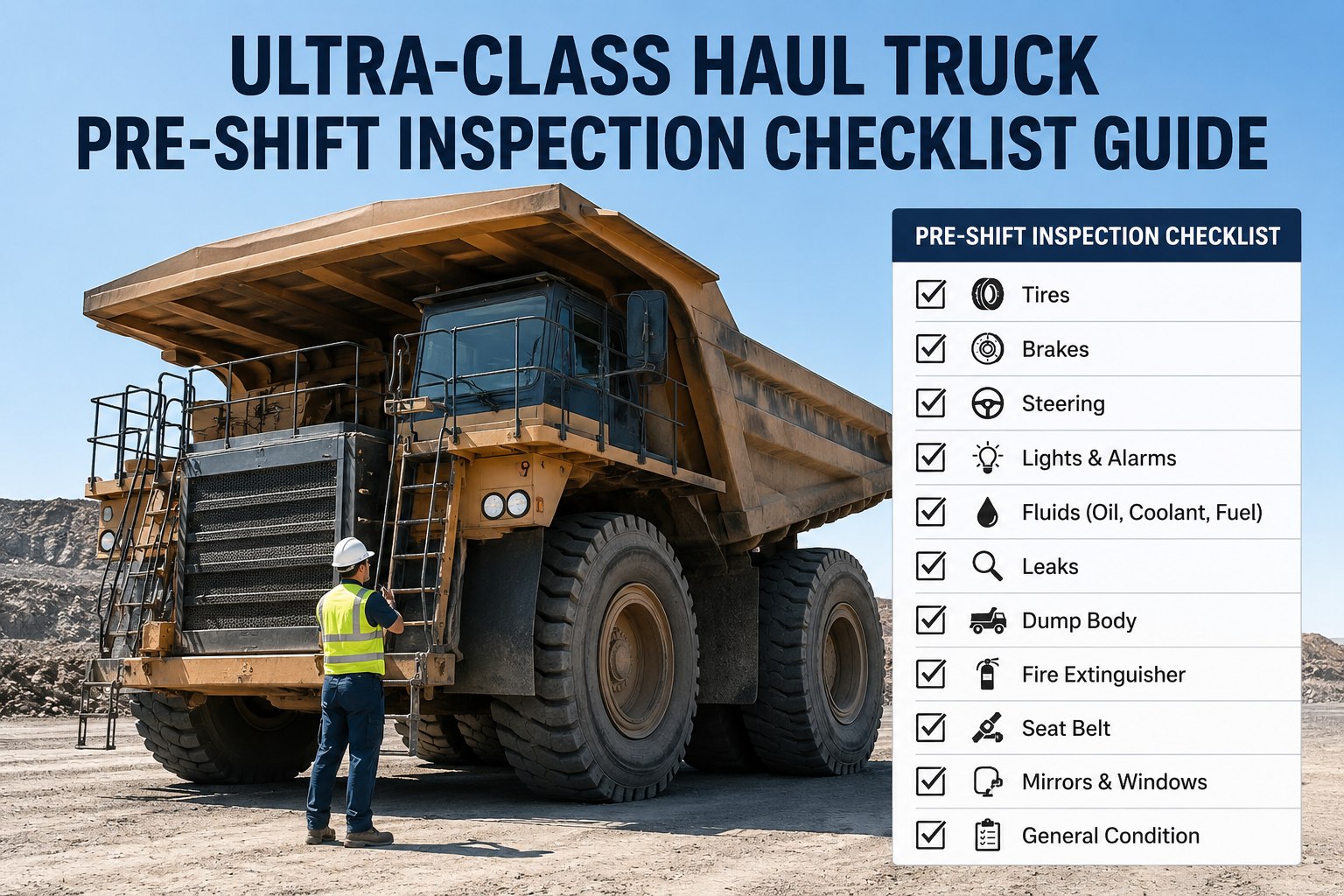
It is 05:40 at the pit gate, the shovel is waiting on its first truck of the shift, and your operator is standing next to a 400-ton machine with a flashlight and a paper card. A proper haul truck pre shift inspection on an ultra-class unit takes about thirty minutes, and those thirty minutes are the cheapest insurance on the site. At $5,000 to $20,000 an hour in downtime per truck, and a single major failure cascading past $2 million a day once the loading unit and the whole truck queue sit idle, the walk-around is not a formality. It is the only thing standing between a normal shift and a very expensive phone call. This guide gives you the eight inspection sections in order, the tag-out triggers you cannot negotiate on, and a realistic way to run it all digitally so nothing gets pencil-whipped. If you want to see this running on your own fleet before you commit to anything, you can book a 30-minute walkthrough of the digital checklist and bring your toughest questions.
The 30-Minute Walk-Around That Protects a $5 Million Asset
Eight sections, in order, built for machines like the Cat 797F, Komatsu 980E and Liebherr T 284. This is the checklist your operators actually complete, not the one that lives in a binder.
- Walk-around, tires and wheels, brakes and steering, engine and fluids
- Hydraulics, cab and controls, lights and warnings, fire suppression
- Hard tag-out triggers: TPMS above 185°F, brake defects, steering play, ROPS damage
- Photo evidence on brakes, tires, ROPS and fire suppression, with dispatch auto-blocked on critical defects
What a Haul Truck Pre Shift Inspection Actually Covers
Run the sections in this order and the inspection flows with the machine, not against it. Each one below lists what your operator checks and the defect that ends the conversation.
Walk-Around
Full circle of the machine at ground level. Look for fresh oil or coolant on the ground, loose or missing handrails, damaged access ladders, rock damage to the frame and anything hanging where it should not be. On a 797F or 980E this alone is a five-minute lap because of the sheer size of the machine.
Tires and Wheels
Check TPMS readings before anything else. Any tire reporting above 185°F is an immediate tag-out — that tire can fail violently. Then walk each position: sidewall cuts, separations, rock ejectors, rim damage, loose wheel nuts and valve stem condition. A single ultra-class tire costs more than most pickup trucks.
Brakes and Steering
Test service brakes, secondary brakes, parking brake and retarder response. Any brake defect is a tag-out, full stop. For steering, check for play beyond manufacturer limits, hydraulic leaks at the cylinders and unusual noise at full lock. A loaded ultra-class truck that cannot stop or steer is a site-wide emergency.
Engine and Fluids
Engine oil, coolant, hydraulic oil and fuel levels, plus a look at belts, hoses and air restriction indicators. Check for active leaks, not just stains — a weeping hose on a pre-shift becomes a burst hose under load at hour three. Note any fault codes on the dash before clearing anything.
Hydraulics
Hoist cylinders, steering cylinders, lines and fittings. Cycle the body up and down once if the machine is in a safe position and listen for cavitation or slow response. Wet fittings, chafed lines and scored cylinder rods all get logged with photos, because a hoist failure with a raised body is one of the worst events on a mine site.
Cab and Controls
Seat and belt, mirrors and cameras, horn, wipers, gauges, warning lights and the ROPS structure itself. Any visible ROPS damage — cracks, bent members, weld repairs — is a tag-out. The cab is the operator's survival cell; treat every defect there as personal.
Lights and Warnings
Headlights, work lights, beacon, reverse alarm, turn signals and brake lights. On a haul road shared with light vehicles, a truck without working lights and alarms is invisible until it is not. Night shift makes this section non-negotiable.
Fire Suppression and Safety
Fire suppression system charge status, discharge indicators, extinguisher seals and the emergency egress path. Engine compartments on ultra-class trucks run hot and carry thousands of litres of fuel and oil — a failed suppression system turns a small fire into a total loss in minutes.
Haul Truck Defects That Mean the Truck Does Not Move
Some findings are "log it and watch it." These are not. Any one of these on a mining truck inspection means the unit is tagged out and dispatch is notified before the operator leaves the cab.
TPMS Above 185°F
A tire reporting over 185°F is at risk of pyrolysis and explosive failure. The truck parks, the tire gets quarantined, and nobody works within the exclusion zone until it cools and is assessed.
Any Brake Defect
Soft pedal, slow retarder response, a failed secondary brake test or visible damage to brake components. There is no "run it to the shop" on a 400-ton machine. It gets towed or it gets fixed where it sits.
Steering Play Beyond Limits
Free play at the wheel beyond the manufacturer's limit, hydraulic steering leaks or delayed response at full lock. Steering failure on a loaded downhill run is unrecoverable.
ROPS Damage
Cracks, deformation, unauthorised welds or impact damage anywhere on the rollover protection structure. The ROPS is engineered as a system — one compromised member voids the whole structure.
The enforcement problem: on paper, these triggers depend on the operator's honesty and the supervisor's memory. With a digital checklist, a critical defect answer automatically blocks the truck from dispatch and opens a work order before the operator finishes the form. That is the difference between a policy and a system. You can see the auto-block workflow in a live demo with your own defect list loaded.
Why the Paper Mining Truck Inspection Form Keeps Failing You
The checklist itself is rarely the problem. The medium is. Here is what the same thirty minutes looks like on a paper card versus a digital haul truck inspection app.
| Step | Paper Card | Digital Checklist (HVI) |
|---|---|---|
| Start of shift | Operator finds a blank card, a pen that works, and a flat surface | Operator scans the QR code on the cab door; the correct checklist for that unit loads instantly |
| Tire check | "Tires OK" ticked from the cab step | TPMS reading entered per position; photo required on any flagged tire |
| Brake test | Tick box, no evidence | Photo evidence required on brakes; a fail answer triggers a critical defect |
| Defect found | Card goes in a tray; supervisor hears about it at the pre-start meeting, maybe | Critical defect auto-blocks dispatch and opens a work order in real time |
| Audit request | Someone digs through a filing cabinet and hopes the cards are legible | Timestamped, photo-backed records pulled by unit, date or defect in seconds |
| Trend visibility | None — cards are data graveyards | Repeat defects by unit, operator and component surface in analytics automatically |
The pattern is always the same: paper records the intention, digital records the evidence. When a tire lets go at hour six and the investigation starts, "he ticked the box" is not a defence. A timestamped photo of that tire at 05:47 is. If your current process still runs on cards and a tray, you can start running digital inspections free and have your first unit live before the next shift change.
See the Auto-Block Run on Your Own Defect List
Bring your tag-out triggers and your worst unit. In 30 minutes we will load your checklist and show you exactly what happens when an operator flags a critical defect.
What One Missed Defect Costs on an Ultra-Class Truck
Run the numbers on a single skipped inspection and the thirty minutes pays for itself before lunch. Here is a worked example your CFO will understand.
That is a 40,000:1 ratio between the cost of the check and the cost of the event it prevents. No other thirty minutes in your operation carries that kind of leverage. The question is never whether you can afford the inspection time. It is whether you can afford the shift where someone decided they could not. If you want to pressure-test these numbers against your own fleet, book a demo and bring your downtime figures — the maths usually gets uncomfortable fast.
Built for the Haul Road, Not the Office
HVI is cloud + mobile Vehicle Inspection and Maintenance Work Order CMMS software. These four capabilities map directly to the problems above.
QR-Scan Checklist Loading
The operator scans the code on the cab and the correct ultra-class checklist for that exact unit loads on any phone or tablet. No hunting for cards, no wrong form, no "I could not find a pen." Works in the pit, on the ramp, at a remote site with no signal — it syncs when coverage returns.
Mandatory Photo Evidence
Brakes, tires, ROPS and fire suppression require a photo before the form can be submitted. You stop getting "all good" from an operator who never left the cab, and you start building an audit trail that holds up when an investigator, insurer or client asks hard questions.
Dispatch Auto-Block on Critical Defects
A critical answer — TPMS over 185°F, brake defect, steering play, ROPS damage — automatically blocks the unit from dispatch and opens a work order with the photos attached. The policy enforces itself at 05:47 when the supervisor is still in the car park.
Defect Analytics by Unit and Component
Repeat tire flags on one truck, brake defects clustering on one operator's shifts, hydraulic weeps trending across a model — the patterns surface in reporting before they become failures. That is preventive maintenance driven by what your operators actually see every morning.
If you run mixed plant — haul trucks, loaders, dozers, light vehicles and shop equipment — HVI covers all of it on one platform, with parts and inventory, fuel management and tire management in the same system. Walk through it on your own fleet and see how the pieces connect.
From Paper Cards to Digital Pre-Shift in One Week
This does not need a six-month project. Most sites are live inside five working days.
Build the Checklist
Load your eight sections, set the photo-required items and define your critical defect answers. Start from the ultra-class template and adjust for your OEM and site rules.
Tag the Fleet
Print and mount QR codes on each unit. One code per truck, linked to that unit's checklist, service history and open work orders.
Train the Crew
Fifteen minutes per operator at the pre-start meeting. If they can use a phone camera, they can run the inspection. Technicians get the work order side the same day.
Go Live on One Circuit
Run one truck fleet digitally while the rest stay on paper. Watch the first auto-block fire and the first photo-backed defect land as a work order.
Roll Out Site-Wide
Pull the paper cards. Every unit, every shift, every inspection timestamped and photo-backed from this point forward. Your audit trail starts building itself.
The fastest rollouts we see are the ones where the safety manager and the maintenance manager agree on the tag-out triggers before day one. Get that alignment early and the rest is logistics. Sign up free and build your first checklist today — you can have it ready before your next planning meeting.
The Short Version for Your Next Budget Meeting
- An ultra-class haul truck pre shift inspection takes about thirty minutes and covers eight sections in a fixed order — walk-around through fire suppression.
- Four findings are non-negotiable tag-outs: TPMS above 185°F, any brake defect, steering play beyond limits, and any ROPS damage.
- At $5,000 to $20,000 an hour in downtime and a $2 million daily cascade risk, the inspection is the highest-leverage thirty minutes on the site.
- Paper cards record intention. A digital haul truck inspection app records evidence — and enforces the tag-out automatically.
- You can be live in five days. The checklist, the QR codes, the training and the auto-block workflow are all faster to set up than the meeting where you debate them.
"I used to find out about brake defects at the ten o'clock breakdown call. Now my phone buzzes at 5:50 in the morning with a photo of the problem and a work order already open. We have not had a truck leave the gate with a critical defect in fourteen months. The number I watch is repeat defects per unit — when that drops, everything else follows."
Darren Kowalski — Maintenance Manager, open-pit mining contractor
Haul Truck Pre Shift Inspection FAQs
How long should a pre-shift inspection take on an ultra-class haul truck?
What defects should trigger an immediate tag-out on a mining haul truck?
Can a digital checklist work in a pit with no phone signal?
How do I stop operators from pencil-whipping the inspection?
Does this replace our existing maintenance software or work alongside it?
Your Next Pre-Shift Could Be Photo-Backed and Auto-Enforced
Thirty minutes of inspection protects a $5 million machine and a $2 million day. Make sure it actually happens — with evidence — on every unit, every shift.
Free to start — Works on any phone — No card needed