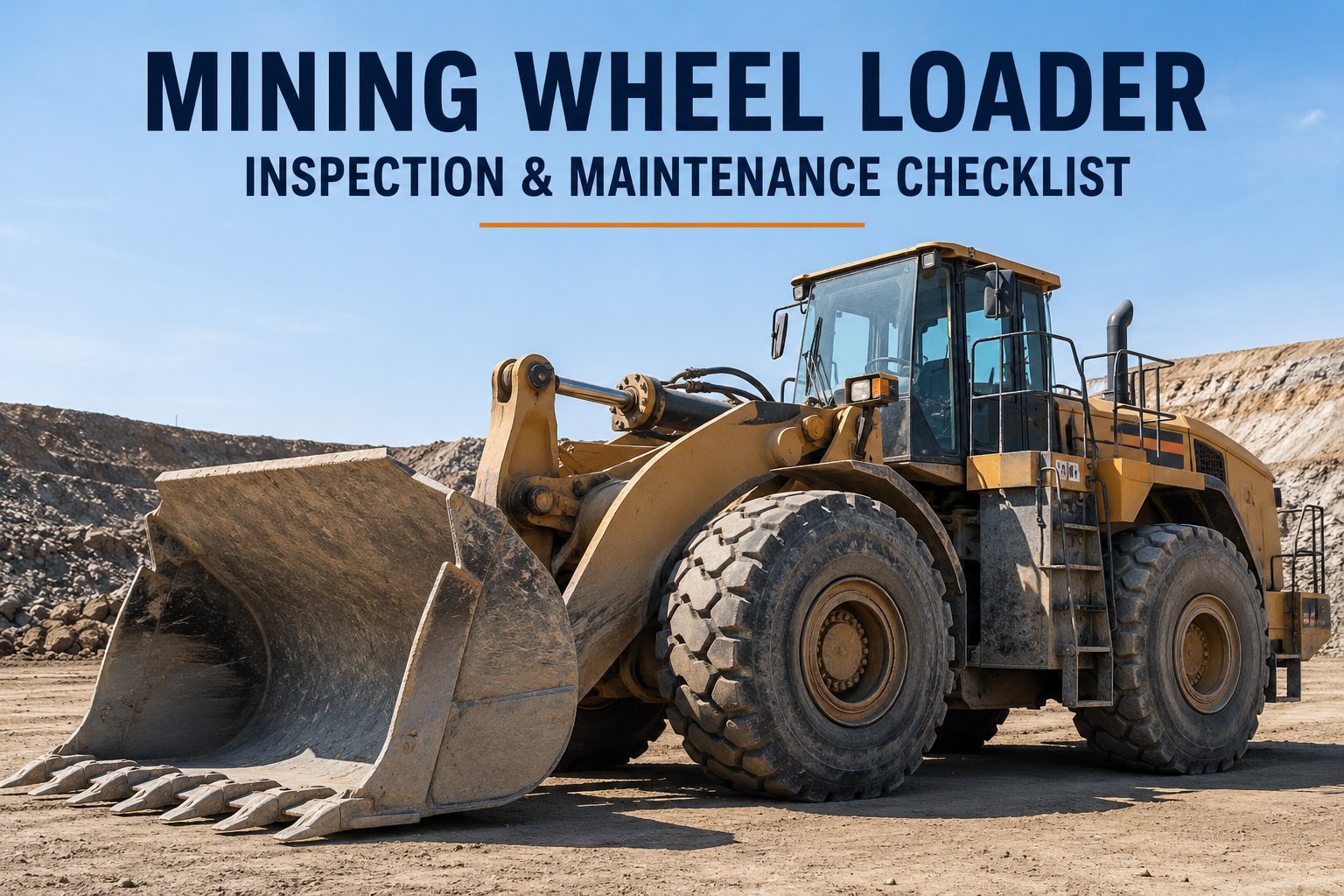
A wheel loader's articulation pin has been grinding for two shifts — logged once on a torn paper sheet that never left the cab. On the third shift, the joint lets go mid-swing with a loaded bucket, and the machine sits at the face while every haul truck behind it backs up. A digital wheel loader inspection checklist exists to catch that pin before it fails, not after. See it running on your own fleet
Every Wheel Loader Failure Starts at One of These Six Points
HVI turns a mining loader's pre-start walkaround into a guided digital check — articulation, lift arms, bucket, tires, hydraulics, and cab — with photos, flagged defects, and an auto-generated work order before the machine ever reaches the face.
- 1Cab, steering & visibility
- 2Articulation joint & center pin
- 3Lift arms & hydraulic cylinders
- 4Bucket & cutting edge
- 5Tires & rims
- 6Rear chassis & engine bay
A wheel loader doesn't fail the way a haul truck does. There's no single catastrophic system to watch — it's a dozen small, high-load points working against each other constantly: a swinging chassis, arms lifting multiple tons, a bucket biting into rock, tires carrying all of it over uneven ground. Any one of those points going unchecked for a shift is how a machine that passed yesterday's walkaround is parked at the shop today.
What an unchecked wheel loader actually puts at riskthe numbers behind one missed pre-start check
None of that shows up on a single line item the way a diesel bill does. It shows up as a load-haul cycle that backs up, a defect report filed after the fact instead of before the shift, and a safety audit that can't say when a machine was last actually checked. Book a demo to see defect history tracked per machine automatically.
The wheel loader pre-start checklist worth running every shifteight checks across all six zones, under three minutes
This is the list that catches the pin, the hose, or the cut tire before the shift starts — not the incident report filed after. Run it on a phone at the start of every shift change, with a photo attached to anything flagged.
Articulation joint & center pin
Excessive play here means a sudden swing under a loaded bucket — feel for play, not just look.Lift arms & pin welds
A hairline crack near a load-bearing weld doesn't announce itself until it fails mid-lift.Bucket, teeth & cutting edge
A chipped edge wastes fuel pushing into the pile instead of cutting through it.Hydraulic cylinders & hoses
A pinhole leak at 3,000+ PSI sprays fine enough to miss on a quick glance.Tires, rims & wheel nuts
A cut sidewall caught today is a patch; missed, it's a five-figure replacement and a stranded machine.Brakes & steering response
Loaded stopping distance on a haul road grade isn't the moment to find out the brakes are soft.Lights, backup alarm & mirrors
A blind spot around a 20-plus-ton machine is a hazard to everyone else on the bench, not just the operator.Engine bay & fluid leaks
Packed debris near a hot exhaust manifold is a fire risk that builds up quietly over weeks.This exact checklist is ready to use on day one in HVI's checklist center, or build your own for any loader model in the fleet. Start free and load it onto your first machine this week.
From a flagged pin to a closed work orderhow one defect moves from the bench to the shop
The checklist only matters if a flagged item actually reaches the shop before the next shift starts. Book a demo to see this path run on your own loader fleet — here's what it looks like once it's set up.
-
1
Operator runs the digital walkaround
The six-zone, eight-point check above, completed on a phone at shift change, with a photo on anything flagged.
-
2
A flagged defect opens a work order
No shift-change phone call needed — the work order exists the moment the inspection is submitted.
-
3
The right pin, hose, or tire gets pulled
Parts and inventory tracks high-cost consumables like tires and pins, so a repair isn't waiting on a part nobody knew was low.
-
4
The loader clears for the next shift
Its full inspection and repair history stays attached to the machine, not to whoever happened to notice the problem.
A service interval ladder that matches how hard the loader actually worksmeter-based PM, not a date on a calendar
A wheel loader at a high-throughput face can rack up more engine hours in a month than a passenger truck does in a year. Scheduling its service by calendar date instead of by meter reading is how a loader quietly runs 80 hours past due. HVI's preventive maintenance engine triggers on hours run, the same way the machine's own meter does.
First service
Oil, filters, and a full torque check on a new or rebuilt engine.
Standard PM
Routine oil and filter cycle repeats from here through the loader's working life.
Drivetrain check
Transmission, differentials, and hydraulic fluid sampled for early wear signs.
Major inspection
Lift arm pins, articulation joint, and structural welds get a full teardown check.
Those thresholds aren't a one-time setup and forget — analytics and reporting shows which machines are closing in on their next interval across the whole fleet, not just the one in front of you.
What's actually running underneath the checklist
Meter-hour PM scheduling
PM intervals trigger on engine hours, matching how hard a loader actually works instead of a fixed calendar date.
Defect-to-work-order automation
A flagged pin or hose doesn't wait on a phone call — the digital walkaround opens the ticket itself.
High-cost parts tracking
Tires, pins, bushings, and bucket teeth tracked by SKU, so a repair isn't waiting a week on a part nobody flagged.
Fleet-wide reliability reporting
Inspection and repair history per machine, exportable for safety audits and safety compliance reviews.
From a mine maintenance supervisor who used to chase paper logs
We ran twelve wheel loaders across two pits, and every operator's pre-start sheet lived in a clipboard box in the shift shack. Half the time a defect got mentioned verbally at the handover and never made it onto paper at all. We had a lift arm pin seize on a 966-class loader because the play had been "a little loose" for two weeks running, according to three different operators who never wrote it down the same way twice.
Now the walkaround takes under three minutes on a phone, and every flagged item comes with a photo and goes straight to the shop. We still get breakdowns — it's a mine, not a showroom — but we're not finding out about a problem secondhand anymore.
Want your loader fleet checked this way? Book a 20-minute demo built around your own equipment list.
Frequently asked questions
What should a wheel loader digital inspection checklist cover?
It should cover six zones: cab and steering, the articulation joint, lift arms and hydraulics, the bucket and cutting edge, tires and rims, and the rear chassis and engine bay. Each zone needs specific checks, not a generic pass/fail.
How is a wheel loader inspection different from a haul truck's?
A loader's structural risk centers on the articulation joint and lift arm pins under repeated lift-and-swing loads, while a haul truck's centers more on brakes and tires over long hauls. Both need daily checks, but the failure points differ.
How fast does a flagged defect turn into a work order?
Immediately. The moment an operator flags an item on the digital walkaround, HVI opens a work order automatically, so the defect reaches the shop before the next shift starts, not after a verbal handover.
Does HVI schedule maintenance by engine hours or by date?
By engine hours. A wheel loader's meter reading drives its PM schedule, matching the real workload instead of a fixed calendar date that can run a high-use machine past due.
Can this track other mining equipment besides wheel loaders?
Yes. Haul trucks, dozers, excavators, graders, and other mobile mining assets can run the same digital inspection, work order, and PM workflow alongside your loaders in one system.
Catch the pin, the hose, or the tire before the shift does
HVI's wheel loader inspection software puts a digital pre-start checklist, automatic work orders, and meter-hour PM in one system built for how mining mobile equipment actually runs — not a generic fleet tool stretched to fit. Live on your site in under two weeks.
No credit card · works alongside your existing mobile fleet · set up your first loader today