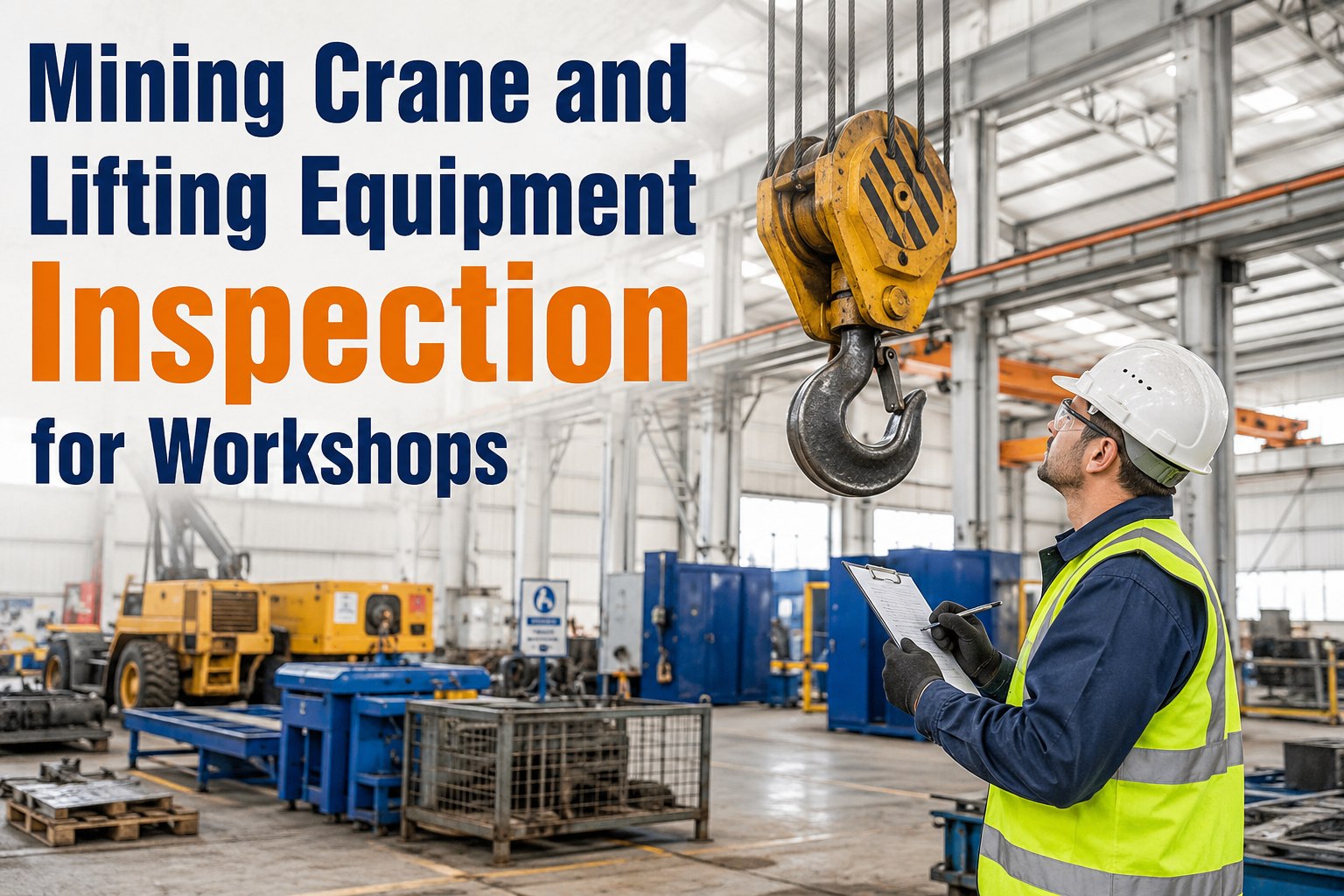
It's 2 a.m. on night shift and a 793 haul truck needs its rear wheel motor changed out before the morning blast. The overhead crane is booked, the rigging crew is ready, and the sling that comes off the hook has a tag so faded nobody can read the serial number. That moment — a routine lift on a routine component change — is where most mine sites discover their lifting equipment register is a spreadsheet from 2019 and three certificates expired last quarter. Mining crane inspection and lifting gear control is not an occasional project event on a mine; it is daily workshop reality, and it needs the same discipline as your fleet PM program. If you want to see how a digital register handles this before your next change-out, you can book a 30-minute walkthrough on your own equipment list.
Is every crane, sling and shackle on your site certified right now — and could you prove it in 60 seconds?
Component change-outs make heavy lifting routine on mine sites. Routine is exactly when discipline erodes. Here is the register, inspection and lift-planning framework that keeps your workshop lifting equipment compliant, auditable and off the incident report.
- Unique ID and live certificate status for every crane, sling, shackle and lifting point
- Pre-use checks by the operator, thorough periodic inspections by a competent person
- 90, 60 and 30-day expiry alerts so no certificate lapses before a major lift
- Photo-backed, timestamped records retrievable during any client or regulator audit
What actually belongs on a mine lifting equipment register
Most sites undercount by half. The register is not just the overhead crane — it is every item that bears, guides or connects a load, and each one needs its own identifier, certificate and inspection history.
Workshop overhead cranes
The 20-tonne bridge crane over your rebuild bay lifts more tonnes in a month than the mobile fleet. Rails, end stops, hoist brakes, limit switches and pendant controls all sit on the periodic thorough-inspection list.
Mobile and rough-terrain cranes
Frannas and all-terrains moving between the workshop, the pit and the laydown yard. Daily pre-start checks, annual thorough inspection, and load chart verification after any boom or winch repair.
Slings, chains and shackles
The highest-turnover, highest-abuse items on site. Synthetic slings get cut, chains stretch, shackle pins walk. Every single piece needs a tag, a WLL and a traceable certificate — no tag, no lift.
Jacking and support equipment
Hydraulic jacks, stands and cribbing used under 200-tonne trucks during wheel and strut work. Jacking equipment on a mine is lifting equipment — it belongs on the register with proof-load records.
Dedicated lifting devices
Spreader beams, wheel-motor lifting frames, cylinder dogs and OEM-designed component handlers. These engineered devices have their own design registration and inspection regime — treat them as assets, not consumables.
Lifting points and beams
The welded lugs, eyes and monorail beams built into the workshop and onto major components themselves. They corrode, crack and get overloaded — and they are the most forgotten items on any register.
Pre-use checks vs thorough inspection: who does what, and when
Confusing these two tiers is the most common audit finding on mine sites. The user checks before every lift; a competent person tears it down on a fixed interval. Both produce records — and both records get requested.
Pre-use inspection — by the operator
- Tag and serial number present, legible and matching the register
- Sling eyes, stitching and sleeve free of cuts, burns and abrasion
- Chain links free of stretch, twist, nicks and heat discolouration
- Shackle pin correct type, fully seated, no body distortion
- Crane hook safety latch working, brake test at first lift of shift
- Anything suspect gets tagged out — not "used carefully"
Thorough inspection — by a competent person
- Typically 12-monthly for cranes and lifting machines, 6-monthly for slings and tackle in many jurisdictions
- Strip-down examination of hoist, brakes, wire rope or chain, drum and sheaves
- NDT on critical welds, lifting lugs and dedicated lifting frames
- Proof-load testing after repair, modification or overload event
- Written report with defects graded and rectification deadlines
- Certificate issued, linked to the item's unique ID, expiry tracked
The gap that kills you: pre-use checks live in the operator's head and thorough-inspection certificates live in a filing cabinet in the admin building. When an auditor or client asks for the history of sling HVI-0237, you need both in one place. Sites that see the register running in a live demo usually spot three expired items in their own inventory within the first ten minutes.
Lifting points on major components need their own inspection regime
A haul truck wheel motor weighs around 5 tonnes and arrives from the OEM with engineered lifting eyes welded on. Those eyes spend years in the pit getting hammered by vibration, corrosion and the occasional side-load from a rigger in a hurry.
What goes wrong with component lifting points
Cracked welds on a final-drive lifting lug do not announce themselves. The lug holds for a hundred lifts, then lets go on the hundred-and-first with the component swinging over a technician's legs. Corrosion under paint hides section loss. A lug designed for a vertical pull gets used at 45 degrees because the crane can't get square over the load — and its capacity drops by half without anyone doing the maths.
The fix is boring and effective: every lifting point gets an ID, a rated angle and capacity, and a place on the periodic inspection schedule. NDT on the critical ones. If you want to see how per-item records handle a lug the same way they handle a crane, walk through it on a 30-minute demo call with your own component list in front of you.
Lift planning for major change-outs
A wheel motor, strut or final-drive change is a planned lift, not an improvised one. The lift plan names the crane, the rigging configuration with WLLs at the actual sling angles, the lifting points to be used, the exclusion zone and the competent person signing off. On well-run sites, no plan means no lift — even at 2 a.m.
The practical test: could your night-shift supervisor pull up the last wheel-motor lift plan, confirm the crane certificate was in date that night, and show the pre-use check on the slings — all before the kettle boils? That is the standard a client audit or a regulator investigation will hold you to.
One register for every crane, sling and lifting point — with proof attached
HVI is cloud + mobile inspection and maintenance software built for fleet-heavy operations. Your lifting register lives in the same platform as your trucks, trailers and off-road plant — no separate spreadsheet, no filing cabinet.
Per-item asset records
Every crane, sling, shackle, jack and lifting lug gets a unique ID, photos, WLL, location and full history. Scan the tag on your phone and the item's whole life is on screen — outcome: no more unidentifiable gear on the hook.
Certification tracking with 90/60/30 alerts
Thorough-inspection certificates attach to the item with expiry dates. HVI flags items 90, 60 and 30 days out — outcome: you book the competent person before the lapse, not after the auditor finds it.
Mobile pre-use checklists with photo evidence
Operators run the pre-lift check on any phone or tablet, with photo capture of defects and instant tag-out that raises a work order — outcome: failed gear leaves circulation the same shift, not the same month.
Audit-ready retrieval in seconds
Timestamped, photo-backed records for every inspection, certificate and defect, exportable on demand — outcome: when a client, insurer or regulator asks for sling HVI-0237's history, you answer in one search, not one weekend.
What auditors ask for on lifting equipment — and where it should live
Whether it is a client audit, an insurer review or a regulator visit, the requests are remarkably consistent. Map each one to a record you can produce in seconds, and the audit stops being a fire drill.
| Audit request | What they expect to see | Where it lives in HVI |
|---|---|---|
| Current lifting equipment register | Every item, unique ID, type, WLL, location, status | Asset module — filterable live register, exportable |
| Thorough inspection certificates | In-date certificate per item, competent person named | Certificate attached to asset, expiry alerts active |
| Pre-use inspection evidence | Dated checks by the user, defects actioned | Mobile checklist history with timestamps and photos |
| Defect and quarantine records | Failed gear tagged out, repaired or scrapped, traceable | Defect-to-work-order trail with closure evidence |
| Lift plans for major change-outs | Documented plan, rigging config, sign-off | Plan attached to the work order for the change-out |
| Lifting point inspection regime | Lugs and beams on a schedule, NDT where required | Lifting points as assets with PM intervals and alerts |
Sites moving off paper usually start with the register and certificates, then add pre-use checklists once crews see how fast the mobile flow is. You can start building your lifting register free and have the first crane and sling set entered before smoko.
Your next component change-out is already scheduled. Is your lifting register ready for it?
See HVI running on your own cranes, slings and lifting points in a 30-minute demo — bring your current register and we will show you the gaps.
A worked example: what one uncertified sling actually costs
Abstract risk does not move budgets. Numbers do. Here is a scenario any maintenance manager can take into a budget meeting.
The stop: a client auditor on a routine visit asks for the certificate on the bridle sling rigged for a strut change. It expired five weeks ago. The lift stops immediately — truck down, crew standing, crane demobilised.
The downtime: the truck misses a full shift waiting for a certified replacement sling to arrive from town. On a large haul truck, one lost shift of production is routinely valued in the tens of thousands of dollars — the sling itself cost under $400.
The audit finding: the expired certificate becomes a written non-conformance against your contract. Two more like it and you are explaining your safety system at contract renewal, not your production numbers.
The alternative: a 30-day expiry alert fires, the replacement is ordered with normal freight, the swap happens on a planned down day. Total cost: the sling and ten minutes of admin. That is the entire business case for a demo of certification tracking with 90, 60 and 30-day alerts.
Mining crane inspection is a system, not a certificate
Heavy component change-outs make lifting a routine workshop activity on every mine site, and routine work is where standards quietly slip. The sites that stay ahead of it share the same habits: a complete register covering cranes, slings, jacking equipment, dedicated lifting devices and component lifting points; a unique ID on every item tied to a live certificate; pre-use checks by the operator on every lift; thorough periodic inspection by a competent person on a tracked interval; and documented lift plans for major change-outs. None of that is complicated — it is only hard when the records live in five places and the expiry dates live in nobody's calendar. Put the register, the checklists, the certificates and the alerts in one platform and mining crane inspection stops being an audit panic and becomes background process. If your current system is a spreadsheet and a filing cabinet, the cheapest time to fix it is before the next 2 a.m. change-out.
"My personal rule is simple: if I can't read the tag, the sling doesn't lift. But for years I was the only one enforcing it, because the register was a spreadsheet nobody opened. Now every item has an ID and the expiry alerts come to me 90 days out — last quarter I counted 47 lifting items across the workshop and laydown, and I can tell you the certificate status of every one without leaving my desk. The gripe I still have is with myself for waiting until after a client audit finding to do it."
Dan Whitfield — Maintenance Superintendent, contract mining services company
Mining crane and lifting equipment inspection FAQs
How often does lifting equipment need a thorough inspection on a mine site?
What is the difference between a pre-use check and a thorough inspection?
Do lifting points welded onto components really need to be on the register?
What should a lift plan for a major component change-out include?
Can HVI manage lifting gear alongside our trucks and heavy fleet?
Build the lifting register your next auditor will actually be impressed by
Unique IDs, live certificates, 90/60/30-day alerts, photo-backed pre-use checks and lift plans attached to the job — all on any phone, in the workshop or at the pit.
Free to start — Works on any phone or tablet — No card needed