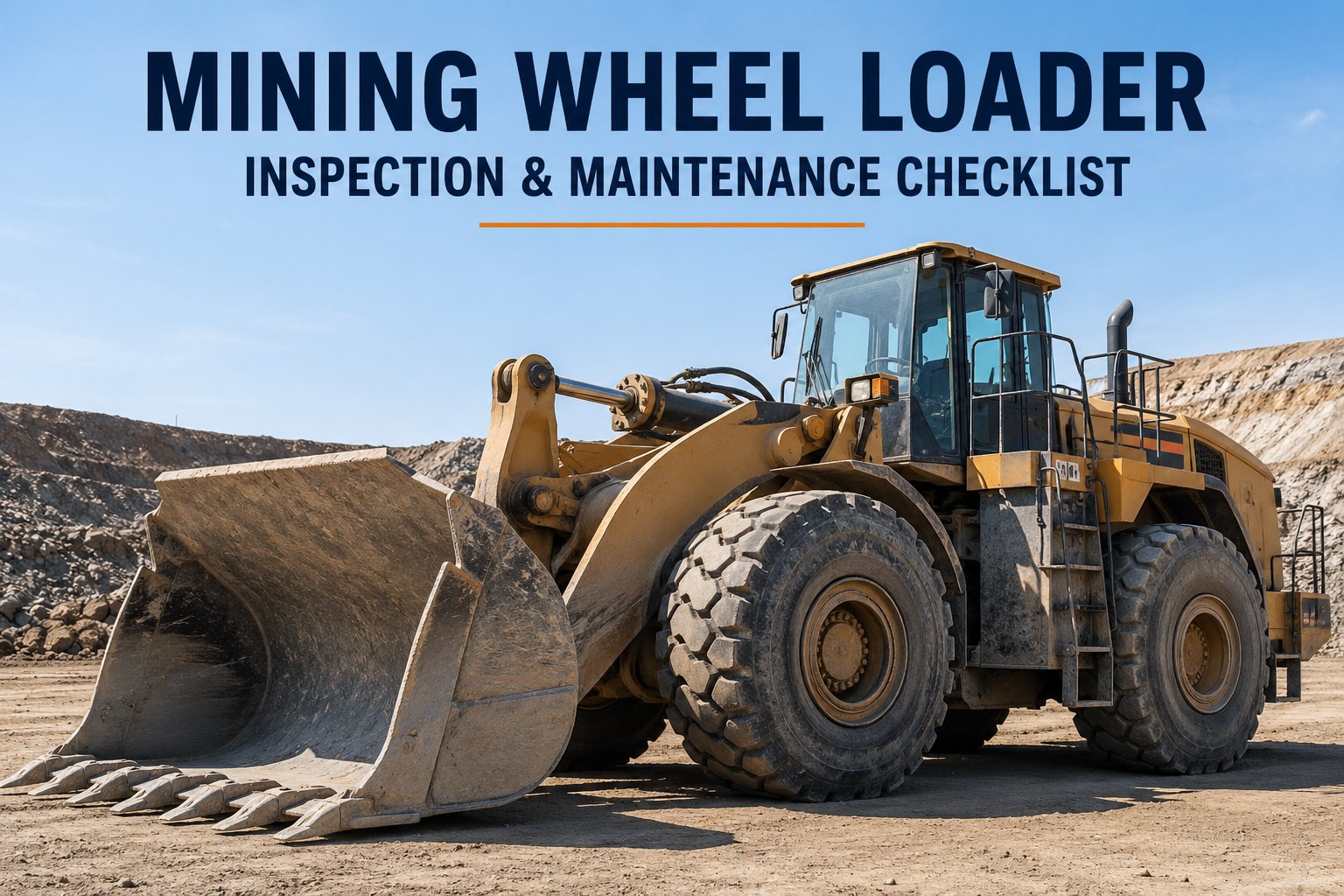
In a truck-and-loader mining operation, the loader is the production constraint. Twelve haul trucks running perfectly can't move a single ton if the one loader feeding them is down. That's the argument for prioritizing loader maintenance ahead of truck maintenance when shop resources are contested — and the argument for a mining wheel loader inspection and maintenance checklist that treats articulation joints, hydraulics, GET, and tires as the single most important asset class in the pit. This guide walks the pre-shift, the wear tracking, and the interdependence math that makes the case internally. Book a demo to see loader-specific templates.
The Loader Is the Bottleneck. The Whole Pit Waits On It.
Here's why loader availability caps the entire fleet's production — and the math behind prioritizing loader maintenance when shop time is contested.
If a haul truck goes down mid-shift, you lose 1/N of production. If the loader goes down, you lose N/N. That's the math a maintenance director uses when defending a decision to pull the loader for scheduled service instead of another truck. It's also why loader pre-shift inspection deserves more discipline than any other unit in the fleet — a missed defect on a loader compounds into fleet-wide downtime, not single-unit downtime.
The 6 inspection zones every loader pre-shift must coverHigh-dust engines, hydraulic circuits, articulation, GET, tires, cab safety
A mining wheel loader inspection has to cover more inspection surface than most equipment in the pit because loaders combine truck-scale hydraulics, mobile equipment articulation, and continuous ground-engaging tool wear all in one machine. Skip a zone and you'll find out about it during the shift — usually at the worst possible moment. Book a demo to see the loader template mapped against all 6 zones
Engine & cooling in high-dust conditions
- Air pre-cleaner + primary filter restriction indicator — check daily in mining dust
- Radiator fins free of packed debris (visual + reverse-flow air check)
- Coolant level cold + coolant condition (no oil sheen)
- Engine oil level + color; watch for coolant contamination or fuel dilution
- Belts — no cracks, correct tension, no glazing
- No visible fluid weeping at hoses, fittings, or gasket lines
Hydraulics — lift, tilt, steering circuits
- Hydraulic tank level in sight glass; no discoloration or foam
- Lift cylinder rods — no scoring, pitting, or fluid weeping past seals
- Tilt cylinder rods — same inspection standard as lift
- Steering cylinder rods — especially critical, feed articulation motion
- All hoses — visible chafing, bulges, or heat damage flagged out
- Function check — full lift-tilt cycle through range, no hesitation or drift
Articulation joint — structural
- Center pivot pin condition — grease evidence, no visible wear or seating gap
- Upper & lower pin bushings — no excessive play (rock the frame, watch for movement)
- Grease fittings clear & delivering — hand-pump verify at each fitting
- Frame welds at articulation point — no cracks, no crack growth from previous repair
- Steering frame lock pin — stored in holder, not engaged, accounted for
- Full steering lock-to-lock — smooth, no dead spots, no unusual noise
Bucket, teeth & cutting edge (GET)
- All bucket teeth present, secured, wear within replacement threshold
- Adapters secure, no wobble, no pin walk
- Cutting edge thickness measured against OEM replacement spec
- Side cutters + wing shrouds intact, no missing hardware
- Bucket body — no cracks around wear plates, no significant deformation
- Coupler/pin engagement verified (visual + operational)
Tires, rims & wheel ends
- All four tires — sidewall cuts, chunking, exposed cord, bulges
- Tread depth measured; heat pattern uniform (uneven = alignment or load issue)
- Rim condition — no dents, cracks, or rust perforation
- Lug nut torque check on a rotating pattern (all wheels quarterly minimum)
- Valve stems intact, caps present
- Wheel end play — grab & rock check with weight off wheel
Brakes, ROPS & cab safety devices
- Service brake test at low speed — straight stop, no pull
- Parking brake grade-hold verification on the steepest grade unit will operate
- ROPS structure — no cracks, all mounting hardware torqued, no modifications
- Seatbelt functional, no fraying, latch positive engagement
- Backup alarm, horn, work lights, mirrors all functional
- Fire extinguisher — present, charged, mounting bracket secure
GET wear tracking: protecting the bucket structureGround engaging tools are consumables. The bucket underneath them is not.
Bucket teeth, adapters, cutting edges, and shrouds are designed to wear — they exist so the bucket structure underneath them doesn't. When operators run GET past its replacement threshold to save a shift's downtime, wear starts eating into the bucket lip and side plates. A $2,000 tooth replacement deferred becomes a $40,000 bucket rebuild. Wear tracking is the discipline that catches the replacement window before the damage cascades.
Log every replacement with hour meter reading. Fleet MTBF per tooth type tells you if a lane change is wearing units faster than the rest.
Measured, not eyeballed. Below minimum = the edge stops cutting and starts wearing the bucket lip itself.
The side plates take the abrasion that would otherwise wear into the bucket sidewall. Exposed base plate = welded repair on a much larger surface.
Uneven tooth wear across the bucket = operator technique issue, misaligned coupler, or lane-face geometry problem. The pattern tells you which.
HVI supports per-asset GET history with meter-based replacement scheduling and photo capture on each replacement. Book a demo to see GET wear trending on a real loader
Defending loader priority in the shopHow to make the interdependence argument stick
Every shop foreman has had the conversation: three assets are flagged for service, only bay time for two. The loader almost always loses because "the trucks are actively running." That decision optimizes for what's visible today and creates the very bottleneck this article opened with. Here's the frame that reverses it.
Frame it as fleet-wide risk, not single-asset risk
"If I defer this loader PM another shift, we risk N trucks of downtime, not 1." N is the number of trucks in the loading queue. On a 12-truck fleet, the loader defer is 12× the risk of any single truck defer.
Pull the loader's per-asset MTBF trend
If MTBF on the loader is trending down — the intervals are getting shorter between failures — that's the data that turns "gut feel" into a defensible operational argument. HVI's per-asset history makes this a 30-second pull.
Quantify the unplanned-downtime cost differential
Planned loader service = known bay time, predictable duration, parts on the shelf. Unplanned loader failure = tow, unplanned parts, extended shop time, and typically 3–9× the total cost of planned work.
Show the last time the loader stopped the fleet
Pull the actual downtime record from the last loader failure. Hours lost, tons of production missed, dollar cost. Fleet leadership makes this decision easier when they can see the pit standing still for 4 hours in a photo timeline.
From a maintenance director running a Cat 994 in copper
We had a Cat 994 on articulation pin wear that our night-shift operator kept flagging. Two consecutive pre-shifts noted "slight play, still safe to run." Shop deferred both times because we had three trucks with brake issues pulling higher priority.
Third shift the loader lost steering feel with a full bucket at height. We were lucky nobody got hurt. That afternoon I pulled the interdependence math on our whiteboard: 8 trucks at $850/hr production value each, downtime 6 hours for the loader repair = $40,800 in lost production. Any one of those brake jobs deferred one shift would have cost us maybe $3,200. We changed our prioritization the next day — loader flags now trump everything except a safety-out-of-service on a truck. Not close.
Frequently asked questions
Why does loader availability matter more than individual truck availability?
Because of the topology of a truck-and-loader operation. Trucks operate in parallel — if one is down, production drops by 1/N (one truck's worth of tonnage). The loader is the single feeder for all N trucks in the loading queue — if it's down, production drops by N/N (all trucks idle waiting). On a 12-truck operation feeding one loader, a loader hour of unplanned downtime costs 12× the production value of a truck hour of unplanned downtime. This is what makes loader inspection and maintenance discipline the single highest operational-leverage practice in a truck-and-loader pit. Getting this decision right is where a maintenance director defends their prioritization when the shop is resource-contested and every asset seems to need attention at the same time.
How often should articulation joint pins be inspected on a mining loader?
Visual inspection every pre-shift, hands-on play check weekly, and OEM-spec measurement quarterly at minimum. The articulation joint is a critical structural point specific to articulated loaders — it carries every ton of bucket load through a single pivot, and unlike a rigid-frame machine, worn pins create unpredictable steering response with a full bucket at height. The pre-shift visual is a walkaround-level check (grease evidence, visible pin seating, no obvious cracks in the frame welds at the joint). The weekly check is a hands-on rock test with the loader on level ground — any excessive movement is a shop item. The quarterly measurement uses a straight-edge and feeler gauges (or dial indicator) against OEM spec to catch cumulative wear before it reaches the "excessive play" threshold. Fleets running multi-shift ops on abrasive material should compress the weekly check to twice-weekly and the quarterly measurement to monthly.
Is a wheel loader inspection required by MSHA or OSHA regulations?
Yes — the requirement varies by jurisdiction. Under MSHA regulations for surface metal and nonmetal mines, 30 CFR 56.14100 requires a pre-operational examination of self-propelled mobile equipment by the operator before it is placed in operation on that shift, with any defects that affect safety documented and corrected. Under OSHA for non-mining earthmoving operations, 29 CFR 1926.20 and 1926.602 similarly require pre-shift inspection of earthmoving equipment. Neither regulation prescribes a specific form — both require that the inspection actually happen, that defects be identified and corrected, and that unsafe equipment be removed from service. Most mining operations design their pre-shift templates to explicitly cover the 30 CFR 56.14100 required components (brakes per 56.14101, steering, warning devices, coupling, mirrors, lights) plus the loader-specific items covered in this guide's 6 zones.
How do we track GET wear across a loader fleet without slowing down operations?
Two disciplines make this practical without adding cycle time. First, log GET replacements against the hour meter reading at the moment of change — this generates MTBF data per tooth type per loader over time. HVI supports meter-based scheduling and per-asset history for exactly this workflow. Second, require a photo of the bucket at each pre-shift once tooth wear reaches 50% — the photo timeline shows wear progression across shifts without requiring a measurement every time. When the photo shows teeth approaching the replacement threshold, the shop schedules the change against actual bucket state, not against an arbitrary calendar interval. This catches the two failure modes worth catching: teeth run too long (bucket base plate wear), and teeth changed too early (unnecessary parts cost). The whole workflow adds maybe 30 seconds per pre-shift once the loader has QR-loaded template access from the operator's mobile device.
Should loader PM intervals be shorter than haul truck PM intervals?
Usually yes, and for two reasons. First, duty cycle intensity: loaders complete a full lift/tilt/dump cycle every 30–90 seconds during production, meaning hydraulic system stress and cylinder cycle count accumulate faster per operating hour than on a haul truck doing longer transport legs between shorter dump events. Second, the interdependence argument — a loader failure has fleet-wide production impact where a haul truck failure has single-unit impact, which justifies more conservative interval spacing on the loader even if raw component wear rates were identical. Most mining operations run loader oil-and-filter service at 250 hours vs 500 on haul trucks, and hydraulic-focused inspections at 500 hours vs 1,000 on trucks. Adjust for your duty cycle and MTBF trend data — the intervals in the OEM manual are conservative starting points that should tighten if your MTBF data shows failures inside the interval.
Run mining loader inspections that match the asset's operational leverage
HVI supports QR-loaded loader-specific pre-shift templates, photo-verified critical sections on articulation joints and GET, one-click work order creation on flagged defects, meter-based PM on hour intervals, and per-asset inspection history that makes the loader-priority argument defensible in front of ops leadership. Live in under 2 weeks.
No credit card · No hardware · Loader templates ready on day one