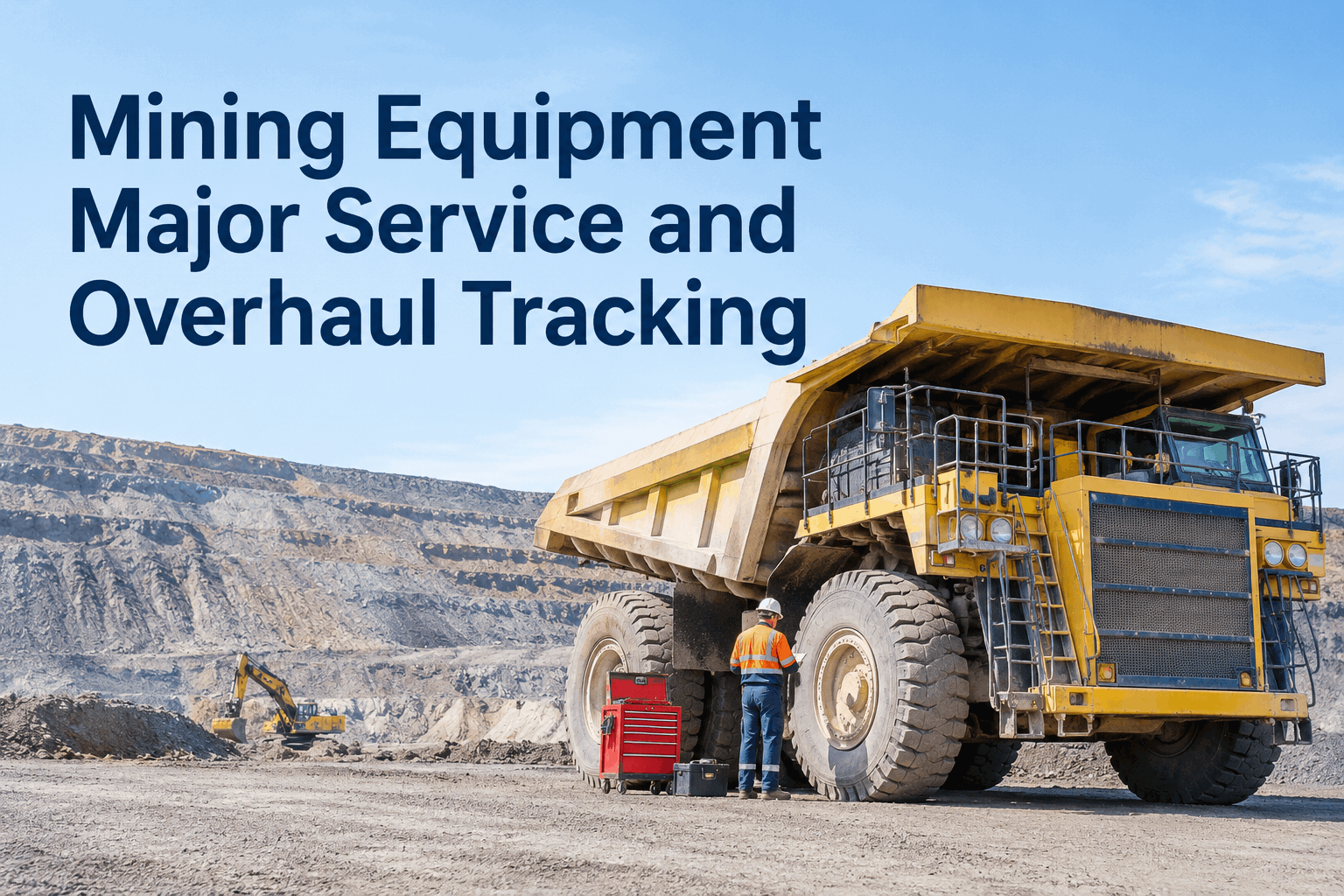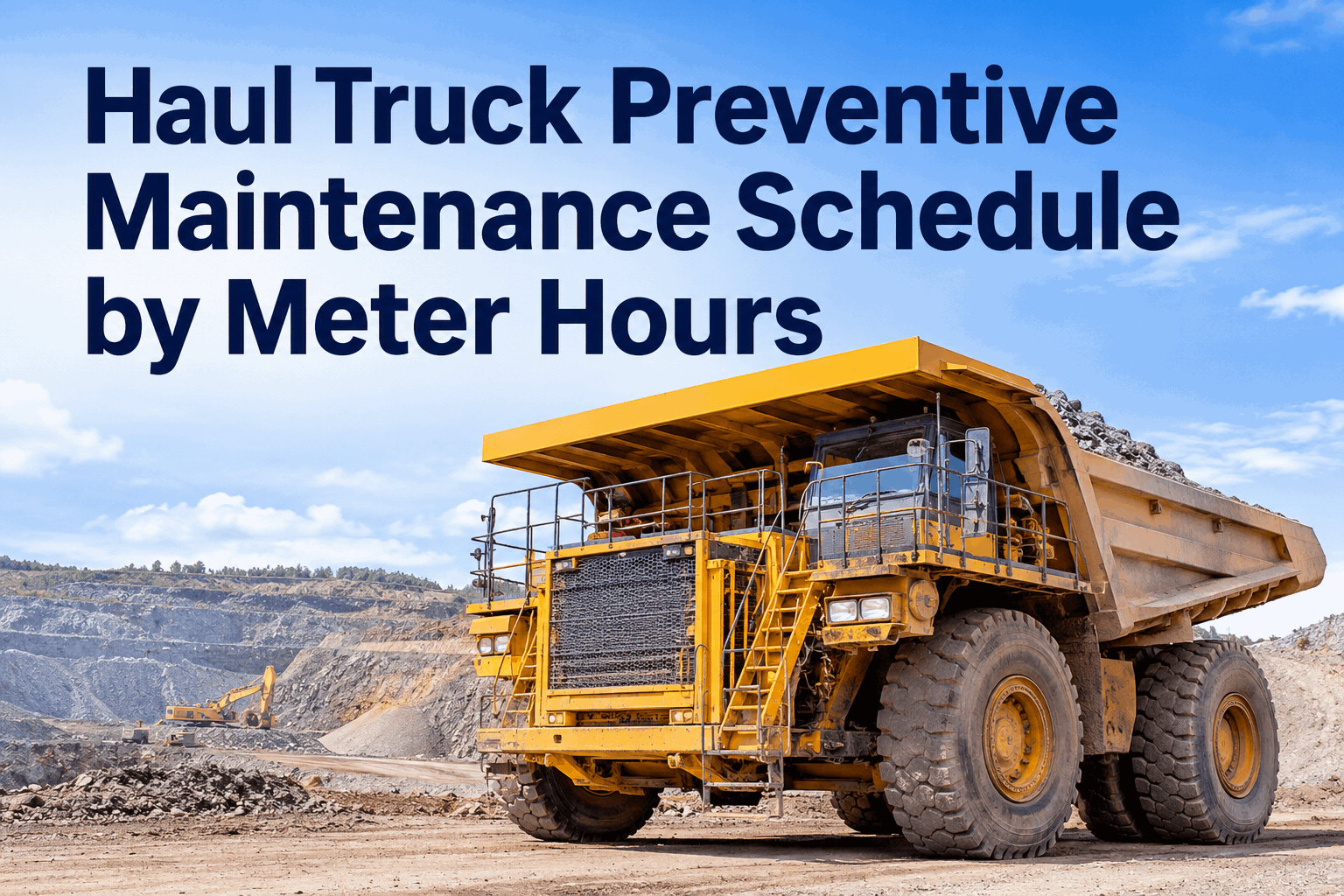
The interval wasn't a mystery. A haul truck crosses its service hours mid-shift during the busiest week of the quarter — and the reading that would have warned you was sitting in a logbook nobody checked in time. A haul truck preventive maintenance schedule by meter hours only works when something reads the meter and fires the reminder before the window closes. This is how HVI runs that schedule across a whole mining fleet.
A meter reading in a logbook never stopped a mid-shift breakdown
HVI schedules haul truck maintenance by real meter hours, surfaces every truck that's due or overdue, and lets supervisors assign mechanics, stage parts and document repairs — all before the service window arrives.
- See which trucks are due, overdue and on-track at a glance
- Assign mechanics and stage parts before the window
- Full service history and cost-per-hour per machine
Mining PM runs on a different clock than the rest of a fleet. A $5-to-$8 million ultra-class truck earns its keep only when it's moving, and unplanned downtime on a single haul truck runs $5,000 to $20,000 an hour in lost production — because a stopped truck idles the shovel loading it and starves the crusher downstream. That's why the schedule can't live on a calendar or in someone's memory. It has to fire off the number on the meter, which is exactly what meter-based preventive maintenance is built to do.
The gap between the reading and the reminderwhere a meter-hour schedule actually breaks down
The intervals themselves aren't the hard part — most teams know a haul truck wants a minor service around every 250–500 hours. The failure happens in the gap between the meter ticking past the threshold and anyone acting on it. Here's where a paper or spreadsheet schedule loses the truck.
Meter crosses the threshold
The truck hits its PM hours in the pit — but the reading only lives on the dash and in a logbook.
Nobody reads it in time
The sheet gets updated days late, if at all. The service sits unscheduled while the hours pile up.
It fails before the service
Engine or drivetrain lets go mid-haul — and an emergency repair runs about 4.8× a planned one.
Close that gap and most of the cost disappears: an hour-based system that reads the meter and fires the reminder on time is what turns "we'll catch it next service" into a scheduled work order. You can start free and put your haul fleet on meter-hour scheduling today .
Run the schedule before the window, not during itthe coordination that keeps a service from becoming downtime
A haul truck service only protects uptime if the parts, the mechanic and the bay are ready when the truck rolls in. The difference between a planned service and an unplanned one is almost entirely in what happened in the days before — and that's the part software earns its keep on. HVI lets a supervisor line up each piece against the upcoming meter-hour window.
See it coming
Upcoming services surface by meter hours, so a planner sees next week's due list, not last month's misses.
Stage parts & labor
Kit the right components from parts inventory and reserve technician time before the truck is down.
Assign & close out
Assign the mechanic, generate the work order, and document the repair when it's done.
Done this way, a scheduled service lands in a window you chose instead of one the component chose for you. Book a demo to see the due list and parts staging for your haul fleet
What one missed service actually costswhy a few points of availability are worth a fortune
The reason supervisors chase overdue PM so hard isn't tidiness — it's the arithmetic. On a fleet of trucks worth $5–$8 million each, every point of availability is worth six figures a year, and the big-ticket failures that a missed service invites are brutal.
World-class mines hold haul-truck availability at 92–94% against an industry average closer to 78–82% — and the gap is mostly unplanned downtime that a disciplined meter-hour schedule prevents. For the big-ticket component clocks behind those numbers, HVI's major service and overhaul tracking runs on the same meter. Book a demo to see availability and cost-per-hour per truck
Every machine's history on one meterfrom the daily walkaround to the next scheduled service
Running the schedule well means every service, inspection and repair writes back to the machine — so a planner can open any haul truck and see what was done, at what hour, with which parts. That record is what makes the next window predictable and the cost-per-hour real instead of estimated.
Daily walkaround, logged
Operators run the pre-shift digital inspection — defects flagged with photos, meter reading captured, even offline in the pit.
Meter hours fire the PM
Each service tier triggers on real meter hours and surfaces on the due board — tightened automatically for severe-duty conditions.
Work order, parts & labor
The service becomes a work order with parts kitted and the mechanic assigned; every part and hour links to the asset.
History & cost-per-hour update
The closed job writes to the machine's permanent history and feeds analytics — audit-ready for MSHA and planner-ready for the next window.
Nothing about the service's true cost or timing goes unrecorded, so the schedule gets sharper every cycle. Book a demo to see per-asset history and cost-per-hour
What a working meter-hour schedule needsthe checklist for running PM that actually holds
These are the capabilities that separate a schedule that holds from a spreadsheet that drifts. Build them once in preventive maintenance and every haul truck stays on its own meter. For the interval ladder itself — what happens at 250, 500, 1,000 and 2,000 hours — see the mining haul truck PM schedule guide.
On a spreadsheet, every one of these depends on someone remembering. In HVI, the meter drives the schedule and every service writes back to the machine — automatically.
Build Your Meter-Hour Schedule FreeFrom a reliability & maintenance planner
Our PM was in a spreadsheet, and the meter readings came in on paper a shift or two late. We were always reacting — a truck would be forty hours past its service before anyone flagged it, and twice that turned into a drivetrain failure in the pit.
Once the meter hours fed in automatically and the due board showed me next week instead of last month, the whole thing flipped. I schedule services into windows I pick now, with parts already staged. We didn't buy a single new truck — we just stopped being surprised.
Frequently asked questions
Why schedule haul truck PM by meter hours instead of the calendar?
Because a haul truck wears by how hard it runs, not by the date. Two trucks a month apart on the calendar can be hundreds of operating hours apart, so a meter-hour schedule services each one on its real usage and stops fast-accumulating machines from being missed.
How does the software know when a truck is due?
HVI reads meter hours from your telematics or the daily digital inspection and fires each PM tier automatically, surfacing due and overdue trucks on a fleet board. Intervals can be tightened for severe-duty conditions like heat, dust and steep grades.
Can supervisors assign mechanics and stage parts ahead of a service?
Yes. Upcoming services surface by meter hours so a planner can generate the work order, assign a mechanic, and kit the right parts from inventory before the truck is down — which is the difference between a planned service and emergency downtime.
Does it keep a service history for each machine?
Every completed service, inspection and repair writes back to the machine with its meter hour, parts and labor, so a planner can open any haul truck and see its full history. That record is audit-ready for MSHA and feeds cost-per-hour reporting.
How long does it take to get set up in HVI?
Most fleets are live across their haul trucks in under two weeks, and HVI works offline in remote pits. You load your service intervals once and the meter drives the schedule for every unit from there.