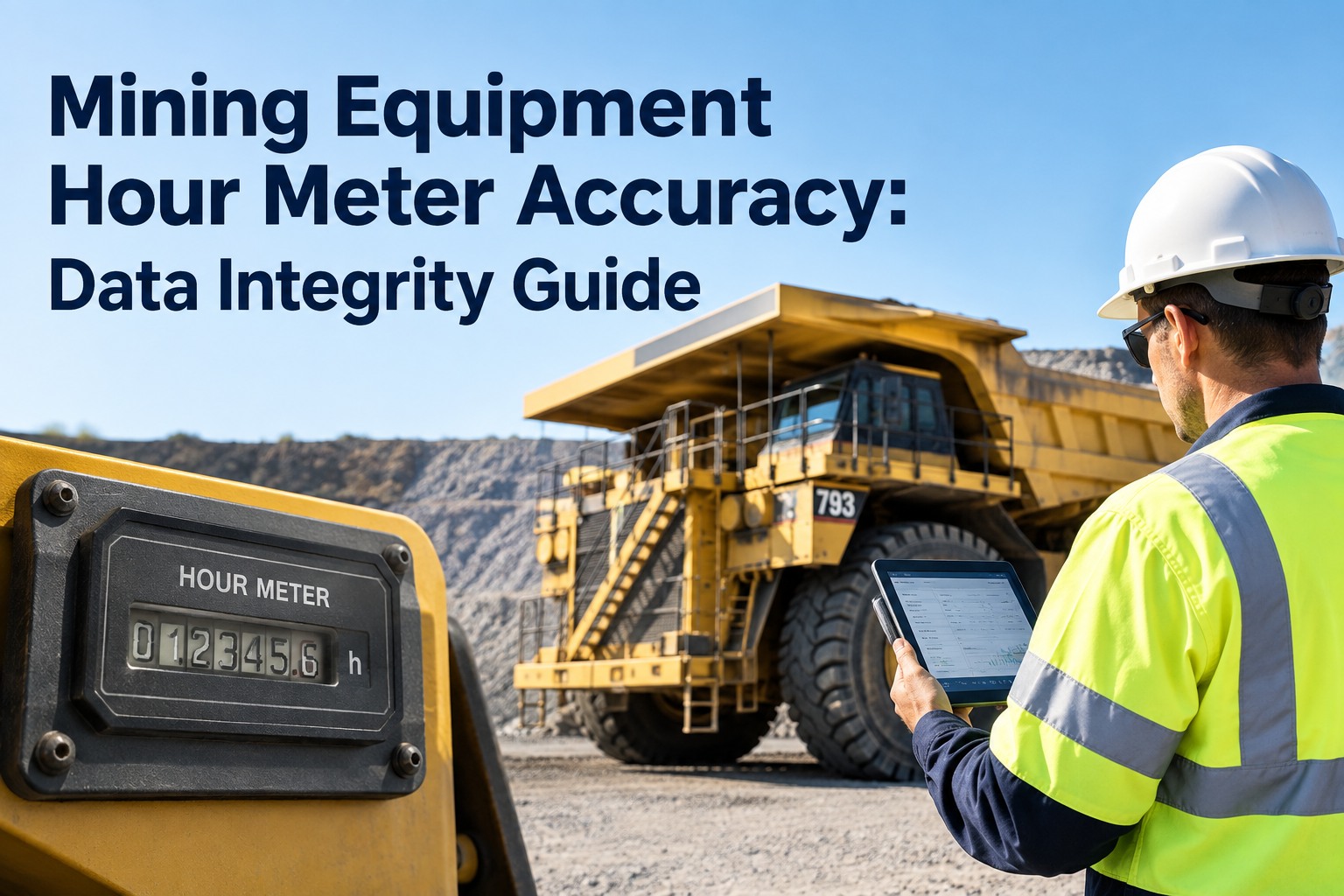
A Caterpillar 950M loader shows 7,800 hours on the dash. Plug in a scan tool and the engine ECU reads 12,300. That 4,500-hour gap isn't a rounding error — it's a machine that's four filter changes and a hydraulic service overdue, valued for resale as if it were half-worn. Hour meter accuracy in mining is the quiet foundation under your whole PM program, your cost-per-hour numbers and your resale value, and when the number drifts, everything built on it drifts with it. This page shows where hour data goes wrong and how to keep it honest. Book a demo to see automated hour capture.
Every PM trigger, every cost-per-hour report and every resale valuation rests on one figure: engine hours. When the meter and the ECU disagree, the meter usually loses.
A 4,500-hour gap on a single wheel loader — enough to mis-time every service and mis-value the asset by tens of thousands.
Mining runs on hours, not miles. A haul truck's odometer tells you almost nothing about wear; its engine hours tell you everything. So the entire maintenance and reliability program hangs off one data point per machine — and that data point is more fragile than most fleets assume. It gets hand-copied wrong, drifts as mechanical meters age, resets when a meter is replaced, and occasionally gets tampered with outright. Below is where each of those failures comes from, what one bad hour reading actually costs downstream, and how to lock the number to a source that doesn't lie.
Hour Meter Accuracy in Mining: Why One Wrong Reading Costs More Than You Think
Hours aren't just a maintenance trigger. They're the denominator under half your fleet decisions. Get the number wrong and the error doesn't stay contained — it ripples into four places at once, each one expensive in its own way.
PM fires at the wrong time
Under-count and the service never triggers — the oil runs 4,500 hours late and the engine wears. Over-count and you service a machine that didn't need it, burning parts and labour on a healthy asset.
Cost-per-hour goes fictional
Divide maintenance spend by wrong hours and every cost-per-hour figure is off. You can't compare machines, justify a replacement, or trust the report you take to the budget meeting.
Resale value swings
Hours are the starting point of every valuation. On a mid-size machine the gap between 4,000 and 8,000 hours can mean $30,000–$50,000 — and a buyer's scan tool will find the truth.
Warranty claims get challenged
OEM warranty and service intervals are hour-based. Records that don't match the ECU invite disputes exactly when you need a claim to go smoothly — a warranty rejection you caused with bad data.
Notice these all share one root: a single unreliable number feeding four decisions. Fix the number at its source and all four get more accurate at once. That's why data integrity, not just data capture, is the real goal — capturing the wrong hours faster doesn't help anyone. Book a demo to see PM and cost reports driven by verified hours
The five ways hour meter accuracy breaks downmost fleets have at least three of these running right now
Bad hour data isn't one problem with one fix. It's five distinct failure modes, and a mining fleet running a mix of new and older machines usually has several at once. Knowing which one you're dealing with tells you how to close it.
Four of these five vanish the moment hours come straight from the source that can't drift or be hand-typed: the engine control module. The fifth — meter replacement — is a records problem, solved by keeping the machine's history continuous across the swap. Start free and pull hours from the ECU, not a clipboard
Where the true number livesthe dash gauge is a display; the ECU is the record
Here's the distinction most hour-data problems come down to. On any machine built roughly since the mid-2000s — and that's most of the mining fleet from Cat, Komatsu, Deere, Volvo and Hitachi — the engine control module logs total hours independently and feeds that value to the cab display. The gauge is just a screen. The ECU is the ledger. You can unplug or swap the gauge; you can't casually rewrite the ECU.
Reading the gauge
Pulling from the ECU via telematics
Modern telematics uses open standards — AEMP and J1939 — so one integration can read hours across a mixed-OEM fleet rather than needing a different tool per brand. For older machines with only a mechanical meter, an ignition-signal or inspection-based capture still lands far closer to the truth than a spreadsheet updated from memory. The point isn't that every machine needs the same solution; it's that every machine needs its hours coming from something more reliable than someone's handwriting. Book a demo to connect your telematics to meter-based PM
The meter change problemwhen the number resets to zero but the machine didn't
This is the one failure mode telematics alone doesn't solve, and it's where good fleets still lose their history. A meter fails, gets replaced, and the new unit reads zero — while the machine has 9,000 real hours on it. If your records don't bridge that gap, the asset's entire service history is now split across two numbers that don't connect, and every hour-based interval resets as though you bought a new machine.
The fix is a system that records the meter change as an event — noting the reading at swap-out and carrying a lifetime-hours figure forward — so the history stays continuous even when the physical gauge starts over. A replaced meter with no documented prior reading is exactly the red flag used-equipment buyers are trained to spot, and it's the same red flag an auditor or your own reliability analysis will hit. Keeping the full history against the asset, not the meter, is what makes the swap a footnote instead of a data cliff. Start free and keep lifetime hours across meter changes
From a reliability manager who chased the numbers
We were proud of our cost-per-hour reporting until I reconciled a dozen machines against their ECUs. Three were off by more than a thousand hours — one loader had had its meter replaced two years earlier and nobody carried the old reading forward. Every cost-per-hour number I'd presented for that asset was fiction.
Once we started pulling hours straight from telematics, two things happened. The obvious one: PM stopped firing early or late. The one I didn't expect: the arguments stopped. When the hours come from the ECU, nobody debates whether the service is really due — the number isn't anyone's opinion anymore. That alone was worth it.
Frequently asked questions
How accurate are equipment hour meters, and why do they drift?
It depends entirely on the type. Older mechanical hour meters, driven by a small synchronous motor, commonly lose 10–15% accuracy over their life because voltage fluctuations, vibration and age all cause the motor to run fast or slow. They're also easy to stop or reset — disconnect the wire and the meter stops counting. Modern machines built roughly since the mid-2000s store hours electronically in the engine control module (ECM/ECU), which logs runtime independently and feeds the cab display. That electronic record is far more reliable and effectively can't be casually altered, which is why a real gap between the displayed gauge and the ECU reading is a well-known sign of a drifted or tampered meter. The Association of Equipment Management Professionals recommends treating any hour reading as unverified until an ECU or telematics pull confirms it. In practice, that means the gauge is a display to sanity-check, not a number to build a maintenance program on by itself.
Is telematics more accurate than reading the hour meter manually?
Yes, and importantly it's not because telematics reads a different, better number — it reads the same ECU value that feeds the dash gauge. The accuracy gain comes from removing the manual step. When someone reads a gauge and types the figure into a spreadsheet, every reading is a chance to transpose a digit, misattribute it to the wrong machine, or skip it entirely on a busy shift. Telematics streams the ECU hours directly and continuously — commonly syncing every 15 minutes — so the figure in your maintenance system is accurate to within minutes of actual use, with no transcription error possible. It also logs independently of the display, giving you a built-in cross-check. For machines that genuinely can't support telematics, capturing hours during a structured digital inspection is the next best thing: still more consistent and traceable than a spreadsheet updated from memory. The goal is simply to get the number from a source that can't be mistyped.
What happens to the maintenance history when an hour meter is replaced?
Without deliberate handling, the history breaks. A failed meter gets swapped, the new unit reads zero, and unless the machine's true prior hours are carried forward, the asset's whole service history is now split across two disconnected numbers — and every hour-based PM interval resets as though the machine were brand new. That means overdue services silently stop triggering and your cost-per-hour and reliability analysis become meaningless for that asset. The correct approach is to record the meter change as a documented event: capture the old meter's reading at removal, note the new meter's starting value, and maintain a lifetime-hours figure that spans both. A good maintenance system keeps this history against the asset itself rather than against the physical meter, so a swap becomes a recorded footnote instead of a data cliff. It's also worth knowing that an undocumented meter replacement is precisely the red flag used-equipment buyers and auditors look for, so keeping the record continuous protects resale value as well as PM accuracy.
Why does accurate hour data matter for cost analysis and resale?
Because hours are the denominator under both. Cost-per-hour — the single most useful metric for comparing machines, justifying replacements and budgeting — is maintenance spend divided by hours run. If the hours are wrong, the figure is wrong, and every decision you base on it inherits the error. On the resale side, hours are the starting point of every valuation conversation: on a mid-size machine, the difference between 4,000 and 8,000 hours can swing resale value by $30,000–$50,000. A serious buyer will pull the ECU record, so any gap between your stated hours and the machine's true hours surfaces immediately — and undocumented meter replacements or drifted mechanical meters both create exactly that kind of gap. Accurate, well-documented hours protect the number you report internally and the price you command externally. It's one of the clearest cases where clean data converts directly into money, which is why capturing hours from a reliable source is worth the effort. You can book a demo to see verified hours flow into cost reporting.
Should mining PM be scheduled on hours or on the calendar?
For most mobile mining equipment, hours — because engine hours track actual mechanical wear in a way the calendar never can. A haul truck running back-to-back double shifts accumulates wear far faster than an identical truck parked half the week, yet a pure calendar schedule would service them identically: over-maintaining the idle machine and under-maintaining the hard-run one right up to a mid-production breakdown. Hour-based (or broader meter-based) scheduling fires the PM when the machine has actually done the work, which is both safer and cheaper. That said, the best programs blend triggers — some tasks are genuinely time-based, like fluids that degrade whether or not the machine runs, so a system that can fire on whichever threshold comes first (say 250 hours or three months) is ideal. The non-negotiable underneath all of it is that the hours driving those triggers are accurate. Hour-based scheduling built on a drifted or mis-typed meter just automates the wrong decision. Get the data right first, then let it drive the schedule.
Stop building your PM program on a number someone hand-typed
HVI captures engine hours through telematics straight from the ECU, fires meter-based PM on verified thresholds, validates the data as it comes in, and keeps a complete equipment history that survives meter changes. Accurate hours in means reliable PM, honest cost-per-hour and defensible resale value out.
Telematics capture · Meter-based PM · Complete history across meter changes