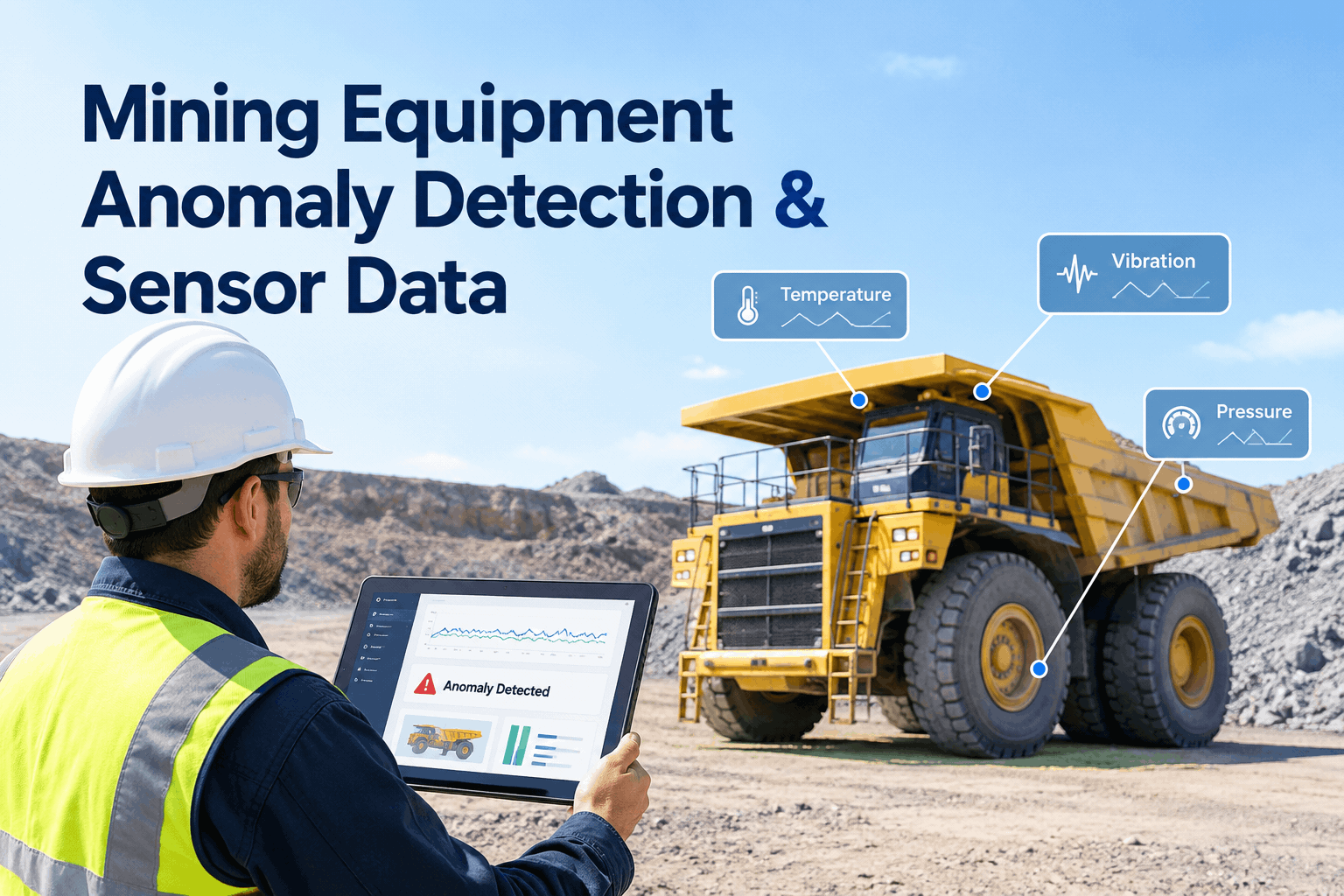
An anomaly is a question, not an answer. When a haul truck's vibration ticks above its normal band or an excavator's hydraulic pressure drifts, the sensor isn't telling you what's wrong — it's telling you where to look. Mining equipment anomaly detection only pays off when that flag turns into a prioritized review and a tracked action, not one more alert nobody owns. This page is about what happens after the flag. Book a demo to see anomalies turned into action.
Mining Equipment Anomaly Detection That Turns the Flag Into a Fix
Rank every anomaly by severity, route it to a prioritized maintenance review, and close it with an inspection and a work order — so a flagged pattern becomes a planned repair, not a missed warning.
Most mine sites don't have an anomaly problem — they have an anomaly-overload problem. Signals fire all day, and without a way to rank and route them, the real ones drown in the noise. Fixing that starts with understanding what an anomaly actually is.
What a mining equipment anomaly actually looks like
An anomaly is simply a reading that has left its normal band. The system learns what healthy looks like for a component, then flags the moment a signal drifts out of that range — before the number becomes a failure. Seeing it drawn makes the idea concrete: the value you watch for isn't the reading, it's the departure from baseline.
The detection itself usually comes from the machine's own sensors and the condition-monitoring or telematics layer that scores them. HVI's job starts where that flag lands: turning it into a reviewed, prioritized, actioned item. For the modelling side — how those predictions get built and why data quality decides whether they work — see our guide to AI predictive maintenance for mining equipment. Book a demo to see a flag become a work order.
Two kinds of anomaly — and one your sensors can't see
Sensors catch what's happening inside a machine right now. But some of the clearest warnings don't live in a sensor stream at all — they live in your maintenance history, where a unit's defect rate, repair cost, or downtime quietly drifts away from its own baseline and its peers. A complete anomaly program watches both.
Sensor-signal anomalies
A vibration, temperature, pressure, or fuel-vs-load reading leaves its normal band in real time.
From the machine & telematicsMaintenance-data anomalies
A unit's repeat-defect rate, cost per hour, or downtime diverges from its history and its sister machines.
What HVI's own analytics surfaceThat second kind is where a maintenance system earns its place in an anomaly program: a machine with no sensor alarm can still be the one quietly eating parts and hours. HVI's analytics and reporting surface those patterns per unit, and its OEM and telematics integration brings the sensor flags into the same queue. Sign up free and see both anomaly sources together.
Which anomaly do you act on first? Triage by severity and confidence
The reason anomalies get ignored is that they all arrive looking equally urgent. They aren't. A flag's priority is a function of two things — how severe the consequence would be, and how confident the signal is — and plotting them decides what gets a technician today versus a watch-list entry.
Every flag lands in one of four boxes, and each box has a default action — so nothing sits undecided and nothing low-value steals attention from a genuine threat. That triage logic is exactly what the review queue automates. Explore HVI's preventive maintenance to see how a prioritized anomaly becomes a scheduled job, or book a demo to set your own triage thresholds.
Is your mining anomaly program actually closing the loop?
Detecting anomalies is the easy part — most tools do it. The gap is everything after the flag. Walk your program through these five stages; the first one you can't tick is where your anomalies are going to die.
Every anomaly — sensor and maintenance-data — lands in one place, not scattered across dashboards.
Each flag is scored by severity and confidence, so the queue is ordered by what matters, not by what fired last.
A named person reviews each one — no anomaly closes itself and none sits in a shared inbox unassigned.
A real flag becomes an inspection and, if confirmed, a work order with parts and a schedule.
The outcome — real fault or false alarm — is recorded, so the baseline and the triage get sharper over time.
A program that ticks all five turns anomaly detection from a dashboard into downtime avoided. HVI runs stages two through five; the detection in stage one can be your own, your OEM's, or a telematics provider's. Read our mining predictive maintenance guide for the foundation this sits on, or book a demo to close your own loop.
What catching the anomaly early is really worth
On a mine, the gap between a flagged drift and an unplanned failure is the gap between a planned swap and a haul road blocked by a dead truck. That leverage is why the review queue matters more than the detector.
A component changed on a planned window costs a fraction of the same part failing mid-shift on the pit floor.
The whole value of an anomaly is the weeks of warning it buys — wasted if the flag isn't acted on in time.
Unranked alerts train crews to ignore them; triage is what keeps the real flags credible.
Directional of widely reported planned-versus-unplanned maintenance cost patterns in mining; your own equipment, site, and failure modes set the actual figures. HVI organizes and actions the data — the detection model and sensor accuracy sit with your monitoring provider.
The detector finds the drift; the system that acts on it is what turns the finding into uptime. See how mining operations run HVI, or book a demo to act on your anomalies faster.
From a maintenance manager on a surface mine
We had condition monitoring throwing alerts for two years before we admitted the truth: nobody was doing anything with them. They'd pop up, nobody owned them, and we still ran machines to failure. The fix wasn't a better detector — it was a queue. Now every flag, sensor or record-based, gets ranked and assigned, and the high ones become inspections the same shift. Our unplanned failures on monitored units dropped hard, and the crews actually trust the alerts now because we stopped crying wolf on the low ones.
Mining equipment anomaly detection FAQs
Does HVI run the anomaly-detection algorithm on raw sensor data?
What is a maintenance-data anomaly?
How do you decide which anomaly to act on first?
Do I need sensors on every machine to start?
How does acting on anomalies reduce downtime?
Turn mining equipment anomalies into planned repairs
Bring every sensor flag and maintenance-data anomaly into one ranked review queue, assign it, and close it with an inspection and a work order — so a flagged drift becomes a planned swap, not a failure on the pit floor.
No credit card · Works with your telematics & OEM feeds · Analytics from day one
- Ranked anomaly review queue
- Maintenance-data anomaly analytics
- OEM & telematics integration
- Flag → inspection → work order
- Outcome feedback per unit