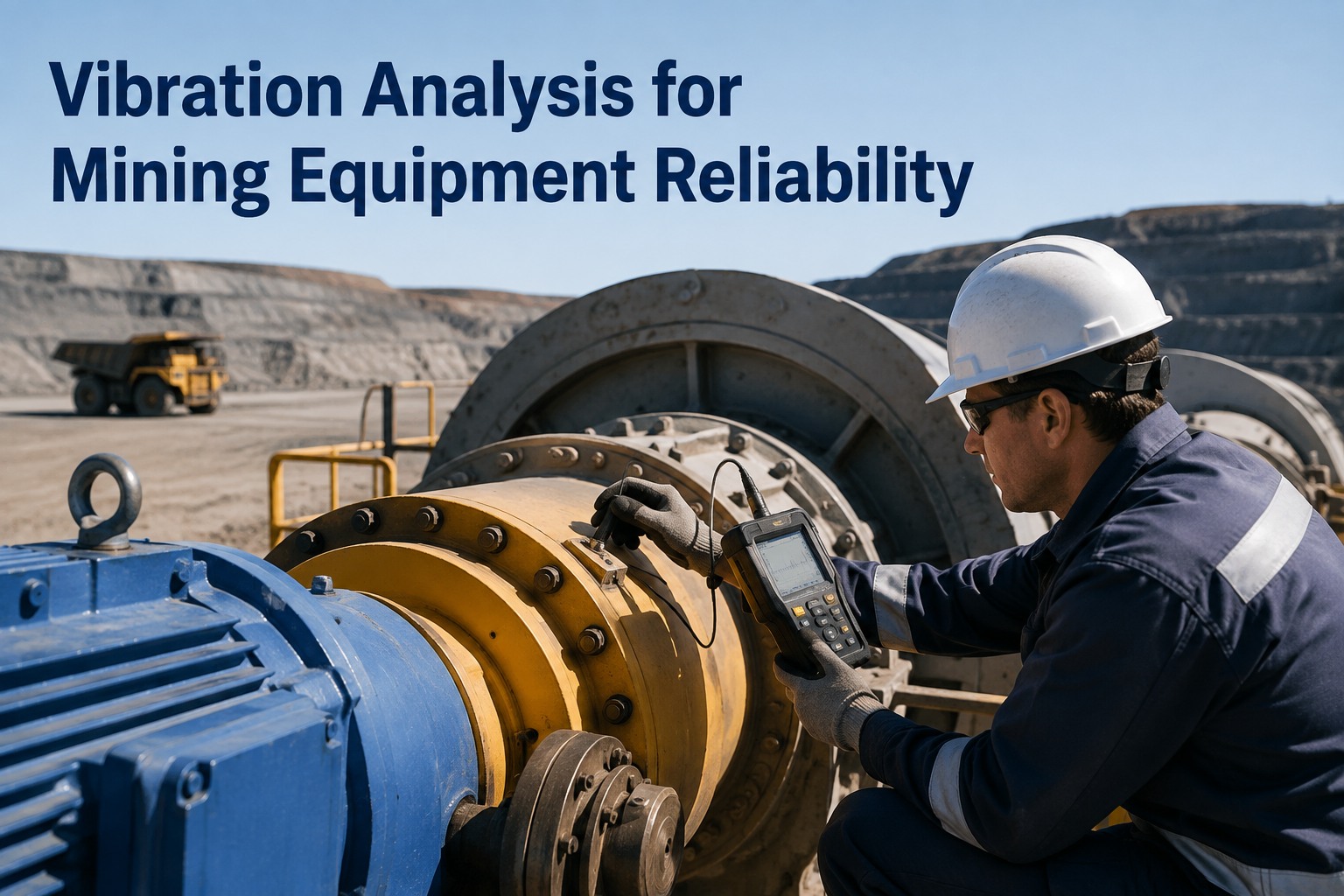
Vibration analysis is the diagnostic. HVI is where the diagnostic becomes a maintenance action. Your vibration analyst or condition monitoring system detects the bearing defect, misalignment, or gear wear — and then something has to happen. Vibration analysis for mining equipment reliability only earns its cost when a finding on Monday becomes a repair on Wednesday instead of a failure on Friday. This guide covers what the analysis reliably catches and the after-finding workflow that turns a data point into a scheduled repair. Book a demo to see the flow.
Vibration Analysis Finds the Fault. The Workflow Prevents the Failure.
The analyst detects it. The CMMS turns it into a scheduled repair with the right parts on the shelf.
Bearing-related failures account for roughly 40–70% of malfunctions in rotating machinery. Misalignment causes up to 50% of premature bearing failures. Both are diagnosable weeks before catastrophic failure through vibration signature analysis — when the program is disciplined, when the baseline is established, and when the finding-to-action loop closes reliably. Where mining reliability programs fail is rarely the analysis. It's what happens after the finding lands in someone's email and never becomes a work order.
The 4 faults vibration analysis reliably catchesAnd what each signature actually looks like
Vibration analysis detects a bounded set of mechanical faults with characteristic signatures. Each fault produces a distinct frequency pattern that a trained analyst (or a well-configured monitoring system) can identify. Lead time to failure varies significantly by machine, fault type, and operating conditions — the numbers below are typical ranges, not guarantees. Book a demo to see how findings from any of these fault types get captured in HVI
Bearing degradation
Imbalance
Misalignment
Mechanical looseness & gear defects
Fundamentals of a program that actually worksBaselines, routes, thresholds — repeatable, or the trends are noise
A vibration monitoring program produces useful decisions only if the measurements are repeatable. Same machine, same points, same operating conditions, same sensor mounting, same route sequence. Change any of these and the trend line means nothing. The five fundamentals below are what separate a program that catches faults from one that produces a monthly report nobody trusts.
Establish baselines when the machine is healthy
The baseline is the reference for every future measurement on that asset. Take it after commissioning, after major rebuild, or after a period of confirmed-good operation. Without baseline, an "elevated" reading is just a number.
Consistent measurement points, marked and labeled
Same location on the bearing housing every time. Same direction (radial horizontal, radial vertical, axial). Physically mark the points so different technicians measure the same spot on the same route.
Repeatable measurement routes
Fixed sequence, fixed frequency (weekly, monthly, quarterly depending on asset criticality). Route drift is why trend lines look random — if the machine is measured at a different load state each time, the data is comparing apples to oranges.
Record operating conditions with every measurement
Load, speed, feed rate, ambient temperature, hours since startup. A vibration reading without operating context is not comparable to the last one. Log the conditions or the trend line is unreliable.
Trend results over time — not point-in-time snapshots
A single reading tells you almost nothing. The slope of the trend line tells you when the failure is coming. Reliable programs live in the trend view, not the current-value view.
Alarm thresholds: machine-specific, not genericWhy the ISO chart on the wall is a starting point, not a policy
Generic vibration alarm thresholds (ISO 10816 categories, OEM tables, vendor default limits) are useful reference points — they are not compliance rules. What matters is the alarm limit appropriate for that specific machine, measurement method, and operating condition. A high-speed centrifugal fan has different acceptable levels than a low-speed gearbox output shaft. A radial reading has different significance than an axial. A machine running at 50% load produces different baseline vibration than the same machine at 100% load. Applying a generic threshold blindly generates false alarms that erode analyst credibility — and missed alarms that erode the program's value.
The multipliers above are illustrative — the actual thresholds should be set per machine based on baseline data, machine class, and consequence of failure. Book a demo to see how per-asset thresholds are configured in HVI
Fixed mining equipment applicationsWhere vibration analysis earns its cost in a mine
Vibration analysis returns the highest value on rotating equipment that runs continuously, has high consequence of failure, and produces predictable failure signatures. Mining sites have several such asset classes.
Crusher drives
Motor-gearbox-crusher coupling chain. Imbalance from wear rings, misalignment after rebuild, gearbox tooth wear. Downtime is production-critical.
Conveyor drives
Head pulley bearings, drive motor, gearbox output shaft. Belt tracking issues show up as pulley imbalance. Bearing life is the primary trend concern.
Slurry & process pumps
Impeller wear creates imbalance, cavitation shows as broadband high-frequency noise, seal degradation shows in bearing signatures.
Fans & blowers (ventilation)
Material buildup on blades = imbalance. Bearing failures on large ventilation fans are safety-critical (mine air quality) as well as production-critical.
Motors (across the site)
Rotor imbalance, bearing degradation, foundation looseness. High-value assets with long lead time to replace — catching failures early has outsized payback.
Gearboxes
Gear mesh frequency + sidebands reveal tooth wear, cracks, eccentricity. Gearbox rebuilds are expensive and time-consuming — the earliest possible warning matters most here.
The after-finding workflowWhere reliability programs typically fall apart — and how to close the loop
A vibration finding that sits in an email or a monthly report is worth nothing. The value is unlocked in the workflow that runs after the finding: validate, assess severity, plan, source parts, create work order, schedule, execute, verify. This chain is where a CMMS earns its cost — and where a good vibration program becomes a great reliability program. Book a demo to see the full finding-to-close workflow in HVI
Validate the indication
Every alarm gets a validation step before it becomes an action. Repeat the measurement, verify sensor mounting, check for operating condition anomalies. Roughly 15–25% of "alarms" don't survive validation — skipping this step floods the shop with false-positive work.
Assess severity & time-to-failure estimate
The analyst calls the severity: monitor, plan repair this month, schedule this week, take offline now. Estimate is bounded by the fault type, trend slope, and operating conditions — never a promise, always a range.
Document the finding against the asset in HVI
Defect logged on the asset record with the analyst's severity call, evidence attached (spectrum plot, waveform screenshot), and trend context. This is where the finding leaves the analyst's report and enters the maintenance system.
Plan the repair & identify parts
Shop planner scopes the work — teardown estimate, labor hours, tools required — and pulls the parts list. HVI's Parts and Inventory module surfaces on-shelf availability and flags anything requiring order lead time.
Create the work order & schedule
Work order created with severity-driven priority, tech assigned, bay slot booked. Scheduled before the failure — not after the alarm turns into a breakdown.
Execute repair & log outcome
Repair performed. Tech logs corrective action, parts consumed, actual labor hours, and any measurements or findings during teardown. Confirms whether teardown matched the vibration prediction — this feedback loop is how the program calibrates over time.
Post-repair verification measurement
New vibration measurement after the repair confirms the fault is resolved and establishes the new post-repair baseline. Result gets logged as the next reference point for that asset. Logbook history closes the loop.
Every step in the chain lives on the same asset record — finding, WO, parts, labor, verification — so the audit trail from vibration alarm to closed repair is a single pull. Start a free trial and configure this workflow against your own assets.
From a reliability engineer running a copper mill program
Our vibration contractor was excellent — they'd send us a monthly report with 40–60 findings ranked by severity. Problem was, the reports lived in someone's email. About 40% of the findings actually became work orders. The rest just aged out until the equipment failed and everyone was surprised.
We changed the process: every validated finding becomes a defect record on the specific asset in HVI on the same day the analyst calls it. That triggers a work order with the analyst's severity as the priority, and the planner pulls parts against the WO immediately. Failure-to-action rate went from 40% closed to 92% closed within a year. Same analysts, same equipment, same monthly report — just a real workflow underneath it.
Frequently asked questions
Does HVI perform the vibration analysis itself?
No. HVI is the CMMS layer where findings are documented and the maintenance workflow is managed after the analysis is complete. The vibration analysis itself is performed by your reliability team, an in-house condition monitoring program, a third-party contractor, or an integrated sensor system — each generating findings that then need to flow into a maintenance workflow. HVI provides the destination for those findings: asset-level defect documentation, work order creation with priority mapping to analyst severity calls, Parts and Inventory to identify and reserve required components, Logbook history for the asset, and maintenance analytics to trend repair patterns over time. This separation is deliberate — specialist vibration analysis tools are a mature ecosystem, and HVI complements rather than replaces them by being the reliable execution layer for the resulting work.
How much advance warning does vibration analysis typically give before failure?
It varies by fault type, machine, and operating conditions — and the ranges below are typical, not guarantees. Bearing degradation is often detectable weeks to months before catastrophic failure, especially when captured through envelope spectrum analysis of high-frequency energy. Imbalance and misalignment are typically detectable within days to weeks of onset, though they can persist for months before causing secondary damage to bearings and couplings. Mechanical looseness can degrade quickly (days) once the underlying joint or fit is compromised. Gear defects typically progress over weeks with characteristic sideband growth around mesh frequencies. Lead time also depends heavily on program discipline — measurement frequency, baseline quality, and how quickly a finding gets from the analyst to an actioned work order. A finding that takes 3 weeks to become a work order has burned most of its advance warning.
Should we use ISO 10816 thresholds as our alarm limits?
Use them as a reference starting point, not as a compliance policy. ISO 10816 (and its successor ISO 20816) provides vibration severity zones for various machine classes and is useful when no baseline exists on a new machine, when comparing across a fleet of similar assets, or as a sanity check on baseline measurements. But applying ISO thresholds blindly across a mixed fleet generates false alarms on machines that naturally run outside the standard zones and missed alarms on machines that show degradation while still within a zone. The best practice is: use the machine's own baseline as the primary reference, set alert/alarm/danger thresholds as multipliers of baseline (typical starting points 2× / 4× / 10×), and use ISO zones as an outer bound for any machine where a baseline is not yet established. Adjust thresholds based on operational experience — false alarms erode analyst credibility as fast as missed ones.
Which mining assets deliver the highest return on a vibration monitoring program?
Rotating equipment that runs continuously, has high consequence of failure, and has long parts lead time or high replacement cost. On a typical mining site, that means: crusher drives (production-critical, expensive rebuilds), conveyor head pulleys and drive motors (production-critical, long belt outage windows if failed), slurry pumps (impeller wear, seal life, availability constraints), mine ventilation fans (safety-critical for air quality, large motors with long lead time), large process motors across the site, and gearboxes in every application (long rebuild time, expensive parts). Lower-return applications tend to be low-speed intermittent equipment, redundant equipment where one spare is always running, or equipment where the failure mode is not vibration-driven (electrical, thermal, corrosion). Start with the highest-consequence rotating assets and expand as the program proves out.
How do we prevent vibration findings from getting lost between the analyst and the shop?
Structural workflow, not process discipline alone. The most reliable pattern is: every validated finding becomes a defect record on the specific asset in the CMMS on the same day the analyst calls it, with the analyst's severity mapped directly to the work order priority tier. This turns the analyst's output into a queue item the shop planner already reviews daily, rather than an email that competes with 200 other emails. In HVI, this means the vibration finding is logged as an asset defect (with spectrum plot or waveform screenshot attached), a work order is auto-created with the mapped priority, Parts and Inventory is queried immediately for required components, and the WO enters the shop's normal scheduling flow. The reliability program's "failure-to-action" rate becomes measurable — and once you can measure it, you can improve it. Fleets typically move from 40–50% action rate to 85–95% within a year of implementing this discipline.
Make HVI the execution layer for your reliability program
HVI supports asset-level maintenance records, inspection and defect documentation, maintenance work orders, Parts and Inventory, Logbook history, and maintenance analytics — the destination for every vibration finding your analysis team, contractor, or sensor system produces. Close the loop between the analyst's report and the shop's schedule. Turn advance warning into scheduled repairs.
No credit card · No hardware · Finding-to-work-order workflow ready on day one