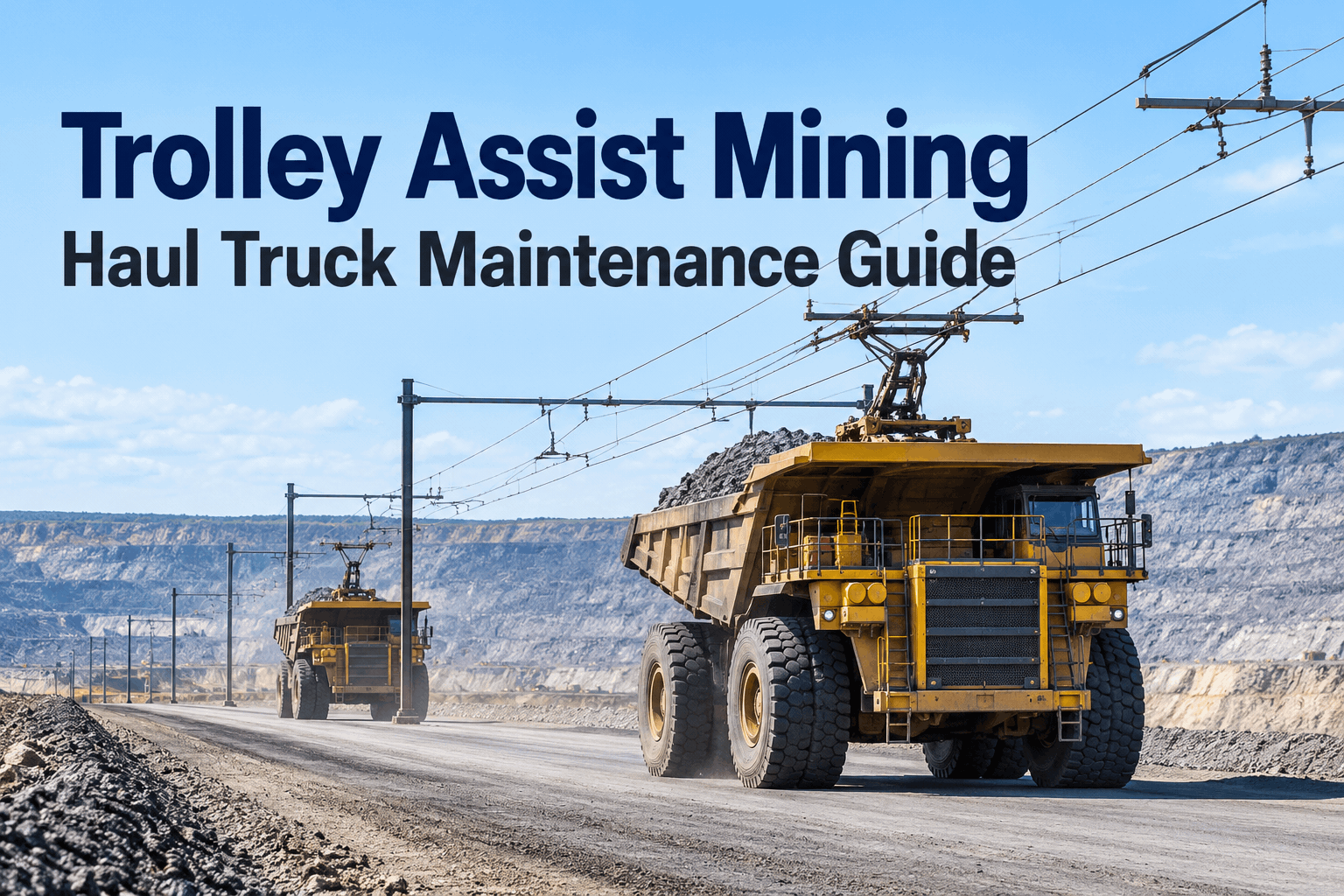
Trolley assist mining combines diesel-electric haul trucks with powered overhead conductors on selected haul-road segments, typically sustained uphill ramps. For mine maintenance teams, the opportunity is more than lower fuel use: it is a new interface between trucks, pantographs, electrical infrastructure, road conditions and dispatch planning. This guide explains how to evaluate the system, build a practical inspection program, track maintenance and costs, and avoid treating electrified haulage like an ordinary diesel fleet.
Trolley Assist Mining: Keep the Truck, Power the Climb
A field-ready guide to pantograph inspections, overhead infrastructure, maintenance ownership and the operational evidence needed to evaluate trolley-assisted haulage.
How trolley assist haul trucks work
Trolley assist supplies electrical power to compatible trucks while they travel under an energized overhead line. Depending on the truck and system design, onboard diesel generation may be reduced while the external supply supports traction. The truck leaves the trolley section and continues operating under its normal onboard power arrangement.
Truck reaches the electrified ramp with a compatible configuration and an authorized operating route.
Pantograph engages the contact system under OEM-defined conditions and operating controls.
External electricity supports traction demand on a high-load haul-road segment.
Truck transitions away from the overhead supply before exiting the designated zone.
Unlike a fully battery-electric haul truck, a trolley-assisted diesel-electric truck does not necessarily depend on a large traction battery for its entire haul cycle. That distinction matters for maintenance, electrical design, fueling assumptions and the mine's decarbonization roadmap. A site considering trolley assist mining should document exactly which truck models, power architectures and haul routes are compatible before forecasting benefits.
Start with the mine's actual route profile rather than a headline savings percentage. A long, repeatable uphill haul with sustained traction demand may present a stronger candidate than a frequently changing route with short climbs or difficult overhead-line clearance. Book a demo to see how HVI can organize maintenance records for candidate haul trucks.
Where trolley assist makes operational sense
Power supply alone does not make a route suitable. Mines need a stable combination of haul volume, grade, traffic control, conductor clearance, road geometry and access for maintenance crews.
Route suitability screen
Questions before design
- Which loaded uphill segments have consistent truck traffic?
- Will the route move as the pit develops?
- Can power infrastructure be installed and safely maintained?
- Do curves, intersections and road width permit the system?
- What happens during an outage or a truck/pantograph fault?
- Who owns inspection and isolation of electrical assets?
A useful feasibility study should evaluate production impacts, not just theoretical energy savings. Include queueing, connection reliability, road maintenance windows and the fallback operating mode.
One haulage system, three maintenance boundaries
Maintenance ownership is where many trolley-assist programs become complicated. Truck technicians, electrical infrastructure specialists and mine-road teams need separate responsibilities, coordinated shutdowns and clear defect handoffs.
Truck & pantograph
Mechanical mounting, contact components, actuators, visible wear, fault history and OEM-prescribed checks.
Truck maintenance teamPower infrastructure
Overhead contact system, poles, insulators, feeders, substations, protection and electrical isolation.
Qualified electrical teamRoad & operations
Grade, drainage, alignment, clearance, traffic rules, signage and access for infrastructure repair.
Mine operations / roadsCritical safety boundary: overhead trolley equipment can involve lethal electrical hazards. Inspection, testing, isolation and repairs on energized or potentially energized systems must follow site procedures, applicable requirements and OEM guidance, with work performed by appropriately qualified personnel. HVI can help document assigned inspections and work orders; it is not an electrical protection, isolation or permit-to-work system.
Build asset records for compatible trucks and relevant maintained equipment, assign preventive maintenance tasks, record findings and keep work histories accessible to supervisors. Start free to organize trolley-assist haul truck inspections and service records.
Trolley assist maintenance checklist by component
Use this as a planning framework, not a substitute for OEM service manuals or qualified electrical procedures. Inspection methods and intervals must be set for the installed system, site risk assessment and actual operating hours.
| Asset / component | What to check | Evidence to capture | Escalation owner |
|---|---|---|---|
| Pantograph assembly | Visible damage, mounting condition, contact strip wear, alignment and operating faults | Truck ID, condition photos, defect code, service hours | OEM-trained truck team |
| Truck electrical interface | Indications, reported faults, connectors and OEM-defined checks | Fault description, date, diagnostic reference | Qualified truck electrical staff |
| Overhead contact system | Conductor condition, hardware and clearances under approved procedures | Line section, inspection result, corrective action | Qualified infrastructure electrical team |
| Substation / feeders | Protective equipment, condition and scheduled testing per engineering program | Asset ID, test record, authorization | Electrical engineering team |
| Haul road corridor | Road surface, drainage, alignment, signage and obstructions | Location, defect severity, repair completion | Road maintenance / operations |
| Operating handoff | Connection failures, disengagement events and route restrictions | Event time, truck, section, production impact | Dispatch + maintenance |
Make inspection records specific enough to distinguish a worn contact strip from a damaged overhead component. A generic “trolley fault” category is too broad for recurring-failure analysis. Where the mine uses multiple truck types, separate checklists by OEM and configuration rather than copying one procedure to every asset.
Preventive maintenance scheduling should account for truck service hours, manufacturer recommendations, seasonal conditions and the mine's operating calendar. Track missed inspections and overdue corrective actions as operational risks, not merely administrative exceptions. Book a demo to explore mining equipment PM scheduling with HVI.
Put trolley-equipped trucks on a repeatable maintenance schedule
Keep inspections, service history, assigned repairs and equipment costs connected to the correct fleet assets.
How to calculate trolley assist fuel savings and operating costs
Fuel savings should be measured against a comparable operating baseline. Mines should account for differences in payload, grade, speed, road condition, queueing and production hours before attributing every change to the trolley system.
Illustrative energy-cost worksheet
Hypothetical example only; not an industry benchmark or predicted site result. Electricity consumption and all added costs must be calculated separately.
Cost categories to compare
(Avoided diesel cost + any validated productivity value) − (added electricity cost + added maintenance + infrastructure operating expense)
Capital expenditure and lifecycle assumptions must be included separately for NPV, payback and total-cost-of-ownership decisions.For example, if an operating period would otherwise consume 100,000 liters of diesel on the relevant duty cycle, a hypothetical 40% reduction would avoid 40,000 liters. The financial value depends on the actual diesel price and must be offset against electricity and other costs. This calculation alone cannot establish mine-wide savings because the trolley zone may represent only part of each haul cycle.
Use truck-level fuel and maintenance histories to build a baseline, then compare equivalent periods after commissioning. HVI can support the organization of fleet maintenance and cost records; electricity metering, power quality and trolley-system telemetry may require separate specialized systems. Book a demo to review HVI equipment cost tracking for mining fleets.
Measure the failures that affect production
Trolley assist system maintenance is not successful merely because scheduled inspections are completed. The operational test is whether the mine can sustain reliable truck movement through the electrified corridor.
Successful engagements ÷ eligible attempts. Investigate by truck, section and conditions.
Time the trolley segment is available for authorized operations ÷ planned service time.
Repeat pantograph or interface faults after repair, grouped by failure mode.
Time from reported defect to verified return to service, with isolation delays noted.
Agree on measurement definitions before launch. A line may be electrically available while a road restriction prevents use; a truck may be mechanically serviceable while its pantograph is unavailable. Separate those states to avoid misleading uptime numbers.
When a failure occurs, capture the affected truck, line segment, duty cycle, fault type, lost operating time, corrective work and parts used. That creates a usable record for reliability reviews and helps distinguish a fleet-wide design issue from a single-asset maintenance problem.
A practical trolley assist adoption and maintenance roadmap
Introduce trolley infrastructure as a cross-functional mine project. A phased rollout helps avoid committing the full haulage fleet before the electrical design, operational procedures and maintenance responsibilities have been proven at site level.
Establish the baseline
Document truck models, haul cycles, fuel use, repair history, route geometry and existing electrical capacity. Identify the decision criteria and cost assumptions.
Engineer and prepare
Complete specialist design and safety studies, assign asset ownership, develop procedures, train authorized personnel and plan maintenance access.
Commission and verify
Validate operation under the approved commissioning plan. Capture faults, connection events, production impacts and early component wear.
Optimize and scale
Compare normalized fuel, electricity, cost and reliability results. Revise PM tasks and decide whether to extend the system to more trucks or routes.
Mine teams should prepare an outage response plan before commissioning. Define how trucks safely continue or stop when trolley power is unavailable, how a line section is secured for work and how dispatch communicates restrictions. Electrical emergency procedures must be designed and authorized by competent specialists.
Keep the planning decision distinct from the maintenance system. HVI is suited to organizing equipment records and follow-up maintenance; it does not replace mine engineering, electrical design, operational control or specialist commissioning tools.
How HVI supports trolley-equipped mining fleets
The value of fleet maintenance software is consistent evidence across assets and shifts. As trolley-assist trucks enter service, managers need to see what was inspected, what failed, which work was assigned and how maintenance expense changes over time.
Identify trolley-compatible haul trucks and relevant maintained assets with equipment-specific records.
Use appropriate truck inspection checklists and document defects that require follow-up.
Schedule recurring tasks, record completed maintenance and follow open corrective work.
Review repair histories and expense trends to support operational and investment decisions.
For example, a supervisor may notice repeat pantograph-related repair entries on one truck. By reviewing inspection findings, maintenance records and work-order history, the team can determine whether the same symptom is recurring and escalate the technical investigation to qualified specialists. That is a realistic fleet-management workflow, not a claim that HVI diagnoses high-voltage faults automatically.
Use Sign up free to begin organizing mining fleet maintenance records in HVI, or book a demo to discuss trolley-assist truck inspection and PM workflows.
Pre-launch checklist for mine maintenance leaders
Before the first trolley-equipped truck enters production service, use this short gate review to confirm that operating and maintenance responsibilities are not being assumed without evidence.
Compatible units identified; OEM guidance accessible; inspection and defect codes established.
Qualified team assigned; inspection, isolation, testing and emergency rules approved.
Clearance, road conditions, signage, traffic procedures and access arrangements reviewed.
PM tasks scheduled; work-order escalation, spares and shutdown windows planned.
Fuel, energy, maintenance costs, productivity and downtime definitions agreed.
Loss-of-power response, dispatch restrictions and safe recovery process rehearsed.
Do not treat this checklist as engineering sign-off. It is a management coordination aid that should sit alongside formal design verification, safety procedures and site-specific commissioning documentation.
Make mining equipment maintenance easier to track
Bring haul truck inspections, scheduled maintenance, repair histories and cost records into a consistent workflow as your fleet evolves.
Trolley assist mining FAQs
What is trolley assist mining?
Trolley assist mining uses overhead electrical conductors to supply traction power to compatible haul trucks on designated haul-road sections. It is often considered for sustained uphill ramps, where truck power demand is high. The specific operating arrangement depends on the truck and trolley system.
Does trolley assist eliminate diesel use?
Not necessarily. A diesel-electric truck may continue to use onboard power outside the trolley zone and can have residual diesel consumption during trolley operation depending on its design. Mine-wide fuel savings depend on the portion of the duty cycle under trolley, operating conditions and system performance.
What maintenance does a trolley assist haul truck need?
It retains the applicable truck maintenance program and adds OEM-defined checks for the pantograph, mounting, electrical interfaces and related components. Overhead conductors and substations require separate qualified electrical maintenance programs. Inspection frequency should follow OEM and site requirements.
How do mines estimate trolley assist fuel savings?
Compare normalized fuel use for similar trucks, payloads, grades, routes and production conditions before and after trolley operation. Then account for electricity, infrastructure maintenance, downtime and capital cost. Do not apply a single savings percentage to an entire fleet without duty-cycle evidence.
Can HVI manage trolley assist maintenance records?
HVI can help organize mining equipment assets, inspection findings, preventive maintenance schedules, work orders and cost histories. Specialized trolley electrical protection, live controls, isolation procedures and power-system diagnostics remain outside that fleet maintenance role.