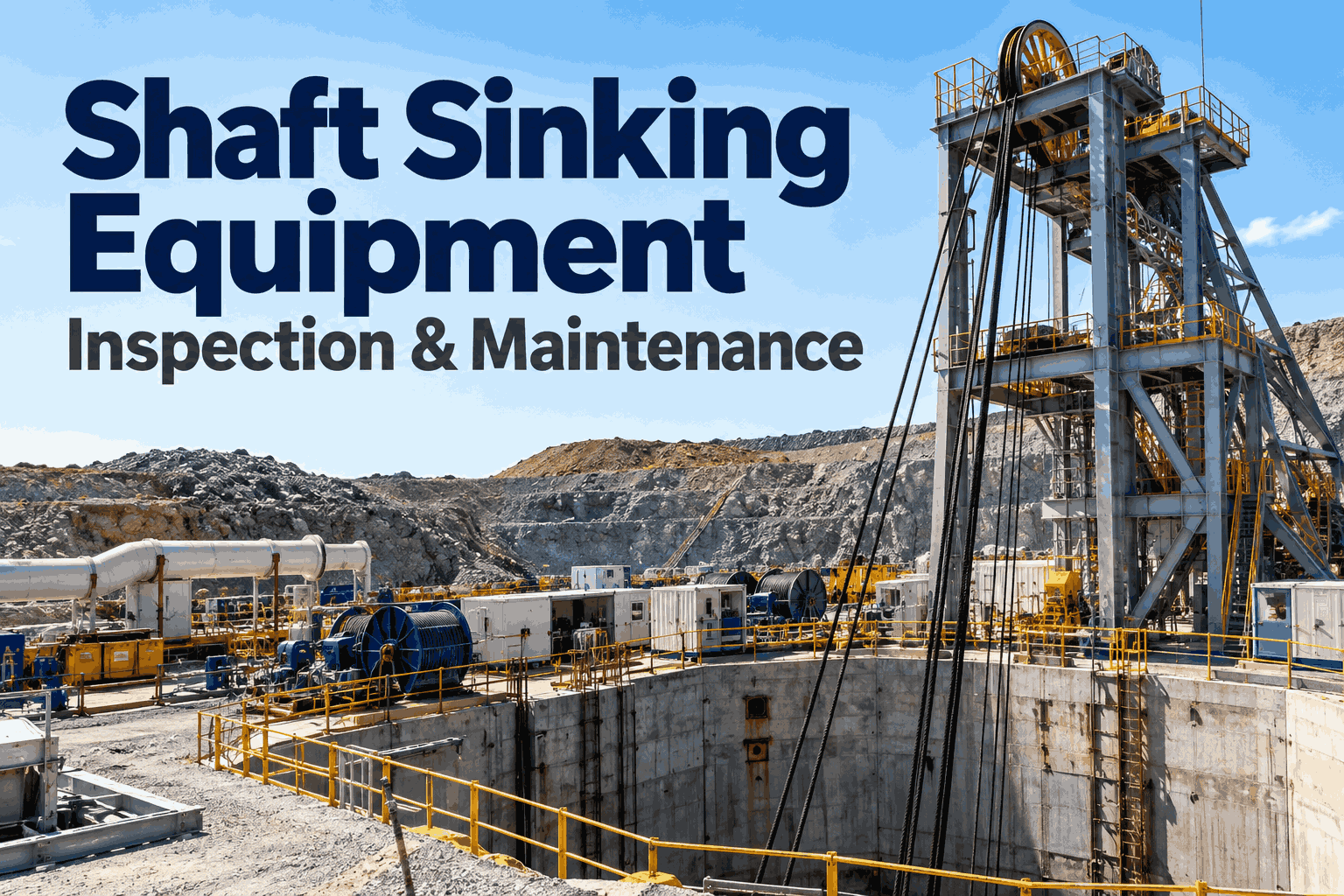
The sinking cycle has a rhythm to it — drill, blast, muck, hoist, support, repeat — and every stage depends on the equipment from the last one working. When a mucking bucket's hoist attachment starts showing a hairline crack nobody logged, the crew doesn't find out from a report. They find out when the bucket won't lift, the cycle stops, and everyone at the bottom of the shaft is waiting on a repair that a five-minute inspection would have caught days earlier. Shaft sinking equipment inspection isn't paperwork bolted onto the job — it's the only thing standing between a routine cycle and a shaft that goes quiet for a week.
Every Stage of the Sinking Cycle Runs on Equipment That Didn't Fail Last Shift
Drilling, mucking, hoisting and support all run on a tight loop. One piece of equipment goes down without warning, and the whole cycle — plus everyone working beneath it — stops with it.
Mechanical failure topping the list isn't a mystery — it's the predictable result of equipment running in a tight repeating cycle, underground, often past the point where a worn part should have been flagged. Book a demo to see how HVI standardizes shaft sinking equipment inspections across every system in the cycle, captured underground, synced when connectivity allows.
The Systems a Sinking Cycle Actually Depends On
A sinking operation isn't one machine — it's several systems handing the job to each other in sequence, and a program built around just the obvious equipment leaves real gaps. Build the inspection program around every system actually in the cycle, not just the one that's easiest to picture.
Hoists & conveyances
Ropes, drums, brakes, sheaves and the skip or stage carrying people and muck — the system that gets the closest scrutiny, for good reason.
Sinking stage
The working platform itself — structural connections, guides, decking and the winches that move it.
Drilling & blast prep
Drill rigs, rod handling and the hydraulics behind them — condition here drives both cycle time and hole quality.
Mucking & material handling
Buckets, attachments and loading equipment clearing broken rock between blast and the next cycle.
Pumps
Water control that, left unchecked, turns a dry shaft into a wet, caving-ground problem fast.
Ventilation
Fans, ducting and controls keeping breathable air moving to the working face — a life-safety system, not a convenience.
Four Inspection Tiers, Not One Checklist Repeated Forever
Treating every inspection the same — one generic form, every day — is how a slow-developing defect slides through unnoticed for weeks. Each tier is built to catch something different.
Before equipment starts the shift
A quick, focused check — is this specific piece of equipment safe to put into the cycle right now, today.
Through the working shift
Ongoing observation for anything that changed since pre-use — a new sound, a new leak, a new vibration.
At set intervals
A deeper look on a defined cadence — the one that catches slow wear pre-use checks aren't built to find.
At service intervals
Component-level inspection tied to manufacturer requirements and actual operating hours, not a date on a calendar alone.
Why Hoisting Equipment Gets a Closer Look
Pull almost any MSHA fatality bulletin involving a shaft, and the recommended best practice repeats itself: examine hoist ropes and safety mechanisms thoroughly, on a daily basis, before they fail — not after. It shows up again and again because hoisting failures don't give much warning, and the equipment is directly supporting people, not just material.
Ropes, drums, brakes and sheaves should be on a daily examination before hoisting people or material — broken wires, wear, corrosion and lubrication condition are all things a rushed glance misses but a structured inspection catches every time.
That means a hoist rope inspection can't quietly share a generic equipment form with a mucking bucket — book a demo to see a hoist-specific inspection form built around that daily examination requirement, not a one-size-fits-all checklist stretched to cover something it was never designed for.
From Defect Found to Equipment Back in the Cycle
Skip the middle steps — log it but never verify the fix — and the defect record becomes evidence the hazard was known and left open, not proof it was handled. Each step needs to close before the equipment goes back into the cycle, not just the first and last.
Preventive Maintenance by the Hour, Not Just the Calendar
Shaft sinking equipment doesn't run on a tidy 9-to-5 schedule — a hoist might log more hours in a tight two-week sinking push than it would in two months of lighter work elsewhere. A maintenance schedule built only around dates misses that entirely.
Service every 90 days, regardless of how hard the equipment actually ran — under-maintains equipment in a heavy push, over-maintains it in a slow stretch.
Service tied to actual run time and maintenance history — the schedule matches the real wear, whichever direction the pace of sinking goes.
The strongest programs use both — a hard calendar ceiling as a backstop, and operating hours driving the actual trigger most of the time.
What Underground Inspection Records Need to Hold Up
Captured offline, synced later
No gap in the record because the shaft had no signal that day.Photo evidence attached
A crack, a leak, or wear documented visually, not just described.Operating hours logged
Tied to the equipment, not just a generic maintenance date.Defects tracked to closure
Correction and verification both documented, not just the finding.Recurring defects flagged
The same component failing repeatedly surfaces as a pattern, not six separate work orders.Signed by the inspector
Named and dated, retrievable per piece of equipment on demand.From a Shaft Superintendent Who Stopped Losing Shifts to Surprises
We lost almost a full shift once because a mucking bucket's attachment point had been cracking slowly for weeks and nobody had a clean way to flag it before it finally gave out. It wasn't that the crew didn't notice — it's that noticing and it actually reaching someone who could act on it were two different things underground with no signal.
Now the inspection happens on a tablet at the collar, offline if it has to be, and syncs the second someone's back in range. The bucket that would've failed quietly now gets flagged the same shift it starts cracking, not three weeks later.
Frequently Asked Questions
What equipment needs to be covered in a shaft sinking inspection program?
A shaft sinking inspection program should cover every system in the sinking cycle: hoists and conveyances, the sinking stage itself, drilling equipment, mucking and material handling systems, pumps, ventilation equipment, and the supporting machinery each stage depends on. Treating the program as only about the hoist or only about the drill rig leaves real gaps in equipment that's just as critical to a safe, continuous cycle.
How often should shaft sinking equipment be inspected?
Most programs run four inspection tiers: a pre-use check before equipment starts a shift, ongoing shift observation, a deeper scheduled inspection at set intervals, and maintenance-level inspection tied to manufacturer requirements and operating hours. Hoisting equipment in particular is commonly inspected daily, given how directly it affects personnel safety and how little warning a hoisting failure typically gives.
Why does hoisting equipment need extra inspection attention?
Hoisting equipment directly supports personnel and material moving through the shaft, and failures — a broken rope, a brake that doesn't engage — tend to happen with little warning. MSHA fatality investigations involving hoisting equipment repeatedly recommend thorough daily examination of ropes, drums, brakes and safety mechanisms as a core preventive measure, which is why hoisting typically gets its own dedicated inspection form rather than sharing a generic one with other equipment.
Should preventive maintenance be scheduled by calendar date or operating hours?
Operating hours generally give a more accurate picture of actual wear, especially for shaft sinking equipment that can run far harder during an intensive sinking push than during lighter periods. Many programs combine both — operating hours driving the routine maintenance trigger, with a calendar-based ceiling as a backstop so equipment doesn't go indefinitely without service during slower stretches.
How should inspections be handled where there's no connectivity underground?
Inspection records should be capturable offline at the point of inspection, including photo documentation, and then synchronized automatically once a connection becomes available. Relying on connectivity to log a defect in real time risks losing or delaying records in exactly the environments — deep shaft work — where timely defect reporting matters most.
Digitize Shaft Equipment Inspections With HVI
HVI gives your crew configurable inspection forms for every system in the sinking cycle, defect tracking that closes the loop from found to verified, and offline capture that doesn't care whether the shaft has signal — so the cycle keeps moving and the record keeps up with it.
No credit card · Offline-ready inspections · Defect & preventive maintenance tracking