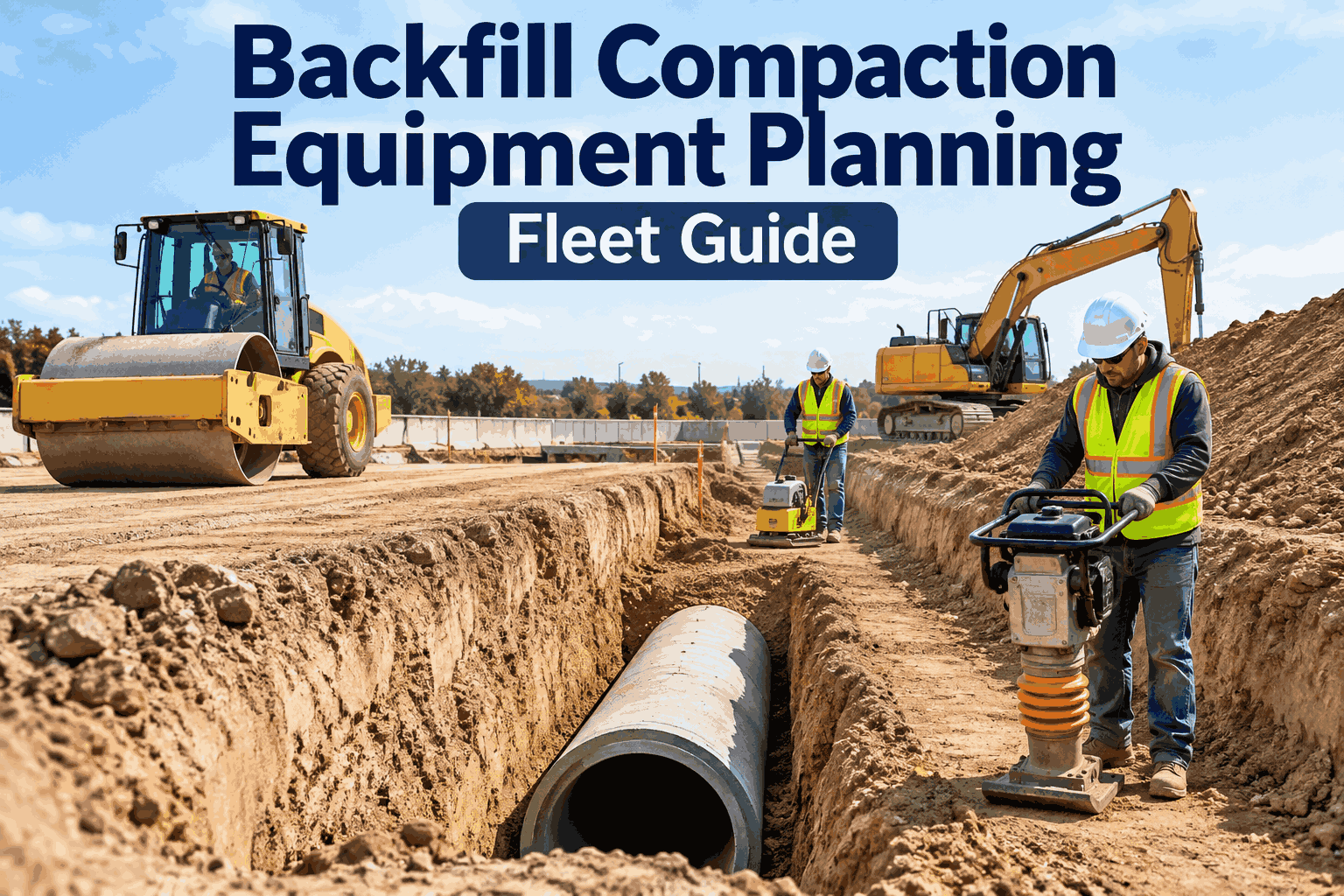
Choosing the right backfill compaction equipment is the difference between a trench that stays put and one that sinks six months later and takes the road surface with it. You've probably seen it — a utility crew backfills a trench, packs it down with whatever compactor was on the truck, passes the eyeball test, and then the patch dips and cracks over the next winter because the fill was never really compacted. The machine, the soil, and the lift thickness all have to line up, and getting that match right up front is far cheaper than digging it out again. This guide walks through how to plan compaction equipment for backfill so you pass the density test the first time. Book a demo to see how HVI keeps your compaction fleet tracked and job-ready.
Match the Compactor to the Job, Not the Truck
The right backfill compaction equipment depends on three things — the soil you're compacting, how thick your lifts are, and how much room the trench gives you. Get those right and the density test takes care of itself.
Here's the plan — why compaction force type matters, the main equipment types and what each is built for, how to match the machine to your soil, the lift-thickness rule that decides success, the trench-access constraints that narrow your choices, and how to keep that fleet of compactors ready when the crew shows up.
Compaction isn't one machinethree kinds of force, three kinds of soil
Every compactor works by driving air and space out of the soil, but they do it in different ways — and the way matters. Impact force hammers the soil from above, vibration shakes particles into a tighter pack, and static pressure squeezes with sheer weight. The soil you're backfilling decides which of those actually works.
Force type is the first decision, before you even pick a model. Cohesive soils like clay hold together and need impact or kneading force to break them down and pack them; granular soils like sand and gravel have no cohesion and respond to vibration. Use the wrong force on the wrong soil and you can run the machine all day without ever hitting target density.
The backfill compaction equipment typeswhat each machine is actually built for
There's a handful of machines you'll reach for on backfill work, and each has a job it does well and jobs it does badly. Knowing the lineup is the foundation of any compaction equipment planning — pick from strengths, not from whatever's parked closest.
Rammer (jumping jack)
Force: Impact. Best for: Cohesive clay and silt in narrow trenches. High impact energy in a small footprint — the go-to for tight utility backfill.
Vibratory plate
Force: Vibration. Best for: Granular sand and gravel on open ground. Fast and light for bedding and shallow granular lifts — poor on clay.
Reversible plate
Force: Heavy vibration. Best for: Deeper granular lifts and mixed fill. More force and depth than a single-direction plate, and it walks itself forward and back.
Trench roller (padfoot)
Force: Impact + kneading. Best for: Cohesive soil in confined trenches. Remote-operated, articulated, and drum feet that knead clay to depth — the deep-lift workhorse.
Ride-on roller
Force: Vibration / static. Best for: Wide, open backfill and subgrade. High output over large areas — too big for a trench, ideal once you're back at surface level.
The rule of thumb
Match force to soil first, then size to the trench. A rammer and a plate are not interchangeable — they're built for opposite soils.
Most fleets carry two or three of these, and the mistake is treating them as interchangeable. A crew that grabs a vibratory plate for a clay trench will be there twice as long and still fail the test. Keeping the right mix of compactors available and serviceable is half the battle, and it's where knowing your own equipment inventory pays off.
Match the machine to the soilthe single decision that makes or breaks density
If there's one thing to get right in backfill compaction, it's matching force type to soil type. This is the pairing that decides whether you hit density or spin your wheels, and it's genuinely simple once you see it laid out.
Moisture matters too — soil that's too dry won't pack and soil that's too wet turns to pudding, so backfill compacts best near its optimum moisture content. But the force-to-soil match is the foundation, and it's the first thing to plan before a machine ever leaves the yard. Start a free trial and keep your soil-to-machine playbook attached to each asset.
Lift thickness decides the outcomethin layers compact through; thick ones don't
Even the right machine on the right soil will fail if the lifts are too thick. Compaction energy only reaches so far down, so a lift that's too deep leaves a soft, uncompacted middle that no number of passes will fix. Thin lifts, fully compacted one at a time, are what actually build a solid backfill.
As a working rule, match lift thickness to the machine: light plate compactors handle shallow lifts, while a heavy trench roller can compact deeper layers in one pass. The manufacturer's spec for each machine tells you its lift capacity, which is one more reason to keep every asset's details on file rather than in someone's memory. Book a demo to see equipment specs travel with the machine
Let trench access narrow the choiceroom to work rules out half the lineup
The trench itself makes some of your decisions for you. A wide, open cut lets you bring in bigger, faster equipment; a deep, narrow utility trench rules out anything you can't fit or operate safely from outside. Access is often the constraint that settles the final pick.
Narrow, deep trench
A rammer or a remote trench roller — small footprint, and no one has to stand in the trench.
Medium trench
A reversible plate covers the width and gives more depth per lift than a light plate.
Wide, open fill
A ride-on roller once you're above the pipe zone — high output over the whole area.
Operator safety sits right alongside access here — a remote-controlled trench roller keeps a worker out of an unsupported trench entirely, which is why it's the default for deep confined backfill. This kind of thinking overlaps with the same discipline behind a good trencher inspection routine and a solid excavator daily checklist — the machine has to be right for the job and safe to run.
Why backfill compaction failsthe four mistakes behind most failed tests
When a trench fails a density test or settles later, it's almost always one of these four — and every one is a planning decision made before the crew started, not a mystery of the soil. Spot them ahead of time and the rework disappears.
The through-line is that backfill compaction is a planning job as much as a field job. Deciding the machine, the lift depth and the test plan before the trench is even open is what keeps a crew from finding out too late — and it's a lot cheaper than a callback, since keeping each job's plan and each machine's status in one place is what turns guesswork at the yard into a decision made in advance.
Test as you build, not at the endquality control that catches a soft lift early
Compaction quality is verified by density testing — typically against a target like 95% of Standard Proctor maximum dry density for structural backfill. The trick is to test as the trench fills, lift by lift, not once at the top. Catching a soft lift while it's still reachable is a quick fix; catching it after the trench is full is a re-dig.
Keeping those records against the equipment and the job is where digital asset management earns its keep — the machine, its service history and the job it worked all live together instead of on a clipboard that gets lost. Book a demo to see equipment and job records in one place
Keep the compaction fleet job-readywhere equipment planning meets asset management
All the planning in the world doesn't help if the machine you need is broken, missing, or overdue for service when the crew arrives. That's the other half of backfill compaction equipment planning — knowing what you own, where it is, and whether it's ready to run.
Every compactor tracked
Rammers, plates and rollers logged with location and status, so the right machine is never missing at the yard.
Service kept current
Maintenance scheduled by hours or calendar, so a compactor doesn't die mid-trench with a job waiting.
Inspection-ready
A quick pre-use check on every machine, so it leaves for site safe and working, not broken on arrival.
That's the payoff of pairing good equipment selection with real asset management: the machine your soil needs is planned for, tracked, serviced and checked — so the crew spends the day compacting, not chasing down a working compactor. It builds on the digital inspection and equipment data HVI already captures across its inspection platform, so the compaction fleet lives in the same system as the rest of your machines and gets organized the day you start.
From a site manager
We used to keep one make of plate compactor on every truck and wonder why the clay jobs kept failing density. The answer was embarrassingly simple — a plate does nothing for cohesive soil, you need a rammer or a padfoot roller that actually kneads it. Once we matched the machine to the soil and kept our lifts to 200mm instead of guessing, the re-digs basically stopped. The other half was just knowing which compactor was where and whether it was serviced. Half our delays weren't the soil at all, they were a rammer that wouldn't start because nobody had logged its service.
How HVI helps plan your compaction fleettrack it, service it, check it
Backfill compaction equipment planning works when the machines are as organized as the plan. HVI's assets management keeps every compactor tracked, serviced and inspection-ready, so equipment selection turns into equipment that's actually there and running.
Track every machine
Each compactor logged with type, specs, location and status.
Keep it serviced
Maintenance scheduled by hours or date, so nothing dies mid-job.
Check before it ships
A pre-use inspection so it arrives on site ready to work.
See how your rammers, plates and rollers can live in one tracked, serviceable fleet inside HVI's assets management. Walk through your own equipment list in a quick demo
Backfill compaction equipment: quick answers
What compaction equipment is best for trench backfill?
It depends on the soil and the trench. For cohesive soils like clay in a narrow trench, a rammer (jumping jack) or a remote-operated trench roller with padfoot drums works best, because they deliver the impact and kneading force clay needs. For granular soils like sand and gravel, a vibratory or reversible plate compactor is the right tool. Once you're back at surface level over a wide area, a ride-on roller gives the most output. The rule is to match force type to soil first, then size the machine to the trench.
How do I choose backfill compaction equipment?
Work through three questions in order. First, what's the soil — cohesive clay needs impact or kneading force, granular sand and gravel needs vibration. Second, how thick are your lifts — lighter machines handle thinner lifts, heavier ones reach deeper. Third, how much room does the trench give you — a narrow, deep trench rules out anything you can't operate from outside, favouring a rammer or remote trench roller. Answer those three and the right machine is usually obvious.
What lift thickness should I use for backfill compaction?
Match the lift thickness to the machine's compaction reach — a common working range is around 150–300mm depending on the equipment, with lighter plate compactors on the thinner end and heavy trench rollers able to compact deeper lifts. The principle is that compaction energy only travels so far down, so a lift that's too thick leaves a loose, uncompacted middle that settles later. Always check the manufacturer's rated lift capacity for the specific machine, and compact one lift fully before adding the next.
Why does backfill compaction fail a density test?
Usually one of four planning mistakes: the wrong force type for the soil (a vibratory plate on clay), lifts built too thick so the middle never compacts, moisture too far from optimum so the soil won't pack, or no testing until the trench is full so a soft lift is only found when it's expensive to fix. All four are decided before the crew starts, which is why planning the equipment, lift depth and test approach up front prevents most failed tests and rework.
How does HVI help with compaction equipment planning?
HVI's assets management keeps your whole compaction fleet — rammers, plates and rollers — tracked in one place with location, specs, service status and inspection records. That means the machine your soil and trench call for is actually available, serviced and safe to run when the crew arrives, instead of missing or broken. Pairing sound equipment selection with real asset tracking is what stops the delays that come from chasing down a working compactor mid-job.
Get your backfill compaction fleet organized
Pick the right compactor for the soil and the trench — then let HVI keep every machine tracked, serviced and inspection-ready, so the one your job needs is there and working when the crew shows up.
No credit card · Get your equipment list organized on day one
- Match force type to the soil
- Size the machine to the trench
- Keep lifts within the machine's reach
- Check moisture near optimum
- Test each lift, not just the top