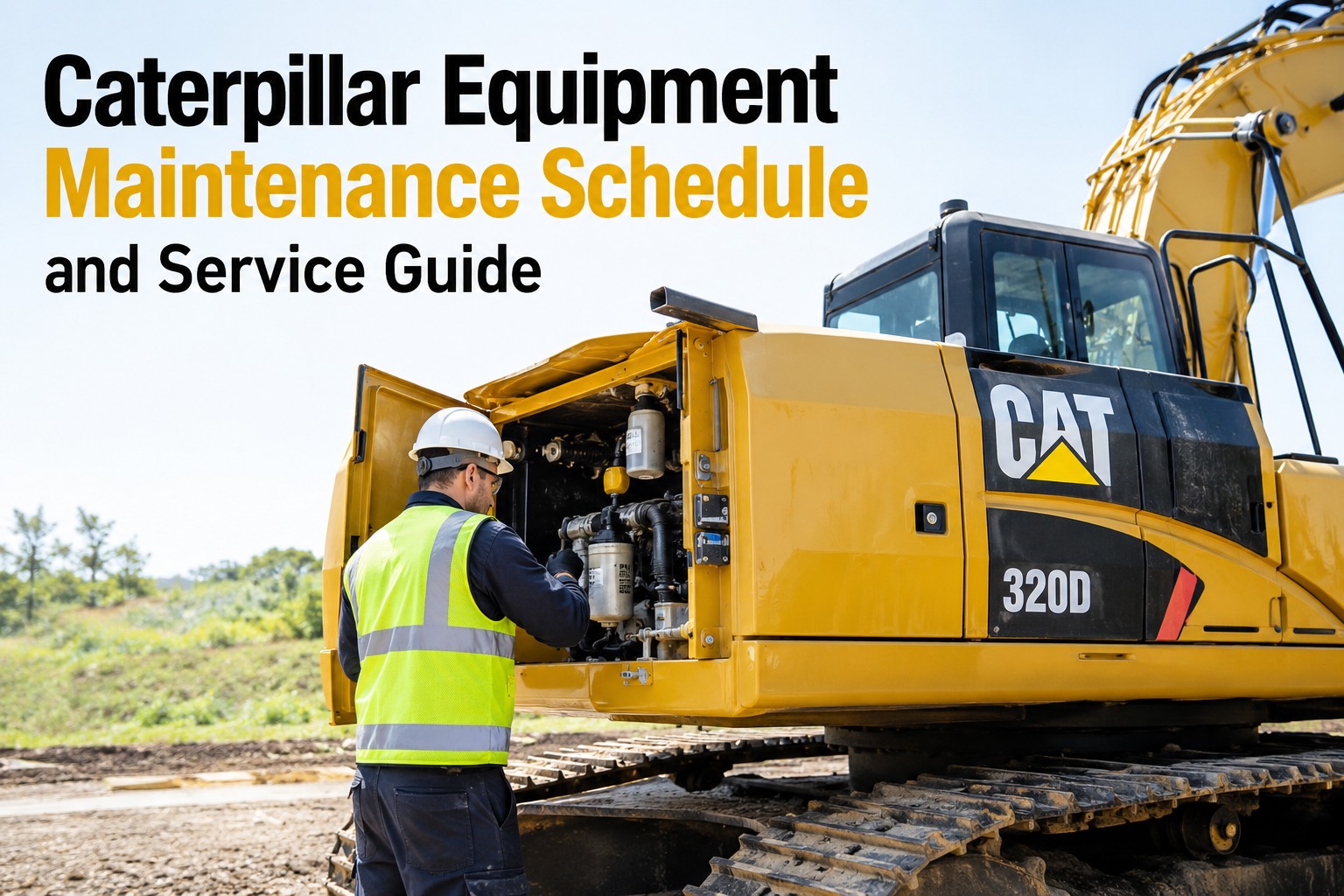
It's Monday, and the question is simple: which Cat machine is due for service this week? Answering it means cross-checking hour meters against a Cat equipment service schedule across the fleet — and if half your machines are other brands, their portals too. A Caterpillar equipment maintenance schedule only protects your machines if you can see, at a glance, what's due. Book a demo to see every machine's next PM on one screen.
The Caterpillar Maintenance Schedule Is Four Tiers. The Hard Part Is Tracking Them.
Cat structures planned maintenance as PM1 through PM4, keyed to engine hours. The schedule is published and clear — staying on it across a working fleet is where it breaks down.
Caterpillar publishes a clear, structured maintenance schedule — four planned-maintenance tiers keyed to engine operating hours, adjusted for machine model and working conditions. Following it extends equipment life, protects your warranty and turns unpredictable emergency repairs into predictable planned services. The catch isn't knowing the schedule; it's executing it across a fleet of machines that all hit their intervals at different times, plus keeping non-Cat equipment on the same page. This guide covers the PM1–PM4 structure, why hours beat the calendar, how duty cycle shifts the intervals, and how to run it all without living in a stack of separate portals.
Caterpillar PM1–PM4 service intervalsthe Caterpillar preventive maintenance tier structure explained
Cat's planned maintenance system is built on four cumulative tiers, each triggered by engine operating hours. Cumulative means each higher tier includes everything below it plus deeper service — so a PM3 at 1,000 hours also performs the PM1 and PM2 tasks. The tier structure is universal across Cat excavators, dozers, wheel loaders and motor graders, though the exact tasks, fluids and filters vary by model and engine.
| Tier | Interval | Typical scope |
|---|---|---|
| PM1 | 250 hours | Engine oil & filter, lubrication, visual inspection, fluid checks |
| PM2 | 500 hours | All PM1 tasks + fuel filters, coolant sample, belt checks |
| PM3 | 1,000 hours | All PM1–PM2 + hydraulic service, deeper component checks |
| PM4 | 2,000 hours | Most comprehensive — major service and inspection intervals |
Swipe to compare →
The single most important rule: the exact contents of each tier depend on your specific machine and engine, so the authoritative source is always that machine's Operation and Maintenance Manual (OMM). The 250/500/1,000/2,000-hour tier framework is universal; the task list inside each tier is not.
Alongside the numbered tiers sit daily and weekly checks — the Cat equipment inspection routine of walk-arounds, fluid levels, leaks, and track or tire condition — that catch problems between scheduled services. And nearly every serious Cat maintenance program leans on S·O·S fluid analysis: oil samples sent to a lab that flag internal wear trends long before they become failures, and that provide the data needed to safely extend an interval. Book a demo to load model-specific PM templates for every Cat machine
Are Cat service intervals hours or calendar-based?why operating hours and duty cycle drive the schedule
A road truck runs on mileage; a Cat machine runs on hours. The engine-hour meter is the true measure of how hard a machine has worked, which is why every Cat service interval is defined in operating hours first. But hours alone aren't the whole story — how those hours were spent matters just as much.
Normal loads, moderate temperatures, clean conditions — run the published intervals.
PM1 at 250 hours, and so on up the ladder. The OEM schedule assumes these baseline conditions.High idle, heavy loads, extreme heat or cold, heavy dust — tighten the intervals.
Severe conditions can drop an oil interval toward 200 hours and call for far more frequent air-filter service. The schedule bends to the work.This is why a good Caterpillar equipment maintenance schedule is dynamic, not fixed. A machine grinding through a dusty quarry in summer needs tighter intervals than the same model on light, clean work — and treating them identically either over-services one or under-services the other. The right approach is to start from the OEM interval and adjust for real conditions, ideally backed by fluid analysis rather than guesswork. Start free and set condition-adjusted intervals per machine
Caterpillar maintenance tracking across a fleetwhy staying on schedule gets hard on real, mixed-brand fleets
Knowing the schedule is easy. The difficulty is operational, and it compounds with every machine you add. On a single Cat excavator, checking hours and staying on interval is manageable by hand. On a fleet — especially a mixed-brand one — it turns into a daily scavenger hunt across separate systems.
Cat's own telematics, VisionLink, gives you excellent visibility into your Cat machines: engine hours, fault codes, fluid analysis and maintenance due dates in one place. But most operations don't run a single-brand fleet. The loader might be a Cat, the dozer a Deere, the articulated truck a Komatsu — and each brand has its own portal: VisionLink, JDLink, KOMTRAX. Fleet managers routinely lose 12 to 15 hours a week just switching between these dashboards, reconciling different data formats, and trying to answer one question — "which machines need attention today?" — that lives across four separate logins.
The Caterpillar maintenance schedule isn't the problem. Fragmented visibility is. When your Cat PM data lives in one portal, your Deere data in another, and your older machines in nobody's portal at all, staying on schedule becomes a matter of memory and manual reconciliation — which is exactly how intervals get missed.
And there's a coverage gap even within VisionLink: older Cat iron and non-telematics machines don't report automatically, and a typical construction or rental fleet has a meaningful share of assets — older equipment, attachments, trailers — that no OEM portal tracks at all. Book a demo to pull VisionLink data and cover the machines it misses
Cat equipment maintenance on one dashboardstandardising Caterpillar and mixed-fleet service in a single view
The fix isn't to abandon VisionLink — it's to unify it with everything else so the whole fleet lives on one schedule and one screen. That's what turns a published Caterpillar equipment maintenance schedule into something a busy manager can actually execute across dozens of machines.
Pull Cat hours automatically
Integrate VisionLink so engine hours flow in without anyone reading a meter, triggering the right PM tier on time for every Cat machine.
Bring every brand together
Cat, Deere, Komatsu and the rest side by side, with older and non-telematics machines added by mobile hour entry — one dashboard, no portal switching.
Model-specific templates
Each machine gets the correct checklist for its make, model and PM tier — not a stretched universal form — so the right tasks get done every time.
One schedule, one report
Every machine's next service, overdue items and full history in one place — and a single answer to "what's due this week" across the entire fleet.
Standardising this way keeps you fully compliant with Cat's schedule — the model-specific templates and hour-based triggers honour the OEM intervals exactly — while extending the same discipline to every other machine you run. The result is one source of truth instead of four, and hours a week handed back to actually managing the fleet. Start free and put your whole mixed fleet on one maintenance schedule
From a construction fleet maintenance manager
We run mostly Cat but we've got Deere and Komatsu in the mix too, and I was genuinely spending the first hour of every day just logging into three telematics portals to figure out what was due. VisionLink is great for the Cat machines, but it's only half my yard.
Once the Cat hours fed in automatically and the other brands sat right alongside them, that whole morning ritual disappeared. PM1s and PM2s fire on their own now, each machine gets its own checklist, and I've got one list of what's due this week instead of piecing it together from four screens. The Cat schedule was never the hard part — seeing the whole fleet on it was. We stopped missing intervals the month we switched.
The takeaway
The Caterpillar equipment maintenance schedule is four cumulative PM tiers — PM1–PM4 at 250/500/1,000/2,000 hours — with exact tasks set by each machine's Operation and Maintenance Manual.
Intervals run on operating hours, adjusted for duty cycle — severe conditions tighten them — and S·O·S fluid analysis is what safely confirms any extension.
The real challenge is execution across a fleet: pull Cat hours from VisionLink automatically and unify every brand on one dashboard, instead of losing hours a week to separate portals.
Caterpillar hands you a clear, proven maintenance schedule — the value is in living up to it on every machine, every interval, without a machine slipping through because its hours sat in a portal nobody checked. Honour the OEM tiers, adjust for how each machine actually works, pull the hours automatically, and put your whole fleet — Cat and everything else — on one screen. That's how a maintenance schedule stops being a document and becomes something your fleet actually runs on. Book a demo to manage Caterpillar equipment maintenance with HVI
Frequently asked questions
What are Caterpillar's PM1, PM2, PM3 and PM4 service intervals?
Caterpillar's planned maintenance system uses four tiers keyed to engine operating hours: PM1 at every 250 hours, PM2 at every 500 hours, PM3 at every 1,000 hours, and PM4 at every 2,000 hours. The tiers are cumulative, meaning each higher tier includes all the tasks of the tiers below it plus additional, deeper service — so a PM2 performs everything in a PM1 plus more, and a PM4 is the most comprehensive service. This 250/500/1,000/2,000-hour structure is universal across Cat excavators, dozers, wheel loaders and motor graders. However, the exact tasks, fluids and filters within each tier vary by machine model and engine configuration, which is why the authoritative reference for any specific machine is always its Operation and Maintenance Manual. Alongside these numbered tiers, Cat also specifies daily and weekly checks — walk-around inspections, fluid levels, leak checks — that catch issues between scheduled services. Following the full schedule protects the machine's warranty and, according to Caterpillar, significantly extends equipment life while reducing unplanned downtime.
Are Caterpillar maintenance intervals based on hours or calendar time?
Primarily operating hours, because the engine-hour meter is the truest measure of how much work a machine has actually done — far more meaningful than mileage or elapsed time for off-road equipment. Cat's PM tiers are defined in service hours first (250, 500, 1,000, 2,000). That said, calendar time acts as a backstop: a machine that accumulates hours slowly should still be serviced on a time basis (for example, an annual interval) because fluids degrade, seals dry out and moisture accumulates even when a machine sits. The best practice is to run whichever comes first — hours or the calendar limit. Duty cycle then modifies the hour intervals: severe conditions such as high idle, heavy loads, extreme temperatures or heavy dust can shorten an oil-change interval toward 200 hours and require much more frequent air-filter service. So the most accurate way to think about it is hours-first, with a calendar backstop for low-use machines and tighter intervals for severe-duty work. A good maintenance system tracks both hour-based and calendar-based triggers on every machine so neither is missed.
Can you extend Caterpillar service intervals to save money?
Sometimes, but only with data — never by assumption. Some Cat fluids are formulated to support extended intervals in specific engines, and it's possible to safely lengthen an oil-change interval, but only when S·O·S fluid analysis confirms the oil is still in good condition and internal wear metals are within limits. Extending an interval blindly to save on service costs is a false economy: it risks the exact catastrophic failures the schedule is designed to prevent, and it can void warranty coverage, since Cat's warranty requires adherence to the published maintenance schedule. The economics strongly favour discipline — skipping or over-stretching intervals doesn't save money, it shifts cost from predictable, relatively inexpensive planned services to unpredictable major repairs that can be an order of magnitude more expensive. The sound approach is to follow OEM intervals, use genuine Cat fluids and filters where warranty compliance matters, and only adjust intervals — in either direction — based on fluid analysis and documented operating conditions rather than a desire to defer cost.
How does VisionLink help manage Caterpillar maintenance?
VisionLink is Caterpillar's telematics and fleet-management platform, and it gives strong visibility into Cat machines — live engine hours, fault codes, fluid-analysis results, location, utilisation, and upcoming maintenance and inspection due dates in one place. Because it reports engine hours automatically, it removes the need to manually read hour meters, which is the single biggest source of missed intervals. VisionLink also supports mixed fleets to a degree, integrating data from other OEM brands via Product Link devices or API feeds using the AEMP 2.0 (ISO 15143-3) telematics standard. Where operations still hit friction is coverage and consolidation: older Cat machines and non-telematics equipment don't report automatically, and many fleets prefer to see Cat data unified with their inspection records, work orders and non-Cat machines in a single maintenance system rather than managing telematics separately from maintenance execution. The strongest setups pull VisionLink's automatic hour data into a maintenance platform that then triggers the correct PM tier, attaches the model-specific checklist, generates the work order, and covers the machines VisionLink can't — turning telematics visibility into completed maintenance.
How do you manage Cat maintenance alongside other equipment brands?
The core problem with a mixed-brand fleet is fragmentation: Caterpillar machines report through VisionLink, John Deere through JDLink, Komatsu through KOMTRAX, and each portal has its own login, data format and terminology. Managers running mixed fleets commonly lose 12 to 15 hours a week just switching between these systems and reconciling them to answer a basic question — which machines need service. The solution is a unified maintenance platform that pulls data from each OEM system (typically via API, standardised by the AEMP 2.0 / ISO 15143-3 protocol) into one dashboard, so a Cat alert and a Komatsu alert read the same way and every machine's next service appears on one list. Older machines and equipment without factory telematics — which can be a large share of a construction or rental fleet — are brought into the same view through mobile hour entry or aftermarket devices, closing the gaps the OEM portals leave. Crucially, this doesn't compromise Cat compliance: each machine still runs its own model-specific, hour-triggered PM schedule honouring the OEM intervals. It simply puts the whole fleet on one schedule and one screen, which is what makes consistent maintenance achievable at fleet scale.
Run your Caterpillar maintenance schedule on autopilot
HVI pulls live engine hours from Cat VisionLink, fires the correct PM tier with the model-specific checklist attached, and puts every machine — Cat, Deere, Komatsu and older iron alike — on one maintenance schedule and one dashboard. Honour every OEM interval, adjust for duty cycle, and stop losing hours a week to separate portals. Live on your fleet in under two weeks.
No hardware to start · VisionLink & multi-OEM integration · Model-specific PM templates