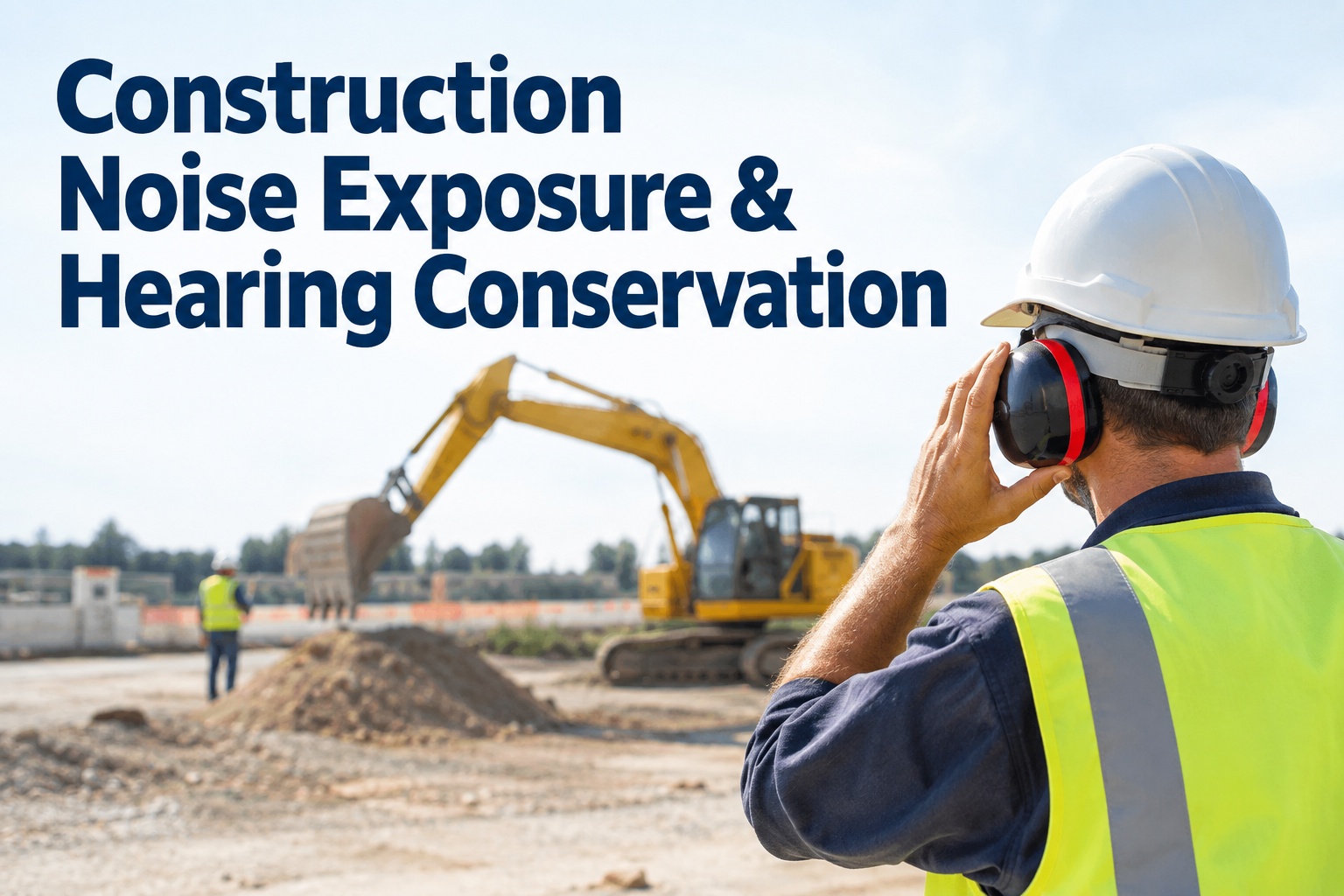
A jackhammer running at 105 decibels doesn't get a pass because "it's just for a few hours" — OSHA's actual rule ties exactly how many hours to exactly how many decibels, on a table most safety managers have never actually looked at directly. Construction noise exposure isn't managed by instinct; it's managed by a specific duration-versus-level trade-off, and most jobsite noise violations trace back to nobody checking the table at all. Book a Demo
The louder it is, the less time you're allowed near it
This is the real permissible exposure table from 29 CFR 1926.52 — not a rounded rule of thumb.
Cross a level in this table and the rule isn't optional PPE — controls or protection become mandatory, and a continuing hearing conservation programme is required. Start Free Trial
Construction noise exposure rules look deceptively simple — one table, a handful of numbers — until you try to apply them to a real jobsite where three different tools are running at three different volumes for three different durations, and the calculation for whether that's actually compliant isn't the number anyone eyeballs from memory.
Construction Noise Exposure Doesn't Work Like General Industry's Rulea distinction that trips up more safety programmes than the decibel table itself
Construction has no 85 dBA "action level" — general industry does
General industry's noise standard sets an 85 dBA action level that triggers a formal hearing conservation programme, with detailed requirements for monitoring, audiometric testing, and training. Construction's standard, 29 CFR 1926.52, doesn't use an action level at all — instead, once sound levels exceed the specific durations and levels in Table D-2, the requirement is simply for a "continuing, effective" hearing conservation programme, without the same level of prescribed detail on monitoring and testing methods.
That difference doesn't mean construction sites get an easier standard — it means the specifics of what "continuing and effective" looks like are left more to the employer's judgment, which is exactly why documentation matters more here, not less.
29 CFR 1926.101 adds a separate, general requirement to provide hearing protection devices when needed — a provision that works alongside Table D-2 rather than replacing it. Book a Demo
When a Worker Hits Three Noise Levels in One Shiftcombined exposure doesn't average — it accumulates against the table
Real jobsites rarely produce one steady noise level all day. A worker might run a jackhammer for an hour, work near a crane for two, and spend the rest of the shift somewhere quieter — and OSHA's formula treats each exposure period as a fraction of what Table D-2 would permit at that level alone, then adds the fractions together.
Worked example
A worker is exposed to 110 dBA for 15 minutes, 100 dBA for 30 minutes, and 90 dBA for 1.5 hours. Table D-2 permits 30 minutes at 110 dBA, 2 hours at 100 dBA, and 8 hours at 90 dBA. Each actual exposure period is divided by its permitted duration, and the results are added together:
(0.25 ÷ 0.5) + (0.5 ÷ 2) + (1.5 ÷ 8) = 0.5 + 0.25 + 0.19 = 0.94
Since the total stays under 1.0, this combined exposure is within permissible limits — but it's close enough that adding even a little more high-decibel time would push it over.
A result over 1.0 means the exposure exceeds the permissible limit for that day, regardless of how reasonable any single noise period looked in isolation. Start Free Trial
Common Jobsite Tools and What They Mean for Exposure Timerough guidance — always confirm with an actual sound level meter
| Tool / source | Typical level | Roughly permitted per Table D-2 |
|---|---|---|
| Crane | 90–96 dBA | ~4–8 hours |
| Hammer (manual) | 87–95 dBA | ~4–8+ hours |
| Jackhammer | 102–111 dBA | ~15 min–1.5 hours |
| Pneumatic chip hammer | 103–113 dBA | ~15 min–1 hour |
These are general reference ranges, not a substitute for measuring actual levels on your own site — the same tool can read differently depending on condition, material, and distance from the operator. Book a Demo
Building a Hearing Conservation Program Before the Table Forces Onecontrols first, protection second — not the other way around
OSHA's own sequence matters here: feasible administrative or engineering controls come first, and personal protective equipment is the fallback only when those controls can't bring levels within the table on their own. In practice that means looking at scheduling (running the loudest work when fewer people are exposed), equipment substitution, and distance before defaulting straight to earplugs.
Once hearing protection is genuinely necessary, a real programme layers in fit and selection appropriate to the noise level, training on correct use, and a way to confirm protection is actually being worn during the loud work — not just issued once and assumed.
From a safety manager who stopped eyeballing decibel levels
We used to hand out earplugs to anyone working near loud equipment and consider that "handled." Nobody was actually tracking how long anyone was exposed at what level, so we had no way to answer a real question about combined exposure if it ever came up.
Now every noise-heavy task gets logged with an actual reading and a duration, tied to the crew working it. It's a small habit change, but it's the difference between guessing we're probably fine and actually knowing where we stand against the table.
Karen's crews didn't need different equipment — they needed their exposure actually measured instead of assumed. Start Free Trial
Frequently asked questions
What are OSHA's permissible construction noise exposure limits?
Under 29 CFR 1926.52's Table D-2, permissible exposure decreases as sound level increases: 8 hours at 90 dBA, 6 hours at 92 dBA, 4 hours at 95 dBA, 3 hours at 97 dBA, 2 hours at 100 dBA, 1.5 hours at 102 dBA, 1 hour at 105 dBA, 30 minutes at 110 dBA, and 15 minutes or less at 115 dBA. When sound levels exceed these values, feasible administrative or engineering controls must be used first, with personal protective equipment required if controls alone can't bring levels within the table.
Does construction have the same 85 dBA action level as general industry?
No. General industry's noise standard uses an 85 dBA action level that triggers a detailed hearing conservation programme with specific monitoring and audiometric testing requirements. Construction's standard, 29 CFR 1926.52, does not include an action level; instead, once exposure exceeds the levels in Table D-2, a general requirement for a "continuing, effective" hearing conservation programme applies, without the same level of prescribed monitoring detail.
How is combined noise exposure from multiple sound levels calculated?
When a worker is exposed to two or more different noise levels during a shift, OSHA's formula divides the actual time spent at each level by the permissible duration for that level from Table D-2, then adds those fractions together. If the total exceeds 1.0, the combined exposure exceeds the permissible limit for that day, even if no single exposure period alone would have been a violation.
What comes first: engineering controls or hearing protection?
Under 1926.52(b), feasible administrative or engineering controls must be used first when noise exceeds Table D-2 levels. Personal protective equipment is required only if those controls fail to bring sound levels within the table on their own. In practice, this means considering scheduling changes, equipment substitution, or distance from the noise source before defaulting to hearing protection alone.
What noise level is treated as impulsive or impact noise under the construction standard?
Exposure to impulsive or impact noise is limited to 140 dB peak sound pressure level. Separately, if variations in a continuous noise level occur at intervals of one second or less, the noise is treated as continuous for the purposes of Table D-2, rather than being evaluated as a series of separate impulse events.
Manage Construction Noise Exposure With Records, Not Estimates
HVI keeps noise monitoring results, hearing protection records, and toolbox talk documentation tied to the job and crew that generated them, so your hearing conservation programme is genuinely continuing and effective — and provable. Live in under two weeks.
No credit card · Safety records tied to job & crew · Ready on day one