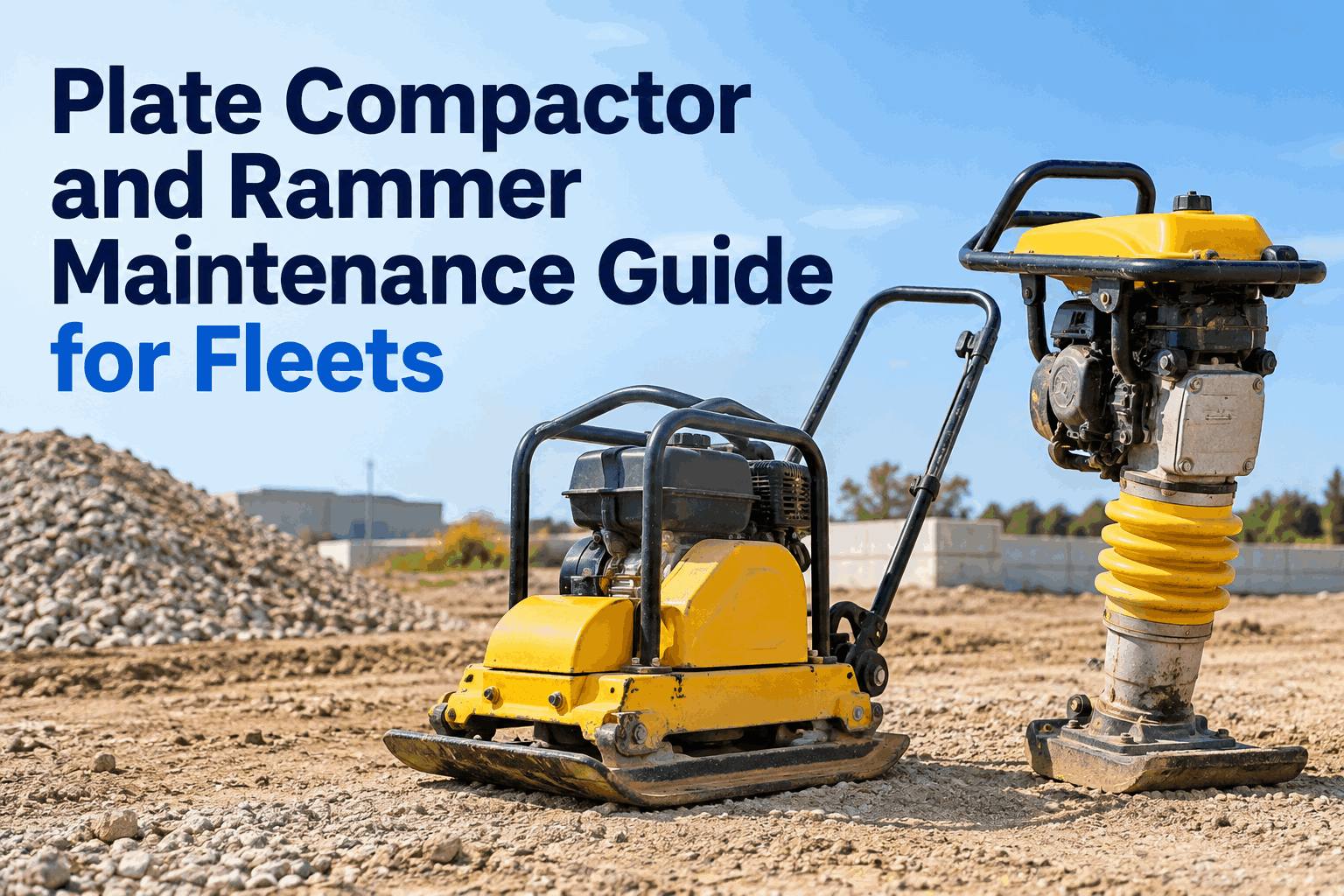
Plate compactor maintenance is the job everyone skips — until a $3,000 machine seizes on the biggest pour of the week. These walk-behind units and rammers get run hard in dust and heat, then parked in a corner with no service record, and the failure is almost always the same short list: a clogged air filter, a starved exciter, a glazed belt. Book a demo to see hour-based PM tracked across every small unit on site.
Plate compactor maintenance is five small jobs on an hour clock
Most compactor deaths trace back to a service that never happened — an air filter left dirty, exciter oil never checked, a belt run loose. Put each one on its engine-hour interval and the machine outlives three of its neighbors.
A plate compactor or rammer isn't a complicated machine — that's exactly why it gets neglected. There's no dashboard nagging you, no annual inspection forcing the issue. But every one of these units fails in the same few places, and every one of those failures has a service interval that would have caught it. Here's the whole maintenance program, the parts that actually break, and how to keep it on a clock instead of in your head.
The six things that actually breakwhere plate compactor and rammer maintenance is won or lost
Forget the full parts diagram. On a walk-behind compactor, six systems account for nearly every field failure. Learn these and you know where your plate compactor maintenance time should go — the rest is mostly bolts staying tight.
Air filter
The number-one killer. On dusty sites fine grit blows straight through a clogged filter into the carburetor and cylinder, scarring the walls until compression is gone. Clean weekly, replace when soiled.
Clean 25h · replace when soiledVibration exciter
An eccentric weight spinning in an oil bath is what makes the plate vibrate. Let that oil run low and the bearings weld themselves solid — the single most expensive repair on the machine.
Check 100h · change 200hDrive belt & clutch
A loose or glazed V-belt slips, so power never reaches the plate — weak compaction and a belt that cooks itself. Correct tension is 10–15 mm of deflection; most makers say replace at 200 hours.
Check 50h · replace 200hBase plate
Rocks kicked up by the vibration crack and gouge the plate, and hot asphalt bakes on if it isn't scraped. A damaged plate compacts unevenly and shakes the whole machine apart faster.
Inspect daily · clean each shiftFuel system
Dirty fuel is the other path to cylinder damage — particles ignite and strike the walls. Run a strainer at the tank plus an inline filter, and inspect the fuel filter and lines for cracks.
Inspect filter yearly · lines dailyRammer clutch & bellows
Rammers add a wet clutch and a rubber bellows. A worn clutch shoe slips and the ram loses its punch; a torn bellows lets dust into the piston. Both are cheap to replace, ruinous to ignore.
Rammers only · check monthlyNotice the pattern: five of the six are killed by dirt or by a fluid running low — both of which a fixed service interval prevents outright. Book a demo to see each system tracked per machine on its own hour clock.
The skipped service and what it coststhree failures that scrap plate compactors early
Every one of these starts as a five-minute job and ends as a repair bill or a replaced machine. The pattern is always the same: the cheap service gets skipped, the damage compounds, and the unit dies before its time.
Dirty air filter left on
Filter clogs, grit bypasses it into the carburetor and down into the cylinder.
Scarred cylinder, dead engine
Compression is gone. The engine won't hold power — often cheaper to replace the whole unit.
Exciter oil never checked
The oil bath around the eccentric weight runs low and stops cooling the bearings.
Seized exciter
Bearings weld solid. The most expensive single repair on a plate compactor — sometimes a new machine.
Belt run loose
A slipping V-belt glazes and overheats while the plate barely vibrates.
Weak compaction, cooked belt
The pad fails density, the work gets redone, and the belt shreds — a failed test on top of a part.
The fix for all three isn't skill — it's a reminder that fires on schedule. Start free and set the air-filter and exciter intervals on every compactor today.
Plate compactor vs rammer — different upkeepsame jobsite, two maintenance profiles
People lump them together, but a vibrating plate and a rammer (jumping jack) wear differently and need different attention. Match the service to the machine and both last longer.
- Exciter oil is the critical fluid — check 100h, change 200h
- V-belt drives the plate — tension 10–15 mm, replace ~200h
- Base plate takes rock and asphalt damage — clean each shift
- Best on granular soils, sand, gravel, asphalt
- Wet clutch & shoe wear is the weak point — slips when worn
- Rubber bellows seals the piston — a tear lets dust in
- Air filters (often four) clog fast — check both sides weekly
- Best in trenches and on cohesive, clay-heavy soils
Running mixed compaction gear means two service profiles on the board at once — easy to blur when it's all "the small stuff." Book a demo to give each machine type its own checklist and intervals.
The plate compactor maintenance schedulewhat to service, and on what interval
Here's the whole program on one clock. Hours are typical manufacturer guidance — always confirm against your unit's manual, since a heavy dust or asphalt duty cycle pulls every interval shorter.
| Service | Interval | Why it matters |
|---|---|---|
| Clean air filter | Weekly / 25 h | Stops dust reaching the cylinder |
| Check & adjust belt | Every 50 h | Keeps compaction force at the plate |
| Engine oil change | Every 100 h | Standard engine life |
| Check exciter oil | Monthly / 100 h | Prevents the costliest failure |
| Change exciter oil | Every 200 h | Bearings stay cool and lubricated |
| Replace drive belt | Every 200 h | Avoids mid-job slip and shred |
| Inspect fuel filter | Annually | Keeps dirty fuel out of the engine |
Seven line items, most under ten minutes — the whole program fits on a card. The only hard part is remembering it across a yard full of near-identical machines that walk between jobsites. Start free and load this schedule onto every compactor in your fleet.
How HVI keeps small equipment on schedule
The reason plate compactor maintenance slips isn't that the jobs are hard — it's that nobody owns the clock for a $3,000 machine. HVI's preventive maintenance and mobile inspection put every small unit on the same footing as your big iron.
Log the hours
Record engine hours from the field on a phone. Each compactor and rammer carries its own running total, so intervals fire off real usage, not a guess.
Schedule by interval
Set air-filter, exciter, belt, and oil intervals once per machine type. HVI counts down to each and alerts before it's due — no one has to remember.
Inspect & record
Crews run a quick daily check on the phone, flag a damaged plate or torn bellows into a work order, and the service history builds itself for resale and warranty.
It's the same discipline behind our vibratory plate compactor daily inspection checklist and our roller compactor service-log guide — applied to the walk-behind units that usually get none. It runs on HVI's preventive maintenance scheduling and fleet inspection tools, tuned for small jobsite equipment.
We used to buy two or three new plate compactors a year and never really knew why they died. Turned out it was always the same thing — air filters nobody changed and exciters nobody topped up, on machines that never had a service record because they were "just the small stuff."
Once every unit had engine hours and a PM interval, the failures basically stopped. We're getting three, four seasons out of the same plates now. The reminder does the remembering — the crew just does the ten-minute job when it pops up.
Plate compactor maintenance FAQsthe questions crews ask most
How often should you service a plate compactor?
Clean the air filter weekly or every 25 hours, check the belt every 50 hours, change engine oil and check exciter oil around 100 hours, and change exciter oil and the belt near 200 hours. Shorten every interval on heavy dust or asphalt work. Always confirm against your machine's manual.
What is the most common plate compactor failure?
A clogged air filter letting dust into the engine, and a starved vibration exciter. The filter path scars the cylinder and kills compression; the exciter path seizes the bearings. Both are prevented by a cheap, scheduled service that too often gets skipped.
How do you maintain a rammer or jumping jack?
Same engine basics as a plate — air filter and oil on schedule — plus two rammer-specific items: check the wet clutch and shoe for slip, and inspect the rubber bellows for tears that let dust into the piston. Both are inexpensive parts that cause major damage if ignored.
What is the correct plate compactor belt tension?
Typically 10–15 mm of deflection when you press on the belt. A loose belt slips and glazes, giving weak compaction and burning itself out; too tight overloads the bearings. Check tension every 50 hours and replace the belt around 200 hours.
Can maintenance software track small equipment like compactors?
Yes. HVI logs engine hours per machine, schedules each service interval, alerts before it's due, and keeps the history — so a compactor or rammer gets the same PM discipline as your big iron. It's built for exactly the small units that usually have no service record.
Stop replacing compactors you could have maintained
Put every plate compactor and rammer on an engine-hour service clock, alert the crew before each interval, and build the record that protects resale and warranty — all from the phone in their pocket. Live for your fleet in days.
No credit card · load your first machine's schedule on day one