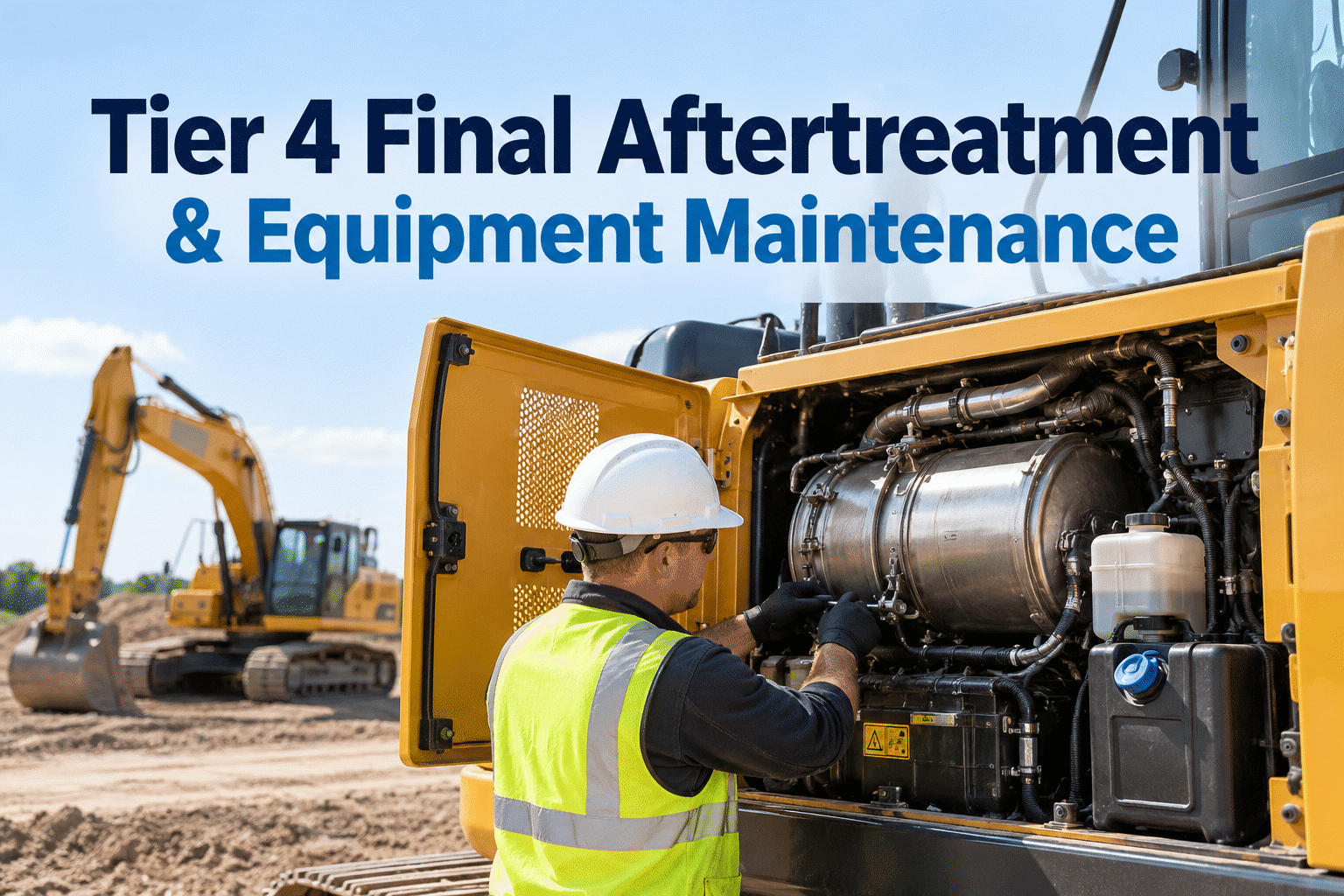
A wheel loader stops midway through a concrete pour, the dash displays an emissions warning, and the operator reports that engine power has dropped. For a construction fleet, a Tier 4 Final aftertreatment issue is more than a warning light: it can interrupt production, trigger unplanned diagnostics and complicate maintenance scheduling. Understanding how DPF regeneration, SCR and DEF systems interact helps crews recognize problems early, document symptoms accurately and plan compliant repairs before downtime spreads across the jobsite.
Tier 4 Final Aftertreatment: Keep Equipment Working, Not Waiting on Emissions Faults
Understand the exhaust-treatment chain, recognize regeneration and DEF issues, and connect operator reports to reliable maintenance records—without treating every emissions alert as the same problem.
Conceptual layout only. Actual engine configurations, sensors and controls vary by OEM and model.
How Tier 4 Final Aftertreatment Works on Construction Equipment
Tier 4 Final is the final phase of the US EPA's nonroad compression-ignition engine emissions standards for applicable engine categories. Manufacturers use different engine and aftertreatment combinations to meet the relevant limits; not every machine contains every component shown in a generic diagram.
Diesel oxidation catalyst (DOC)
Where fitted, a DOC helps oxidize certain exhaust constituents and can support temperature conditions needed for downstream particulate-filter operation. Its behavior depends on engine load and exhaust temperature.
Diesel particulate filter (DPF)
A DPF captures particulate matter. Regeneration oxidizes accumulated soot when operating conditions and control logic permit. Ash is different from soot and may require approved service or cleaning.
Selective catalytic reduction (SCR)
Where equipped, SCR uses ammonia derived from correctly specified diesel exhaust fluid to reduce nitrogen oxides. DEF delivery, temperature, sensors and catalyst condition all affect performance.
These systems work with engine controls, pressure and temperature sensors, and fault monitoring. A fault message is a starting point for diagnosis, not proof that the DPF or SCR catalyst needs replacement. For a coordinated inspection and maintenance process, book a demo to see how HVI organizes equipment defect records.
DPF Regeneration: Know the Operating State Before Acting
Regeneration converts trapped soot under controlled conditions. Depending on the machine, it may occur automatically during normal operation or require a manufacturer-defined parked or service procedure. Never assume a forced regeneration is safe or appropriate without checking the OEM instructions and fault conditions.
Passive / automatic conditions
Under sufficient exhaust temperature and the right operating conditions, soot can oxidize with little operator intervention. The controller may also manage active regeneration using additional heat.
Parked regeneration
Some machines allow a parked regeneration when the control system requests it. The procedure can involve high exhaust temperatures, restricted operating areas and strict site-safety precautions.
Service diagnosis / regeneration
Repeated failed regeneration, active faults or abnormal temperatures may require qualified technician diagnosis. Cleaning, sensor testing or repair may be necessary before another attempt.
Do not bypass emissions controls, defeat derate protections, or initiate regeneration near combustible materials. Follow OEM warnings for exhaust temperature, ventilation, fire risk and personnel exclusion zones.
Aftertreatment Warning Signs and the First Checks to Record
Operators can supply valuable evidence without making a repair diagnosis. Record the exact message, time, engine hours, machine activity, recent regeneration events and any power limitation. Then route the issue to a qualified technician with access to the correct OEM diagnostic information.
| Observed symptom | Possible area to investigate | Useful evidence to capture | Next decision |
|---|---|---|---|
| Frequent regeneration requests | Duty cycle, soot production, sensor readings, incomplete cycles | Engine hours, idle time, operating load, prior events | Review usage pattern and diagnostic codes |
| DPF restriction warning | Soot loading, ash accumulation, differential-pressure sensing | Fault code, warning level, service history | Technician assessment before further operation |
| DEF / SCR fault | Fluid specification, contamination, delivery system, sensors | DEF refill details, storage history, fault snapshot | Test to OEM procedure; do not guess |
| Power derate | Engine or emissions protection strategy | Active codes, operating conditions, severity | Follow machine-specific safe-stop instructions |
| Repeated post-repair fault | Unresolved root cause or incomplete verification | Previous work order, parts, tests and return-to-service result | Escalate recurring failure analysis |
Diagnostic reminder: The same dashboard warning can have different causes across manufacturers. Do not replace components or reset fault codes based on the symptom alone.
Connect Tier 4 Inspection Findings to Maintenance Work Orders
Capture emissions-related defects, assign technicians, document repair evidence and keep the machine's service history in one place.
DEF Quality, Storage and SCR Maintenance
Diesel exhaust fluid is not a fuel additive. It is a separately stored fluid used by compatible SCR systems. DEF quality and handling matter because contamination, wrong-fluid filling or crystallization can affect delivery components and trigger emissions faults.
DEF handling checklist
- Use DEF that meets the equipment manufacturer's specification, commonly ISO 22241 where applicable.
- Keep dedicated, clean, clearly labeled transfer containers and dispensing equipment.
- Protect containers from dirt, fuel, lubricants and other cross-contamination.
- Follow supplier guidance for temperature exposure, shelf life and storage.
- Record refill date, machine ID, product source and suspected contamination.
- Escalate incorrect-fluid fills before starting or continuing operation.
Manages particulate matter. Regeneration addresses soot, but does not remove accumulated noncombustible ash.
Reduces nitrogen oxides when the correct fluid, operating temperatures and control conditions are present.
A consumable fluid for compatible SCR systems—not a cleaner to pour into the diesel tank or a substitute for maintenance.
Where construction crews work across multiple sites, a consistent refill and inspection log makes it easier to connect recurring faults with storage, handling and operating practices. Teams that need a repeatable digital workflow can sign up to organize construction equipment maintenance records.
Build a Tier 4 Final Maintenance Plan Around Hours, Faults and Duty Cycle
A reliable program combines manufacturer service requirements with equipment use and documented warning trends. Construction machines can spend long periods idling, operate under high load, or move between sites with different dust and temperature conditions. These differences matter when reviewing emissions-related issues.
Set the OEM baseline
Register machine model, engine family, serial number, emissions configuration and the correct maintenance manual. Record specified service and inspection tasks rather than copying intervals from a different machine.
Capture every shift
Use operator inspections to record warning indicators, abnormal exhaust behavior, fluid leaks, visible damage and any interrupted regeneration. Note the machine hours and location for each event.
Connect fault and repair evidence
Link diagnostic trouble codes, technician findings, tested components, corrective actions and verification results to the same equipment record. Keep the original fault details rather than only a final “fixed” status.
Review recurring downtime
Compare repeat faults, hours between events, idle-heavy assignments, missed service tasks and total repair cost. Investigate patterns before changing maintenance intervals or authorizing major component replacement.
HVI can help organize scheduled tasks, inspection records and maintenance history. To review how this fits your equipment mix, book a demo for hour-based construction equipment maintenance.
From Operator Warning to Verified Return to Service
Clear handoffs reduce the chance that an emissions warning is forgotten after a shift change. This example illustrates an administrative workflow, not a substitute for manufacturer diagnosis or safe-operation instructions.
Excavator with repeated regeneration interruptions
An excavator spends much of the week idling between short digging cycles. The operator reports several regeneration notices, followed by a restriction warning. Rather than scheduling a forced regeneration immediately, the supervisor records the machine hours and warnings, then requests OEM-based diagnosis. The technician reviews fault codes, sensors, operating history and the required service procedure.
The work order records what was actually found, any approved corrective action and the post-repair checks. At the next weekly review, the maintenance manager compares similar machines working under different duty cycles. This creates a defensible basis for operator coaching or maintenance-plan adjustments without guessing at the root cause.
Measure Aftertreatment Downtime Without Overstating the Data
Equipment managers need more than a count of fault codes. A machine with one long outage may have a greater production impact than another with several brief inspections. Define metrics consistently and review them alongside equipment utilization and site conditions.
Aftertreatment downtime
Hours unavailable because of confirmed emissions-system diagnosis or repair. Separate planned maintenance from unexpected events.
Repeat fault rate
Number of recurring, related faults within a defined operating-hour window after a repair. Investigate whether the original cause was resolved.
Repair cost per operating hour
Documented labor, parts and external service costs divided by machine operating hours for the review period.
PM completion quality
Completed scheduled tasks supported by inspection or service evidence—not just checked boxes or overdue counts.
For emissions compliance, follow applicable federal, state, local and jobsite requirements. Do not remove, disable or alter required emissions-control equipment. Maintenance records should preserve original fault evidence, diagnostic decisions and authorized repairs. Book a demo to see how HVI can centralize those records.
Tier 4 Final Aftertreatment Inspection and Service Record Checklist
Use this as a recordkeeping framework and adapt the actual inspection tasks to each OEM's instructions. It is not a universal diagnostic or repair procedure.
Operator inspection
- Record engine hours and machine identification.
- Note active warning lights and exact display messages.
- Report visible leaks, damage or unusual exhaust conditions.
- Document interruptions, idle-heavy use and site conditions.
- Escalate derate or stop warnings per OEM guidance.
Technician work order
- Capture codes and available diagnostic snapshots.
- Record applicable service information and test results.
- Identify parts, fluid checks and labor performed.
- Attach approved repair and verification evidence.
- Record who authorized return to service.
Consistent records make it easier to spot repeat defects and justify preventive work. Start free with HVI to explore digital equipment inspections and service-history tracking.
Tier 4 Final Aftertreatment FAQs
What is Tier 4 Final aftertreatment on construction equipment?
It refers to exhaust-emissions control technologies used on certain off-road diesel engines to meet applicable Tier 4 Final emissions limits. Depending on the machine, these may include a DOC, DPF and SCR system, supported by sensors and engine controls. Always identify the actual configuration by model and engine serial number.
Can a DPF be cleaned by regeneration alone?
Regeneration is intended to oxidize trapped soot under appropriate conditions. Noncombustible ash accumulates over time and is not removed by ordinary soot regeneration. Whether cleaning or replacement is appropriate depends on OEM guidance, filter condition and qualified diagnosis.
Why does construction equipment enter an engine derate?
Power limitation may be triggered by engine or emissions-system protection strategies, including some aftertreatment faults. The specific cause and required operator response depend on the machine and diagnostic codes. Follow the OEM instructions rather than bypassing controls or repeatedly clearing faults.
How often should DEF and DPF systems be inspected?
There is no single interval suitable for all Tier 4 Final equipment. Follow the engine and equipment manufacturer's schedule, operating-condition guidance and dashboard warnings. Include DEF handling checks, fault reporting and maintenance documentation in regular inspections.
How can fleet maintenance software help with Tier 4 Final equipment?
Maintenance software can organize equipment records, inspections, hour-based service tasks, fault-related work orders, repair expenses and recurring-problem reviews. It does not replace OEM diagnostic tools, emissions certification or qualified technician judgment.
Make Emissions-Related Maintenance Easier to Track
Keep inspections, service intervals, technician work orders and equipment repair history connected—so aftertreatment issues do not disappear between jobsites and shifts.