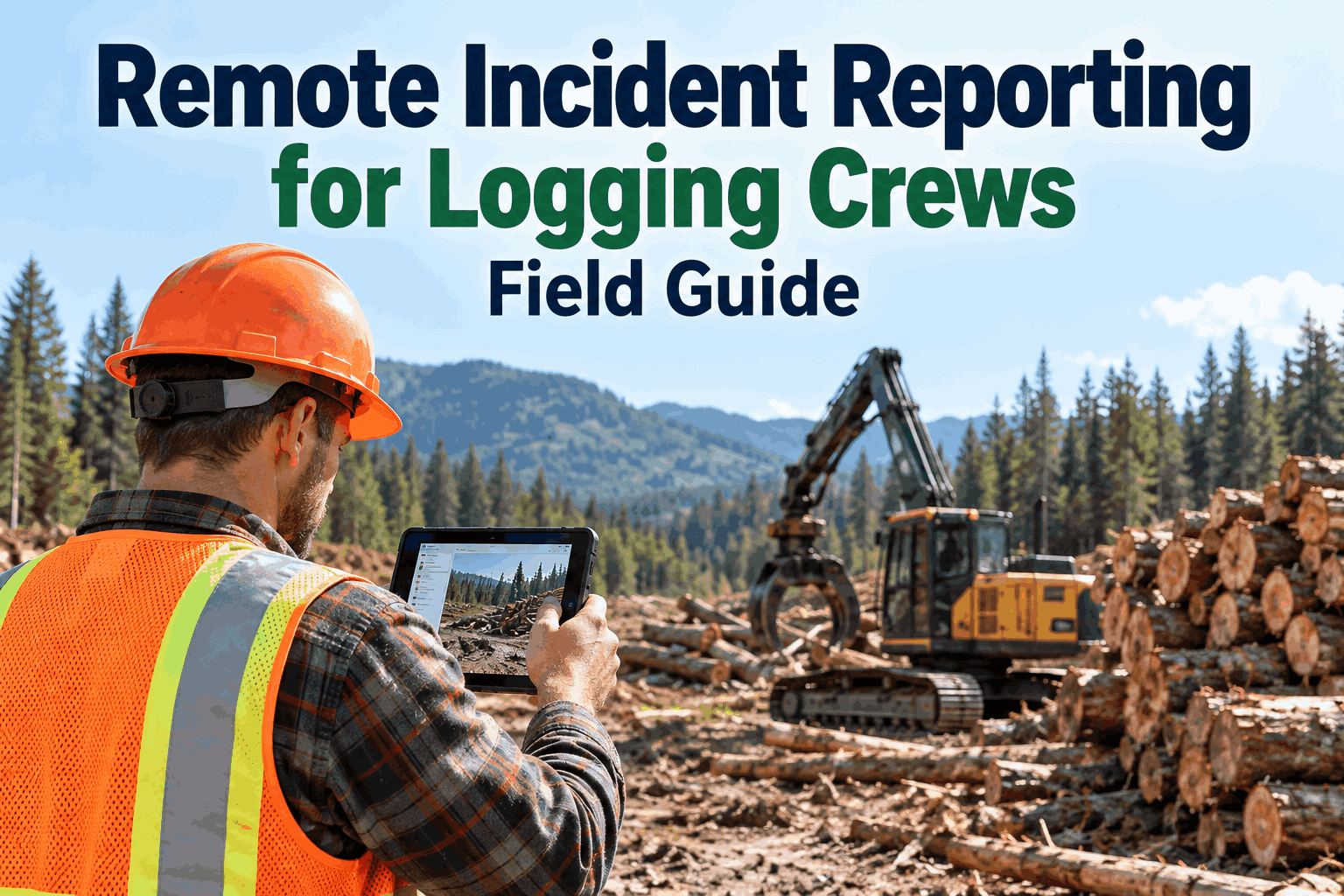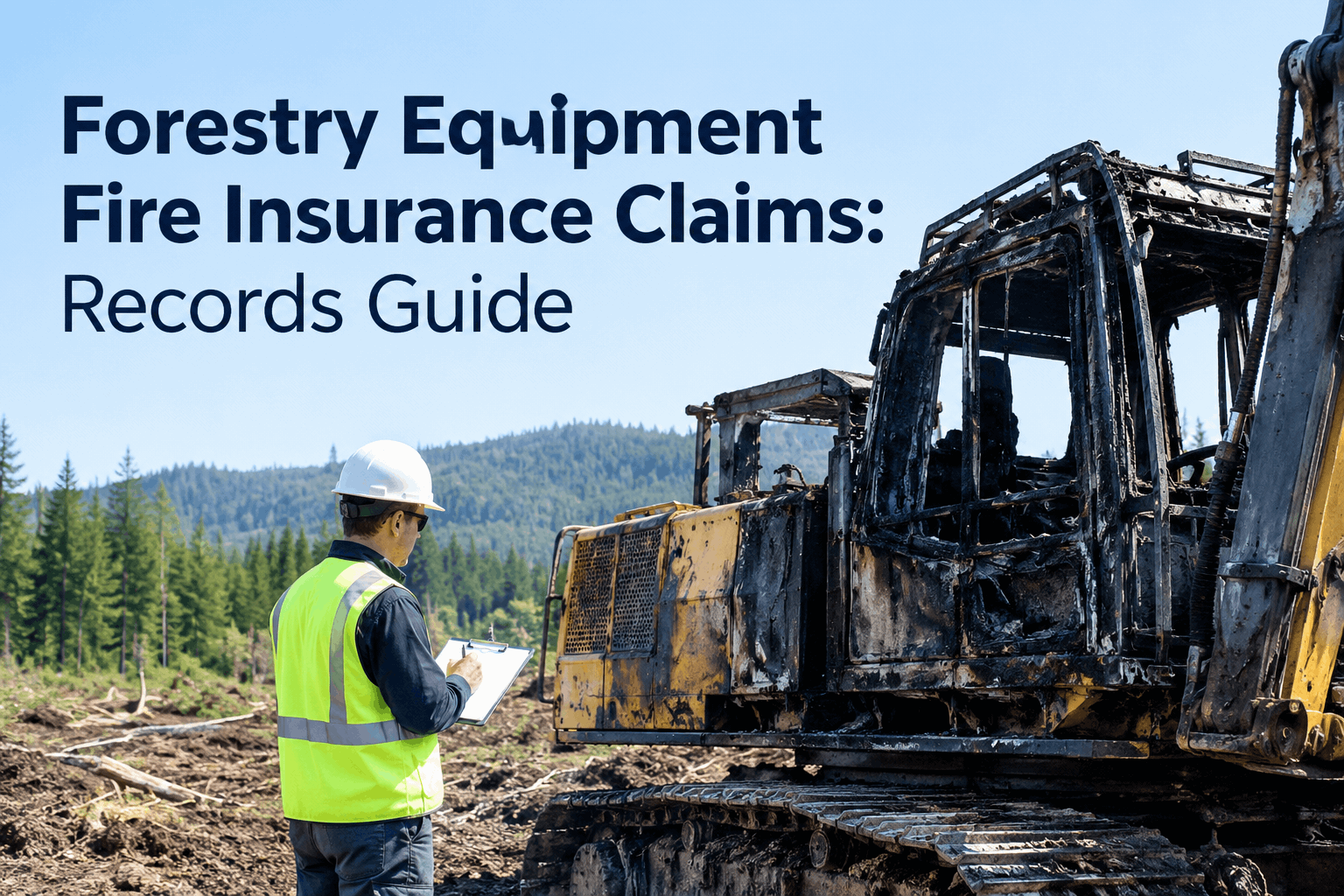
A feller buncher catches fire on a dry block — a hydraulic line onto a hot manifold, and it's a total loss. The insurer doesn't just cut a cheque; the adjuster asks for proof of what the machine was worth, that it was maintained, and what burned. Fleets that can produce it get paid in full; fleets that can't watch the payout shrink. Strong forestry equipment insurance claims are won on records kept before the loss — start a free trial to build your claim-ready record.
After the fire, your claim is only as good as your records.
An adjuster pays on evidence: what the machine was, how it was maintained, and what the loss actually was. Build that record across the fleet before anything happens, and a fire or loss claim becomes a file you hand over — not a scramble you lose.
Being ready for forestry equipment insurance claims comes down to four things: knowing why claims get reduced, knowing exactly what an adjuster asks for, having the record built before the loss, and keeping it where you can produce it in minutes. Below is each — plus the audit-checklist system that keeps that evidence current across your fleet.
Why forestry fire and loss claims get reducedthe documentation gaps that shrink an equipment insurance payout
Insurers rarely refuse a legitimate claim outright. More often they reduce it — and every reduction traces back to a record you couldn't produce. On a remote logging operation, where the machine and its paperwork are miles apart, these are the gaps that cost the most.
Every gap is a record problem, not a coverage problem — and each is fixable with evidence captured as routine, long before a fire. Sign up free and close these claim gaps across your fleet.
What an adjuster actually asks forthe evidence behind every forestry equipment insurance claim
When a claim is filed, the request is predictable — and the fleets that get paid fully are the ones who already have each item. Run your records against this list; what you can't tick today is exactly what to start capturing.
- Ownership & valueSerial/VIN, purchase record and current value for the lost machine.1 / 6
- Maintenance historyDated service and repair records showing the machine was kept up.2 / 6
- Pre-loss condition reportThe most recent inspection showing its state before the incident.3 / 6
- Incident reportWhat happened, when and where, with the hour-meter reading.4 / 6
- Damage photos, time-stampedThe loss documented from multiple angles, dated and tied to the machine.5 / 6
- Exportable record trailAll of it pulled into one file the adjuster can accept quickly.Claim ready
Most of this list is inspection and maintenance evidence you should already be keeping — a claim just reuses it. Book a demo to see a claim-ready record built from routine checks.
Prepared vs scrambling: how the claim plays outthe same forestry equipment loss, two very different payouts
The difference between a full payout and a fight shows up the moment you file. Same fire, same machine — one fleet hands over a file, the other hunts for paperwork while the clock runs. The outcomes aren't close.
- Condition proofLatest inspection on hand
- MaintenanceFull history, exportable
- DamagePhotos, timestamped
- FilingOne file, days
- Condition proofNone — valued low
- MaintenancePaper, incomplete
- DamageA few phone photos
- FilingWeeks of back-and-forth
Everything on the left side exists because the fleet kept records as routine, not in a panic after the fire. Start free and get on the left side before you ever need to file.
The claim-ready records checklist to build nowwhat to capture on every forestry machine before a loss
You can't create a pre-loss record after the loss. Put these in place across the fleet now, as part of routine inspection, and every machine carries its own claim file automatically — ready the day you hope you never need it.
Keeping fire-risk checks on this list isn't only about claims — it's how you avoid the loss in the first place. See the companion Read our logging machine fire extinguisher requirements guide for the prevention side.
Forestry equipment documentation softwarehow HVI audit checklists keep your claim file ready
Claim readiness isn't a one-time project — it's a record that has to stay current across every machine. HVI's audit checklist manager keeps inspection, maintenance and photo evidence tied to each asset, so the claim file builds itself as the fleet works.
The fleets that get paid in full aren't luckier with insurers — they kept the record the claim needed before the loss. See our forestry audit-readiness records guide, and for recovering repair costs the dealer owes, see our forestry warranty management guide.
What a fleet administrator actually watches
We lost a processor to a fire two seasons back, and the claim dragged for weeks because our records were in three binders and a glovebox. The payout came in light. Now every machine carries its own inspection and photo history, so the next time something burns I hand the adjuster one export. I'd rather spend five minutes a day on records than argue value after a total loss.
Frequently asked questions
What records do I need for a forestry equipment insurance claim?
Proof of ownership and value, maintenance history, a recent pre-loss condition report, an incident report, and time-stamped damage photos. Pulled into one file, that package is what gets a fire or loss claim paid at full value instead of reduced.
Why do equipment fire claims get reduced?
Usually a records gap, not a coverage gap — no proof of pre-loss condition, no maintenance history to rebut a neglect exclusion, or poorly documented damage. Each lets the adjuster value the loss low or dispute it, so complete per-machine records matter.
How do I prove a machine's condition before a fire?
With your most recent scheduled inspection record and photos, dated and tied to the machine. That's why regular inspections matter beyond safety — each one is a pre-loss condition report you'll be glad to have if the machine is later destroyed.
Does maintenance history affect an insurance payout?
It can. Insurers may apply a neglect or wear-and-tear exclusion if you can't show the machine was maintained. A complete, dated service history per machine removes that argument and protects the value of the claim.
How does software help with equipment loss claims?
It keeps ownership, inspection, maintenance and photo evidence tied to each machine and exportable in one file. So when a loss happens, the claim file already exists — you produce it in minutes instead of rebuilding it from scattered paper under pressure.
Be ready to claim at full value, not fight for it
HVI keeps ownership, maintenance history, condition reports and photo evidence tied to every machine — so a fire or loss claim is a file you export, not a gap you explain. Start free and build your claim-ready record today — live in under two weeks.
Audit-ready checklists · Photo evidence · One-click claim export