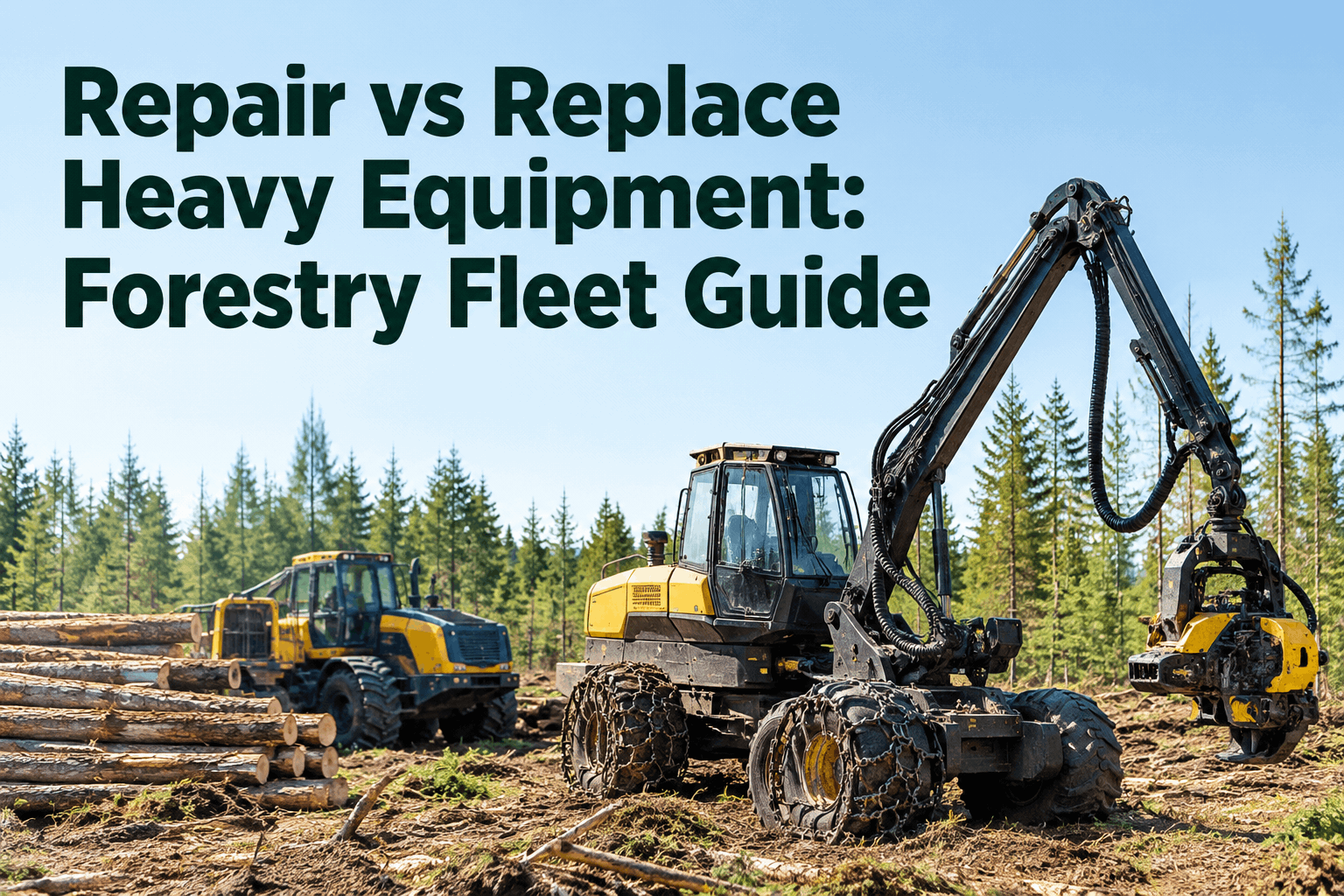
Every forestry fleet owner knows the moment: the skidder's in the shop again, the quote's climbing, and you face the same question — fix it once more, or replace it? Get the repair vs replace heavy equipment call wrong and you either pour money into a machine that's done or scrap one with good years left. The honest answer is in the repair history you may not be tracking. Start a free trial to see each machine's real cost to keep.
The machine tells you when it's done — in the numbers.
A forestry machine's cost to keep rises as it ages; a replacement's cost to own falls as you spread it over hours. The replace decision is the point where those two lines cross — and you only see it coming if every repair, hour and downtime day is on the record.
The repair vs replace heavy equipment decision on a logging fleet comes down to five signals, one crossover point, and a scorecard you can run per machine. Below is each — plus the expense tracking that turns the whole call from an argument into a number you can defend to an owner or a bank.
Five signals a forestry machine is ready to replacethe warning signs that repair is no longer the cheaper path
No single bad day means replace. But when several of these show up together on the same machine, the math has usually already tipped — and the repair history is where you spot them before the breakdown forces your hand.
Each signal is something your records already hold — if you're keeping them. Sign up free and track these replacement signals per machine, before the next big quote lands.
The crossover point that decides itwhere forestry equipment repair costs cross the cost to own new
Think of two lines over a machine's life. Cost to keep the old one climbs as repairs and downtime mount. Cost to own a replacement falls as you spread the purchase over more hours. Where they cross is the economic replace point — past it, every month you keep repairing is money lost.
The catch: you can only draw the amber line if you've been logging repair cost against hours. Without it, the crossover arrives unseen — as a blown transmission on a remote landing. Start free and plot your cost-to-keep curve per machine.
The repair-or-replace scorecardweigh your forestry machine before you commit either way
Run the machine through these. The more you'd answer on the "replace" side, the stronger the case — and if you can't answer them with real figures, that gap is the first thing to fix, because the decision is only as good as the data under it.
- The repair is a one-off, not a pattern, and well under the machine's value
- Repair cost per hour is flat or falling, with low downtime
- The machine has real service life left and parts are still easy to get
- Cash is tight and the machine still earns reliably between fixes
- Annual repair spend is nearing or passing half the replacement cost
- Repair cost per hour is climbing and downtime days keep rising
- A major rebuild is due that approaches what the machine is worth
- You're losing production to breakdowns you can no longer predict
Notice how many lines need a real figure — repair per hour, downtime days, repair-to-value. Start free and build this scorecard on your own machines instead of guessing it.
The repair-cost threshold that flips the decisiona simple rule of thumb for forestry equipment replacement
Fleet managers lean on a long-standing rule: when a machine's annual repair cost approaches a large share of its replacement value — often cited around the halfway mark — repair stops being the economical choice. It's a guide, not gospel, but it reframes the single big quote as part of a yearly trend.
The number only means something if your repair spend is complete and tied to the machine — scattered invoices undercount it, and an undercounted repair bill keeps a money-losing machine on the books. Book a demo to run the repair-to-value math on your fleet.
Forestry equipment cost tracking softwarehow HVI makes the repair-or-replace call provable
Every part of this decision runs on one thing: a complete, per-machine cost record tied to hours. HVI's expense tracking keeps it automatically, so the repair-or-replace call is a report you pull, not an argument you have.
The fleets that replace at the right time aren't guessing — they watch the cost-per-hour line and act when it crosses. See our forestry undercarriage cost-budgeting guide for the biggest rebuild line, and Read our general rebuild-vs-replace framework for the wider method.
What a fleet owner actually watches
I kept pouring money into an old forwarder on feel — it still ran, so I fixed it. The year I finally tracked repair cost per hour across the fleet, that machine stood out instantly: it was costing nearly double the others and down three weeks a year. We replaced it, and the new one paid its own way inside the first season. The number made a call I'd been avoiding for two years.
Frequently asked questions
When should I replace rather than repair heavy equipment?
When repair cost per hour is climbing, downtime is rising, and annual repair spend nears a large share of replacement value — often around half. One costly repair isn't enough; it's the trend across the machine's record that signals the economic replace point.
What is the 50% rule for repair vs replace?
A common rule of thumb: when a machine's annual repair cost approaches about half its replacement value, repair stops being the economical choice. It's a guide, not a hard line — use it alongside downtime, remaining service life and parts availability.
How do I calculate a forestry machine's cost to keep?
Add repair and parts spend, plus the cost of downtime days, over a year, then divide by the hours worked for a cost per hour. Compare that to a replacement's cost to own over the same hours — the point they cross is your replace signal.
Why does downtime matter in the repair-or-replace decision?
Because a cheap repair that keeps a machine in the shop can cost more than an expensive one that keeps it running. On a logging site, each downtime day is lost production — so days out of service belong in the math, not just the repair invoices.
How does software help with repair vs replace decisions?
It keeps a complete per-machine record — repairs, parts, downtime and hours — so cost per hour and repair-to-value fall out automatically. That turns the decision from a gut call into a report you can show an owner or a lender.
Stop guessing whether to repair or replace
HVI tracks every repair, downtime day and hour against each machine, trends cost per hour, and flags the crossover where keeping it stops paying. Start free and turn your next repair-or-replace call into a number you can defend — live in under two weeks.
Per-machine repair history · Cost-per-hour trends · Repair-to-value reporting