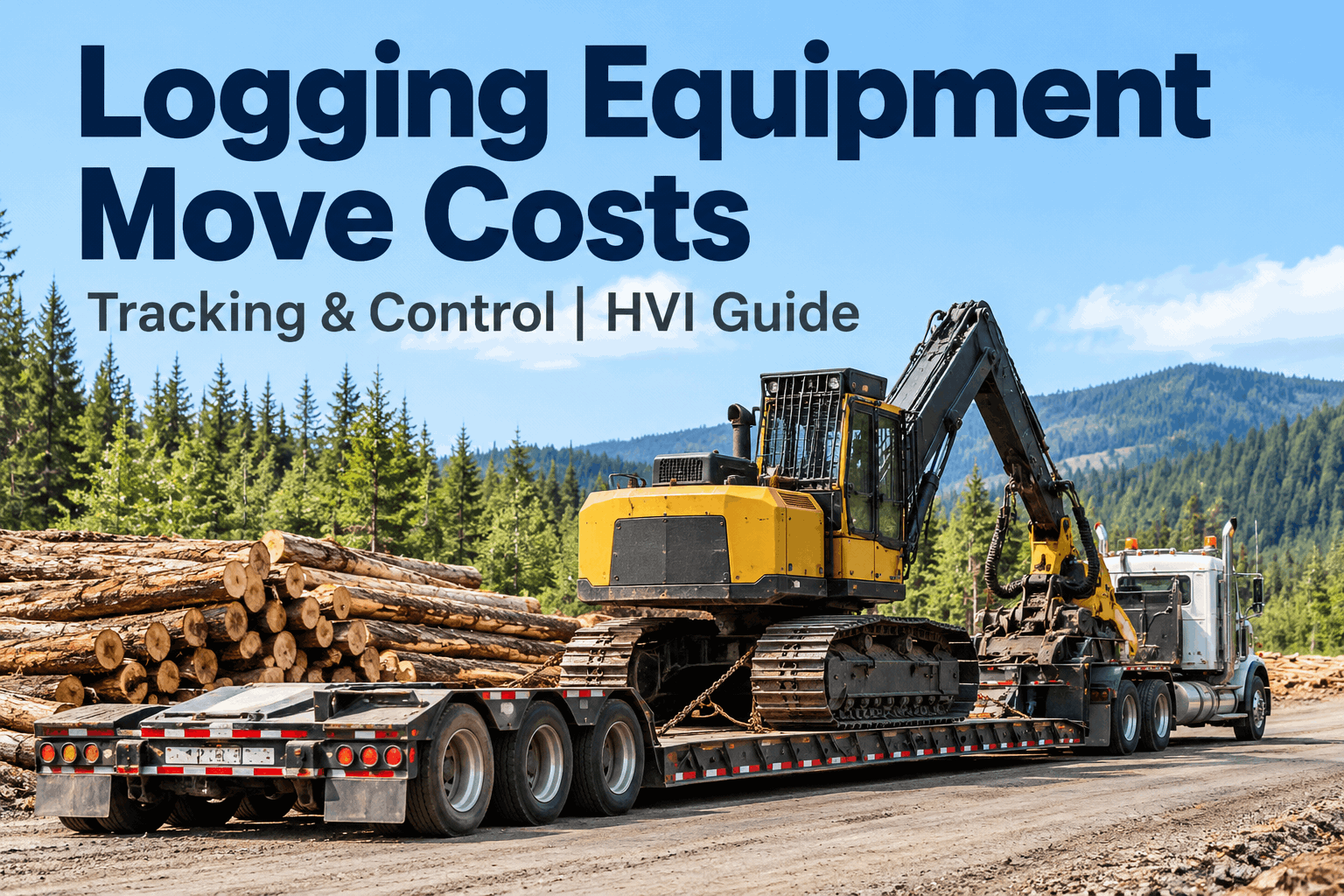
Logging equipment move costs can quietly erase the margin on a profitable harvest block. A lowboy invoice is only the visible portion: loading labor, travel time, escort requirements, machine downtime, and the time needed to restart production all affect the final number. This guide shows logging contractors how to calculate and control those costs using a repeatable move record. Book a demo to explore forestry equipment cost tracking.
Every equipment move has a price. Know the full number before the next block.
Build a defensible move budget for skidders, harvesters, forwarders, processors and support equipment—then compare the estimate with the actual cost after the move.
What counts as a logging equipment move cost?Separate transport invoices from the costs that hide in the production schedule
A relocation begins before the truck arrives and ends only when the machine is productive at the destination. The full cost therefore includes preparation, transport, personnel, access requirements and the operational interruption. Keeping these categories separate makes vendor comparisons fairer and prevents the same expense from being counted twice.
Cleaning, securing attachments, disconnecting implements, loading assistance and any pre-move inspection or repair.
Lowboy charges, mobilization fees, fuel surcharges, pilot vehicles, permits, route restrictions and access-road preparation.
Unloading, reassembly, inspection, setup, test operation, and the time needed to return to planned production.
Some moves also require temporary storage, a second carrier, tire or track protection, or recovery support if access conditions deteriorate. Keep contingency as a separate budget line rather than quietly adding a percentage to every vendor invoice. A good cost record explains why the move was expensive, not just how much was paid.
Logging equipment move cost calculationA worked example for one machine relocating between harvest blocks
Use a consistent calculation for each machine and move. The direct cost includes the invoices and internal resources consumed. The operational impact adds a carefully defined estimate of lost contribution while the equipment is unavailable; it should not be confused with gross sales revenue.
The $1,200 downtime example assumes six hours of avoidable production loss at an estimated $200 contribution per hour. If crews can work on another task during that period, or the move is planned for a scheduled shutdown, the actual loss may be lower. Record the assumption and do not add downtime twice through both labor and lost contribution.
For repeated moves, also calculate cost per machine moved, cost per kilometer or mile and cost per harvest block. Those comparisons reveal whether the issue is carrier pricing, difficult access, too many moves, or poor sequencing. Book a demo to review move and maintenance cost records
Where a move becomes expensiveA harvest-block move timeline with preventable cost triggers
Cost overruns rarely happen at a single point. They develop when the machine is not ready for pickup, the road is unsuitable for the loaded trailer, or the receiving block cannot accept the equipment. A short readiness meeting can prevent hours of avoidable waiting.
Check road condition, grade, turning radius, bridge and load restrictions, unloading space and weather. Confirm the carrier's actual equipment and permit requirements.
Finish urgent repairs, remove or secure attachments, document condition, check transport dimensions and assign the loading crew.
Use trained personnel and the carrier's approved securement procedures. Capture actual loading, travel and unloading time separately.
Complete a post-transport condition check, log any new defects and record when the equipment is genuinely available for production.
The timeline is illustrative, not a mandated schedule. Remote forest roads, seasonal restrictions and specialized equipment may require longer lead times. The principle is to place inspections and access checks early enough that defects are found before the lowboy is already charging for standby.
Forestry equipment move cost-control checklistA practical release-to-restart gate for the next harvest block
Use this checklist at the planning meeting, then again when the machine arrives. Each incomplete item should have an owner and a resolution date. A checklist only saves money when it changes the decision to dispatch.
Before the lowboy arrives
- Confirm machine ID, operating hours and current block
- Record destination, route and planned pickup window
- Verify carrier quote, standby terms and access surcharges
- Check permits, escorts and load dimensions where applicable
- Inspect leaks, attachments, tracks/tires and visible damage
- Resolve defects that would prevent safe loading or unloading
Before the machine returns to work
- Document arrival time and unloading completion
- Inspect for transport-related damage or fluid loss
- Verify attachments, guards and safety systems are ready
- Log work orders for newly discovered faults
- Capture carrier invoice, crew hours and other actual expenses
- Confirm production restart and close the move record
Safety and transport compliance are governed by the equipment manufacturer's procedures, carrier requirements and applicable rules. This operational checklist supports planning; it does not replace a lift plan, securement procedure or required inspection.
Digitizing equipment inspections and maintenance records helps avoid chasing paper when multiple crews are moving between sites. Sign up free to organize forestry equipment inspection records
Compare moves by block—not just by invoiceA transparent cost ledger for forestry contractors
Every harvest block has a different access profile. A steep, wet or distant block can cost more to mobilize than a nearby roadside job, even when the same machine is moved. A consistent ledger lets managers compare like with like and challenge exceptions without relying on memory.
| Move / machine | Transport | Labor & access | Restart | Direct total | Main driver |
|---|---|---|---|---|---|
| A → B · Harvester | $2,750 | $1,100 | $800 | $4,650 | Long haul |
| B → C · Skidder | $1,900 | $780 | $420 | $3,100 | Normal move |
| C → D · Forwarder | $2,200 | $1,250 | $650 | $4,100 | Road access |
To understand the true cost of a harvest block, allocate the move to the block that benefits from it using a rule agreed with operations and finance. If the same transport trip moves multiple machines, allocate shared costs by a documented method—such as equipment weight, hauling hours or an agreed per-machine split—and apply that method consistently.
A single number is not enough to choose the cheapest carrier. Compare service reliability, insurance, specialized equipment, access experience and delay charges alongside the quote. The lowest invoice can become the most expensive move if it causes a missed production shift.
How HVI fits into forestry move cost controlConnect the move decision to the equipment history you already manage
HVI is a fleet and equipment maintenance management platform, not a lowboy booking marketplace or a route-permitting engine. Its value in this workflow is helping teams keep the machine's asset identity, inspections, preventive maintenance, work orders and expense history organized around the same equipment record.
For move-specific costs such as third-party hauling, access fees or lost production, first confirm how your organization will record and reconcile those items. Do not assume a maintenance system automatically calculates every transport charge or attributes all downtime to a harvest block. A consistent process and ownership model are still necessary.
Once equipment records are consistent, managers can compare repeated moves against repair spending, utilization context and asset availability. That helps answer whether a machine is being relocated too frequently, whether the next block is ready, and whether repairs should be completed before transport. Book a demo to explore forestry asset and expense visibility
Five ways to reduce forestry equipment relocation costsOperational improvements that do not depend on cheaper hauling rates
Review the order in which crews enter harvest blocks. A slightly different sequence may reduce deadhead mileage, repeated moves and travel time. Confirm that access, timber availability and production constraints still support the plan.
Coordinate machines that can safely share the same mobilization window. Avoid treating this as permission to exceed vehicle, axle, load or permit limits. The objective is fewer separate dispatches and less crew waiting.
Use a pre-move inspection to identify leaks, starting issues, damaged attachments and overdue service. Work that is inexpensive in a staffed yard may be difficult or slow at a remote landing.
Write down who pays when the trailer waits for a machine, a gate, a road crew or an escort. Record the actual cause of delay so future quotes and scheduling decisions can be improved.
Compare estimated and actual transport, labor, access, maintenance and restart costs. Investigate recurring variances rather than treating every move as a one-off emergency.
For a small contractor, the first win may simply be a single shared cost sheet and a consistent equipment ID. For a larger fleet, the opportunity is standardizing records across crews and contractors so exceptions are visible before the monthly cost review.
A practical 30-day rollout for move-cost trackingStart with one machine class and build a repeatable process
Agree on direct cost categories, downtime rules, block allocation and the person responsible for closing a move.
Record a real machine move, from release inspection to restart, including quotes, timestamps and actual invoices.
Compare estimate and actual, document causes and remove confusing fields that crews cannot complete reliably.
Apply the revised process to the next moves, assign ownership and review trends in the normal operations meeting.
Keep the pilot narrow. A move-cost program fails when crews are asked to fill out a complex form that nobody reviews. Start with the fields that change a decision: machine, origin, destination, carrier, crew hours, direct cost, delays and restart time. Add detail only when it proves useful.
Logging equipment move costs: common questionsAnswers for logging contractors and forestry equipment managers
What should be included in logging equipment move costs?
Include lowboy hauling, loading and unloading labor, permits, escorts, road access preparation, setup, and other directly attributable charges. Track the operational effect of downtime separately, using a defensible lost-contribution estimate rather than simply treating gross revenue as lost profit.
How do I calculate equipment mobilization cost per harvest block?
Sum the direct costs of relocating the machines needed for the block, then allocate shared charges using a consistent method. Record the destination block, each equipment ID and the reason for unusual costs. If you also report lost production contribution, label it separately from direct mobilization spending.
Why can a short forestry equipment move still be expensive?
Loading, securement, permits, difficult forest-road access, equipment preparation and unloading can dominate the bill even when travel distance is short. Waiting time and delayed production restart may exceed the transport charge on a poorly coordinated move.
How can a logging contractor reduce lowboy hauling expenses?
Improve block sequencing, give carriers accurate dimensions and route information, coordinate machine readiness, review standby terms and close each move with actual costs. Do not reduce cost by compromising securement, permits or safe loading procedures.
How can HVI help with forestry equipment move cost control?
HVI helps organize equipment asset information, inspections, preventive maintenance, work orders and maintenance-related cost history. That provides useful equipment context for move planning and cost reviews. Carrier booking, permit approval and full transport-cost allocation remain separate operational processes unless specifically configured and verified.