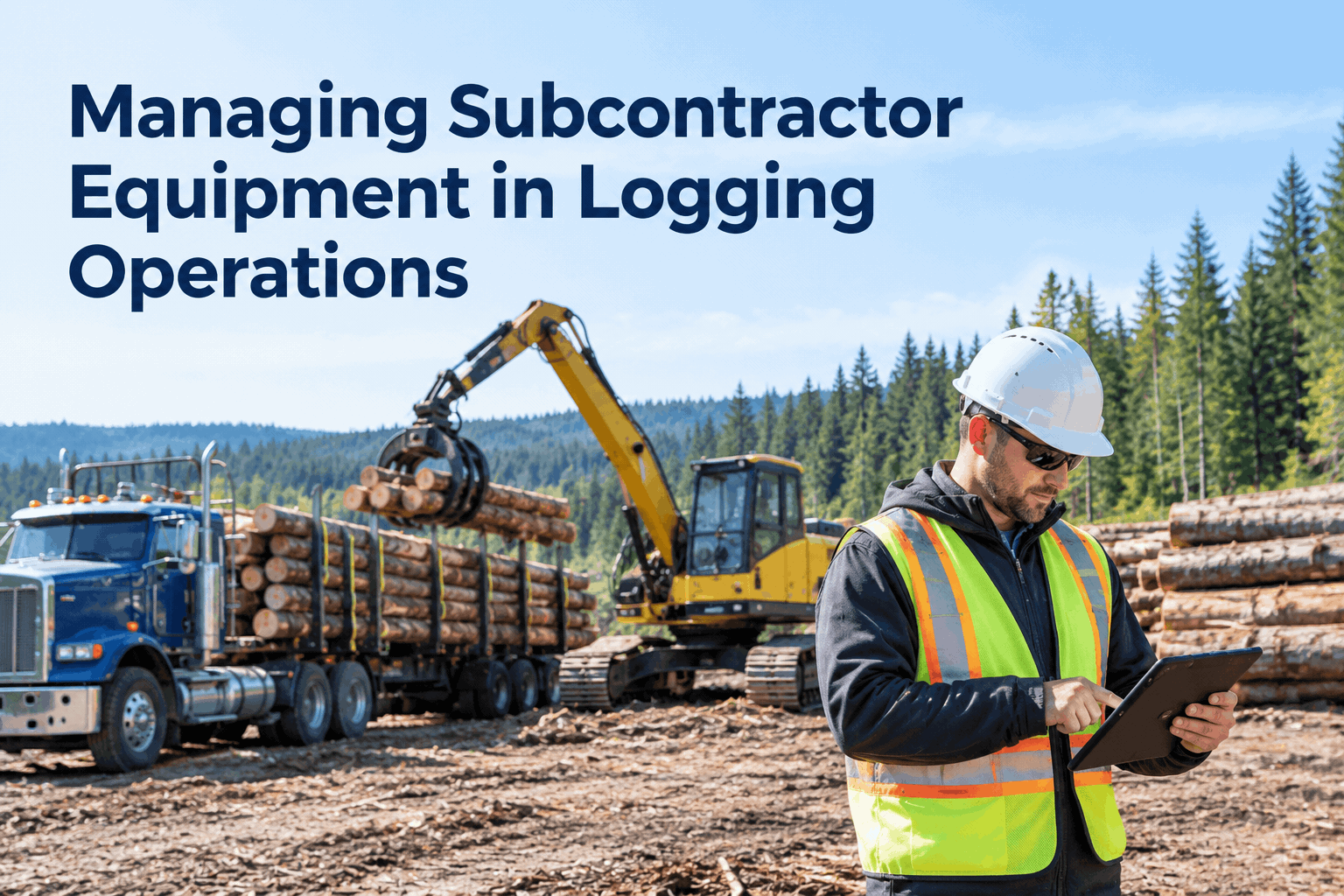
When a harvester drops a hydraulic line on a remote block, the repair invoice is the smallest part of what it costs you. The skidder goes idle, the crew stands around on the clock, the truck gets turned away — and the real logging equipment downtime cost runs three or four times the parts and labour on that quote. Most fleets never see the full number because it's spread across machines nobody adds up. Book a demo to calculate your true downtime cost per hour.
The repair bill is the tip. The real cost is underneath.
A stopped logging machine costs you the fix — plus the production you didn't cut, the crew you still paid, and the whole harvesting chain that waited behind it. Put a per-hour number on that and downtime stops being invisible.
Calculating logging equipment downtime cost means three things: knowing the full cost stack behind a stopped machine, understanding how one failure stalls the whole system, and tracking hours-down per machine so the number is real. Below is each — plus the analytics that turn downtime from a vague worry into a line you can cut.
What a stopped logging machine really coststhe downtime cost stack most fleets never add up
The quote covers parts and labour. The real logging equipment downtime cost has three more layers stacked under it — and those hidden layers usually dwarf the repair itself. Here's the full stack on a single machine-down event.
Budget only for the repair and you're planning for a quarter of the real cost. The three hidden layers are exactly what per-machine tracking surfaces. Book a demo to put a number on your hidden downtime cost, not just the invoices.
Why one machine down stops the whole systemthe chain effect that multiplies forestry downtime costs
A mechanized logging operation is a chain, not a set of independent machines. Each stage feeds the next, so when one link stops, the stages behind it back up and the stages ahead run dry. That's why a single breakdown costs far more than one machine's hourly rate.
- Feller buncherCuts
- SkidderDOWN
- ProcessorStarved
- Load & truckWaiting
One skidder down doesn't cost one skidder's hourly rate — it costs the idle time of every machine and operator up and down the chain. That multiplier is the heart of logging downtime cost, and it only shows up when you track the whole operation together. Sign up free and track downtime across your chain.
How to calculate downtime cost per hourthe simple formula behind logging equipment downtime cost
You don't need a complex model — just the four inputs most fleets already half-know, multiplied out honestly. The formula below turns a vague sense that "downtime hurts" into a defensible hourly figure you can budget against and measure improvement on.
Run that per machine and the worst offenders stand out fast — usually not the ones you'd guess. Book a demo to build this calculation on your fleet with your own tons, margin and wage figures.
Two levers that cut downtime costreduce how often machines stop and how long they stay down
Downtime cost is frequency multiplied by duration, so there are only two levers — stop machines failing as often, and get them running faster when they do. Both run on the same thing: catching defects early and turning them into tracked work before they become breakdowns — book a demo to cut downtime on both levers.
- Catch wear and leaks on daily checks, before they fail mid-shift
- Meter-based PM so services happen on time, not after a breakdown
- Trend repeat faults per machine to kill the root cause
- A flagged defect becomes a work order with photos and parts, instantly
- Parts and history on hand, so the fix starts sooner on-site
- Clear priority on the machine whose downtime stalls the whole chain
Shave either lever and the per-hour cost falls across the whole operation. Explore meter-based preventive maintenance for the frequency side, and the Explore inspection-to-work-order flow for the duration side.
Logging fleet downtime reporting softwarehow HVI analytics turn downtime into a number you can cut
You can't cut a cost you can't see. HVI's analytics and reporting capture hours-down per machine, tie them to production and crew cost, and surface your true downtime cost per hour — so the biggest drains are obvious and the improvement is measurable.
The operations with the lowest downtime cost per hour aren't luckier — they measure it and act on the worst machine first. See fleet cost-per-hour reporting, and for the budgeting side of these numbers, see our forestry undercarriage cost guide.
What a logging executive actually watches
I used to measure downtime by the repair invoices, which made it look cheap. The day we tied hours-down to tons we didn't cut and the crew still on payroll, one skidder jumped out — it was quietly costing us more in lost production than its last two rebuilds combined. We fixed the root fault and our cost per ton dropped the next month. You can't manage a number you never add up.
Frequently asked questions
How do I calculate logging equipment downtime cost?
Add the repair cost, the production lost while the machine was down (tons not cut × margin per ton), and the idle crew and machine wages, then divide by the hours down. That gives a true downtime cost per hour — usually three to four times the repair bill alone.
Why does downtime cost more than the repair bill?
Because the invoice only covers parts and labour. The bigger costs are the production you didn't cut, the crew you still paid, and the rest of the harvesting chain idled behind the stopped machine — none of which show up on the repair quote.
How much does logging downtime cost per hour?
It varies by operation, but lost production alone is often cited around $20 a minute for a down machine on a remote site, and the full chain effect pushes it higher. The only accurate figure is the one calculated from your own tons, margin and crew cost.
How can I reduce logging equipment downtime?
Work two levers: fewer stops and shorter stops. Catch defects on daily checks and keep meter-based PM on time to cut failures, and turn flagged faults into tracked work orders with parts ready so repairs start faster when they do happen.
How does software track downtime cost?
It logs hours-down per machine, ties them to lost production and crew cost, and reports a downtime cost per hour across the fleet. That surfaces the worst machines and makes the improvement measurable, instead of leaving downtime as a vague worry.
Know your true downtime cost per hour
HVI tracks hours-down per machine, ties them to lost production and crew cost, and reports your real downtime cost per hour — so you cut it where it hurts most. Live across your logging operation in under two weeks, no hardware.
Downtime analytics · Repeat-fault tracking · Cost-per-hour reporting