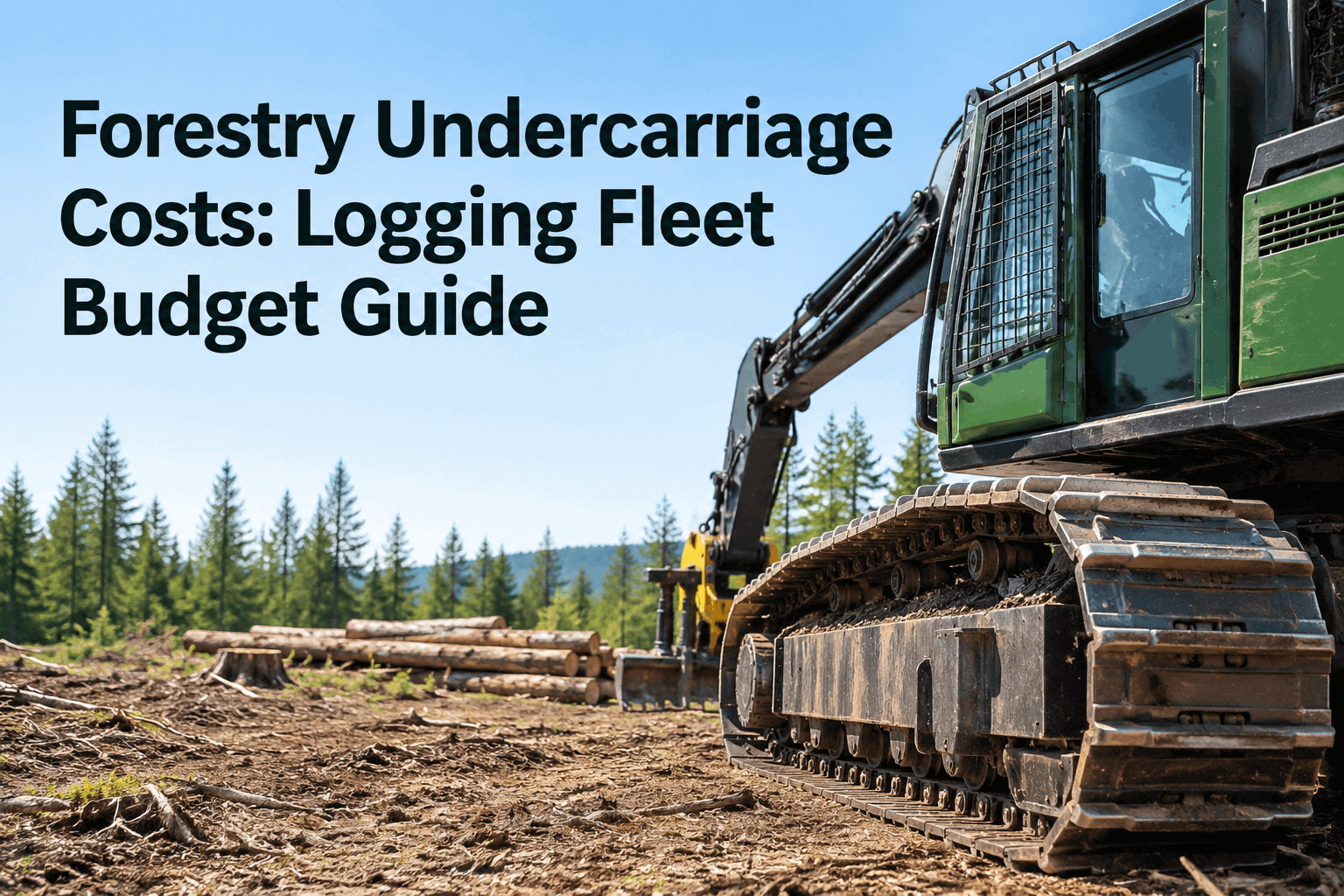
The undercarriage is the most expensive part of any tracked logging machine to run, and the one most fleets budget worst. It can eat up to half of lifetime repair spend, yet still lands as a surprise five-figure bill because nobody tracked the wear against hours. Getting forestry undercarriage costs onto a predictable per-hour budget is the whole game — book a demo to forecast undercarriage spend on your logging fleet.
Your biggest wear cost shouldn't be a surprise.
Tracks, rollers, idlers and sprockets wear on a curve you can measure — so the rebuild has a date and a dollar figure long before the machine stops. Budget it per hour and the five-figure bill becomes a planned line, not an emergency.
Undercarriage cost budgeting for logging fleets comes down to four questions: how big a share of your costs it really is, what makes the bill move, when the rebuild lands, and how to set money aside for it. Below is each one, built into a budget you can defend — and an expense-tracking system that keeps it honest per machine.
What moves the undercarriage billthe wear-rate drivers that decide forestry undercarriage costs
Two identical machines on different ground can see undercarriage wear rates swing by roughly double. That's the whole reason a flat per-hour estimate fails — the rate is set by how and where the machine works, and each factor is something you can see in the operating data.
Each driver leaves a signal in your records — hours, site, tension checks, cleaning logs — which is exactly what turns a wild estimate into a defensible wear rate. This is the cost side of Read our forestry undercarriage and track wear management guide for the measurement mechanics.
From wear readings to a rebuild budgethow measured wear becomes a dated, funded undercarriage cost
Budgeting undercarriage isn't guesswork once you measure. Readings taken at set hour intervals draw a wear curve, the curve projects the rebuild hour, and that date divides the known rebuild cost into a simple amount to set aside each month. Here's the path from a tape measure to a funded line — book a demo to turn wear readings into a rebuild budget.
-
1
Measure on a cadenceSix wear points read at fixed hour intervals, logged against the meter — not once a year.
-
2
Plot the wear curveTwo or more readings set the real wear rate for this machine on this ground.
-
3
Project the rebuild hourThe curve hits the wear limit at a predictable hour — your rebuild date, months ahead.
-
4
Fund it per monthRebuild cost divided by months remaining — a set-aside you budget instead of absorb.
The difference between a planned rebuild and an emergency one isn't just the repair bill — it's the parts bought early, the work booked between blocks, and the production day you don't lose. Sign up free and log your first undercarriage reading to start the curve.
Planned vs emergency: the real cost gapwhat tracking undercarriage costs actually saves a logging fleet
The budget case is simplest shown side by side. Same worn-out undercarriage, two ways to arrive at it — one tracked and funded, one ignored until the machine drops a track on a remote landing. The numbers below are illustrative, but the shape is what every fleet sees.
- Rebuild knownMonths ahead
- PartsOrdered early, no rush fee
- DowntimeBooked between blocks
- Cash impactSpread monthly
- Rebuild knownWhen it stops
- PartsExpedited at a premium
- DowntimeMid-harvest, lowboy out
- Cash impactOne five-figure hit
Every advantage on the left comes from one thing: knowing the cost and the date early enough to act. Book a demo to model your planned-vs-emergency gap on real machine hours.
Forestry equipment cost tracking softwarehow HVI budgets undercarriage spend per machine
Undercarriage budgeting only works if the wear readings and the dollars live in the same place as the hours. HVI's expense tracking ties every undercarriage cost to the machine and its meter, so cost per hour and the rebuild forecast fall out automatically.
The fleets that never get surprised by an undercarriage bill aren't lucky — they track the cost per hour and fund it on a curve. See fleet cost-per-hour reporting, and for the dealer-plan side of the cost decision, see our OEM service agreement cost guide.
What a fleet owner actually watches
Undercarriage used to be the line that wrecked my quarter — a track lets go and there goes twenty grand I didn't plan for. Now every tracked machine carries a cost-per-hour and a projected rebuild hour, so I'm setting money aside months out and ordering parts on my schedule. The bill's the same size; the difference is it never surprises me anymore.
Frequently asked questions
How much do forestry undercarriage costs run?
On tracked logging machines the undercarriage can reach around half of lifetime repair spend, which is why it's the line most worth budgeting. The exact figure depends on terrain, hours and tension — but tracked per hour per machine, it stops being a guess.
How do I budget for undercarriage replacement?
Measure wear on a cadence, project the rebuild hour from the wear curve, then divide the known rebuild cost by the months remaining to get a monthly set-aside. That turns a five-figure surprise into a planned line you fund over time.
What makes undercarriage wear faster on logging ground?
Steep or rocky terrain, long hours with tight turns and counter-rotation, incorrect track tension, and packed-in mud and debris all raise the wear rate. Two machines on different sites can wear at roughly double the rate of each other.
Why is planned undercarriage work cheaper than emergency?
A planned rebuild lets you order parts early without rush fees, book the work between harvest blocks, and spread the cost monthly. An emergency rebuild means expedited parts, mid-harvest downtime and a lowboy — one hit that blows the budget.
How does software help track undercarriage costs?
It ties wear readings and every undercarriage dollar to the machine and its hours, so cost per hour, the rebuild forecast and budget-vs-actual fall out automatically. You see the spend building instead of discovering it at failure.
Know your undercarriage cost per hour before the track lets go
HVI tracks wear readings and undercarriage spend against each machine's hours, projects the rebuild date, and funds it on a curve — so the biggest line in your fleet is a budget, not a surprise. Live in under two weeks, no hardware.
Cost-per-hour analytics · Expense tracking per asset · Budget vs actual reporting