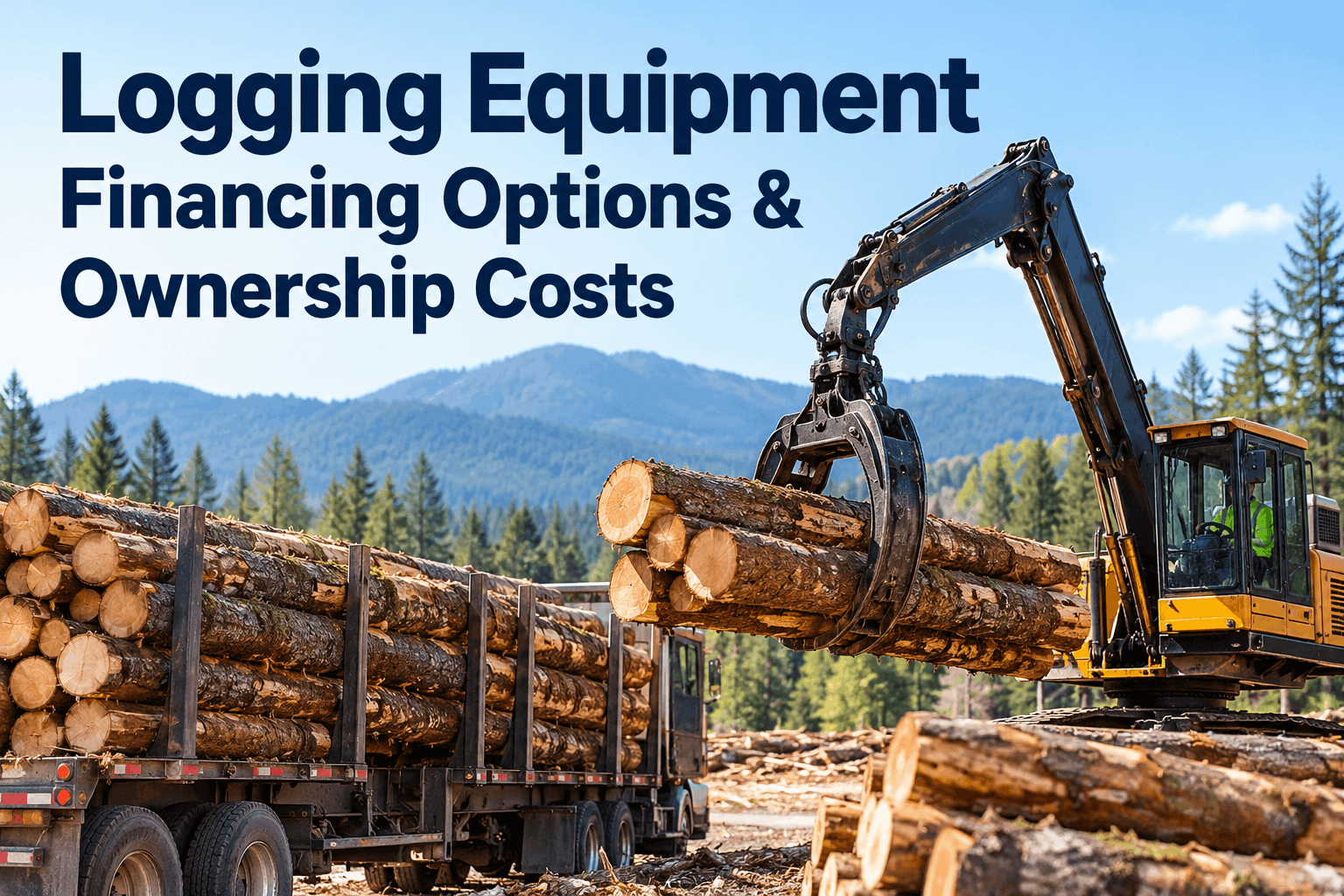
Logging equipment financing is the decision that sets the next five years of your business — a new feller buncher or skidder can run several hundred thousand dollars, and how you pay for it shapes your cash flow long after the machine is in the woods. Loan, lease, or line of credit each change what you owe, what you own, and what you can write off. But the financing is only half the math: the sticker price is what you see, and the cost to run and maintain that machine is what quietly decides whether it was a good buy. Book a demo of equipment cost tracking.
Logging Equipment Financing Is Half the Decision — Running Cost Is the Other Half
Loan, lease, or line of credit gets the machine into the woods. What it costs to keep it running decides whether the deal was worth it — and that part isn't on the quote.
Borrow, pay it off, own it outright. Builds equity in the machine.
You own itLower upfront, fixed payments, newer iron. Return or buy at term end.
FlexibilityDraw as needed for used buys or bridging. Interest only on what you use.
On demandEvery logging contractor hits the same wall eventually: a machine is worn out or the work has outgrown the fleet, and a new purchase means a six-figure commitment you'll carry whether the season is good or bad. The financing choice — loan, lease, or line of credit — gets most of the attention because that's the number on the contract. But the contractors who stay profitable through a soft market are the ones who went in knowing the full cost of owning the machine, not just the cost of buying it. This guide walks the financing options, then the part the lender won't quote you: what the machine actually costs over its life.
The three pathsloan vs lease vs line of credit for logging equipment
There's no single best way to finance logging equipment — the right path depends on your cash position, how long you'll keep the machine, and whether owning it outright matters to you. Here's how the three main logging equipment financing options actually compare.
| Factor | Equipment loan | Lease | Line of credit |
|---|---|---|---|
| Ownership | You own it at payoff | Lender owns; buy option at term | You own what you buy with it |
| Upfront cost | Down payment, often 10–20% | Low to none | None until you draw |
| Payments | Fixed term, builds equity | Fixed, usually lower monthly | Interest only on what's used |
| Flexibility | Locked to one asset | Swap to newer iron at term | Draw and repay as cash allows |
| Best for | Core machines you'll run for years | Keeping a modern, low-downtime fleet | Used buys, bridging, parts & repairs |
A loan suits the core machine you'll run until it's done; a lease suits a contractor who wants newer, lower-maintenance iron and predictable payments; a line of credit fills the gaps — a used skidder deal or a big repair bill. Whichever you choose, the lender judges you on your books, so clean asset and maintenance records help your case. Explore equipment asset records.
The cost you don't seetotal cost of ownership below the purchase price
The purchase price is the part everyone negotiates. It's also the smaller part. Over a logging machine's working life, what you spend keeping it running — fuel, maintenance, repairs, and the production lost when it's down — typically dwarfs the sticker. Finance the machine without a handle on this, and a "good deal" can bleed you for years.
- Above the line — purchase priceThe number on the finance contract. Negotiated hard, then forgotten.
- Below the line — running costMaintenance, repairs, fuel and lost production over the machine's life — usually the larger share, and the part no quote shows.
- The deciderA low price on a machine that's costly to keep is not a good deal. Running cost is what tells you.
This is where the financing decision and the maintenance decision stop being separate. The only way to know a machine's true cost of ownership is to track what it spends after you own it — and that record is also what tells you when a machine has crossed from "worth keeping" to "time to replace." Explore repair cost tracking per machine, and book a demo of ownership-cost records.
Lease or buythe logging equipment lease vs buy call
The lease-vs-buy question comes down to how long you'll keep the machine and how much you value owning it versus staying flexible. Neither wins every time — here's which way the decision usually leans.
- You'll run the machine for many years, well past payoff
- You want to build equity and own the asset
- Your hours are high enough to justify full ownership
- You're comfortable carrying maintenance as it ages
- You want newer iron with lower downtime and warranty cover
- Upfront cash is tight and predictable payments matter
- You'd rather swap machines every few years
- Tax treatment of lease payments suits your books
Either way, the deciding number is the same: what the machine costs to keep as it ages. A buy looks great until year four's repair bills land; a lease looks expensive until you price in the downtime you avoided. Only your own running-cost history tells you which actually won — and that history is worth starting now. Sign up free and start tracking machine cost.
Before you financethe questions a smart logging equipment purchase answers first
A financing deal looks different once you can answer these. Run through the list before you sign — each "yes" is a number that strengthens your decision, your loan application, and your resale position later.
- You know the running cost per hour on your current machines
- You track repair spend per machine, not just totals
- You can see which machines cost the most to keep
- You know which machine is nearing replacement
- Rising repair costs are flagged before they force your hand
- You're buying on a plan, not after a breakdown
- Your assets have clean, documented maintenance records
- You can show a lender a well-run, low-risk fleet
- Service history is ready to prove value at trade-in
- Preventive maintenance is scheduled, not skipped under load
- Warranty-required servicing is documented
- The machine's condition is recorded, not just remembered
Answer these with records instead of guesses and every financing conversation gets easier — and the machine holds more value when it's time to move it on. Book a demo to see the fleet cost view.
Protecting the investmentwhy records are part of the financing decision
A financed machine is an asset you're betting on. Three things determine whether that bet pays off over the loan or lease term — and all three come down to records you either keep or don't.
None of this arranges your financing — HVI doesn't lend, set rates, or give financial advice. What it does is keep the ownership-cost side of the equation in one place, so the financing decision rests on what the machine really costs and the asset holds its value through the term. See forestry maintenance and compliance records. Book a demo of forestry asset tracking.
The cost on recordwhat ownership cost looks like tracked, per machine
When every repair, service and hour runs against the machine, the true cost of ownership reads off one view — and the finance-or-replace decision stops being a guess. Here's the kind of record that replaces the shoebox of receipts.
That view is the difference between financing on a hunch and financing on numbers. It's built from the same records HVI keeps for repairs, assets and maintenance — the cost of ownership is just those records, totaled per machine. Explore preventive maintenance scheduling.
From a logging contractor owner running a mixed harvesting fleet
I used to pick financing on the monthly payment alone — lowest number won. What I didn't count was what the machine cost me after I signed. My last skidder looked like a steal until the repair bills in year three ate the whole saving, and I had no records to show for it when I went to trade it. Now every repair and service runs against the machine, so I can see the real cost per hour and I know exactly when one's getting too expensive to keep. When I go to the lender for the next one, I walk in with a clean history and a fleet I can prove is well run. It changes the whole conversation.
Logging equipment financing — FAQs
What are the main logging equipment financing options?
The three common paths are an equipment loan (borrow, pay off, own it), a lease (lower upfront, fixed payments, return or buy at term), and a line of credit (draw as needed for used buys or repairs). The right one depends on cash flow, how long you'll keep the machine, and whether owning it matters.
Is it better to lease or buy logging equipment?
Buying suits a core machine you'll run for years and want to own; leasing suits a contractor who wants newer, lower-downtime iron with predictable payments. The deciding factor is running cost over time — which only your own maintenance and repair history can tell you.
What is the total cost of ownership for logging equipment?
It's the purchase price plus everything the machine costs after you own it — fuel, maintenance, repairs, and lost production from downtime over its working life. The running cost usually outweighs the sticker, which is why a low purchase price alone doesn't make a good deal.
Do maintenance records affect equipment financing?
Indirectly, yes. Clean asset and maintenance records show a lender a well-run, lower-risk fleet, help you time purchases before a breakdown forces one, and prove a machine's condition at trade-in or refinance — all of which strengthen your position.
How does HVI help with equipment ownership costs?
HVI isn't a lender and doesn't give financial advice. It tracks repair cost, maintenance and downtime per machine so you know the true cost of ownership, time your finance-or-replace decisions on data, and keep the service history that protects resale and warranty value.
Know what the machine really costs before you sign
Loan, lease, or line of credit is only half the decision. HVI keeps the other half — repair cost, maintenance and downtime per machine — so you finance on the true cost of ownership, time your next purchase on data, and keep the records that protect resale and warranty value through the term.
No credit card · No hardware · Track every machine's true cost from day one