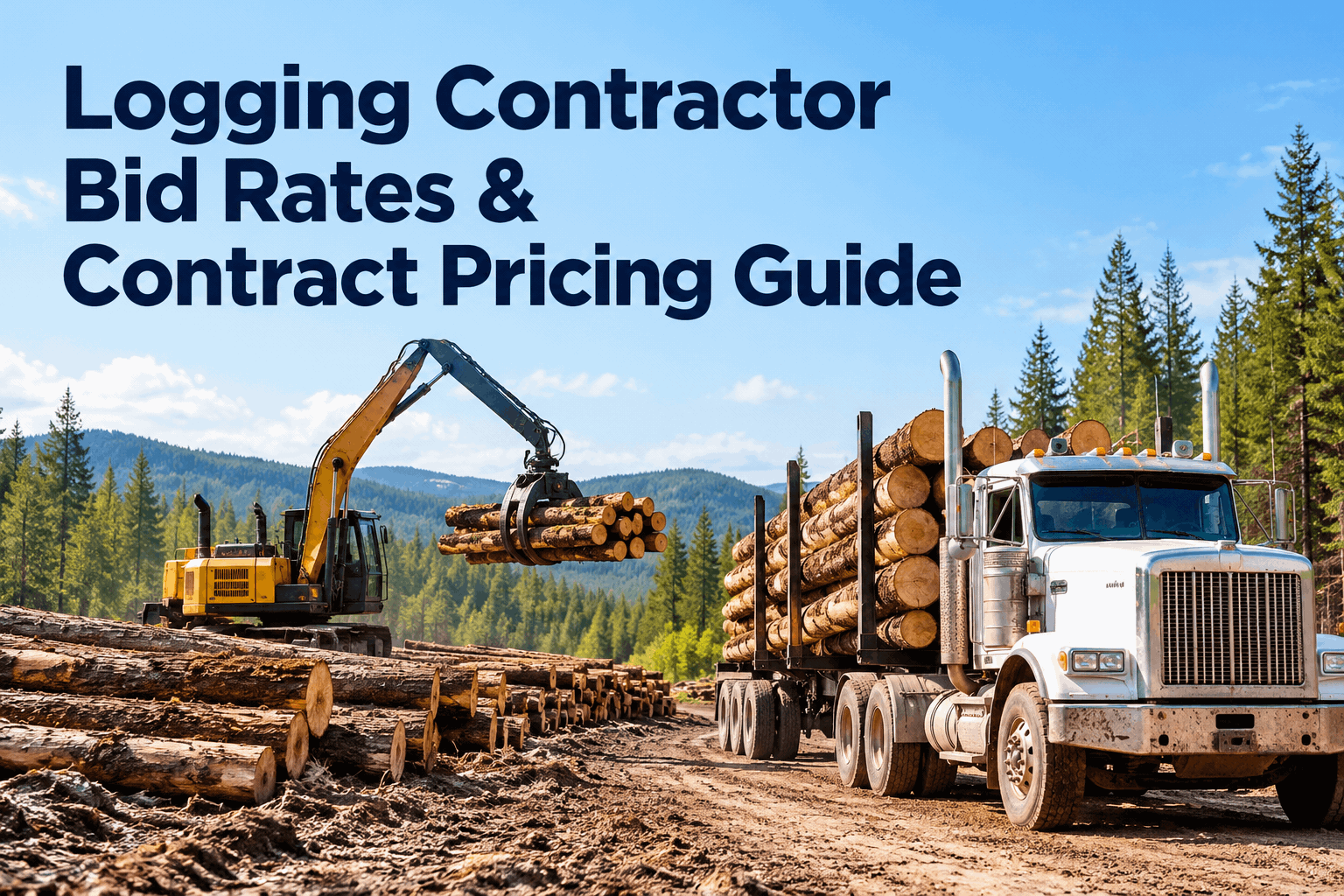
Logging contractor rates are the hardest number you set all year, because a wrong one costs you either way: bid too high and you lose the job, bid too low and you win work that bleeds money for months. A solid bid rate isn't a guess or last year's number plus a little — it's your real cost per ton with a margin on top, and the contractors who price to profit are the ones who know their costs cold. Book a demo of equipment cost tracking.
Logging Contractor Rates Are Built From Cost Up — Not Guessed From the Gut
A bid rate is your real cost per ton with a margin on top. Know the cost and you can price to win and profit. Guess it, and you're betting the job on a number you can't defend.
Pricing a logging job is a tightrope. On one side is the buyer's budget and the next contractor who'll undercut you; on the other is the hard floor of what the work actually costs you to do. Bid between those and you make money; miss on either side and you either don't get the job or you get a job you'll regret. The trouble is that most contractors build their rate on feel — last season's number, a round figure, a gut sense of the ground — and feel doesn't account for a skidder that's quietly costing twice what it used to in repairs. The fix isn't a pricing trick. It's knowing your real cost, especially your equipment cost, before the bid goes in.
Two ways to losewhy a logging contractor's bid rate has to be right both ways
A bad bid rate fails in one of two directions, and both hurt. The whole point of knowing your cost is to find the narrow band between them where you win the job and still make money.
You win the contract — and then grind through it losing money, because the rate never covered what the machines actually cost to run.
- Equipment cost underestimated
- Repairs and fuel eat the margin
- Locked into a losing rate for the term
You protect your margin on paper — but the buyer hands the job to a competitor, and your machines sit idle earning nothing.
- Padded the rate to feel safe
- Lost the work to a sharper bid
- Idle equipment still costs you
Both failures come from the same root: not knowing your true cost, so you either guess low and get burned or pad high and get beaten. Pin the cost down and the safe bidding band appears. The biggest and most-often-wrong number in that cost base is equipment — see how the equipment slice is measured. Book a demo of real cost-per-ton data.
Building the ratehow to construct a logging bid rate from cost up
A defensible bid rate is built, not guessed. You start from what the work costs you per ton or per hour, then add the margin you need to stay in business. Here's the sequence.
The cost base is the floor — the rate is built up from it. Get the equipment layer wrong and every layer above it is off.
-
1Total your operating cost
Add up fuel, repairs, maintenance, labor and overhead for the job or period. This is the floor — the rate can never go below it and survive.
-
2Divide by production
Split that cost over the tons (or hours, or loads) you expect to produce. Now you have your cost per unit — the real number a rate has to beat.
-
3Add your margin
Layer on the profit you need — not a random markup, but enough to cover risk, slow seasons and reinvestment. Cost plus margin is your rate.
-
4Sanity-check against the job
Adjust for haul distance, terrain and timber on this specific job, and check the rate against what the market will bear. Then bid with confidence.
Every step after the first depends on getting step one right — and the line contractors most often get wrong in step one is equipment cost, because fuel and repairs are lumpy and easy to under-remember. Track them per machine and your cost base is solid, which makes every number downstream trustworthy. Explore cost-per-ton reporting, and book a demo of the equipment cost base.
What goes in the ratethe cost lines a logging bid has to cover
Under-bidding usually isn't about the obvious costs — it's the ones left out. A complete bid rate has to carry every one of these, or the margin you think you built in isn't really there.
The fuel and repair lines are where bids most often fall short, because they're hard to estimate from memory. The haul portion has its own rate logic worth knowing when you price a job with distance — see log trucking cost per mile and per turn. Sign up free and build your cost base.
Is your bid solidthe bid-rate readiness checklist
A bid is only as good as the numbers under it. Run your pricing against this list — any "no" is a place where your rate is resting on a guess instead of a figure you can stand behind.
- You know your fuel cost per machine, with price
- Repair and maintenance spend is tracked per machine
- You can total true operating cost for a job
- You know your production — tons, hours or loads
- Cost divides cleanly into a cost per unit
- You can see cost per ton by machine and crew
- Your margin is deliberate, not whatever's left
- Overhead is in the rate, not forgotten
- The rate still profits if a machine's cost rises
- You can adjust the rate for haul and terrain
- You can defend the number if the buyer pushes back
- You'd walk from a job that bids below your floor
Twelve confident "yes" answers mean you bid from knowledge, not nerves — and you know which jobs to chase and which to let go. Book a demo to see the cost-per-ton view.
Rate structuresper ton, per hour or per load — matching the rate to the job
Logging contractor rates get quoted a few different ways, and the right structure depends on the job. Whatever the unit, the cost base underneath is the same — only the way you divide it changes.
| Rate structure | How it works | Best when |
|---|---|---|
| Per ton | Cost and margin divided by tons produced | Production is measurable and steady — the common default |
| Per hour | Machine and crew time billed by the hour | Conditions vary wildly or the scope is open-ended |
| Per load | A flat rate per truckload delivered | Loads are consistent and haul is a big share |
| Lump sum | One price for the whole tract | You know the timber and ground well enough to commit |
Per ton is the most common because it ties your pay to production, but it also puts the risk on you to actually produce — which makes knowing your cost per ton non-negotiable. Whichever structure you quote, the floor underneath it is your real operating cost, and the equipment share of that is the piece HVI helps you nail down. See how fuel cost per ton is tracked.
The cost behind the bidthe equipment cost base, tracked per machine
A confident bid rests on a cost base you can see. When fuel, repairs, maintenance and hours run against each machine, your equipment cost per ton reads off one view — ready to drop into the bid. Here's that record.
That view is the foundation of a rate you can defend — the real equipment cost that turns a hopeful bid into a calculated one. It's built from the records HVI already keeps for fuel, repairs and hours. Explore per-machine cost records.
From a logging contractor owner who tightened up his bidding
I lost money on a two-year contract once because I bid it on last year's numbers, and in between my equipment costs had crept way up without me really clocking it. By the time I felt it, I was locked in at a rate that didn't cover my repairs. After that I stopped bidding from memory. Now before any bid I pull my real equipment cost per ton off the system, add my labor and overhead, and put a proper margin on it — and I can see exactly how low I can go before a job stops being worth it. I've walked away from a couple of lowball tenders since, and the jobs I do take actually make the money I bid them to make.
Logging contractor rates — FAQs
How do logging contractors set their rates?
By building the rate from cost up: total operating cost — fuel, repairs, maintenance, labor and overhead — divided by expected production, plus a margin. The result is a cost-per-ton or per-hour rate that covers the work and leaves a profit, rather than a guess.
What's the most common mistake in logging bids?
Underestimating equipment cost. Fuel and repairs are lumpy and easy to under-remember, so contractors bid on an optimistic number and then lose the margin when the real costs land. Tracking equipment cost per machine fixes it.
Should I bid per ton, per hour, or per load?
Per ton is the common default and ties pay to production. Per hour suits jobs with variable conditions, and per load works when loads are consistent and haul is a big share. The cost base underneath is the same — only how you divide it changes.
How do I know if a bid rate is too low?
If it doesn't clear your real cost per ton plus a margin, it's too low — even if it wins the job. That's why knowing your true operating cost, especially equipment cost, matters: it gives you a floor you won't bid below.
How does HVI help with bid pricing?
HVI doesn't set your rate — it gives you the cost base behind it. By tracking fuel, repairs, maintenance and hours per machine, it tells you your real equipment cost per ton, so your bid rests on data instead of a guess and you can price to win and still profit.
Walk into every bid knowing your real cost per ton
The difference between a bid that profits and one that bleeds is knowing your equipment cost before you quote. HVI tracks fuel, repairs, maintenance and hours per machine, so you build every rate on a real cost base, price to win the job, and keep the margin you bid for. Book a demo and see it on your fleet.
No credit card · No hardware · Know your equipment cost per ton before you bid