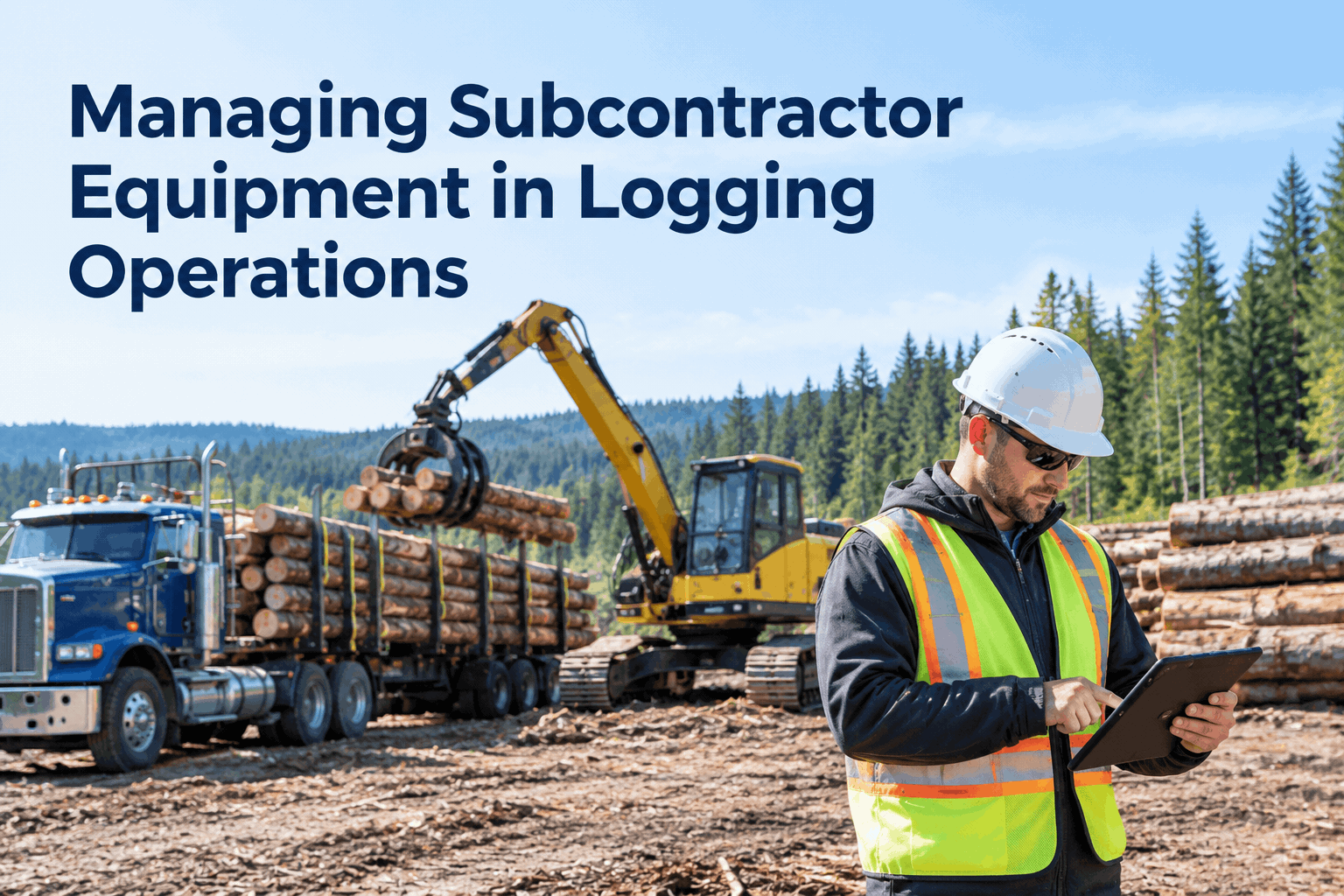
A subcontractor's skidder rolls onto your cut block Monday morning. You've never inspected it, you don't know when its brakes were last serviced, and you're not sure the operator's ticket is current. If that machine hurts someone or tears up a sensitive site, the exposure doesn't stay with the sub — it lands on whoever runs the block. Subcontractor equipment management in logging is the discipline of proving every outside machine is fit and documented before it turns a wheel on your job. Book a demo of subcontractor verification.
Subcontractor Equipment Management in Logging: No Iron Works Your Block Until It Clears
Verify every outside machine's inspection, maintenance, and paperwork before it mobilizes — so the risk you can't see doesn't become the liability you can't escape.
When the work scales up during harvest, you bring in subs — and with them, machines and operators you didn't train and equipment you didn't maintain. The production is welcome. The blind spot isn't. Every unverified unit is a gap in your safety case and a liability you're carrying without knowing the size of it.
The liability doesn't subcontractwhy subcontractor equipment management in logging is yours to own
Here's the trap: you can hand off the work to a sub, but you can't hand off the responsibility for what happens on your block. If a subcontractor's machine with a failed brake injures a worker, or its leaking hydraulics foul a stream, the investigation looks at who controlled the site — not just who owned the machine. "We assumed they maintained it" is not a defense. Documented verification is.
- The machine and its maintenance
- The operator's wages and training
- Their own equipment records
- Responsibility for conditions on the block
- The incident, the stop-work, the citation
- The duty to prove you checked before they started
That's the whole case for a verification step: it moves the risk from "we hoped" to "we checked and here's the record." The same approach HVI runs for mining contractor equipment compliance verification and utility contractor fleet compliance applies directly to a logging block. Book a demo to see the forestry version.
The clearance gatefour steps from a sub's machine arriving to it earning access
Verification isn't a stack of emailed PDFs nobody reads. It's a gate — a defined sequence every subcontractor machine passes through before it's cleared onto the block. Each step produces a record, so "cleared" means something you can stand behind later.
-
1Submit before mobilizing
The sub sends inspection records, maintenance proof, insurance, and operator tickets ahead of the start date — not at the gate on day one.
-
2Review for current & complete
You check each document is in date and nothing's missing. Gaps get flagged back to the sub to fix before the machine moves.
-
3Condition check on arrival
The machine gets a walkaround against the same standard as your own fleet — paper records mean nothing if the unit shows up leaking.
-
4Clear & log access
Approved units are logged with the date, the checker, and the evidence. That record is your defense if anyone ever asks.
The gate is only as strong as the standard behind it, which is why a subcontractor's machine should pass the same checks your own does. Run both on one system with the HVI fleet inspection module, and the clearance record builds itself as you go.
Subcontractor verification checklistwhat every outside machine must produce before it works
This is the pre-start checklist to run on every subcontractor unit before it's cleared. Grouped by what you're verifying — the machine, the paperwork, and the operator. If any line can't be answered with a current record, the machine waits.
- Current inspection record, dated and signed, for this specific unit
- Maintenance history showing services are up to date
- Arrival walkaround passed against your own fleet standard
- Fire suppression, guarding, and safety devices present and working
- Liability insurance in force, covering the dates of the work
- Workers' compensation coverage confirmed for the crew
- The sub's written safety program on file
- Any site- or client-specific compliance documents provided
- Operator certification or ticket current for the machine class
- Site safety induction completed before first shift
- Emergency and communication plan acknowledged for remote blocks
Cleared isn't foreverwhy subcontractor equipment management fails after week one
Most oversight passes the first inspection and then quietly rots. The insurance that was valid when the sub mobilized expires three weeks into a two-month contract. The operator ticket lapses mid-harvest. Nobody notices, because verification was treated as a one-time gate instead of a window that keeps closing. The machine is still on the block — now uncovered.
This is where a connected system earns its keep: expiry dates are tracked, alerts fire before a document lapses, and a machine whose coverage has run out gets flagged off the block automatically. Keeping that record audit-ready is the job of forestry safety compliance records and audit readiness — which covers your own fleet's documents, while this page covers the subs you bring onto it. Book a demo to see expiry alerts in action.
What a forestry safety manager says about subcontractor oversight
We'd collect certificates in a folder at the start of a job and never look at them again. Then an auditor asked me to produce current insurance for a sub's processor, and I couldn't — it had expired six weeks earlier and the machine was still cutting. Now every sub's docs and inspections live in one place with expiry alerts, and nothing works my blocks that I can't stand behind in a review. It took one bad morning to change how we run subs for good.
Subcontractor equipment management in logging — FAQs
What is subcontractor equipment management in logging?
It's the process of verifying that every outside machine working your block is inspected, maintained, insured, and operated by a certified crew — before work starts and throughout the contract. It protects you from liability for equipment you don't own. Book a demo of the verification workflow.
Am I liable for a subcontractor's equipment on my site?
Responsibility for conditions on a block generally follows whoever controls the site, not just who owns the machine. Documented verification before work begins is the practical defense. This isn't legal advice — confirm your exposure with counsel. Explore HVI safety management.
What documents should I collect from a logging subcontractor?
At minimum: current equipment inspection and maintenance records, liability and workers' comp insurance, the sub's safety program, and operator certifications for each machine class. Collect them before mobilization, not at the gate. Book a demo to see the document set tracked.
How do I keep subcontractor compliance current during a job?
Track each document's expiry and set alerts ahead of the date, so a lapse is caught before the machine is uncovered. One-time collection at the start isn't enough for a multi-month harvest. Book a demo of automated expiry alerts.
Can subcontractors submit their own records in HVI?
Yes — role-based access lets each sub submit and see only their own documents and inspections, while you review, clear, and keep the full audit trail. See the HVI inspection module, or book a demo.
Bring subs onto your blocks without inheriting their blind spots
Verify every subcontractor machine and operator before they mobilize, track documents to expiry, and keep a clearance record you can produce in any audit — so the extra capacity never comes with hidden exposure.
- Pre-start document & inspection gate
- Same standard as your own fleet
- Automated expiry alerts
- Timestamped audit trail per machine