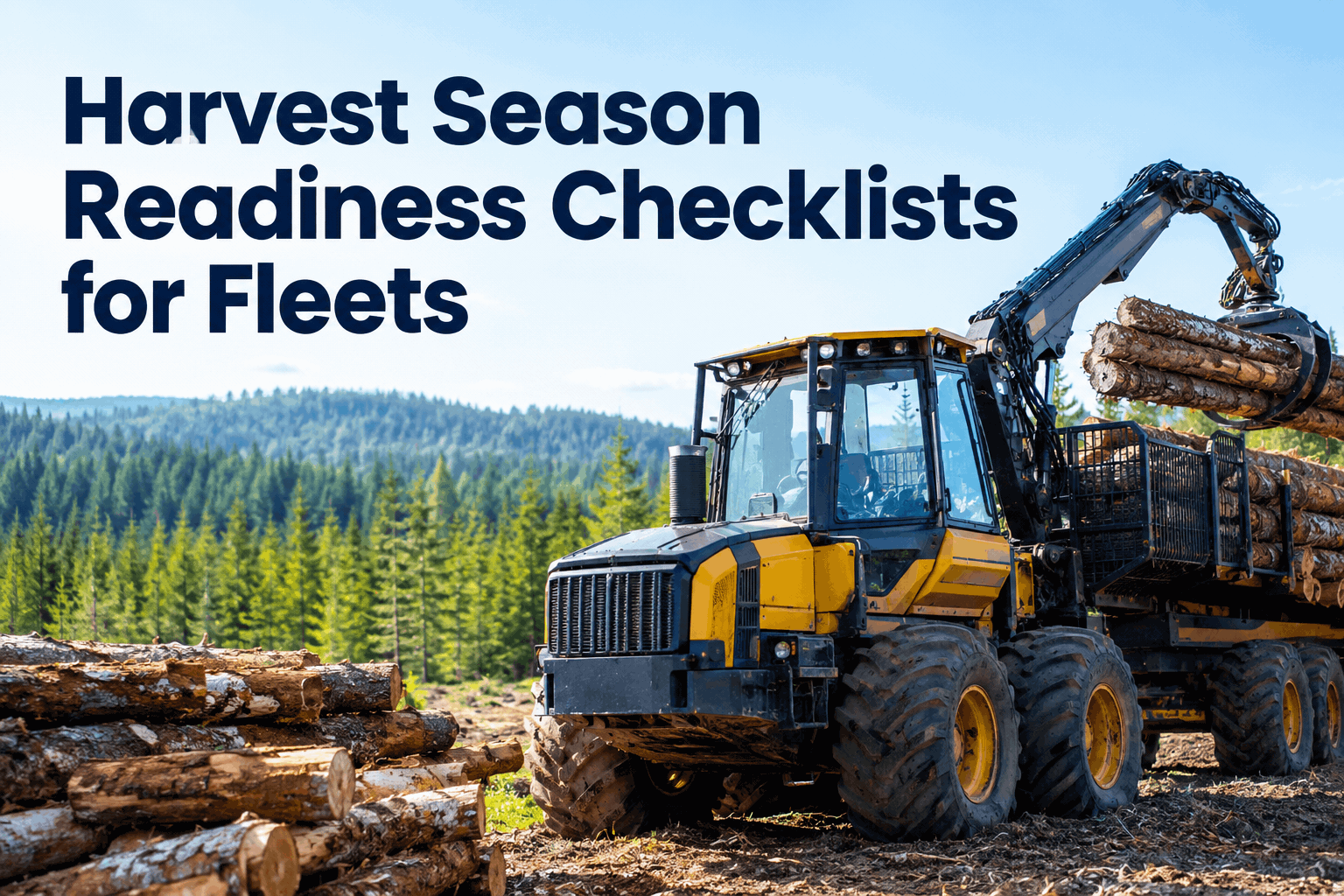
The worst day to find out a skidder's winch brake is shot is the second morning of a booked harvest, with the mill expecting loads and the machine deadlined at a landing an hour from the nearest parts counter. A harvest readiness checklist run across the whole fleet in the weeks before the season opens is what keeps that morning from happening. It turns a scramble into a plan. Book a demo of fleet-wide readiness checks and see how it works at remote sites.
Harvest Readiness Checklist: Get the Whole Fleet Season-Ready Before Opening Day
Catch the worn hoses, weak brakes, and overdue services in the shop week — not on a landing with the mill waiting. One checklist, every machine, tracked to done.
A harvest readiness checklist isn't a daily walkaround. It's the deeper, once-a-season pass that catches the things a quick morning check misses — the services coming due mid-season, the wear that's been limping along since last fall, the spare you meant to order in July. Done early, it's cheap. Found on the job, it's a deadline and a loss.
Why the season breaks fleetsthe cost of a harvest readiness checklist skipped
Harvest doesn't ease in. Machines that idled through the slow months get pushed to full shifts on rough ground overnight, and every weak point that was tolerable at half-use becomes a failure at full tilt. On a remote landing, a single blown hydraulic hose can cost around $20 a minute in lost production while the crew waits, and a reactive repair typically runs two to three times what the same fix would have cost caught early in the shop.
That's the whole case for a pre-season readiness pass: it moves the failure from the landing, where it's expensive and public, to the shop, where it's cheap and quiet. Running it as a digital inspection means nothing slips through a paper form left in a cab. See how failed items become work orders in the HVI fleet inspection module, or book a demo to watch a readiness check run end to end.
The run-up to opening daya four-week readiness countdown that actually holds
Readiness isn't one frantic week. The fleets that start the season clean break the work into a countdown, so parts arrive before they're needed and nothing bottlenecks the shop on the last weekend. Here's the shape of it.
-
4 wksInspect & assess every machine
Run the full readiness checklist on each unit. Log every defect and overdue service. This is the inventory of what the season needs.
-
3 wksOrder parts & book major work
With defects logged, order long-lead parts now — hoses, bearings, tracks, undercarriage. The gap between flagging and fixing is where seasons get lost.
-
2 wksClear preventive maintenance backlog
Catch up every PM coming due in the first two months of the season, so no machine gets pulled for a service mid-harvest.
-
1 wkVerify & sign off fleet-ready
Re-check the units that had work done, confirm every open item is closed, and mark the fleet ready. Nothing goes to the woods flagged.
The reason this holds together is the gap between week four and week three — flag early, and the part is on the shelf before the machine needs it. Scheduling the PM catch-up by meter hour is the job of HVI preventive maintenance scheduling, so the backlog is visible, not a memory.
The readiness checklistby system, every line observable — this is the one to run
Here's the core harvest readiness checklist, grouped by machine system. Each line is something you can see, test, or confirm — not a vague "check the hydraulics." Run it on every unit four weeks out, and log a pass or a defect on each.
- Coolant level and condition; radiator and oil cooler blown clear of chaff and bark
- Air filter restriction checked; spare primary filter on the shelf
- Fuel/water separator drained; no leaks at lines or injectors
- Belts and hoses inspected for cracking and chafe
- Every hose checked for chafe, bulge, and weeping at fittings; high-pressure lines first
- Oil level and condition; filter service interval confirmed
- Cylinders checked for drift and rod scoring; no visible leaks
- Spare high-pressure hoses and fittings stocked on the service truck
- Track tension and wear measured; bogie wheels and rollers checked
- Tires inspected for sidewall cuts and bead damage; chains fitted for the terrain
- Final-drive and axle oil levels confirmed
- Service and winch brakes tested; park brake holds on grade
- Fire extinguishers charged, in date, and mounted; spark arrestor intact
- Lights, strobe, backup alarm, and cab guarding all working
- First-aid kit and emergency kit stocked for remote sites
Paper dies at the landingwhy the harvest readiness checklist has to go digital
A readiness checklist on a clipboard works fine in the shop. It falls apart the moment the fleet scatters to remote blocks with no cell service, where a defect photographed on a phone goes into a group chat and gets lost. The difference between paper and a digital check isn't neatness — it's whether the flagged winch brake actually gets fixed.
- Defect noted on a form that stays in the cab
- Photo lost in a text thread, no unit attached
- No view of which machines are actually ready
- Work order never opens; the fix gets forgotten
- Defect captured offline, syncs when signal returns
- Photo tied to the exact unit and checklist line
- Live board shows fleet readiness at a glance
- Failed item fires a work order automatically
This is exactly where remote-site forestry work tests a system. A rock-cut tire or a cracked line gets photographed on any phone at the landing, no signal needed, and it syncs when coverage returns — the record follows the machine instead of dying in a group chat. The daily side of this lives in the HVI logging daily inspection checklist guide, while the deeper machine-by-machine pass is covered in the forwarder inspection checklist. Want it mapped to your fleet before season? Book a demo of offline readiness checks.
What a forestry maintenance manager says about readiness
We used to treat pre-season as a long weekend of catching up. Two years running, we still had a machine go down in the first week because something got missed on paper. Now every unit runs the same readiness check a month out, and I watch the board fill in from my desk. Last season every machine hit the woods green — first time I can remember not chasing a breakdown in week one.
Harvest readiness checklist — FAQs
What is a harvest readiness checklist?
It's a once-a-season, machine-by-machine inspection run before harvest opens, deeper than a daily walkaround. It catches worn parts, overdue services, and missing spares while there's still time to fix them cheaply in the shop. Book a demo to see one run fleet-wide.
When should I run pre-season readiness checks?
Start about four weeks out, so there's time to order long-lead parts and clear the preventive maintenance backlog before opening day. The gap between flagging a defect and fixing it is where seasons get lost. See HVI preventive maintenance scheduling.
How is this different from a daily inspection?
A daily check confirms a machine is safe to run that shift. A readiness checklist is the deeper seasonal pass that looks ahead — services coming due, wear that'll fail under full load, spares to stock. Both matter. Book a demo to see both in HVI.
Does the readiness checklist work at remote sites with no signal?
Yes — checks and photos are captured offline on a phone and sync when coverage returns, tied to the exact unit and checklist line. Nothing waits on signal to get recorded. Book a demo of offline capture.
How does HVI turn a failed checklist item into a repair?
A failed line on the readiness check opens a work order against that machine automatically, with the photo and note attached, so the fix is tracked to closed rather than forgotten. Explore the HVI inspection module, or book a demo.
Walk into harvest season with a fleet you've already proven ready
Run the same readiness checklist on every unit, track every flagged item to a closed work order, and watch the fleet board hit 100% before the first load — not after the first breakdown.
- Same checklist on every machine
- Offline capture at remote landings
- Failed items become work orders
- Live fleet readiness board