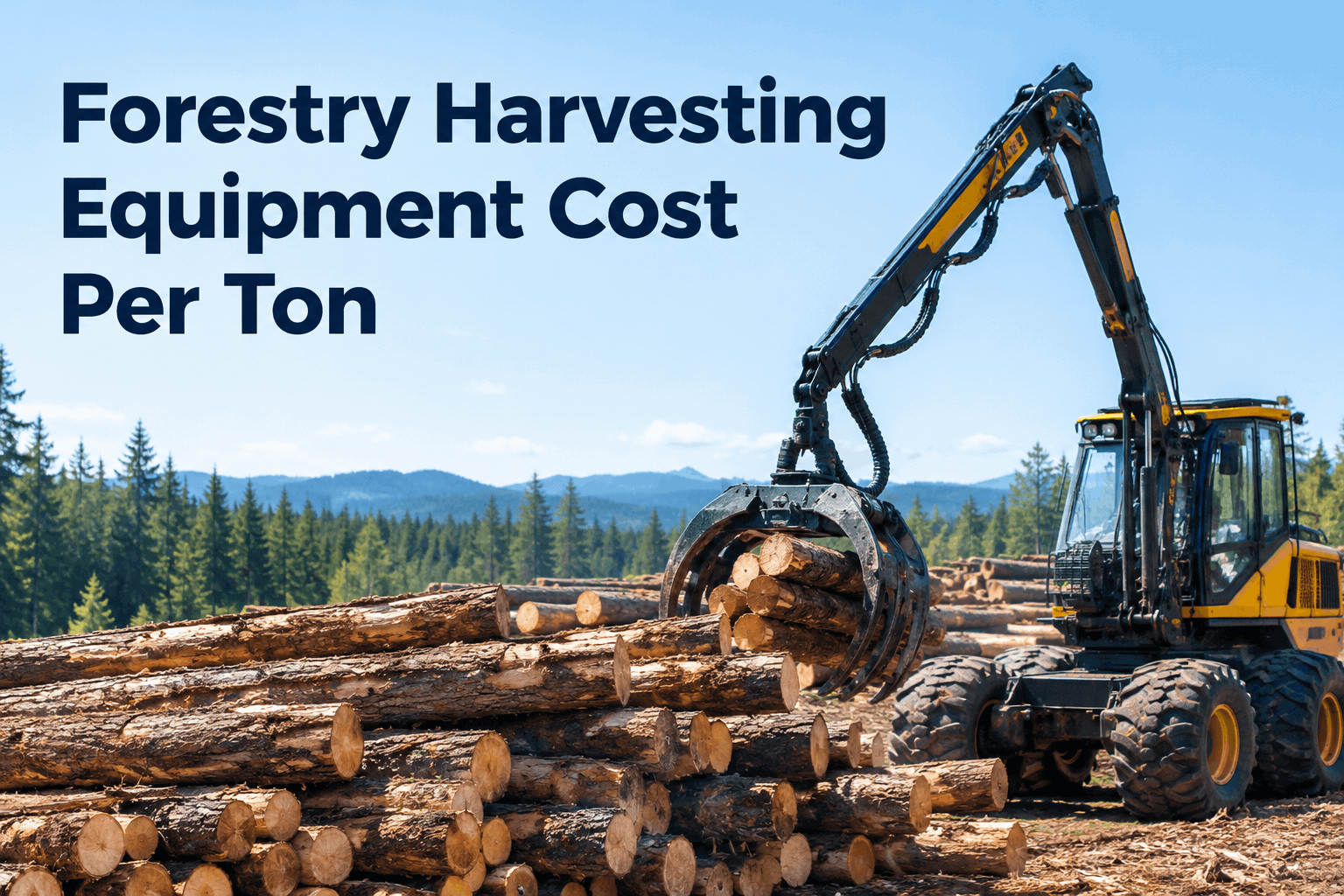
Ask ten logging contractors what their cost per ton is and most will give you a number they feel rather than one they can prove. The forestry harvesting equipment cost per ton you bid against is only as good as the fuel, repair, and machine-hour data behind it — and if that data lives in a notebook or a memory, the real number is almost always higher than the quote. Book a cost-per-ton demo and see where the gap hides.
Forestry Harvesting Equipment Cost Per Ton, Calculated From Real Machine Data
Stop bidding on a gut-feel rate. Tie every fuel fill, repair, and machine hour to the tons a unit actually moves — and watch your true cost per ton come into focus.
Cost per ton is the single number that decides whether a job makes money or quietly loses it. The formula is simple. Getting the inputs right across a fleet working remote landings is where most operations leak margin — and where the number you bid drifts away from the number you actually spend.
Total Cost ÷ Tonsthe formula is easy — the inputs are where margin leaks
Every forestry cost study and every OEM costing model lands on the same definition: cost per ton equals total operating cost divided by total production in tons. The U.S. Forest Service and Tigercat both state it the same way. The hard part isn't the division — it's capturing a complete, honest "total cost" for each machine while it's working miles from the shop.
According to the University of Montana's 2023 contractor survey, reported stump-to-loaded-truck costs ranged from about $36.54 per green ton for ground-based whole-tree systems to $48.25 for cut-to-length and $55.72 for cable systems. Those are blended system rates — the per-machine detail underneath them is exactly what you need to control, and exactly what paper records blur. If you want to see how a connected record keeps that detail machine by machine, book a demo of per-unit cost tracking.
Three cost classeshow the machine-rate method builds your $/ton
The machine-rate method — the costing standard taught in forest-engineering programs — splits every machine's cost into three classes before dividing by production. Miss any one of them and your cost per ton reads low on paper and high in the bank.
Runs whether the machine cuts a single stem or sits idle on a rained-out day. Spread it over too few productive hours and your $/ton balloons.
The line that moves most with hours worked and site conditions — and the one that's easiest to lose track of across multiple service-truck fills and field repairs.
Often tracked separately from the machine, so it gets forgotten in a quick-and-dirty $/ton. It belongs in the stack every time.
Fuel and repairs are the two variable lines that swing hardest. Montana contractors reported that a 10% change in fuel price moves logging cost by roughly 2.5% — small per gallon, large per season. Pair fuel capture with the HVI fuel log and cost tracking and the variable line stops being a guess. For the repair side, see how work orders roll straight into machine cost in the HVI maintenance management module.
The utilization trapwhy downtime is the costliest line you never invoice
Here's the number that quietly wrecks a bid: cost per scheduled machine hour versus cost per productive machine hour. Ownership keeps depreciating while a machine waits on a part. The fewer hours it actually produces, the higher the cost those same fixed dollars have to carry — so every hour of unplanned downtime pushes your real cost per ton up without ever showing on an invoice.
The cash-flow shortcut of dividing last year's total spend by last year's tons hides this completely — the Forest Service warns it does a poor job of spreading major repairs and downtime. The fix is preventive, not reactive: fewer surprise failures means more productive hours and a lower true cost per ton. That's the direct payoff of HVI preventive maintenance scheduling by meter hour. Want it mapped to your own fleet? Book a demo to see utilization and $/ton together.
Where the dollars hidethe per-ton lines most logging operations undercount
When a cost per ton reads too good to be true, it usually is — because a few real lines never made it into the total. These are the ones that separate a quoted rate from a banked one.
Tires and tracks are the classic blind spot — a single sidewall cut on a stump ends a casing in one pass, and that lumpy cost rarely gets pinned to the machine that incurred it. The logic for tracking it sits in the HVI forestry tyres, tracks and bands guide. The broader point: a cost per ton built on a complete record beats a confident guess every bidding season.
Cost-per-ton checklist7 lines to confirm before you trust your number
Run your current cost per ton against this list. If you can't answer any line with real data per machine, that's a leak — and the reason your bid and your bank balance disagree.
- Machine hours are read from the meter, not estimated.Productive and scheduled hours captured per unit, daily.
- Every fuel fill is tied to a specific machine.Including service-truck transfers, not pooled into one bill.
- Field repairs and parts post against the unit that failed.Emergency fixes included, with labor time logged.
- Tire, track and band replacements are costed per machine.Lumpy wear items assigned, not buried in a shop total.
- Downtime hours are recorded, not just repair dollars.Lost production is the cost the invoice never shows.
- Production tons come from scale tickets, matched to the job.Real delivered tons, not a visual load estimate.
- Ownership and overhead are spread over productive hours.Fixed cost carried by hours worked, not calendar days.
From record to dashboardwhat the HVI analytics view shows per unit
Once hours, fuel, and repairs flow in from the field, the cost per ton stops being a spreadsheet you rebuild every quarter and becomes a live metric per machine. This is a sample of what the HVI analytics and reporting dashboard surfaces.
That one flagged unit is the whole argument. A cost per ton reported by machine tells you which unit to fix, retire, or re-rate before it eats a contract — something a single fleet-wide average can never do. The forestry record that feeds it is covered in the HVI forestry CMMS for logging fleets.
What a logging contractor says about the number
For years our cost per ton was whatever the bookkeeper worked out in January — one number for the whole crew. The first month we tracked fuel and repairs by machine, the processor stood out a dollar-fifty a ton over the rest on a hydraulic issue we'd been babying. We'd been bidding every job as if all four machines cost the same. They never did.
Forestry harvesting equipment cost per ton — FAQs
How do you calculate forestry harvesting equipment cost per ton?
Divide total operating cost by total tons produced. Total cost includes ownership (fixed), fuel and repairs (variable), and labor; tons come from scale tickets. The accuracy depends entirely on capturing every cost line per machine. Book a demo to see it built per unit.
Why is my real cost per ton higher than the rate I bid?
Usually because downtime, field repairs, and pooled service-truck fuel never got assigned to the right machine, so the "total cost" was understated. Tracking each line per unit closes that gap. Book a demo of per-machine cost tracking.
What's a typical cost per ton for logging equipment?
University of Montana's 2023 survey reported roughly $36.54 per green ton for ground-based whole-tree, $48.25 for cut-to-length, and $55.72 for cable systems, stump to loaded truck. Your number varies with distance, tree size, and utilization. Explore the HVI analytics dashboard.
Does HVI calculate cost per ton for me automatically?
HVI captures the inputs — machine hours, fuel, parts, and repair cost per unit — and reports cost and downtime by machine. You enter your production tons; it does the rest so the number stays current, not once-a-year. Book a demo to walk through the setup.
How does preventive maintenance lower cost per ton?
Fewer surprise failures mean more productive hours, so the same fixed cost spreads over more tons and the per-ton rate drops. Preventive scheduling by meter hour is the main lever. See HVI preventive maintenance scheduling, or book a demo.
Know your cost per ton before the next job, not after
Give every harvesting machine a complete, connected cost record — and turn a once-a-year guess into a live metric you can bid against with confidence.
- Meter-hour capture per machine
- Fuel & repair cost by unit
- Downtime logged, not just dollars
- Cost per ton, live, per machine