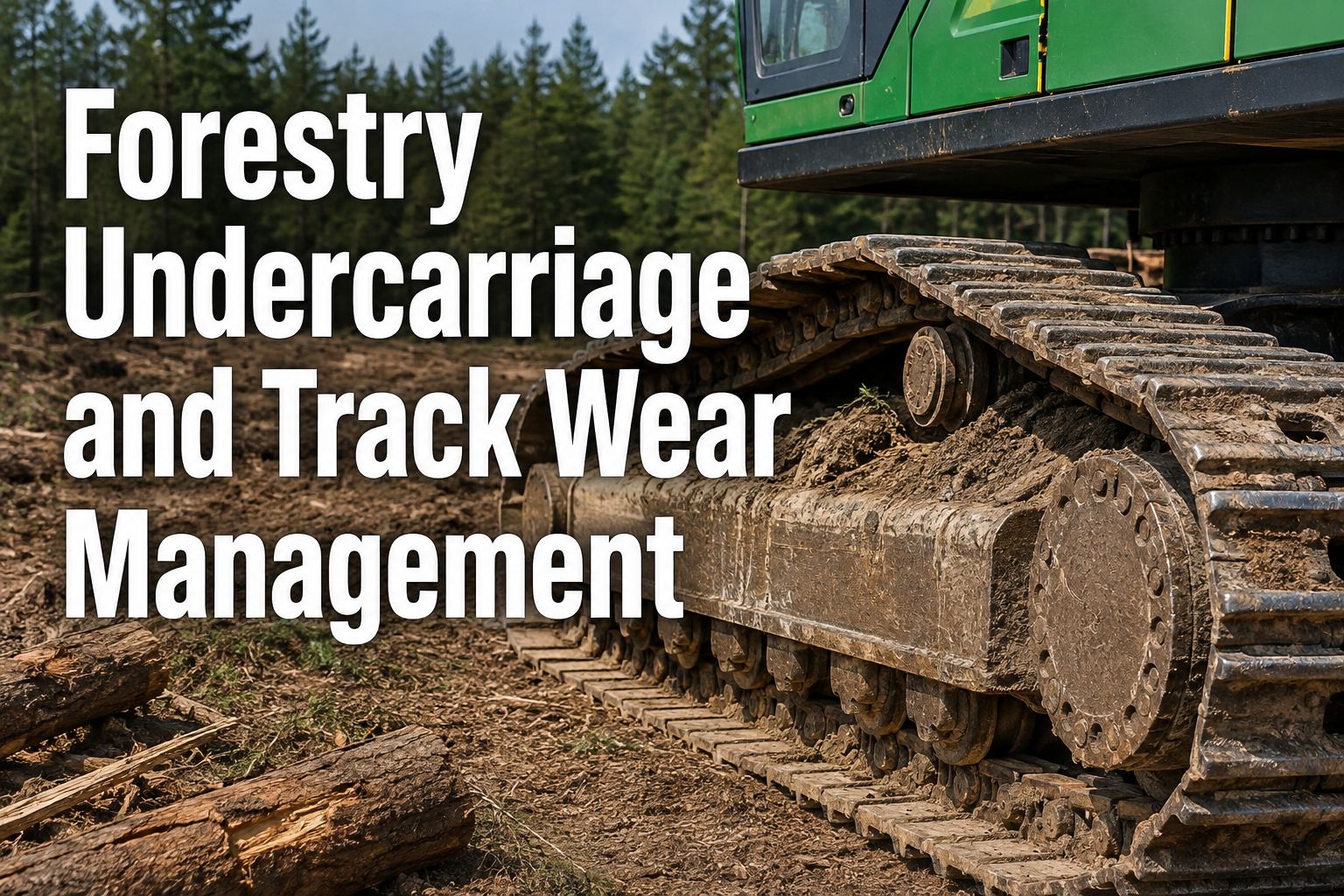
Your feller buncher is down on a Monday morning because a track chain let go on a steep block, and the rebuild quote that follows is the single biggest maintenance invoice you will see all year. Forestry undercarriage wear is the largest single maintenance cost on tracked logging machines, and it is also the most predictable one you have. The ground you work - steep, rocky, wet, stump-covered - eats links, bushings, rollers and sprockets faster than almost any other application, yet most crews still find out about a worn-out undercarriage when it fails, not when the numbers said it would. A simple measurement routine turns that surprise rebuild into a planned one, scheduled between blocks with parts already on the shelf. If you want to see what that looks like on your own machines, you can book a 30-minute walkthrough and watch it run on real units.
FORESTRY TRACK MAINTENANCE
What if your next undercarriage rebuild was on the calendar six months before it happened?
Measurement beats memory. A wear-rate curve built from simple readings tells you the rebuild date, the bushing-turn window and the parts order deadline - before the machine tells you with a thrown track on a hillside.
WHAT REACTIVE COSTS YOU
The real price of guessing at forestry undercarriage wear
Four numbers your accountant already knows, even if your inspection sheets do not.
On tracked machines the undercarriage routinely accounts for around half of all repair spend. Managing it reactively means your biggest cost line is also your least planned one.
Tight turning, high-speed travel and wrong track tension can double wear rate on the same machine in the same soil. Operators influence this number every single shift.
Turning bushings before they wear through restores chain life at a fraction of full chain replacement cost. Miss the window and you buy the whole chain.
A 2000-hour undercarriage overhaul PM only works if hours and wear readings are logged. Without a curve, 2000 hours is a guess dressed up as a schedule.
THE MEASUREMENT SET
Undercarriage measurement for forestry machines: the six readings that matter
None of these need a dealer visit. A trained tech with a gauge, a tape and a phone can capture all six in under an hour per machine.
Track tension vs spec
Measure sag against the manufacturer's specification for your ground conditions. Too tight accelerates pin and bushing wear; too loose chews sprockets and risks de-tracking on side slopes. This is a daily pre-start checkpoint, not a monthly one.
Link height
Rail height tells you how much of the chain is left. Log it per side and per machine so you can spot a chain wearing faster than its twin - usually a tension or turning-habit problem, not a parts problem.
Bushing wear
Outside-diameter wear on bushings decides your bushing-turn window. Measure across several positions; bushings wear unevenly, and the worst one sets the date, not the average.
Pin condition
Check for pin wear, seal leaks and dry joints. One dry joint on a logging machine working wet ground goes from noisy to seized fast, and a seized pin forces a chain split you did not plan.
Sprocket tooth profile
Hooked or pointed teeth mean the sprocket is grinding the bushings. Worn sprockets destroy new chains, so this reading decides whether a chain swap alone is money wasted.
Roller and idler wear
Flange height and tread diameter on rollers and idlers, plus any flat spots or seized rollers. A seized roller drags the chain and shows up as a fuel bill before it shows up as a failure.
In HVI these readings live on the machine's digital inspection form, with photo evidence attached to each measurement point. Tracks are already named as a pre-start checkpoint, so tension and visual condition get captured every shift, and the deeper six-point measurement slots into a scheduled inspection. If you want to see the form itself, you can walk through it on your own units in a demo.
CADENCE AND CURVE
Why a wear-rate curve beats any single reading
One measurement tells you where you are. Four measurements tell you when you will need a rebuild - that is the difference between reacting and planning.
Pre-start track check
Operator checks tension, looks for loose hardware, damaged pads and leaking seals on the pre-start inspection. Two minutes on the phone, photo attached, defect flagged instantly if something is wrong.
Measurement inspection
Tech captures the six-point measurement set and logs it against engine hours. HVI stores every reading on the asset record, so the history builds itself without a spreadsheet.
Wear-rate curve forms
With three or four readings you can see wear per 100 hours and project the date each component hits its limit. That projection is your rebuild date, your bushing-turn window and your parts order deadline.
Overhaul PM fires automatically
The 2000-hour undercarriage overhaul PM triggers on engine hours with due and overdue alerts, and the work order already carries the full measurement history. You can start logging inspections free and have the curve building this quarter.
WEAR DRIVERS
Four operating factors that set your track wear rate on logging ground
You cannot change the terrain, but your operators control more of the wear rate than most fleets realise. Coaching on these four factors is the cheapest undercarriage life extension you will ever buy.
Terrain and ground conditions
Rock and steep side slopes grind rails and flanges; wet, sandy soil works into seals and turns joints abrasive. Match shoe width to ground pressure and re-spec tension for soft going - a machine set up for the block it is on wears measurably slower.
YOU SET THIS PER BLOCKTravel distance between blocks
Long travel runs at speed heat pins and bushings and accelerate internal wear. Where a lowbed move is an option, compare the trucking cost against the wear cost per hour of travel - the wear cost usually loses, and now you have the readings to prove it.
A PLANNING DECISIONTurning habits
Counter-rotation and tight pivot turns are the fastest way to scrub rails and side-load rollers on a slope. Wide, gradual turns and alternating turn direction spread the wear. This is pure operator habit, and it shows up clearly in side-to-side measurement differences.
OPERATOR-CONTROLLED DAILYTrack tension discipline
Tension set once and forgotten is the silent killer. Mud packing into the sprockets tightens a chain as the shift goes on. A daily tension check on the pre-start inspection is the single highest-value two minutes in forestry track maintenance.
TWO MINUTES A DAYBUSHING TURN ECONOMICS
Bushing turn vs full chain replacement: the decision your measurements should make for you
The bushing turn is the highest-stakes timing call in undercarriage management. Too early wastes life; too late destroys the option entirely.
| Decision factor | Bushing turn | Full chain replacement |
|---|---|---|
| Typical cost | Roughly 30-40% of a new chain, plus press time | Full parts and labour, the biggest single line item |
| When it works | Bushings worn but not through; pins and links still within spec | Bushings worn through, links or pins past limit |
| What you get back | A second wear life on the same chain | Full service life, at full price |
| Risk if mistimed | Wait too long and the turn window closes permanently | Done early, you pay for life you did not need yet |
| What decides it | Bushing OD readings trending toward the turn spec | Link height and pin readings past manufacturer limits |
A worked example: say a full chain set on your buncher runs $28,000 fitted. A bushing turn at the right point costs around $9,000-$11,000 and buys a second wear life. Miss the window by 200 hours because nobody measured, and that $10,000 decision becomes a $28,000 invoice plus unplanned downtime mid-block. Fleets that book a demo to see the measurement history view usually spot this exact pattern in their own records within the first session.
See your rebuild date before your machine announces it
Book a 30-minute demo and we will load one of your tracked units into HVI - inspection form, measurement fields, hour-based PMs and all.
PLANNING PAYOFF
Undercarriage rebuild planning: order parts early, book work between blocks
A projected rebuild date is worth more than the measurement itself, because of what it lets you do upstream.
Without a wear projection
- Chain fails or hits limit mid-block; machine down on the hill
- Long-lead undercarriage components ordered at emergency freight prices
- Press and technician booked at whatever rate is available that week
- Production lost while the machine waits on parts
- Bushing-turn window discovered after it has already closed
With a projected rebuild date
- Chains, rollers, idlers and sprockets ordered months ahead at standard pricing
- Work scheduled in the gap between blocks, not in the middle of one
- Shop time and press booked at planned rates
- Work order pre-loaded with the full measurement and photo history
- Bushing turn done inside the window, saving 30-40% per chain
This is where undercarriage budgeting stops being a yearly argument. When every tracked unit has a projected rebuild month, next year's maintenance budget writes itself from data instead of last year's invoices. Parts managers can see what is coming across the whole fleet and stock accordingly, and you can book a demo to see the fleet-wide PM forecast that makes that possible.
HOW HVI HELPS
HVI turns undercarriage readings into rebuild dates
Four capabilities, each mapped to a concrete outcome on tracked forestry equipment.
Digital inspections with photo-backed measurement capture
Tracks are a named pre-start checkpoint, and the six-point measurement set lives on a scheduled inspection form. Every reading carries a photo, a timestamp and the tech's name - no paper sheets lost in the cab.
Hour-based preventive maintenance
The 2000-hour undercarriage overhaul PM triggers automatically on engine hours with due and overdue alerts, so the interval is enforced by the system, not by someone remembering.
Instant defect-to-work-order
A leaking seal or seized roller found at pre-start becomes a work order in seconds, with the photo attached. Small fixes happen this week instead of becoming chain damage next month.
Asset history and cost-per-asset analytics
Every reading, repair and invoice sits on the machine's record, building the wear-rate curve and the cost picture you need to defend rebuild timing and next year's budget internally.
It runs on any phone or tablet, works at the landing with no office involved, and covers your trucks, trailers and off-road plant in the same platform. You can sign up free and build your first track inspection today.
KEY TAKEAWAYS
Forestry undercarriage wear is predictable - manage it that way
Everything on this page comes down to five habits.
The undercarriage is roughly half your tracked machine's maintenance cost and its most predictable one - reactive management is a choice, not a constraint.
Six readings - tension, link height, bushings, pins, sprockets, rollers and idlers - captured on a 250-500 hour cadence build the wear-rate curve that projects your rebuild date.
Operators set the wear rate daily through turning habits, travel discipline and tension checks; coach from measurement data, not gut feel.
The bushing-turn window saves 30-40% per chain, but only measurements tell you where the window is.
A projected rebuild date lets you order long-lead parts early and book the work between blocks - the whole point of measuring in the first place.
"I used to find out about undercarriages from the operator's phone call - track off, machine on a slope, job stopped. Now I watch one number: millimetres of bushing wear per hundred hours. When that number moves, I move the rebuild date. Last year we caught two bushing-turn windows we would have missed, and that alone paid for every minute we spent measuring. My only gripe is we started three years later than we should have."
Dale Merrick - Maintenance Manager, BC-based stump-to-dump logging contractor, 14 tracked units
COMMON QUESTIONS
Forestry undercarriage and track wear: your questions answered
How often should you measure undercarriage wear on logging equipment?
When should you turn bushings instead of replacing the track chain?
What wears an undercarriage fastest in forestry work?
How do you predict an undercarriage rebuild date?
Can a CMMS really help with track wear, or is it just paperwork?
Put your next rebuild on the calendar, not on the incident report
Start with one machine: build the inspection, log the first measurements, and watch the wear-rate curve form. The rebuild date follows.
Free to start - Works on any phone - No card needed