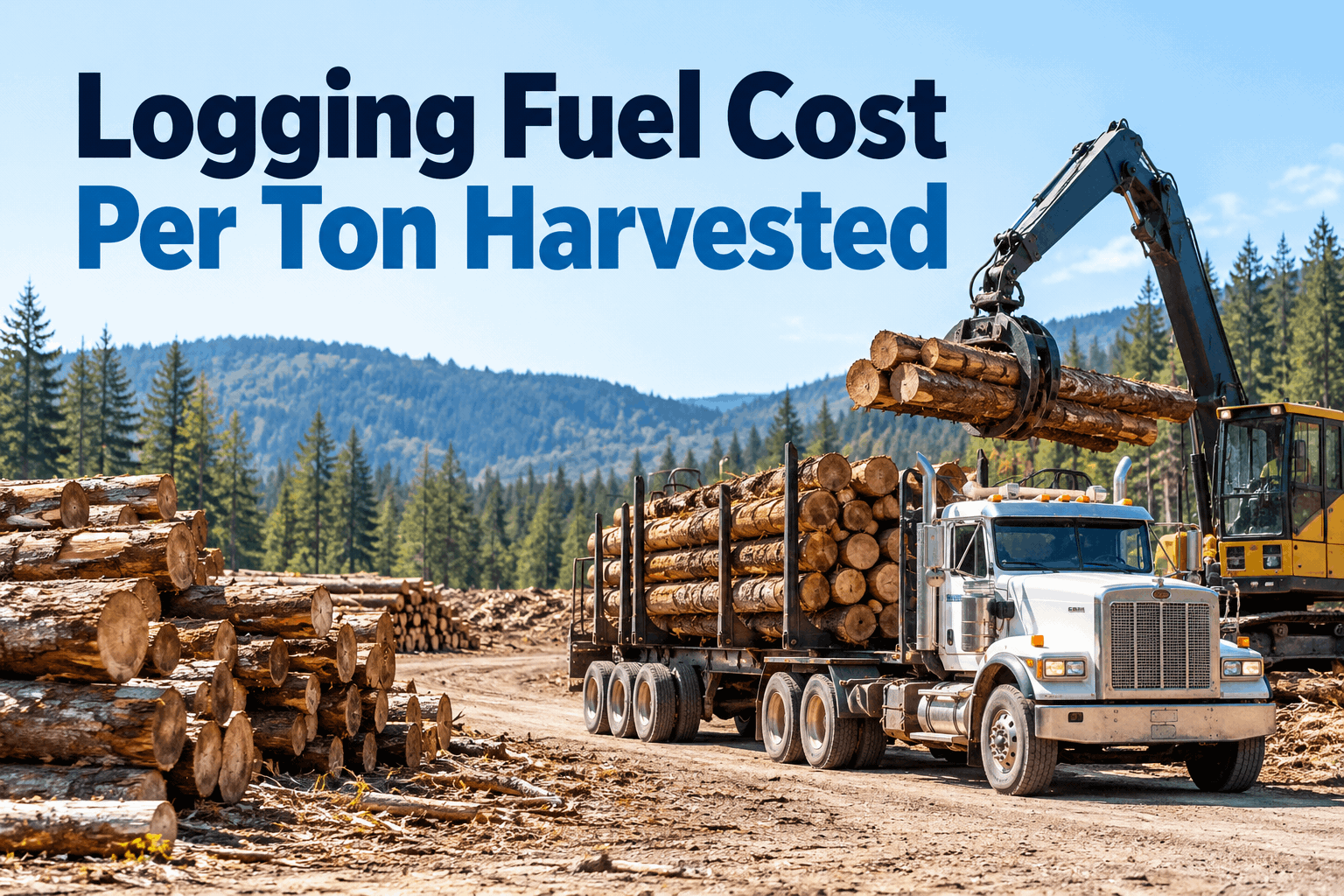
Logging fuel cost per ton is the number that tells you what you're really spending to put timber on the truck. You can track total fuel all day, but a big fuel bill on a big harvest might be fine — and a small bill on a small harvest might be terrible. The only way to know is to divide fuel cost by tons harvested, and once you do, the differences between machines, crews and sites jump out: one feller buncher is sipping, another is drinking, and the idle hours nobody watches are quietly adding dollars to every ton. Book a demo of fuel-per-ton tracking.
Your Logging Fuel Cost Per Ton Is the Number the Fuel Bill Hides
Total fuel spend tells you nothing without the tonnage behind it. Cost per ton harvested turns a big scary fuel bill into a number you can actually judge — and act on.
Fuel is one of the biggest line items in any logging operation, and most contractors watch it as a single scary number on a monthly statement. The problem is that a total tells you nothing about efficiency. Two crews can burn the same fuel and one is making money while the other is bleeding it — the difference is how many tons each put on the truck for that fuel. Cost per ton harvested is the metric that makes fuel efficiency visible, turns a vague "fuel's killing us" into a specific machine or habit you can fix, and lets you compare a buncher to a skidder, this site to the last one, this week to last.
Why per tonthree ways to measure fuel, and why per-ton wins
There are three common ways loggers look at fuel, and the first two can both be misleading. Only cost per ton ties fuel to what it's actually buying you — production.
The monthly bill. Scary and useless on its own — a high number on a big harvest can be perfectly fine.
no contextBetter — ties fuel to run time. But a machine idling or working slow burns fuel per hour while producing nothing.
misses outputTies fuel to production. A machine that burns more but harvests far more can still be your cheapest per ton.
the real numberFuel per hour is a trap in logging because so much fuel goes to idle and repositioning, not cutting. Per ton cuts through it — it rewards the machine that actually moves wood. This is the production-normalized view that general fuel tracking misses — see our general equipment fuel tracking guide for the raw-consumption side. Explore fuel logs per machine.
The equationhow fuel cost per ton harvested is built
Cost per ton is a simple ratio, but it needs three numbers tracked honestly. Get them and the figure falls out; miss any one and you're back to guessing.
- Fuel used × priceGallons or litres burned per machine, times the fuel price. This is the cost side — logged per machine, not pooled.
- Tons harvestedProduction from scale tickets or load counts. The output side the cost is divided by.
- Cost per tonThe result — what fuel costs you to harvest a ton. Comparable across machines, crews and sites.
The honest part: the tonnage comes from your scale tickets, not from a maintenance system. What HVI tracks is the cost side — fuel burned and hours run per machine — so you have an accurate numerator to pair with your production figures. Tracked loosely, the whole ratio is garbage; tracked per machine, it's one of the sharpest efficiency numbers you've got. Explore fuel and hours reporting, and book a demo of per-machine fuel data.
What drives it upthe cost-per-ton killers hiding in your operation
When fuel cost per ton creeps up, it's almost always one of these — and most are invisible until you track fuel against production per machine. Each is a fixable habit or mismatch, not a fact of life.
Idle time alone can swing fuel cost per ton more than any other single factor, and it's invisible without hour and fuel data per machine. Catch it and you've found savings on every ton you cut. Sign up free and start tracking idle and fuel.
Can you cost itthe fuel-cost-per-ton readiness checklist
You can only calculate fuel cost per ton if these are tracked. Run your operation against the list — any "no" is a reason your per-ton number is either a guess or impossible to produce.
- Fuel is logged per machine, not pooled across the fleet
- Fuel price is captured, so cost — not just volume — is known
- Burn can be seen per machine over a period
- Operating hours are tracked per machine
- Idle time is visible, not buried in run hours
- You can tell productive hours from idle ones
- Tonnage harvested is recorded per period or site
- Production can be matched to the machines that did it
- Scale tickets or load counts are kept, not lost
- You can compare fuel per ton across machines
- You can compare it across sites or jobs
- A worsening trend is caught early, not at year-end
Twelve confident "yes" answers mean fuel cost per ton is a number you can produce, compare and act on — not a figure you wish you had. Book a demo to see the fuel efficiency view.
What it revealshow fuel cost per ton exposes the real picture
The power of the metric is in the comparison. Put two machines side by side on fuel per ton and the truth comes out — the one with the bigger fuel bill isn't always the expensive one.
| What you see | Machine A | Machine B |
|---|---|---|
| Total fuel bill | Higher | Lower |
| Tons harvested | Much higher | Lower |
| Idle share | Low | High |
| Fuel cost per ton | Lower — the efficient one | Higher — the costly one |
| The snap judgment | "Looks expensive" | "Looks cheap" |
| The truth per ton | Your best machine | Your worst |
Judge by the fuel bill alone and you'd blame Machine A. Per ton, it's your best performer — Machine B just hides its inefficiency behind a smaller total because it produces less and idles more. That reversal is exactly why per-ton matters, and it only shows up when fuel and hours are tracked per machine against production. It pairs directly with the haul side in our log trucking cost per mile and per turn guide.
The cost on recordfuel efficiency tracked per machine
When fuel, hours and idle all run against the machine, the fuel side of cost per ton reads off one view — ready to pair with your tonnage. Here's the record that replaces the fuel-card guesswork.
That view is the fuel side of your harvesting cost, ready to divide into your tonnage. It's built from the records HVI already keeps for fuel and hours — cost per ton is just those records, read against production. Explore PM that keeps fuel burn efficient.
From a logging operations manager tracking harvest efficiency
We always looked at fuel as one big number and just winced at it every month. The day we started dividing fuel by tons, everything changed — turned out our newest, thirstiest buncher was actually our cheapest per ton because it moved so much wood, and an older machine we thought was economical was the worst once you counted how much it idled. We'd have scrapped the wrong one. Now I watch fuel per ton per machine and per site, and when it creeps up I can usually point straight at the cause — idle, a long skid, or an engine overdue for service. It turned fuel from a number we dreaded into one we manage.
Logging fuel cost per ton — FAQs
How do you calculate logging fuel cost per ton?
Multiply fuel used by the fuel price to get fuel cost, then divide by the tons harvested over the same period. Tracking fuel per machine and pairing it with scale-ticket tonnage gives you a cost per ton you can compare across machines, crews and sites.
Why use fuel cost per ton instead of total fuel spend?
Because total spend has no context — a big bill on a big harvest can be fine. Cost per ton ties fuel to production, so it shows true efficiency and lets you compare a machine that burns more but harvests far more against one that burns less and produces little.
What raises fuel cost per ton the most?
Idle time is usually the biggest single driver — fuel burned while harvesting nothing. Others include an oversized or poorly matched machine, long skid distances, a worn or underserviced engine, and operator habits like heavy throttle and unnecessary travel.
Does idle time really affect fuel cost per ton?
Significantly. A machine idling at the landing burns fuel while producing zero tons, so every idle hour pushes the per-ton number up. It's often the easiest win, but it's invisible unless idle and fuel are tracked per machine.
How does HVI help track fuel cost per ton?
HVI tracks the cost side — fuel burn and operating hours, including idle, per machine. Pair that with your tonnage from scale tickets and you get an accurate fuel cost per ton. It also schedules the PM that keeps engines burning efficiently, so the number stays honest.
Turn fuel from a scary total into a number you control
Fuel and operating hours per machine, idle time made visible, and PM that keeps engines efficient — so you can pair the cost side with your tonnage and see exactly which machines, crews and sites are costing you per ton. The fuel data's already flowing; HVI tracks it where the tonnage can meet it.
No credit card · No hardware · Track fuel and hours per machine from day one