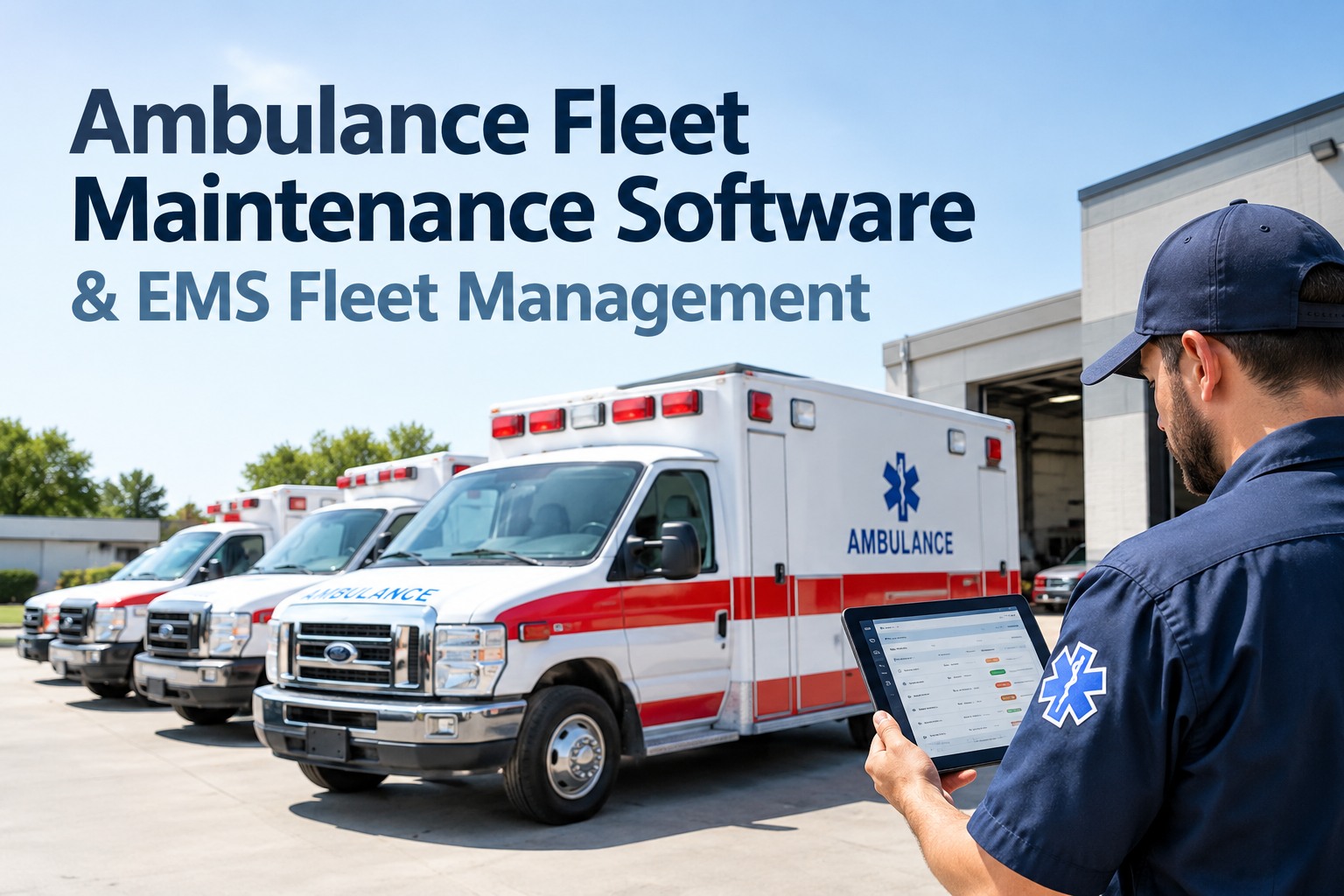
An ambulance parked at the station looks like one vehicle. It's actually three assets stacked together, each aging on its own clock: a hard-idled chassis, a patient module full of independent electrical and oxygen systems, and a cabinet of medical equipment that lives or dies on calibration dates. Manage them as one line on a maintenance schedule and something always slips — usually the defibrillator battery or the module A/C, discovered on a call. Good ambulance fleet maintenance software tracks all three clocks at once and rolls readiness into one dashboard. This guide shows why that matters and what to actually track. Book a demo to see the EMS dashboard.
An ambulance isn't a single maintenance asset
The chassis, the patient module, and the medical equipment each run on a different schedule with different triggers — and a fleet system that tracks only the chassis leaves two-thirds of the ambulance uncovered. Miss any one clock and the unit isn't truly ready, no matter how good the engine looks.
That three-clock reality is why EMS fleet management is genuinely different from running a commercial truck fleet: a mechanically perfect ambulance still can't roll if its oxygen, defibrillator, or medications aren't ready. Below is what drives each clock, why engine hours matter more than mileage, how the shift-change check ties it all together, and how one dashboard keeps units available.
The chassis: why engine hours beat mileage
Start with the mistake that quietly wears out ambulance powertrains: scheduling maintenance on odometer miles alone. An ambulance idles for hours — on scene, at the hospital bay, on standby — running the engine hard while the odometer barely moves. A unit can show low miles and be badly overdue for service, because the wear happened at idle, not on the road.
The fix isn't complicated, but it's specific: schedule powertrain, charging, and HVAC service on engine hours and mileage together, whichever hits first, and load-test the electrical system on the tighter interval emergency duty demands. Book a demo to see multi-trigger PM on one asset
The patient module: a mobile emergency room
Behind the cab is effectively a second vehicle with its own systems — and its own inspection scope under standards like NFPA 1917, which governs far more than the chassis. The module has independent electrical, climate, oxygen, and structural systems, and every one of them is a patient-safety item, not a comfort feature. A module that fails is a unit out of service even with a perfect engine.
Electrical & power
Independent module wiring, the inverter and shore-power systems, and interior and scene lighting — all carrying the load that keeps clinical equipment powered during long idles.
Oxygen systems
Main and portable oxygen — cylinder pressure, delivery, regulators, and mounting. A patient-care system with its own testing and inspection needs, checked for adequate pressure every shift.
Climate control
Module HVAC keeps the compartment and temperature-sensitive medications within range. On a hot standby or a cold call, it's a clinical requirement, not comfort — and it runs off the strained electrical system.
Cot mounts & structure
Gurney mounting and locking hardware, structural mounting points, interior fixtures. A cot lock that doesn't seat is a patient-safety failure in a crash — inspected for smooth, secure operation.
Because the module runs on inspection and calendar cycles rather than engine wear, it needs its own maintenance track that doesn't get buried under chassis service — two tracks, one unit, neither hiding the other. Start free and give the module its own inspection template
Medical equipment: assets with their own certificates
This is the clock that catches fleets built for vehicles, because it has nothing to do with the vehicle. A defibrillator, a cardiac monitor, a suction unit, a ventilator — each is a distinct asset with its own calibration schedule, certification expiry, and testing record, entirely separate from the chassis PM. An AED that won't deliver a shock because its battery lapsed isn't a vehicle problem; it's a patient-safety failure that a chassis-only maintenance system will never catch.
Tracking both chassis and equipment PM in the same system closes the gap where vehicle maintenance and medical-equipment maintenance are managed separately — the gap where neither program covers the whole ambulance and a lapse hides until it matters. Book a demo to track medical equipment with certificate alerts
The shift check: two readiness questions in five minutes
Everything above comes together at shift change, in the single most valuable preventive check an EMS agency has. The crew coming on has to answer two questions, not one: can this vehicle respond safely, and can the compartment support patient care? A mechanically sound ambulance with a dead monitor is not ready — and only a check that covers both layers catches that.
- Fluids, tires, brakes, lights, warning devices
- Fuel and battery state; charging system
- Body and chassis walkaround for damage
- Any dash warnings or new noises
- Oxygen pressure, main and portable
- Defibrillator/monitor powered, charged, tested
- Suction, medications in date, restock complete
- Cot lock, module lighting, climate control
Done on paper, that check is slow and its findings vanish into a binder. Done as a guided five-minute mobile check, each item is confirmed in order, nothing gets skipped, and any failed item routes straight to the shop as a work order with the unit ID attached — no separate form, no lost note. Start free with a guided EMS shift check
Defect to work order to readiness — on one dashboard
The payoff of tracking all three clocks in one system is what happens after a defect is found. Instead of a note that waits for someone to act, the finding moves through a closed loop the whole department can see — and readiness updates in real time, so a shift commander knows what's deployable without calling the shop.
For a government fleet running ambulances alongside fire apparatus, police, and public-works vehicles, one system handling every vehicle type removes a real source of audit risk — department-level visibility in one place, instead of a different process and a different binder for every fleet. And because EMS records tie back to requirements like systematic inspection and recordkeeping under 49 CFR Part 396, keeping that trail digital and complete is compliance insurance as much as operational clarity. Book a demo to see department-level fleet readiness
From an EMS fleet manager who stopped chasing binders
The one that still bothers me: we pulled a rig for a chassis issue, fixed it fast, put it back — and it went out with a monitor whose calibration had lapsed three weeks earlier. Nobody caught it because the equipment records lived in a separate binder from the vehicle PM. The truck was "ready." The compartment wasn't.
Now the vehicle, the module, and every piece of medical equipment are tracked in one place, each on its own schedule, and the shift check covers both layers in one pass. When a certificate is coming due I see it before it lapses, not after. And I can look at the board and know exactly which units are deployable without walking down to the shop. That's the difference — readiness stopped being a guess.
Frequently asked questions
What makes ambulance fleet maintenance different from a regular fleet?
An ambulance is not a single maintenance asset the way a delivery truck is — it combines three things that age on different clocks and must all be ready at once. The first is a high-duty chassis that accumulates heavy engine hours from scene idle, hospital waits, and standby, often far ahead of its mileage. The second is a patient-care module with independent electrical, oxygen, climate-control, lighting, and structural systems, inspected under standards such as NFPA 1917 that cover far more than the engine and brakes. The third is medical equipment — defibrillators, monitors, suction units, oxygen gear — each a separate asset with its own calibration, testing, and certification schedule that has nothing to do with vehicle mileage. The practical consequence is a dual readiness requirement: a mechanically perfect ambulance still cannot enter service if its oxygen, defibrillator, medications, or required records are not ready. Ordinary commercial fleet management, built around chassis PM alone, leaves the module and the equipment uncovered, which is exactly where readiness gaps and patient-safety failures hide. EMS fleet management has to track all three clocks together and confirm both the vehicle and the compartment every shift.
Why track engine hours instead of just mileage on an ambulance?
Because ambulances do a large share of their engine wear standing still. A unit idles for extended periods on scene, waiting at the hospital bay, and on standby, running the engine, charging system, and HVAC hard while the odometer barely moves. If maintenance is scheduled on mileage alone, an ambulance that has idled for hundreds of hours can look low-mileage and overdue for service at the same time — the wear happened, but the trigger that would have caught it never fired. Tracking engine hours alongside mileage, and servicing on whichever interval comes due first, flags a hard-run unit on time rather than months after the damage started. Idle load is also brutal on the electrical system specifically: medical equipment, lighting, and climate control draw heavily while the engine idles, straining batteries, alternators, and inverters, which is why emergency vehicles typically need battery load testing far more frequently than an ordinary fleet. A battery that cranks fine at the station on a summer afternoon can fail on a cold winter call when its capacity drops. Hour-based triggers, plus tighter electrical testing intervals, are how an EMS fleet catches this wear before it becomes an out-of-service event on a response.
How should medical equipment be tracked in a fleet system?
Each piece of medical equipment should be tracked as its own individual asset, with its own calibration schedule, certification expiry, and testing history, linked to the ambulance it's assigned to but maintained as a distinct record rather than lumped into the vehicle's PM. Defibrillators, cardiac monitors, suction units, ventilators, and oxygen equipment each have testing and calibration requirements that are entirely separate from the chassis, and treating them as vehicle sub-items is how lapses slip through. The system should alert well before a calibration or certification date expires — ideally with staged reminders — so testing is scheduled ahead of the lapse instead of discovered during an audit or, in the worst case, on a call when the device is needed. The failure mode that makes this critical is stark: an AED that cannot deliver a shock because its battery was not replaced on schedule is a patient-safety failure, not a vehicle maintenance issue, and a chassis-only system will never flag it. Medication expiry, restock verification, and controlled-substance logs belong in the same record too, so that confirming a unit is ready means confirming the whole compartment, not just the vehicle. Keeping equipment and vehicle maintenance in one system closes the common gap where the two are managed separately and neither program fully covers the ambulance.
What should an ambulance shift-change inspection cover?
A shift-change inspection has to confirm two layers of readiness, because an ambulance can fail on either one independently. The first layer is the vehicle: fluids, tires, brakes, lights and warning devices, fuel and battery state, the charging system, and a body-and-chassis walkaround for damage or new dash warnings — everything that determines whether the unit can respond safely. The second layer is the patient compartment: main and portable oxygen pressure, the defibrillator or monitor powered and tested, suction function, medications present and in date with restock verified, the cot lock and mounting, module lighting, and climate control — everything that determines whether the compartment can support clinical care on arrival. This dual check is the most valuable preventive-maintenance tool an EMS agency has, because it catches problems at the start of a shift rather than mid-response, and digitizing it is one of the highest-return steps a fleet manager can take. A guided mobile check walks the crew through both layers in a few minutes, forces each item to be confirmed so nothing is skipped, and routes any failed item straight to the maintenance queue as a work order with the unit ID attached — instead of a paper form whose findings never reach the shop. Recording it also builds the driver-inspection and maintenance trail that supports compliance.
Can one fleet system manage ambulances alongside other government vehicles?
Yes, and for a government or municipal fleet that's a significant advantage rather than just a convenience. Emergency services and public works departments typically run a mix — ambulances, fire apparatus, police vehicles, and public-works equipment — each with its own inspection templates, maintenance intervals, and compliance requirements. Managing each vehicle type in a separate process, or on paper, creates audit risk because the records are scattered and inconsistent, and it hides fleet-wide readiness behind department silos. A single fleet maintenance system with configurable templates by vehicle type lets an ambulance carry its dual chassis-and-module tracks and its medical-equipment records, while a fire engine or a plow truck carries its own appropriate checks, all in one platform. The benefit for leadership is department-level visibility: a fleet director or shift commander can see readiness across every unit and vehicle type in one dashboard, and every defect flows through the same defect-to-work-order-to-readiness loop regardless of which department the vehicle belongs to. It also keeps maintenance and inspection recordkeeping — relevant to requirements like systematic inspection and repair under 49 CFR Part 396 — consistent and audit-ready across the whole fleet, instead of a different binder and a different standard for each department.
See the EMS fleet dashboard in HVI
HVI brings the ambulance's three maintenance clocks into one government fleet dashboard — chassis PM on mileage and engine hours, module inspections on their own cycle, and medical equipment tracked as individual assets with calibration and certification alerts. Guided five-minute shift checks confirm both the vehicle and the compartment, defects become work orders automatically, and readiness rolls up department-wide. One platform across every vehicle type, keeping emergency units available. Live for your agency in days.
No credit card · Configurable templates by vehicle type · Onboard in days