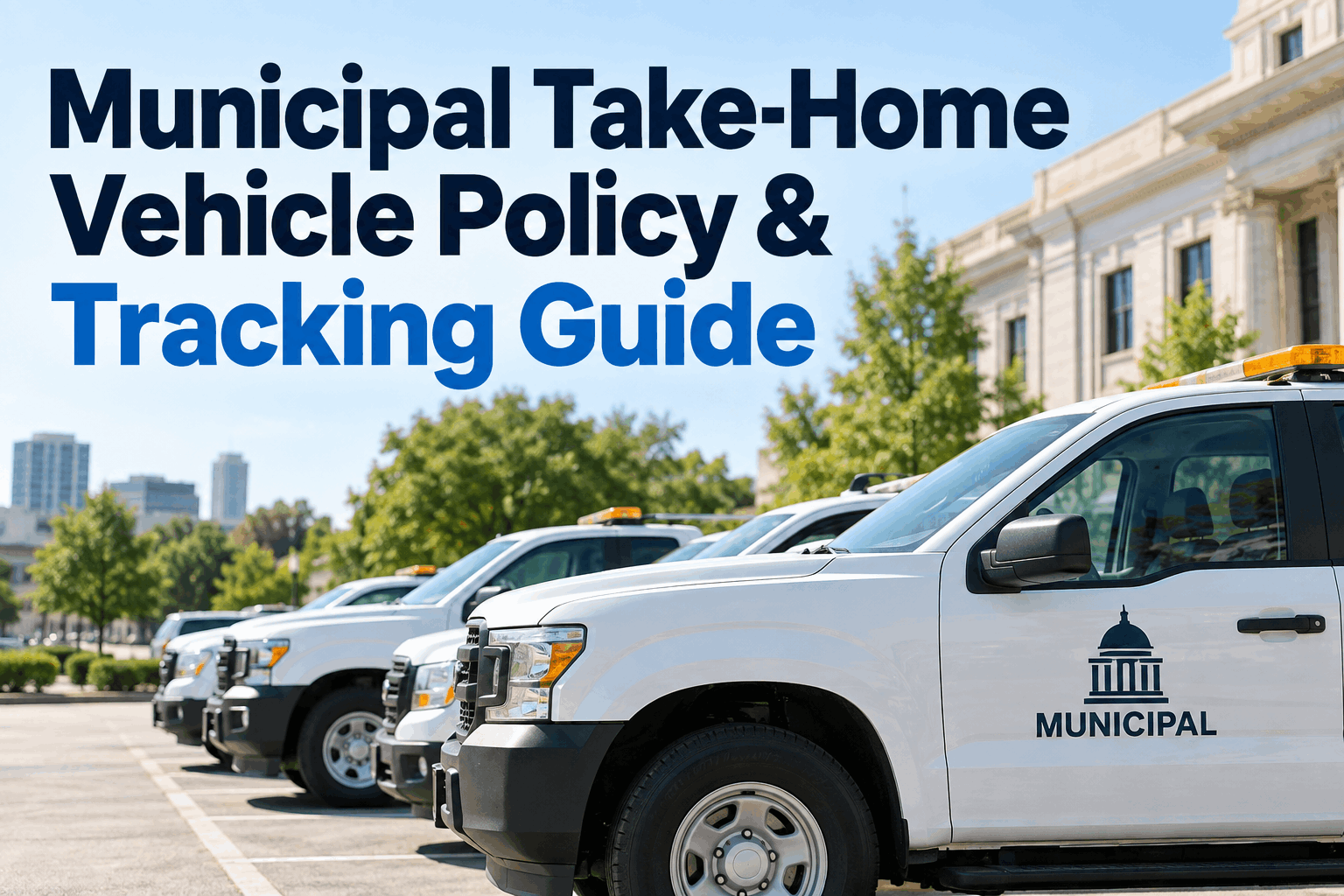
Few fleet topics draw a public audit faster than take-home vehicles. The moment a council member asks "how many city vehicles go home at night, with whom, and why," a fleet office without clear records is on the back foot. A municipal take home vehicle policy answers that before it's asked — who qualifies, on what justification, under what rules, and how often each assignment is reviewed. This guide covers what a defensible policy contains and the records behind it — book a demo to see the recordkeeping in HVI.
Answer "who, why & how often" before the audit asks.
A take-home policy is only as strong as the records behind it. HVI keeps each vehicle's assignment, usage history and service record in one place, so fleet leaders can review every take-home assignment with real asset-level data — not a spreadsheet nobody trusts.
Take-home vehicles aren't inherently a problem — on-call crews, emergency responders and inspectors often genuinely need them. The problem is when nobody can say which assignments are justified, how much they're actually used, or when they were last reviewed. A municipal take home vehicle policy turns those unknowns into a documented, reviewable program. Here's what it has to define, and the records that make it hold up.
Why take-home programs draw scrutinythe accountability gap auditors look for first
Take-home vehicles sit at the intersection of public money and personal benefit, so they attract attention. Audits of municipal programs tend to flag the same few gaps — none about the vehicles themselves, all about the records.
No clear justification on file
A vehicle goes home because it always has, with no documented reason tied to a role or a response requirement. When the audit asks "why this assignment," there's no answer on record.
Assignments never reviewed
An assignment made five years ago is still running because no one revisits it. Roles change, response needs change, but the vehicle keeps going home — unreviewed and unquestioned.
Usage you can't show
The fleet can't produce how much an assigned vehicle is actually used, so there's no way to tell a well-justified assignment from a low-mileage perk. Without usage data, every assignment looks the same.
Each gap is a recordkeeping problem, not a vehicle problem — which means it's solved by keeping the right asset-level record, not by cutting the program. That's where fleet records and utilization reporting turn a take-home program from a liability into something defensible. Book a demo to see assignment records in one place →
What a take-home vehicle policy must definethe 5 elements of a defensible municipal vehicle use policy
A policy that survives an audit spells out five things clearly. Leave any one vague and that's exactly where the questions land.
The first three live in the written policy; the last two live in the system that holds the records. HVI covers the records half — assignment, usage and service history per vehicle — so the policy's requirements have somewhere to actually live. Start free and build your assignment register →
The justification testdoes this assignment actually earn a take-home vehicle?
The heart of a fair policy is a consistent test applied to every assignment — not a case-by-case judgment call. Most defensible programs weigh an assignment against a short set of criteria, and a "yes" has to clear a real bar on at least one.
Applied consistently and documented per vehicle, the test turns take-home decisions from a political question into a records question. HVI stores the justification alongside the usage that supports or undercuts it, so a reviewer can see both together. Book a demo to see justification and usage on one record →
The annual review cyclewhy take-home vehicle tracking is a loop, not a one-time decision
An assignment justified three years ago may not be justified today. The discipline that keeps a program clean is a recurring review — each take-home vehicle revisited on a cadence, checked against the criteria, and re-approved or ended.
The step that fails most often is the review — assignments get made and then forgotten. When the system flags each vehicle's review date and surfaces its usage, the annual check becomes a routine report instead of a special project nobody has time for. That's the loop that keeps a program audit-ready year after year.
Take-home vehicle tracking in HVIthe assignment register a fleet director reviews
This is what makes a program reviewable: every assigned vehicle, who holds it, its justification, annual usage and when it was last reviewed — the view a fleet director or compliance officer opens when the question comes up.
The register surfaces exactly what a reviewer needs — overdue reviews, low-usage assignments worth a second look, and the justification behind each one. That's accountability a scattered spreadsheet can't offer, and it builds from the same asset records and inspections the fleet already keeps. Book a demo to see this register on your own fleet.
Periodic review checklistwhat to confirm on every take-home assignment review
When each take-home vehicle comes up for its periodic review, a consistent checklist keeps the decision fair and documented. Here's a baseline, grouped the way a fleet office works through it — each item a yes/no backed by the record.
- Role still meets eligibility criteria
- Response or field basis still applies
- Written justification on file is current
- Annual mileage consistent with the role
- No low-usage flag left unexplained
- Commute boundary within policy limits
- Assignee and effective date accurate
- Inspection and service history up to date
- Review decision and sign-off recorded
Worked through in the system, each review ends with a documented decision on the vehicle's record — so next year's review starts from a clear history, and an auditor sees a program that governs itself. Start free and run your first review cycle →
From a municipal fleet director
The take-home program was the thing I most dreaded getting asked about. We had vehicles going home that had been assigned before I started, and when the council wanted numbers, I was pulling them together from three different places and still not sure they were right.
Putting every assignment on the vehicle's record — who has it, why, how many miles, when we last looked at it — changed the whole conversation. Now the annual review is a report I run, not a fire drill. And when a low-usage assignment shows up, I can see it and deal with it before anyone else does.
Municipal take home vehicle policy — FAQs
What should a municipal take-home vehicle policy include?
Five things: eligibility criteria for which roles qualify, a documented justification per assignment, usage rules and commute limits, the records required per vehicle, and a review cadence. The first three go in the written policy; the records and review cadence live in the system that tracks each assignment.
How do you justify a take-home vehicle assignment?
Against consistent criteria — typically off-hours response time, specialized equipment carried on the vehicle, or field-start efficiency. "Always had one" or rank alone doesn't qualify. The justification should be documented per vehicle and checked against actual usage at each review.
How often should take-home assignments be reviewed?
Most defensible programs review every assignment at least annually. Roles and response needs change, so an assignment that was justified before may not be now. A system that flags each vehicle's review date turns the annual check into a routine report instead of a one-off scramble.
Does HVI track personal use or GPS trips for take-home vehicles?
HVI focuses on the asset-level records — assignment, mileage and usage history, justification and service records per vehicle — that let fleet leaders review assignments. It's the recordkeeping and review layer, not a GPS trip-logger or a personal-use tax calculator; pair it with those tools if your policy needs them.
How does tracking assignments improve fleet accountability?
It replaces "we think" with "here's the record." Every assignment carries its assignee, justification, usage and last review date in one place, so a fleet leader can show which assignments are justified, spot low-usage ones, and answer an audit with data instead of a scramble.
Make your take-home program one you can defend on paper
HVI keeps every vehicle's assignment, justification, usage and service history on one record, flags reviews as they come due, and surfaces low-usage assignments — so accountability is built in, not bolted on at audit time. Live on your fleet in under two weeks.
No credit card · Works across every department · Assignment register ready on day one