Selling off a retired municipal vehicle sounds like the easy part — until an auditor asks who authorised it, what it sold for, and whether the police laptop mount and the department decals came off first. Municipal vehicle disposal isn't just removing an asset from the fleet list; it's a documented chain of decisions and approvals that has to hold up under audit and a public-records request years later. See the asset history that travels with a disposed vehicle
Every Retired Vehicle Leaves a Paper Trail. Make Sure Yours Survives an Audit.
Follow the disposal chain. Each step needs a decision, an approval, or a record — and a gap at any one is what an auditor finds.
A vehicle qualifies for disposal under the agency's replacement and surplus policy — age, condition, cost, or mission obsolescence. The record this leaves: the documented reason the asset was retired, not just that it was.
Inter-agency transfer, surplus, public auction, direct sale, trade-in, or scrap — each has different rules and revenue. Many agencies must offer for internal transfer first, then sell to realise the best public return.
The disposition needs documented authorisation — who approved it, when, and under what policy. This is the single line an audit checks first, and the one most likely to be missing on a paper process.
Strip government identification and decals, remove agency equipment, and wipe any sensitive data from onboard systems. Selling a vehicle with markings, gear, or data still on it is a real liability, not a cosmetic oversight.
Title transfer, sale price, condition at sale, and the full asset history — retained for the required period and retrievable on demand. This is what answers a FOIA request or an auditor long after the vehicle is gone.
Every retired vehicle is public property, and its disposal spends — or recovers — taxpayer money in the open. That's why the process matters as much as the sale: an undocumented disposition, a vehicle sold with government markings, or a missing approval are exactly what a public-records request or an audit surfaces. Below is the disposal chain done defensibly, from choosing the method to retaining the record that closes the loop.
Choosing the disposal method
"Disposal" isn't one route — it's a decision among several, each with its own rules, revenue, and record. Public policy usually pushes reuse before resale, so the order you consider them matters as much as the choice itself.
Inter-agency transfer
Move the vehicle to another department or agency that can use it. Often required to be offered first — keeps public value inside the public system.
Public auction
Sell through an online government surplus marketplace such as GovDeals, Municibid, or a state auction. Transparent, competitive, and the audit-friendly default for saleable units.
Direct sale or trade-in
Sale to another entity, or trade-in against a new purchase. Fine where policy allows — but document the valuation so the price is defensible.
Scrap or salvage
For vehicles with no resale value, scrap through an authorised vendor at metal value. Still recorded — disposition method and salvage value both go in the register.
Whichever route fits, the method chosen becomes part of the record — an auditor doesn't just ask that a vehicle was disposed of, but that the method matched policy and realised appropriate value. Book a demo to see disposition method recorded against each asset.
The approval and documentation trail
This is the heart of a defensible disposal. Every disposition needs a documented answer to three questions, and if any one is missing, the sale looks improper no matter how routine it actually was. The audit isn't testing the decision — it's testing the paper.
Documented authorisation
The named official or salvage officer who approved the disposition, with the date — the accountability signature on the whole transaction.
Policy basis
The replacement or surplus policy the vehicle qualified under — the reason it was eligible for disposal in the first place.
Disposition outcome
The method, the sale price or salvage value, the buyer, and the title transfer — the closing evidence that the asset was properly relinquished.
Together these are the disposition file, and it's the first thing pulled in any surplus-property audit. Built as you go — approval captured, policy referenced, outcome logged — it's a non-event; reconstructed after the fact from memory and scattered emails, it's where findings come from. Start free and build the disposition trail as you retire each asset.
Preparing the vehicle before it leaves
Before a municipal vehicle goes to a buyer, it has to be de-identified and cleared — and this is the step that turns into a real problem when skipped. A vehicle sold with government markings, agency equipment, or accessible data isn't an embarrassment; it's a security and liability exposure.
Wipe sensitive data
Clear onboard computers, GPS units, radios, and any stored records — especially on public-safety vehicles. Data left behind is the highest-risk oversight of the whole process.
Remove agency equipment
Strip radios, mounts, light bars, partitions, plows, and any upfit that belongs to the agency or has a second life on another asset.
Strip government identification
Remove decals, seals, unit numbers, and government plates so the vehicle can't be mistaken for — or misused as — an official one after sale.
Each of these belongs on the disposal checklist with a sign-off, because "we usually remember" isn't a control. A documented prep step is what proves the vehicle left the fleet properly cleared, not just that someone intended to. Book a demo to see a signed disposal-prep checklist per vehicle.
Funding conditions and the rules that apply
Not every vehicle is free to dispose of however you like. Where it came from can add conditions, and the rules stack differently depending on the funding and the jurisdiction. Missing one of these is how a routine sale becomes a compliance problem.
Grant-funded assets
Vehicles bought with federal funds carry disposition conditions under 2 CFR 200 — the funding agency may have a claim on proceeds above a threshold, and disposition data must be retained.
Federal vs state & local
Federal rules set a floor for grant-funded assets, but state statutes and local surplus policy layer on top — and the local rules are often the stricter ones on approval and method.
Asset-register closure
The retirement is recorded in the fleet's capital asset register with disposition method and salvage value — the financial-side closure that reconciles to the physical disposal.
Because the rules vary by funding source and jurisdiction, confirm the specific requirements for your agency and each vehicle's funding history before disposal — the constant is that whatever applies has to be documented and retained. Book a demo to flag grant-funded assets before disposal.
Record retention and audit retrieval
The disposal isn't finished when the vehicle drives away — it's finished when the record is retained and retrievable. Government asset records are typically kept for the asset's useful life plus several years, and grant-funded ones longer, precisely so a disposition can be examined well after the fact.
This is where a complete, digital asset history earns its place. When a FOIA request, a council question, or a surplus-property audit asks what a vehicle was, what condition it was in, why it was disposed of, and what it sold for, the answer should export in minutes — the maintenance and inspection history, the disposition file, the approval, all against the asset — not cost days of digging through binders for a vehicle that's already gone. A complete asset history is what lets a municipal fleet stay accountable for a vehicle long after it has left the fleet. Book a demo to see a disposed vehicle's full record retrieved on demand.
Accountability doesn't end at the sale. The complete, retained asset history is what answers for a disposal decision years later — and it's the difference between a clean audit and a finding on a vehicle nobody can produce a record for.
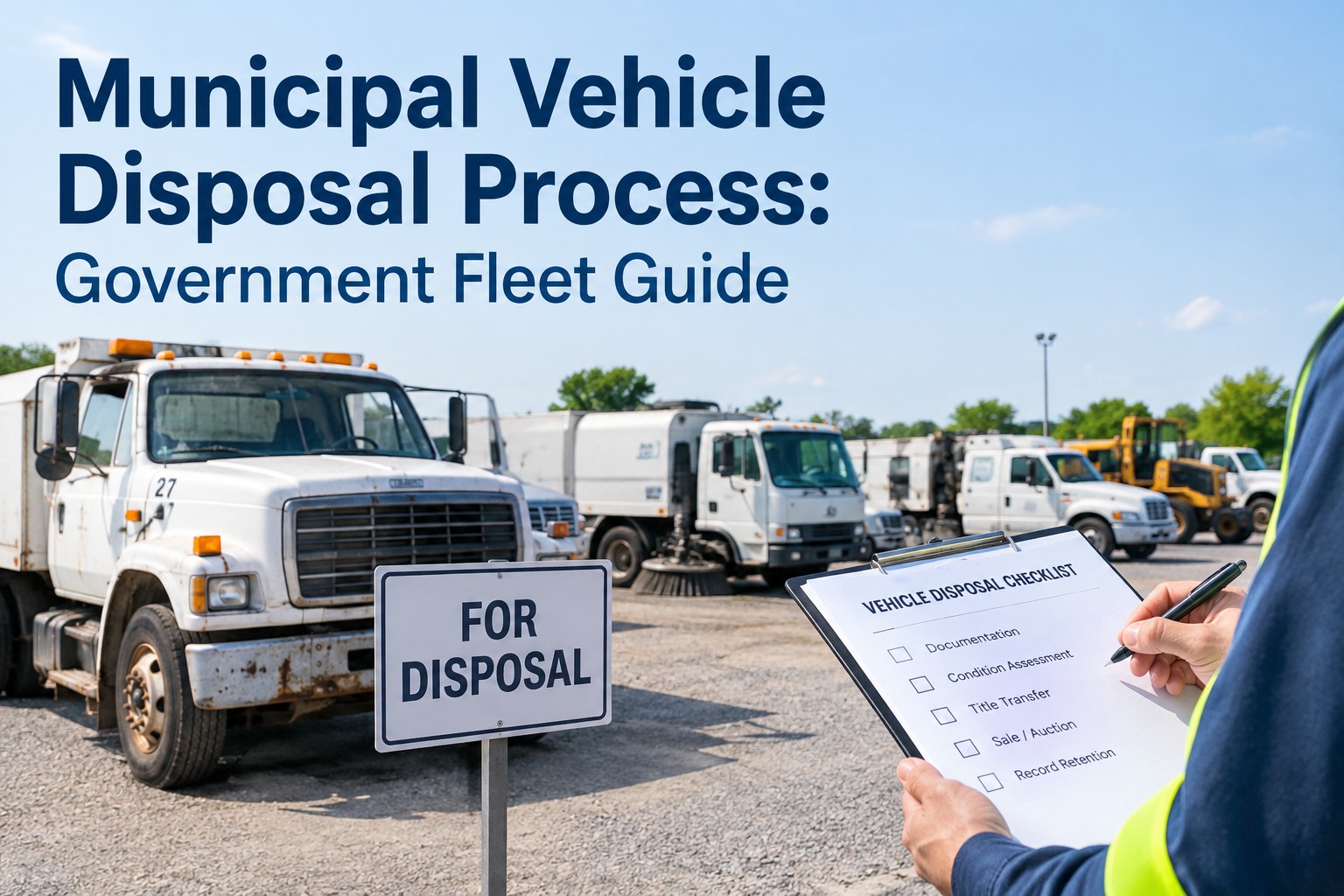
The municipal vehicle disposal checklist
Run this on every vehicle leaving the fleet — it turns disposal from a loose end into a documented, auditable close-out. Use this vehicle disposal checklist online free, with the full asset history and disposition record retained against each vehicle automatically.
Confirm disposal eligibility
Document why the vehicle qualifies under your replacement and surplus policy — the reason, not just the fact.Select and record the method
Transfer, auction, sale, or scrap — offer for reuse first where required, and log the choice.Capture the approval
Who authorised the disposition, when, and under what policy — the first line any audit checks.De-identify and clear the vehicle
Wipe data, remove agency equipment, strip decals and plates — each with a sign-off.Check funding conditions
Flag grant-funded assets and confirm 2 CFR 200 and local disposition rules before sale.Retain the complete record
Title transfer, sale value, condition, and asset history retained for the required period and retrievable.
From a fleet compliance officer who got audited on surplus
We got a records request on a batch of vehicles we'd auctioned eighteen months earlier — someone wanted to know what they sold for and why. Under the old process that would have been a week of pulling paper files and hoping the approvals were in them. Two of those files, honestly, I wasn't sure existed.
Since then, every disposal runs the same way: eligibility documented, method and approval logged, the prep checklist signed, and the whole asset history kept against the vehicle. When the next request came, I exported everything for the batch in an afternoon — condition at sale, maintenance record, who approved each one. The auditor had nothing to find, because it was all there.
Frequently asked questions
What is the municipal vehicle disposal process?
It's the documented chain that retires a public vehicle and removes it from the fleet accountably: confirming the vehicle qualifies for disposal under policy, choosing a disposal method, obtaining and recording approval, preparing the vehicle by removing identification, equipment, and sensitive data, completing the sale or salvage, and retaining the full record for audit. It's more than deleting an asset from a list — because the vehicle is public property, each step needs documentation that can be produced later for an audit or a public-records request.
What are the ways a government fleet can dispose of a vehicle?
The main methods are inter-agency transfer, public auction, direct sale, trade-in against a new purchase, and scrap or salvage for vehicles with no resale value. Public policy often requires offering a vehicle for internal reuse or transfer before selling it, then using a transparent channel — commonly an online government surplus marketplace — to realise the best public return. Each method carries different rules and revenue, and whichever is used, the disposition method and the value realised are recorded in the asset register.
What has to be removed from a vehicle before disposal?
Government identification — decals, seals, unit numbers, and government plates — so the vehicle can't be mistaken for or misused as an official one; agency equipment such as radios, mounts, light bars, partitions, and upfits that belong to the agency or can be reused; and any sensitive data on onboard computers, GPS units, or radios, especially on public-safety vehicles. Data left behind is the highest-risk oversight, since it's a security exposure. Each removal should be documented with a sign-off, not left to habit.
How long must vehicle disposal records be kept?
Government asset and disposal records are generally retained for the asset's useful life plus several years, with grant-funded assets often kept longer under federal rules. The record includes the disposition method, approval, sale price or salvage value, title transfer, and the vehicle's condition and maintenance history. The point of the retention period is that a disposition can be examined well after the vehicle is gone, so the records must stay complete and retrievable throughout — where a digital asset history beats paper files.
Are there special rules for disposing of grant-funded vehicles?
Yes. Vehicles purchased with federal funds carry disposition conditions under 2 CFR 200 — above a value threshold the funding agency may have a claim on a share of the proceeds, and disposition data must be recorded and retained. State statutes and local surplus policy layer additional requirements on top, and the local rules are often stricter on approval and method. Because the conditions depend on the funding source and jurisdiction, confirm each vehicle's funding history and the applicable rules before disposal, and document whatever applies.
Dispose of every vehicle so the record survives the audit
HVI keeps each vehicle's complete service and inspection history, exports it as signed, audit-ready records, and retrieves the full disposition file on demand — long after the asset has left the fleet. So every retired vehicle leaves with its eligibility, approval, prep, and sale documented, and a public-records request or surplus audit becomes an afternoon's export instead of a week in the binders.
No credit card · Complete asset history & disposition file · Audit-ready retrieval on demand