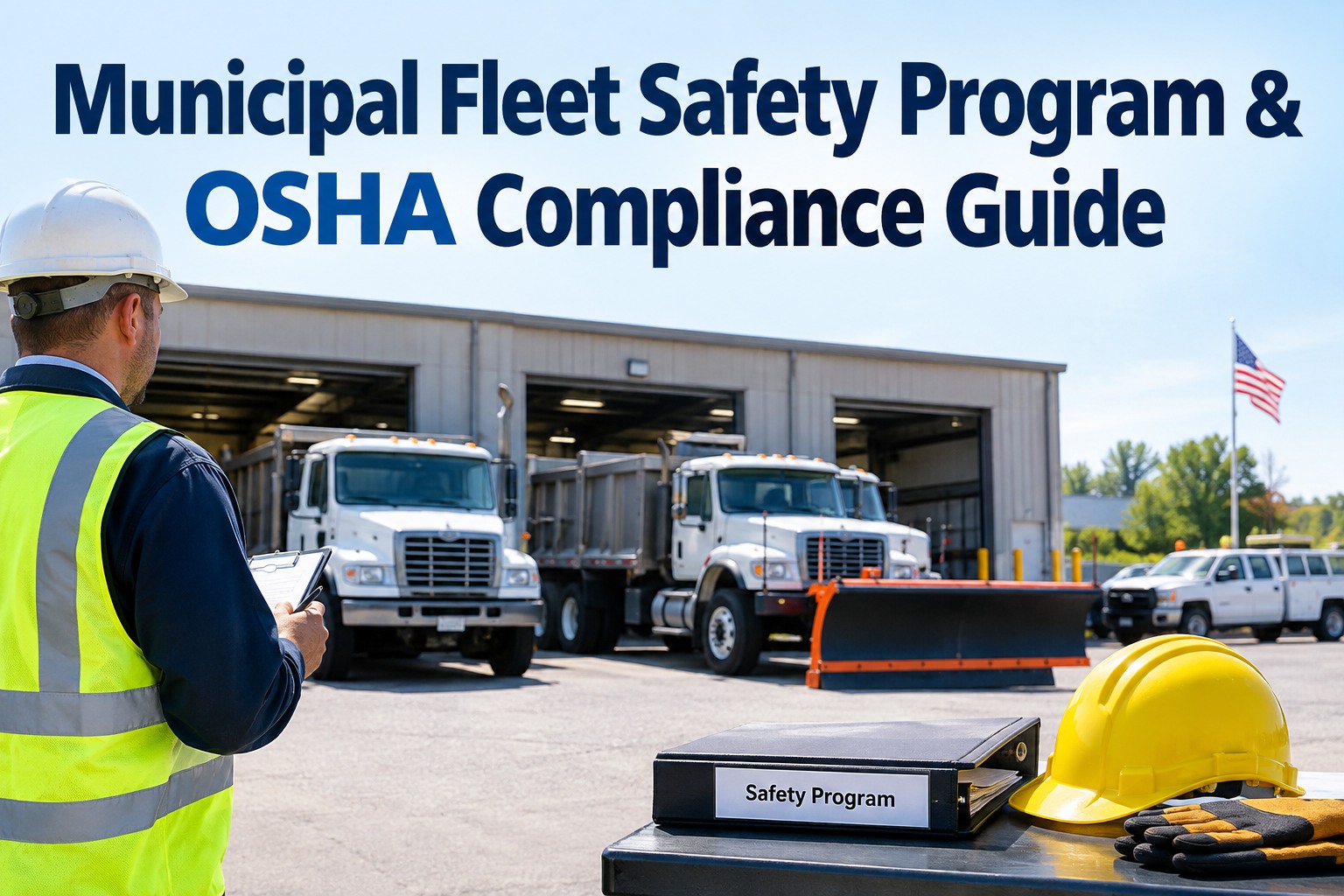
Most municipal shops assume federal OSHA governs their garage the same way it governs a private trucking fleet down the road — and in roughly half the country, that assumption is wrong. A municipal fleet safety program has to start with a jurisdiction question most fleets never actually answer: does OSHA cover you at all, and if not, what does? Here's how that question actually resolves, and what a defensible program needs once you know the answer.
Does OSHA Cover Your Municipal Fleet?
Pick your state's coverage category. See whether federal or state OSHA applies to your garage, and what governs safety if it doesn't.
States like California, Michigan, Oregon and Washington run State Plans covering both private and public employees — your municipal garage is covered the same as a private shop, enforced by the state agency, not federal OSHA directly.
Connecticut, Illinois, New York, New Jersey, Maine and a few others run plans that cover only state and local government employees — your garage is covered by the state plan even though private shops nearby answer to federal OSHA.
Roughly half the states have no state or local government coverage at all under Section 3(5) of the OSH Act — federal OSHA doesn't apply, and unless your state or municipality has adopted its own rule, there's no equivalent floor requiring compliance.
The Jurisdiction Question Most Municipal Fleet Safety Programs Get Wrong
Section 3(5) of the Occupational Safety and Health Act of 1970 excludes employees of state and local government from federal OSHA coverage by default. That's not a loophole or an exemption fleets have to apply for — it's how the law was written. Coverage only exists where a state chose to extend it. Roughly 22 states run a full State Plan covering both private and public sector employees, treating a municipal garage exactly like a private repair shop. A handful of others — Connecticut, Illinois, New York, New Jersey, Maine, Massachusetts and a few territories — run a State Plan limited specifically to public employees, while private employers in those same states stay under federal OSHA. And in the remaining states, roughly half the country, there's no state or local government coverage at all — an estimated 8 million public sector workers nationally fall into this gap.
That third category is where the biggest risk actually sits, and it's counterintuitive: no OSHA jurisdiction doesn't mean no risk. It means no external regulatory floor is forcing a program to exist — which puts the entire burden of defending a safety decision on the municipality's own documented practice, with nothing to point to if a workers' comp claim, a council inquiry or a lawsuit asks whether the shop was actually being run safely.
If OSHA Doesn't Apply, What Governs Your Shop?
Absence of OSHA jurisdiction rarely means absence of exposure. Workers' compensation carriers still evaluate shop safety practices when setting premiums and investigating claims. Many states layer their own public-sector safety statutes or municipal risk-pool requirements on top of the federal gap, independent of whether a State Plan exists. And council members, taxpayers and the media generally don't distinguish "not legally required" from "not being done" when an incident makes the news. Fleets in no-coverage states that voluntarily adopt OSHA general industry standards as an internal policy — not because a citation is possible, but because it's the most defensible, well-documented standard available — consistently fare better in exactly those situations than fleets treating the jurisdiction gap as permission to skip documentation altogether.
The Four Records a Municipal Fleet Safety Program Actually Needs
Training Completion & Renewal
Who completed what training, when, and when it expires — hazardous energy control, PPE, HazCom — tied to the individual, not a class roster nobody updates after the session ends.
Facility & Equipment Inspections
Regular shop and equipment safety inspections with findings recorded, not just a checkbox confirming one happened.
Corrective Action Closure
Not just that a hazard was identified, but proof it was actually fixed, verified, and closed — the step most programs lose track of.
Hazardous Energy Control Documentation
Records showing lockout/tagout and other control procedures were followed on specific jobs, not just that a written procedure exists somewhere in a binder.
None of these four require re-explaining how to perform lockout/tagout or select PPE — that's a training question. This is a records question, and it's the one that actually gets asked during a claim investigation or a council review. Book a demo to see all four record types tied to the same asset and technician profile, instead of split across a training binder, a paper inspection log and a separate incident file.
Corrective Actions: The Step Most Programs Lose Track Of
Identifying a hazard is the easy half of the job — a technician notices a frayed cable, a supervisor spots a blocked exit, an inspection flags a missing guard. What breaks down far more often is the second half: verifying the fix actually happened and closing the loop with a record. A hazard noted in a binder with no closure date isn't a solved problem, it's an open liability sitting in writing — arguably worse than never having documented it at all, because now there's proof the municipality knew and the record doesn't show it was addressed.
What a Compliance Officer Actually Has to Defend Internally
Our state doesn't have a public-sector OSHA plan, so for years the attitude was basically "nothing applies to us." That changed after a workers' comp claim asked for our lockout/tagout training records for the technician involved, and we had a sign-in sheet from two years earlier with no way to confirm it covered current procedures. Now every technician's training, every inspection and every corrective action is tied to a record we can actually produce. Whether OSHA technically applies to us stopped being the point.
The Takeaway
A municipal fleet safety program's first real question isn't what the procedures should be — it's which regulatory floor, if any, actually applies, because that determines how much of the burden of proof sits entirely on your own documentation. Whether or not federal or state OSHA has jurisdiction, the fleets that hold up under a claim, an audit or a council question are the ones with training, inspection and corrective action records tied to real people and real assets, not a policy binder nobody's opened since it was written. Sign up free and build that record regardless of which jurisdiction category your state falls into.
Frequently Asked Questions
Does federal OSHA apply to municipal fleet garages?
Not by default. Section 3(5) of the OSH Act excludes state and local government employees from federal OSHA coverage. Coverage only exists where a state has an OSHA-approved State Plan that extends to public employees — roughly 22 states run a full State Plan covering both private and public sector, a handful of others (including Connecticut, Illinois, New York, New Jersey and Maine) run plans limited to public employees only, and the remaining states have no state or local government coverage at all.
If my state has no OSHA coverage for public employees, do we still need a safety program?
Yes. Absence of OSHA jurisdiction removes an external regulatory floor, not the underlying risk. Workers' compensation carriers evaluate shop safety practices when setting premiums and investigating claims, many states layer their own public-sector safety requirements independent of federal OSHA, and municipalities remain exposed to liability and public scrutiny regardless of whether a specific standard technically applies. Voluntarily adopting OSHA general industry standards as internal policy is common practice in these states.
What records does a municipal fleet safety program need to be defensible?
Four categories matter most: training completion and renewal records tied to individual employees, facility and equipment inspection records with findings documented (not just completion checkboxes), corrective action records showing hazards were not just identified but verified fixed and formally closed, and hazardous energy control documentation showing procedures were actually followed on specific jobs.
Why do corrective actions often fail even when hazards are identified?
Most safety programs are reasonably good at identifying and logging hazards but far less consistent at verifying and documenting that the fix actually happened. A hazard noted but never formally closed remains an open, documented liability — proof the municipality was aware of a risk with no record showing it was addressed, which is often worse in an investigation than having no record of the hazard at all.
How many states cover municipal employees under a state OSHA plan?
Roughly 22 states operate a full State Plan covering both private-sector and state and local government employees, and several additional states and territories — including Connecticut, Illinois, New York, New Jersey, Maine and Massachusetts — operate a State Plan limited specifically to public employees. The remaining roughly half of U.S. states have no state or local government OSHA coverage at all, affecting an estimated 8 million public sector workers nationally.
Build a Municipal Fleet Safety Record That Holds Up
HVI ties training, inspection, corrective action and hazardous energy control records to every technician and asset, flags approaching renewals automatically, and exports a signed, audit-ready package on demand.
No credit card · No hardware required · Live before your next safety review