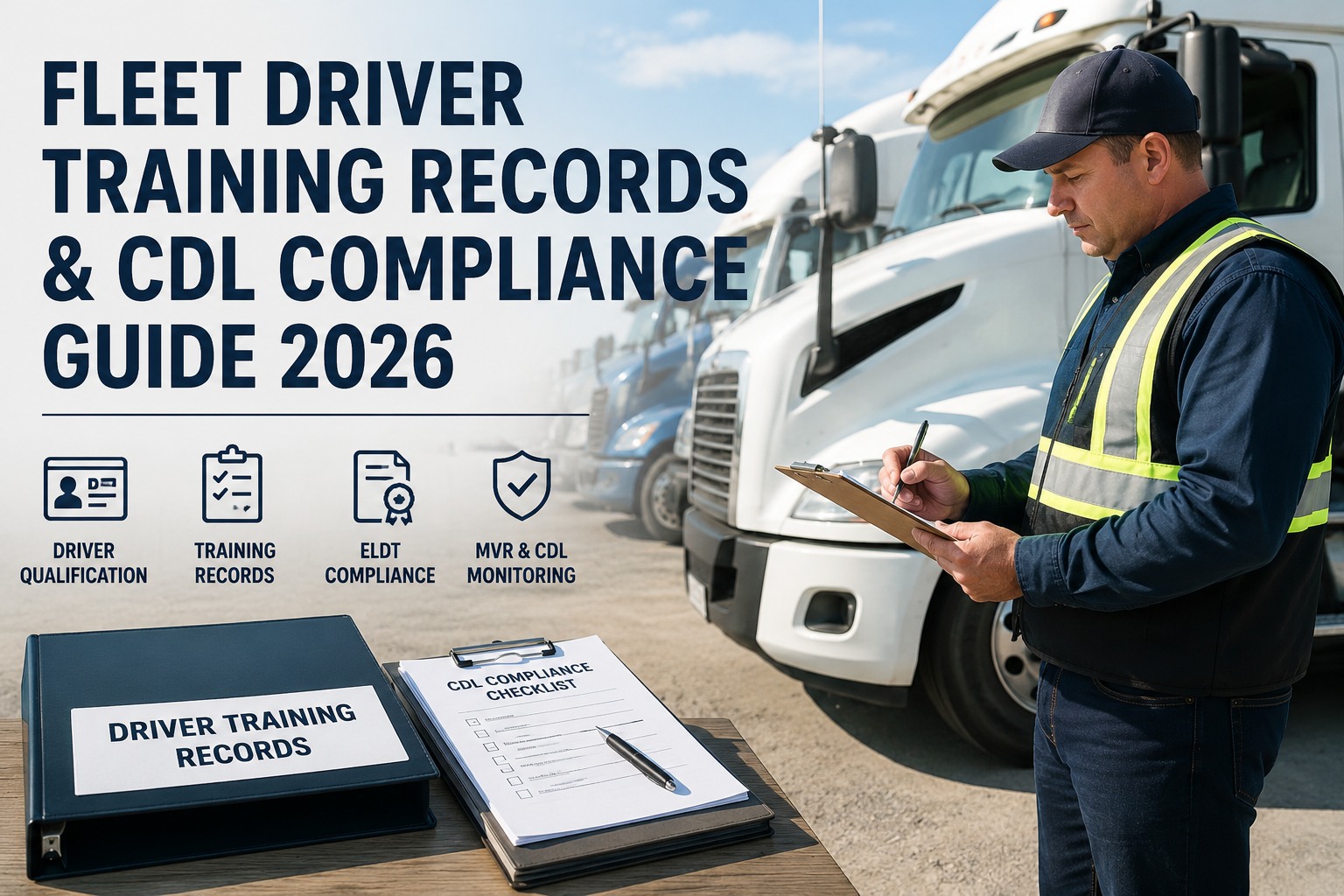
Fleet driver compliance is not one program — it's four overlapping regulatory tracks that must sync per-driver. FMCSA Part 391 driver qualification files. Part 380 Entry-Level Driver Training. CDL and medical certification currency. MVR review and ongoing monitoring. Miss any one and the driver's ability to legally operate a CMV comes into question. This 2026 guide walks the 4 tracks and how driver records connect to vehicles, inspections, trips, and work orders. Book a demo .
The Driver Compliance Stack — and Where It Connects to the Fleet
Four regulatory tracks run in parallel for every driver. Each has its own cadence, its own record set, and its own audit trigger.
Driver compliance findings are among the most-cited categories in FMCSA reviews for two reasons: the requirements span four separate federal regulatory tracks with different anniversary dates, and the records are traditionally maintained in siloed systems that don't talk to each other. HR maintains the DQF; the training school submits ELDT certification to FMCSA; the driver keeps the medical card; dispatch maintains the vehicle assignment. Any one of the four looks fine in isolation. It's the intersection — "on this date, was this driver qualified to operate this vehicle on that trip?" — where audit findings show up. Modern fleet compliance is less about doing any one track better and more about connecting them.
Track B: What Part 380 ELDT actually requiresThe training track fleets most often misunderstand as a school problem, not a carrier problem
The Entry-Level Driver Training rule under 49 CFR Part 380 took effect February 7, 2022 and applies to first-time CDL Class A or Class B applicants, drivers upgrading Class B to Class A, and first-time applicants for the P (passenger), S (school bus), or H (hazmat) endorsement. The rule is not retroactive — drivers who held the credential before that date are exempt. What carriers often miss is that ELDT documentation is part of the driver's overall compliance picture, and gaps show up during hiring reviews. Book a demo to see ELDT records connected with the DQF in HVI
Who is subject to ELDT
Anyone getting a Class A or Class B CDL for the first time, upgrading Class B to Class A, or obtaining a P, S, or H endorsement for the first time on or after Feb 7, 2022. Exceptions: drivers holding the credential before that date, and drivers who qualify for a skills-test exception under 49 CFR Part 383.
Two required components
Theory (classroom, computer-based, or online) covering vehicle systems, HOS, hazard perception, cargo handling, trip planning. Behind-the-wheel (BTW) training on both range and public roads. Both must come from a Training Provider Registry-listed provider under 49 CFR 380.703.
No federal minimum hour requirement
FMCSA guidance is explicit: no minimum hours for theory or BTW. What's mandated is the curriculum content in 49 CFR Part 380 Appendices A–E. Training providers must cover all required topics regardless of time. State requirements can be more stringent (e.g., minimum classroom hours for S endorsement in some states).
Certification submission to FMCSA
Training provider submits training-completion certification electronically to the FMCSA Training Provider Registry, which forwards to the State Driver Licensing Agency (SDLA). Carrier's role: verify the driver's ELDT record was submitted and appears in the driver's compliance history.
Carrier-operated training programs
Carriers running in-house CDL training must self-certify on the FMCSA Training Provider Registry under 49 CFR 380.703, meeting requirements for facilities, vehicles, instructors, and curriculum. Instructor CDL history matters — certain disqualifying offenses under 49 CFR 383.51 bar theory instruction for 2 years after CDL reinstatement.
What ELDT does NOT cover
ELDT is one-time entry training. It does not satisfy carrier's ongoing driver training obligations under other parts (hazmat security, safety training, refresher training after violations). The driver's completion certificate is a milestone in their file, not a permanent credential.
Track C + D: CDL, medical certification, and MVR — the currency tracks that lapse silentlyAnniversary dates that don't align, expiration effects that ground a driver immediately
Track A (DQF) and Track B (ELDT) are documentation events — done once, filed, referenced later. Tracks C and D are recurring currency requirements that lapse silently unless actively tracked. A medical card that expires on Tuesday means the driver cannot legally operate on Wednesday, regardless of how good the rest of their file looks.
CDL + endorsements
Medical Examiner's Certificate
Annual MVR + review
Clearinghouse limited query (CDL only)
The four independent cycles are the single biggest reason mid-size fleets outgrow spreadsheet compliance tracking — the volume of anniversary dates crosses a threshold where manual review starts missing things systematically. Book a demo to see anniversary alerts across all 4 tracks in HVI
Where driver records connect to fleet data — the intersection audits care aboutThe "on this date, this driver, this vehicle" query
Driver compliance records in isolation are worth less than driver compliance records connected to what the driver actually did with the fleet's equipment. Modern fleets structure the connections deliberately so an incident review or audit query can be answered in one pass. Start a free trial to see driver-vehicle-trip connections in HVI.
Driver ↔ vehicle assignment
Which drivers are authorized on which vehicle classes based on endorsement (N, H, X for tankers; passenger cert for buses; hazmat cert for placarded loads). Prevents dispatch from assigning an unqualified driver to a specialized asset.
Driver ↔ inspection record (DVIR)
Every DVIR captures the driver who performed the pre-trip or post-trip and the vehicle inspected. In an audit, this proves the pre-trip actually happened by a qualified driver, and the driver's DQF backs the record's credibility.
Driver ↔ trip / HOS record
ELD HOS records tied to specific driver + vehicle + shift. Cross-reference with DQF (was the driver current on medical + CDL that day) and DVIR (did they document the pre-trip) creates the complete shift compliance picture.
Driver ↔ work order
Defect flagged in a driver's DVIR generates a maintenance work order tagged to the reporting driver, the vehicle, and the shift. When maintenance completes the repair, the work order closes back to the driver-vehicle history record. Full traceability from defect discovery to repair confirmation.
Driver ↔ incident / claim
Post-incident review pulls: driver's DQF status at incident time, most recent MVR, medical cert currency, most recent DVIR of the involved vehicle, HOS records for the shift, any maintenance history on the vehicle. In one query, not five system pulls.
Driver ↔ audit sample
FMCSA compliance review pulls random drivers and asks for complete records including recent trips, inspections, and defect handling. Connected records let compliance teams answer with document pulls; siloed systems produce answer gaps that become findings.
These 6 connection points are what separate compliance documentation from compliance evidence. Book a demo to see driver-vehicle-inspection connections in a live fleet
From a compliance director on connecting the four tracks
Our compliance tracks used to live in different places. DQFs in an HR filing cabinet. ELDT certificates in a spreadsheet. Medical cards in a shared drive. MVR reviews in an email chain. When the FMCSA reviewer asked "on March 3rd, which driver was on truck 217, and what was their qualification status that day?" — that answer took us three days of pulling files and asking questions across four different teams.
We rebuilt around driver records connected to vehicle assignments, DVIRs, and trip logs at the driver level. Same question today gets answered in about 90 seconds — driver record open, filter to date, all connected records visible. Our next FMCSA review produced zero DQF or driver-record findings across 62 drivers reviewed. The regulations didn't change. What changed was that "driver compliance" stopped being four separate programs and started being one connected record.
Frequently asked questions
What driver training and compliance records must a fleet maintain?
A fleet must maintain records across four overlapping regulatory tracks per driver. Track A — Part 391 Driver Qualification File: employment application, previous 3-year (up to 10-year for safety-sensitive) employer investigation, MVRs from every state, road test or CDL equivalent, medical certificate, Drug & Alcohol Clearinghouse pre-employment query, plus annual recurring MVR, driving-record review, driver certification of violations, and Clearinghouse limited query. Retained employment + 3 years per § 391.51(d). Track B — Part 380 Entry-Level Driver Training: for drivers first licensed or first endorsed after Feb 7, 2022, completion records from an FMCSA Training Provider Registry-listed provider covering both theory and behind-the-wheel training. Track C — CDL and medical certification currency: base CDL with applicable endorsements, medical examiner's certificate per 49 CFR 391.43. Track D — MVR and ongoing monitoring: annual MVR from every licensing state, annual driving-record review, Clearinghouse limited query, ongoing 49 CFR 391.15 disqualification monitoring. Drug and alcohol testing records follow a separate 5-year retention under 49 CFR 382.401.
What is FMCSA Entry-Level Driver Training (ELDT) and who does it apply to?
ELDT is the federal training requirement under 49 CFR Part 380, effective February 7, 2022. It applies to drivers obtaining a Class A or Class B CDL for the first time, drivers upgrading a Class B to a Class A CDL, and drivers obtaining a Passenger (P), School Bus (S), or Hazmat (H) endorsement for the first time. The rule is not retroactive — drivers who held the CDL or endorsement before Feb 7, 2022 are exempt from ELDT for that credential. Training must include both theory instruction (classroom, computer-based, or online covering vehicle systems, HOS, hazard perception, cargo handling, trip planning) and behind-the-wheel training (range plus public road), and must be delivered by an entity listed on the FMCSA Training Provider Registry. There is no federal minimum hour requirement — the mandate is curriculum content coverage per Appendices A–E, and states can impose more stringent requirements. The training provider submits completion certification electronically to FMCSA, which forwards to the State Driver Licensing Agency.
How do CDL, medical certification, and MVR currency tracks work together?
Three independent currency cycles run in parallel and none of them align by default. CDL renewal follows the state cycle (typically 4–8 years) with endorsement-specific knowledge tests at renewal. Medical certification under 49 CFR 391.43 has a maximum 24-month cycle from a certified medical examiner on the FMCSA National Registry, shorter for drivers with underlying conditions (12 months or 3 months common). Annual MVR + driving-record review under 49 CFR 391.25 runs every 12 months from the driver's DQF anniversary, with 3-year retention from creation date. Clearinghouse limited query under the Drug & Alcohol Clearinghouse rule runs annually for CDL drivers. Any one of these lapsing grounds the driver for that operation regardless of the others — a driver whose medical cert expires cannot legally operate even with a perfect CDL and MVR. Anniversary tracking with 90-day and 30-day alerts across all cycles is standard operating practice for compliance-focused fleets.
Does HVI support driver training and qualification records connected to fleet data?
Yes. HVI supports organizing driver qualification records (Part 391 DQF documents), ELDT training completion records (Part 380), CDL and medical certification with anniversary tracking, and MVR/Clearinghouse query results at the driver level. Records are connected to vehicle assignments (which driver is authorized on which vehicle class), inspection history (DVIRs tied to driver + vehicle), trip records (shift-level driver-vehicle-record links), and work orders (defects and repairs traceable to reporting driver). When compliance questions arise — "on this date, was this driver qualified for this vehicle on this trip?" — the answer is one query pulling the connected records. HVI is not itself a state MVR service, an FMCSA Drug & Alcohol Clearinghouse portal, or an FMCSA Training Provider Registry — those source-record systems remain state and federal authorities. HVI is the fleet-side layer that stores results, tracks anniversaries, connects driver records to fleet operational data, and organizes files for FMCSA compliance review.
How do municipal and government fleets manage CDL compliance for their drivers?
Municipal and government fleets are subject to the same FMCSA driver compliance requirements as private carriers under 49 CFR Parts 380, 383, 391 — but often with additional procurement, HR, and civil-service overlays specific to their organization. DQFs, ELDT records, CDL and medical currency, and MVR reviews must all be maintained per federal requirements. Government fleets frequently have longer retention practices than the federal minimum for civil-service documentation reasons and often require additional training records beyond FMCSA baseline (defensive driving certifications, jurisdictional-specific safety programs). The connection to fleet operational data (vehicle assignments, DVIRs, trip records) is often more important for municipal fleets because the audit chain runs not just through FMCSA but also through internal auditor generals, insurance pools, and public-records requests. Digital driver-record systems that connect qualification records with fleet operational history serve both the federal compliance requirement and the broader municipal accountability picture.
Turn 4 driver compliance tracks into one connected fleet record
HVI supports DQF organization, ELDT record capture, CDL and medical anniversary tracking, MVR and Clearinghouse result storage, and driver records connected to vehicle assignments, DVIRs, trip records, and work orders. Source-record systems (state MVRs, FMCSA Clearinghouse, Training Provider Registry) remain state and federal authorities. HVI is the connected fleet-side layer that answers "which driver, which vehicle, what qualifications, what day" in one query.
No credit card · No hardware · Driver-record templates ready on day one