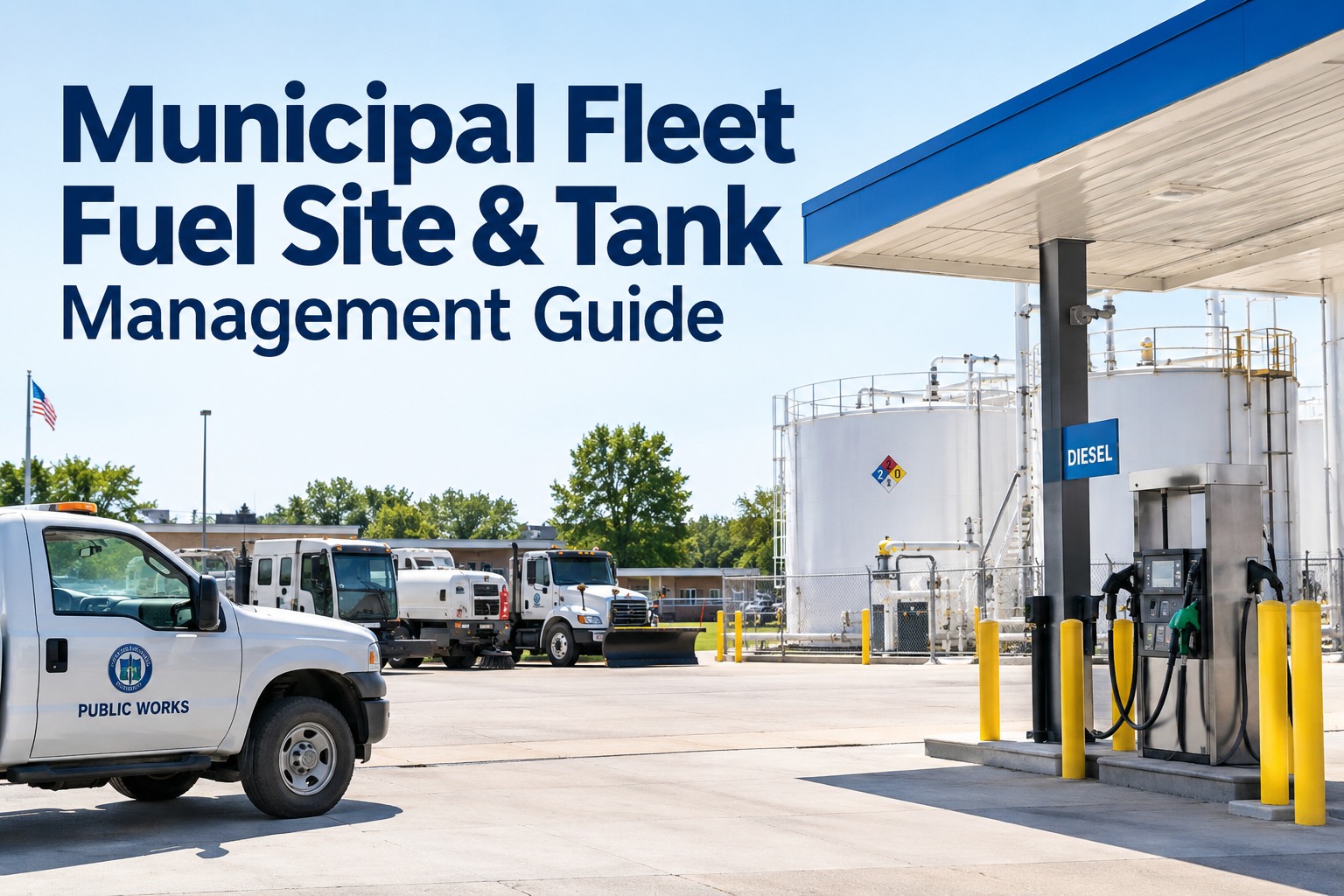
The fuel site has been running the same way for eleven years: a key hanging by the pump, a paper log nobody double-checks, and a tank that gets topped off whenever someone remembers to call the supplier. Then the fiscal year ends 4,000 litres short of what the delivery invoices say came in, and nobody can point to where it went. Municipal fuel site management isn't really about the tank — it's about being able to answer exactly that question before it becomes one.
Fuel Site Management by Cadence, Not by Memory
Dispenser check, meter reading logged, receipts reconciled to entries
Tank-level reconciliation against dispensing records and deliveries
Variance review, cost-by-department rollup, access log audit
Dispenser and hose inspection, tank inspection per jurisdiction requirement
This guide treats the fuel site as what it actually is for a municipal fleet: a controlled resource and a cost centre, not just a tank in the corner of the yard. It covers what every dispensing record needs to capture, the underground-versus-above-ground distinction worth understanding even though the specific rules vary by jurisdiction, how reconciliation catches problems before year-end, access control for after-hours fueling, and a practical checklist you can run on a schedule instead of when something already looks wrong.
The Fuel Site Is a Cost Centre, Not Just Infrastructurethe tank doesn't need managing — the accountability around it does
A municipal fuel site sits at the intersection of two very different jobs: keeping plow trucks, mowers, and patrol cars fueled without delay, and accounting for every litre as public money. Most sites handle the first job fine. It's the second one that quietly falls apart — not through theft, usually, but through a slow drift of unlogged fill-ups, meter readings nobody wrote down, and a reconciliation that only happens once a year, if at all. By the time that annual number comes back wrong, there's no way to tell whether it was a data-entry error in March or a genuine loss in September.
What Every Dispensing Record Must Capturefive fields, every fill-up, no exceptions
A fuel log that just says "40 litres, Tuesday" is barely a record at all. A dispensing record that actually supports cost analysis and accountability needs to consistently tie the fuel to a specific vehicle and a specific person.
Vehicle
Every fill-up tied to a specific asset, not a generic department bucket — this is what makes per-vehicle cost and consumption analysis possible at all.
Operator
Who dispensed the fuel, not just which vehicle received it — the difference between accountability and a guess after the fact.
Date & time
Exact timing matters for two reasons: cost-period reporting, and flagging fills that happen outside normal operating hours.
Quantity
The actual volume dispensed, checked against what the vehicle's tank size makes plausible — a fill that exceeds tank capacity is a data or process problem worth catching immediately.
Meter reading or receipt
The pump meter reading for on-site tanks, or a receipt for third-party fills, ties the transaction to something verifiable rather than a self-reported number alone.
Book a demo to see these five fields captured on every fill-up, with a receipt photo attached automatically.
Underground vs. Above-Ground Tanks: Same Site, Different Rulesthe distinction matters even though the exact requirements don't travel across borders
- Typically requires leak detection monitoring and periodic tightness testing
- Corrosion and groundwater contamination are the primary risk concerns
- Often subject to registration with an environmental agency
- Visual inspection is generally easier — leaks and corrosion are visible without excavation
- Secondary containment (a bund or berm) is a common requirement to catch spills
- Still typically requires clear access, signage, and spill-response equipment on site
Both categories generally require some form of periodic inspection, dispenser and hose condition checks, and spill-response readiness — but the specific standards, testing intervals, and reporting obligations differ meaningfully between the US, Canada, the UK, and Australia, and even between states or provinces within them. Treat this section as a reason to ask the right questions of your local regulator, not as the answer itself.
Reconciliation: Catching the Litre That Doesn't Add Upthe earlier a variance is caught, the cheaper it is to explain
Reconciliation means comparing three numbers that should agree: fuel delivered, fuel dispensed according to logged records, and the tank's actual measured level. When they don't line up, the gap is either a measurement or entry error, evaporation and temperature-related variance, or an actual loss worth investigating. Many sites treat a small, consistent variance — commonly in the low single-digit percentage range — as within normal measurement tolerance, while a larger or recurring gap gets flagged for investigation immediately rather than absorbed into the year-end number. Running this comparison weekly rather than annually is what turns "we're short 4,000 litres and have no idea why" into "Tuesday's delivery was 200 litres light, and we caught it before the invoice was paid."
Access Control & After-Hours Fuelingthe fewer people who can fuel unsupervised, the fewer gaps to explain
A fuel site with a shared key and no login requirement has no way of knowing who dispensed fuel outside a specific transaction, only that someone did. PIN codes, RFID cards, or a mobile login tied to an individual operator turn every fill-up into an attributable event rather than an anonymous one. After-hours fueling deserves particular attention — it's often legitimate (emergency response, overnight snow clearing) but it's also where unsupervised access is most likely to go unnoticed, so those entries are worth reviewing on their own, not folded into the general log without a second look.
Turning Site Records Into Department & Fiscal-Year Cost Reportsthe same data that catches theft also justifies next year's budget
Every field captured on a dispensing record — vehicle, operator, date, quantity — rolls up into something a finance officer or council member actually wants to see: fuel cost by department, trended by fiscal year, broken down enough to explain why public works spent more this quarter than parks and recreation. A site running clean records can answer "why did fuel spend rise 12% this year" with a specific vehicle and a specific month, instead of a shrug and a fuel price chart. Unusual consumption patterns — a vehicle suddenly burning through fuel faster than its history suggests — also tend to surface first in this kind of department-level rollup, often pointing to a maintenance issue before it becomes a breakdown.
From a shop foreman who rebuilt the fuel site's record-keeping
We were doing a full reconciliation once a year, right before the audit, and every single time it was a scramble to explain a gap that had probably built up slowly over eleven months. Once we started checking the tank level against logged dispensing weekly instead of annually, the same total variance we used to find in December started showing up as small, explainable blips every few weeks — a delivery that ran short, a meter that needed calibrating. Nothing dramatic. It just stopped being a mystery.
The Daily, Weekly, Monthly & Periodic Fuel Site Checklistthe same cadence from the top of this page, filled in
How HVI Keeps Every Fuel Transaction Accountable
HVI's fuel logs capture vehicle, operator, quantity, and a receipt photo on every fill-up, whether it happens at the on-site tank, a mobile bowser, or a third-party station — the same per-vehicle detail this guide's dispensing-record section calls for, built into the log itself rather than added on top. Sign up free to start logging fuel this way on your own site today.
Because entries work offline and sync once a connection is available, a fuel site with weak signal — common at municipal yards on the edge of a service area — never turns into a missed or backdated log. Cost rolls up by vehicle, department, and fiscal year automatically, so the reconciliation and reporting work covered above happens continuously instead of once a year under audit pressure. Book a demo — Track Fleet Fuel Costs in HVI to see fuel logs, department cost rollups, and offline capture working together on your own fleet. This connects to the same reporting used across a broader government fleet management program, alongside general fuel management tools for fleets running fuel cards alongside a bulk tank.
Frequently Asked Questions
What should a municipal fuel dispensing record include?
A complete dispensing record should capture the specific vehicle fuelled, the operator who dispensed it, the date and time, the quantity, and either a meter reading (for on-site tanks) or a receipt (for third-party fills). Consistently capturing all five is what makes per-vehicle cost analysis, consumption tracking, and accountability possible — a record missing any of them is much harder to use later.
What's the difference between underground and above-ground fuel tanks for a municipal fleet?
Underground tanks typically require leak detection monitoring and periodic tightness testing because corrosion and leaks aren't visible without excavation, while above-ground tanks are easier to inspect visually but commonly need secondary containment to catch spills. Both usually require some form of periodic inspection and spill-response readiness, but exact standards and intervals vary significantly by country, state, and province — always confirm current requirements with your local environmental regulator.
How often should a municipal fuel site be reconciled?
Weekly reconciliation — comparing fuel delivered, fuel dispensed according to logs, and the tank's measured level — catches discrepancies while they're still small and easy to explain. Reconciling only once a year, typically before an audit, means a full twelve months of small errors or losses can accumulate into a single unexplainable number.
How can municipal fleets prevent unauthorized after-hours fueling?
Requiring a PIN code, RFID card, or individual login to activate the pump ties every transaction to a specific person rather than leaving fuel access anonymous. After-hours entries are often legitimate — emergency response or overnight operations — but they're also the entries most likely to go unnoticed, so reviewing them separately from the general log catches problems that would otherwise blend in.
How does fuel site data support fleet budget reporting?
Consistent dispensing records roll up naturally into cost per vehicle, cost per department, and fiscal-year trends — the exact figures finance teams and council members ask for during budget reviews. Clean records also make it easier to explain a spending increase with a specific cause, such as one vehicle's rising consumption, rather than a general statement about fuel prices.
The Takeaway
Municipal fuel site management comes down to two habits most sites don't do consistently: tying every fill-up to a specific vehicle and operator, and reconciling the tank against those records on a real schedule instead of once a year. The tank type and the exact inspection rules will depend on where the site is, so that part is worth a direct conversation with your local regulator. The record-keeping habits, though, apply everywhere — and they're what turn a fuel site from a quiet cost risk into a resource you can account for, litre by litre, department by department, fiscal year by fiscal year.
Turn your fuel site into a fully accountable cost centre
HVI ties every fill-up to a vehicle, operator, and receipt, works offline at remote sites, and rolls costs up by department and fiscal year automatically.