A sanitation driver is ready for the morning route, but the supervisor cannot confirm whether the driver's CDL endorsement is current. Across public works, another employee is scheduled to operate a loader without a readily available training record. Government fleet driver qualification is not just a filing task: it determines who can safely and lawfully operate each vehicle. This guide explains how to organize credentials, distinguish federal requirements from local rules, and build a renewal process that stands up to review.
One fleet. Different vehicles. Different qualification rules.
Build a clear, defensible view of driver eligibility—from CDL classes and endorsements to department-specific equipment authorization—without treating every municipal employee as a federal DOT driver.
Start with the assignment, not the document folder
Municipal fleets mix CDL-regulated trucks, passenger vehicles, emergency apparatus and heavy equipment. A single universal checklist can miss important distinctions. Create an assignment-based qualification matrix before deciding which records to collect.
Vehicle and duty
Record vehicle type, gross weight ratings, passenger or hazardous-material duties, route and whether the employee performs safety-sensitive functions.
Applicable authority
Review CDL rules, federal and state exemptions, agency policies, labor agreements and role-specific operator standards. Document why a rule applies—or does not.
Evidence and reviewer
Define the source credential, verification date, expiration date, approved reviewer and restrictions on assignment when a requirement is unresolved.
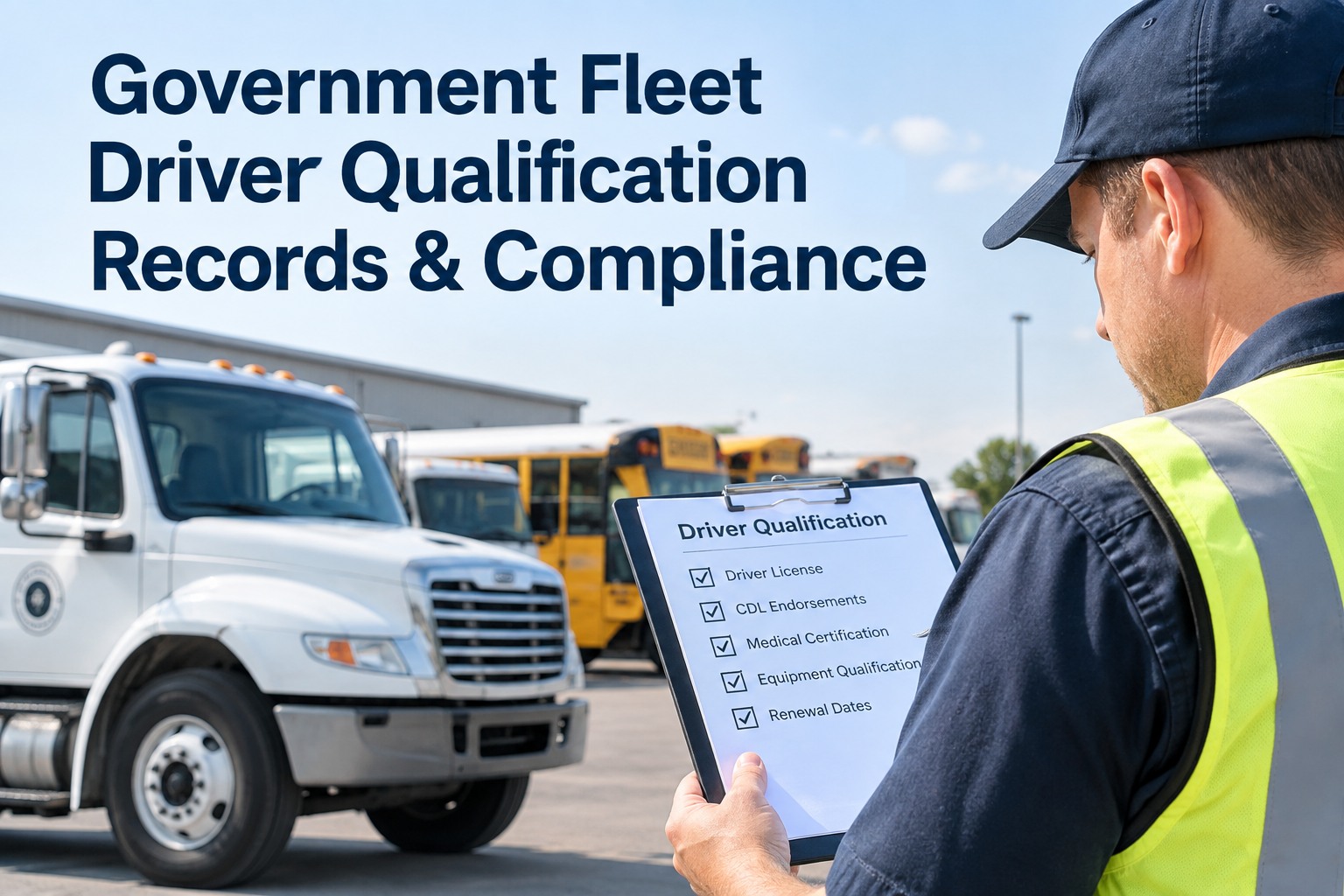
What belongs in a government driver qualification record?
Build a core personnel record, then attach only the credential categories relevant to each assignment. This reduces unnecessary data collection while making a supervisor's eligibility decision easier to explain.
| Record group | Examples to verify | Control question |
|---|---|---|
| Identity and license | License class, jurisdiction, expiration, restrictions | Does the license cover this vehicle? |
| CDL endorsements | Passenger, school bus, tanker or hazmat, when applicable | Are the required endorsements current? |
| Medical qualification | Applicable medical status and supporting verification | Does this driver and operation require it? |
| Safety-sensitive program | Drug/alcohol program records and Clearinghouse obligations, if applicable | Is the agency's covered-driver process complete? |
| Training and authorization | Vehicle orientation, loader/forklift training, refresher review | Has the agency authorized this equipment? |
| Review history | Credential checks, exceptions, corrective actions, approval | Can we show who cleared the assignment? |
A traditional FMCSA driver qualification file under 49 CFR §391.51 (official regulation; verify current text) is not automatically required for every government employee. Use the applicable legal framework rather than assuming that every city driver needs an identical federal file. For practical record organization, book a demo to discuss HVI team member and fleet records.
The driver assignment eligibility gate
Use a clear, human-reviewed gate before dispatch. These statuses are illustrative process examples, not a live HVI product screen or a substitute for checking applicable rules.
Can this operator take this assignment?
Vehicle class, endorsements, equipment authorization and job-specific training.
Expiration, applicable medical status, restrictions and agency policy.
Document version, verification date, owner and secure access to the record.
A supervisor or designated compliance reviewer resolves the exception and records the decision before dispatch.
For a walkthrough of how personnel and inspection records can support this process, book a demo to review HVI's available workflows.
Turn renewal dates into an actionable queue
A spreadsheet may show when a license expires, but it rarely proves that the correct person reviewed the renewed document or stopped an unqualified assignment. Use a simple four-stage process that includes both reminders and an explicit eligibility decision.
Identify
Flag upcoming license, endorsement and training milestones. Confirm contact details and the agency's renewal process.
Escalate
Notify the driver, supervisor and credential owner; record unresolved requirements and alternative staffing options.
Verify
Check the authoritative credential or agency-approved evidence. Record reviewer, date and any restrictions.
Authorize
Reconfirm that the person is eligible for the assigned vehicle and task. Hold the assignment when required proof is missing.
See how driver records connect with fleet operations.
Review HVI's team member records, digital inspections and maintenance workflows with your government fleet use case in mind.
Three common gaps in municipal driver compliance
These scenarios illustrate why a credential list needs an assignment and review process around it.
Valid CDL, wrong endorsement
A driver's license is current, but the planned route involves duties requiring an additional endorsement. A general “license valid” status does not establish assignment eligibility.
Training completed, proof missing
A supervisor remembers an equipment training session, but the date, instructor and machine category were never captured in a searchable record.
Renewal received, status not updated
An employee emails a new credential, but dispatch still sees the old expiration. Without a verification owner, the record remains ambiguous.
For mixed-department fleets, book a demo to review how HVI organizes team members and vehicle activity alongside your existing HR and licensing systems.
A five-step driver qualification audit checklist
Use this review sequence quarterly or before a scheduled internal compliance assessment. Adjust the scope to your state, agency and actual covered operations.
Define the driver population
List active drivers, departments, vehicle categories and special duties; exclude former employees from the active assignment list without destroying records prematurely.
Validate the rule mapping
Confirm CDL applicability, endorsements, medical and drug/alcohol obligations, equipment qualifications and any documented exemptions.
Sample source documents
Check selected records against actual credentials, training evidence and authoritative verification sources—not just manually entered dates.
Test the exception workflow
Show how expired, restricted or unverified credentials are escalated, corrected and considered before dispatch.
Export an evidence packet
Collect policy version, record inventory, review log, exceptions and closure notes with appropriate access restrictions and retention controls.
Audit readiness improves when inspection and maintenance history can be linked to the people operating vehicles. Book a demo to see HVI's digital inspection and fleet record workflows.
Build the process without overcomplicating the software
For many public agencies, the hardest part is not uploading documents. It is agreeing on data ownership between fleet, HR, safety and department supervisors.
First 30 days: establish ownership
- Inventory vehicles and driver roles by department.
- Ask counsel or compliance staff to validate applicable federal and state rules.
- Assign credential owners and approved reviewers.
- Choose a limited set of critical status fields.
Next 60 days: prove the workflow
- Pilot one department with a mix of CDL and non-CDL assignments.
- Test renewal reminders and supervisor escalation.
- Sample records for missing proof and inconsistent dates.
- Document the hold-and-release decision for exceptions.
Team member records
Keep operational personnel information organized and accessible to authorized users.
Digital inspections
Connect vehicle condition reporting to routine fleet oversight.
Maintenance history
Maintain work orders and repair documentation for fleet accountability.
HVI can support centralized fleet and team member record management. Specific CDL validation, automatic expiration alerts, medical-record controls and integration capabilities should be confirmed in a product demonstration rather than assumed. Book a demo to verify qualification-tracking capabilities for your agency.
Government fleet driver qualification FAQs
Do municipal drivers need a federal DOT driver qualification file?
Not automatically. Government transportation has an exception from specified federal motor carrier safety regulations under 49 CFR §390.3(f)(2). Determine whether Part 391 requirements apply to the operation, then check state rules and local policy. A documented internal qualification record can still be valuable.
Are government employees exempt from CDL requirements?
No general exemption covers every government employee. CDL requirements under Part 383 may apply to covered vehicles and operations, with specific exceptions for certain roles or circumstances. Verify the vehicle, assignment, jurisdiction and any claimed exception before dispatch.
Should government fleets track medical certification dates?
Track medical qualification when required by the driver's applicable operation and licensing status. Government drivers may qualify for exceptions under Part 391, but other rules and state licensing procedures can still matter. Limit access to sensitive medical information.
How should equipment operator certifications be handled?
Maintain a separate matrix of equipment types, required training, competency checks, authorization dates and refreshers. A CDL does not automatically demonstrate competency to operate a loader, forklift or specialized machine.
Can HVI automatically verify CDLs or block an unqualified driver?
Do not assume automatic license verification, eligibility blocking or renewal alerts are included. HVI supports fleet and team member record workflows; request a demonstration of the specific fields, notifications, permissions and integrations your agency needs.
Make qualification records easier to find—and easier to review.
Bring your actual driver and equipment requirements to a walkthrough. See where HVI fits into your inspection, maintenance and personnel-record process.