The auditor's email lands on a Tuesday: records for 14 vehicles, some sold last year, ready in 48 hours. Government fleet audit preparation isn't about whether the work got done — it's whether you can prove it fast, across maintenance, fuel, inspections and procurement, without a week of digging. Book a demo to see audit-ready in action.
Audits Aren't Failed on Maintenance. They're Failed on Retrieval.
Auditors don't ask whether the repair happened. They ask you to prove it — and the proof lives in a chain of five linked records. When that chain is intact, an audit is a click. When it's scattered, it's a scramble.
Here's the uncomfortable truth most public agencies learn the hard way: large fleets rarely fail audits because vehicles were neglected. They fail — or burn 40 to 60 staff hours per review — because the records exist but are scattered across paper, locations and people. Government fleet audit preparation is a retrieval problem long before it's a maintenance problem. This guide walks through exactly what auditors ask for, the public-sector rules that make it harder than a private fleet audit, and the 90-day rhythm that keeps you ready year-round.
The real testwhat a government fleet audit actually checks
A common misread sends agencies into audit season fixing vehicles when they should be fixing filing. An audit doesn't grade the health of your fleet — it grades whether you can produce the proof that the fleet was maintained, funded and operated correctly. Reframing the problem this way changes everything about how you prepare.
"Our trucks are well-maintained, so we'll pass. We'll pull the paperwork together when the notice comes."
Leads to 40–60 hours of scramble and gaps auditors flag as non-compliance — even when the work was done."Every record is dated, linked to its vehicle and fund source, and retrievable in minutes — whether the asset is active or was disposed of two years ago."
Turns an audit from a fire drill into a routine export. Preparation drops from weeks to hours.The distinction matters because most audit findings begin with missing or unretrievable documentation, not with an unmaintained vehicle. If it takes more than ten minutes to produce a complete maintenance history for one asset during a mock audit, your organisation system — not your shop — is what needs work. Book a demo to time your own record retrieval against HVI
5 categoriesthe records every public agency must produce on demand
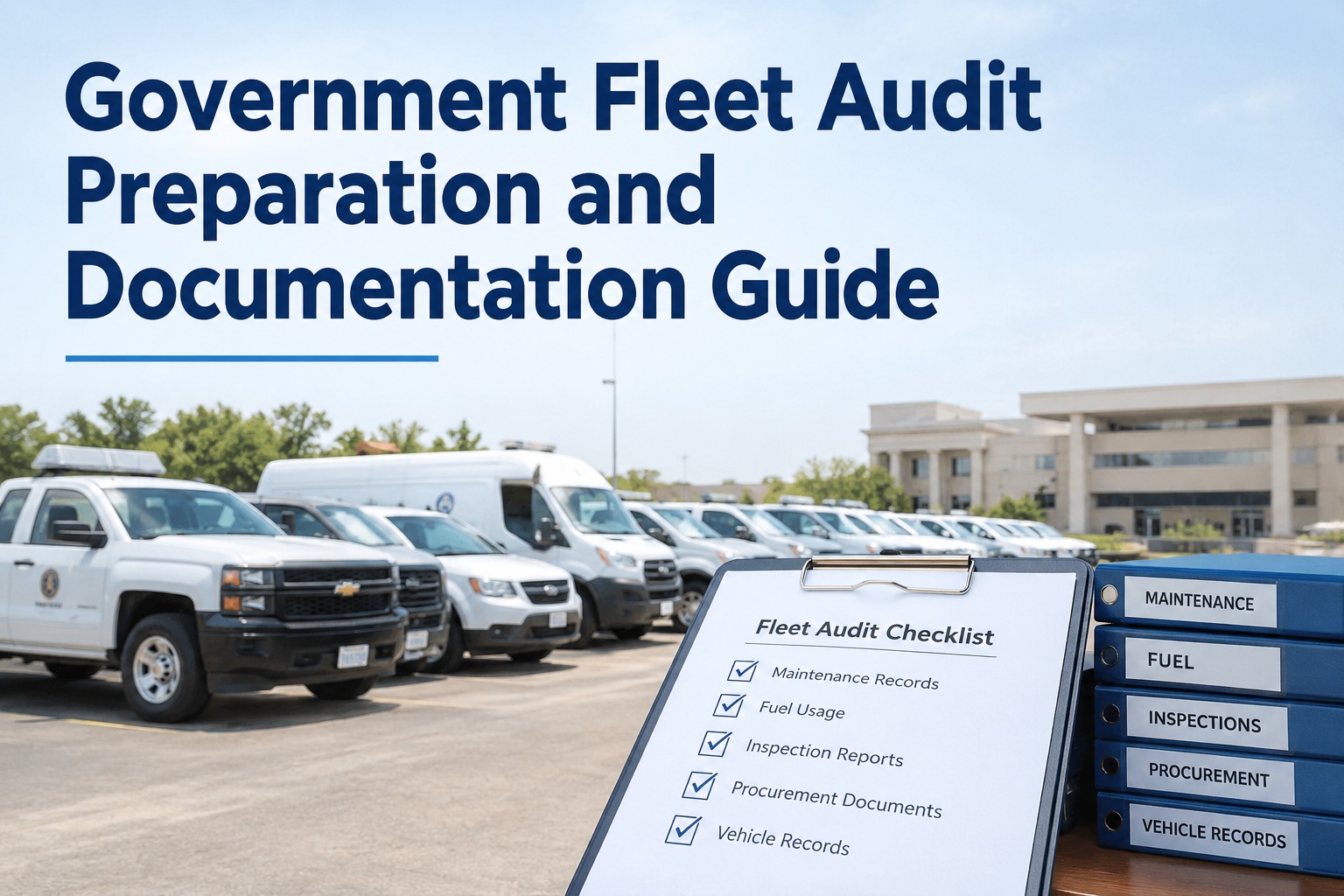
Whether the reviewer is a DOT auditor, an internal compliance team, council oversight, or a federal grant administrator, the request lands in the same five buckets. Building your fleet audit documentation around these categories — and keeping each current — is what continuous readiness looks like in practice.
Maintenance & repair history
PM schedules with documented proof of execution, annual inspections, work orders showing parts, labour and technician, and defect-closure records. Auditors verify the maintenance happened and can be traced — not just that a box was checked.
Inspection & DVIR records
Daily operator reports, pre-trip and post-trip inspections, and safety checklists — dated, signed, and ideally photo-documented. The chain from a reported defect to its repair is exactly what an auditor traces first.
Fuel & cost records
Fuel transactions linked to vehicle and odometer, cost tracking per asset, and department-level allocation. In public fleets these often need to reconcile against fund sources for budget and grant reporting.
Procurement & asset records
Acquisition documents, purchase approvals, the asset register, and disposal records with disposition method and salvage value. Grant-funded assets carry extra requirements and longer retention than the vehicle's service life.
Vehicle & compliance files
Registration, insurance, title, and the complete per-vehicle history from acquisition to disposal. When an auditor asks for a machine sold 18 months ago, the archived file must be just as retrievable as an active one.
The thread running through all five is linkage. A repair record that can't be traced back to the inspection that triggered it, or forward to the fund that paid for it, is a record that raises questions instead of answering them. Start free and file every record by vehicle, date and category automatically
Public-sectorwhat makes a government fleet audit harder than a private one
A commercial fleet answers to DOT and its insurer. A government fleet answers to those plus taxpayers, council oversight, grant administrators and open-records law. These are the three layers that make municipal fleet audit preparation genuinely different — and where spreadsheet-based tracking quietly fails.
GASB 34 asset reporting
Public fleets must produce an asset register that reconciles to physical inventory and supports annual financial reporting, with depreciation and disposal tracked. Spreadsheet tracking typically fails this scrutiny by year three to five as data drift accumulates.
Grant-funded asset rules
Assets bought with federal funds carry added requirements under 2 CFR 200 — federal award ID, percentage of federal participation, and disposition data — retained for the asset's useful life plus three years. Miss these and reimbursement is at risk.
Open-records & retention
Public-records and FOIA requests can require exporting fleet data on demand — without exposing personal information — alongside a defensible retention trail. Records must be both accessible to the public and protected where the law requires.
Each of these is a documentation discipline, not a maintenance task. They reward a system where the asset register, the fund source, and the retention clock are built into how records are stored — and they punish fragmented paper the moment the first financial audit tests them. Book a demo to see grant and asset data tracked per vehicle from day one
90 daysthe readiness rhythm that beats the last-minute scramble
The agencies that sail through audits don't prepare for an audit — they stay ready between them. A structured 90-day cycle turns compliance from reactive to proactive. Here's the rhythm, whether you're anticipating a review or just building the habit.
-
Days
1–30File completeness Review every vehicle and asset file. Identify missing documents, close gaps in inspection-to-repair chains, and start renewals on any expiring registrations, inspections or certifications. -
Days
31–60Verify & reconcile Confirm PM and annual inspections are current with documented proof. Reconcile the asset register to physical inventory and check fuel and cost records tie back to the right vehicle and fund source. -
Days
61–90Mock audit & drill Run a stress test: request files for a disposed vehicle, ask for a full history under a time limit, probe for gaps. Time the retrieval. If any record takes more than ten minutes, fix the organisation, not the vehicle.
Run this loop continuously and audit "season" stops existing — every quarter you're already at the finish line. The stress scenarios matter most: auditors routinely request records for drivers no longer employed and vehicles sold long ago, and those archived files must be as searchable as active ones. Start free and keep active and archived records equally retrievable
From a fleet supervisor who's been through it
Our vehicles were never the problem. The problem was three departments, two shared drives and a wall of binders. The first grant audit, I spent the better part of two weeks reconstructing a paper trail for eight refuse trucks — and still couldn't cleanly show the fund source on two of them.
What changed wasn't our maintenance. It was that every record now lands in one place, tagged to the vehicle and the fund the day it happens. Last review, the auditor asked for a full history on a snowplow we sold in 2023. I exported it while she was still explaining what she wanted. That's the whole game — not doing the work, proving you did it without losing a week to it.
The takeaway
Government fleet audit preparation is a retrieval problem, not a maintenance one. Audits are failed on scattered records, not neglected vehicles.
Build documentation around five linked categories — maintenance, inspection, fuel, procurement and vehicle files — each traceable to its vehicle and fund source.
Public-sector layers — GASB 34, grant rules and open records — reward a connected system and punish spreadsheets. A rolling 90-day cycle keeps you ready year-round.
When an audit tests whether you can produce records on demand, the fleets that win are the ones that never let the records scatter in the first place. Keep the trail connected, keep archived files as retrievable as active ones, and audit preparation stops being a quarterly crisis and becomes a click. That's the difference a single connected platform makes for public fleet compliance. Book a demo to see your agency's records audit-ready in one place
Frequently asked questions
What records do government fleets need for an audit?
Government fleet audits generally request records across five categories: maintenance and repair history (PM schedules with proof of execution, annual inspections, work orders showing parts and labour, defect-closure records); inspection and DVIR records (daily operator reports, pre- and post-trip checks, safety checklists, dated and signed); fuel and cost records (transactions linked to vehicle and odometer, cost tracking, department allocation); procurement and asset records (acquisition documents, purchase approvals, the asset register, disposal records with disposition method and salvage value); and vehicle and compliance files (registration, insurance, title, and complete per-vehicle history from acquisition to disposal). Public agencies face additional layers a private fleet doesn't — grant-funded assets carry extra tracking under 2 CFR 200, and asset registers must support annual financial reporting. The critical requirement across all five is that each record is dated, linked to its vehicle and fund source, and retrievable quickly, including for assets that were disposed of years earlier.
Why do fleets fail audits even when vehicles are well-maintained?
Because an audit tests whether you can produce the proof, not whether the work was done. Most audit findings begin with missing or unretrievable documentation rather than an unmaintained vehicle. Large fleets in particular tend to fail on retrieval: the records exist, but they're scattered across paper, multiple locations, shared drives and individual people, so answering a records request means reconstructing a trail under time pressure. Even when every repair genuinely happened, a gap an auditor can't trace — an inspection with no linked work order, a repair with no fund source, an archived vehicle nobody can find the file for — reads as non-compliance. This is why preparation is fundamentally an exercise in documentation discipline and retrieval speed. If you can produce a complete, linked history for any asset in minutes, the audit is routine. If it takes hours of digging, the fleet's condition never gets a fair hearing.
How can a municipal fleet reduce audit preparation time?
The biggest lever is moving from scattered paper and spreadsheets to a single connected system that files every record by vehicle, date and compliance category automatically as it's created. When inspections, work orders, repairs and fuel transactions are captured digitally with timestamps and a consistent format, audit preparation shifts from reconstructing a trail to exporting one. Agencies that make this move commonly report audit prep dropping from dozens of staff hours per quarter to just a few. Three practices amplify the effect: keep archived records for disposed vehicles as searchable as active ones, since auditors routinely request them; run a rolling 90-day readiness cycle instead of preparing only when a notice arrives; and use guided digital checklists with required fields so records are complete and legible the first time rather than needing follow-up. The goal is continuous readiness — being audit-ready every day, not scrambling to become ready when the request lands.
What extra rules apply to government and grant-funded fleet assets?
Public-sector fleets carry layers a private fleet doesn't. Under GASB standards, agencies must maintain an asset register that reconciles to physical inventory and supports annual financial reporting, with depreciation and disposal tracked — spreadsheet-based tracking often fails this scrutiny within a few years as data drift accumulates. Assets purchased with federal funds add requirements under 2 CFR 200, including recording the federal award ID, the percentage of federal participation, and disposition data, and retaining those records for the asset's useful life plus an additional period (commonly three years). On top of that, public-records and FOIA obligations can require exporting fleet data on demand while protecting any personal information, alongside a defensible retention trail. These are documentation disciplines rather than maintenance tasks, and they reward a system where the asset register, fund source and retention clock are built into how each record is stored, so financial and grant audits find a clean, reconciled trail rather than gaps.
How does fleet management software support government audit readiness?
A purpose-built inspection and maintenance platform supports audit readiness because its data structure is built around accountability and traceability. Every inspection, work order, repair and fuel transaction is captured with a timestamp, the vehicle identity, the responsible person and a clear description, then filed automatically by vehicle, date and compliance category. That creates a linked chain — a reported defect flows into a work order, which becomes a completed repair, which ties back to the vehicle file and forward to the fund that paid for it — so an auditor's request can be answered with an export rather than a search. Role-based permissions protect record integrity by controlling who can alter history, expiration alerts flag registrations and inspections before they lapse, and complete audit packages can be generated on demand for any date range. For government fleets specifically, the system can carry grant and asset-register data per vehicle and support public-records exports without exposing personal information, turning what used to be a multi-week reconstruction into a routine report.
Make your agency audit-ready every day — not just audit week
HVI captures every inspection, work order, repair and fuel record your team creates and files it by vehicle, date, fund source and compliance category — timestamped, linked, and retrievable in seconds, active or archived. When the notice arrives, you export a complete, regulator-ready package instead of losing a week to filing cabinets. Live on your fleet in under two weeks.
No paper · Grant & asset data per vehicle · Records retrievable on demand