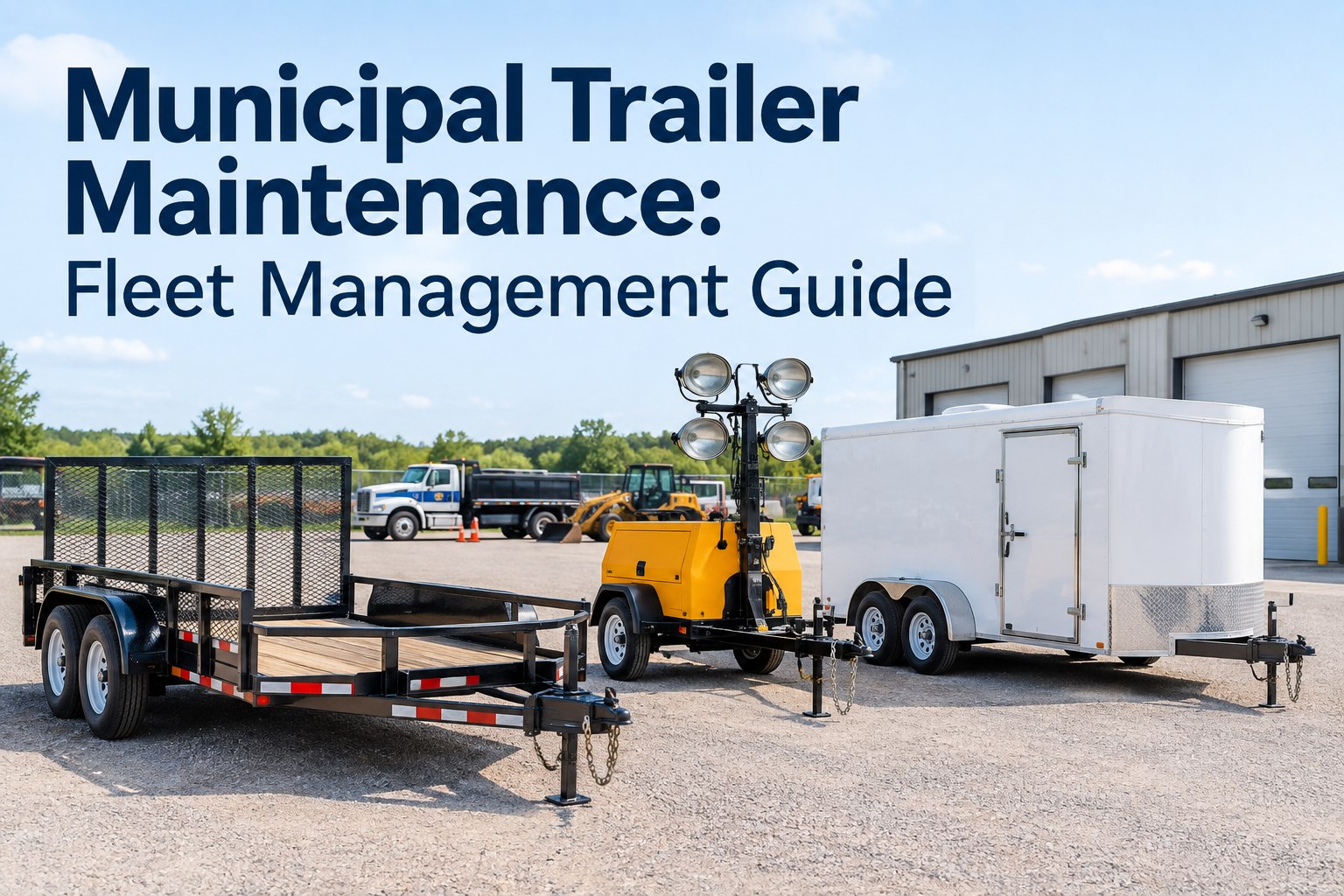
Ask a municipal fleet supervisor how many vehicles they run and you'll get a confident number. Ask how many trailers, and you'll usually get a pause. That pause is the whole problem with municipal trailer maintenance: trailers have no engine, no odometer, and often no clear owner in the yard, so they slip out of every maintenance system built around powered vehicles — a large, cheap, un-metered population that quietly outnumbers the trucks and gets almost none of the attention. Right up until a wheel comes off one on a public road, or a set of brake lights is dark on a highway at night, and suddenly a fifteen-hundred-dollar utility trailer is a liability event with the city's name on it. This guide is about pulling that invisible inventory into the light and onto a schedule. Book a demo to see every towed asset tracked on a calendar.
The assets your fleet system can't see
Switch from what's in the maintenance system to what's actually in the yard. The trucks are tracked. The trailers they tow are not.
Three vehicles, all green. The powered fleet is in the system because it has odometers and PM schedules the software understands. This is the fleet the supervisor sees, reports on, and feels good about. It's also only part of the picture.
Five trailers appear — none of them tracked. They tow behind those same trucks, travel the same public roads, and carry the same liability, but with no engine and no odometer they never entered the PM system. "No PM record" and "last serviced: unknown" is the real state of most municipal trailer fleets — and it's invisible until one fails.
The trailers don't show up because the system is built around engines and odometers — and trailers have neither. That's not a small gap; it's usually the majority of the towed fleet running with no schedule at all. Book a demo to bring every trailer into one tracked fleet view
A trailer is deceptively simple — no engine, few moving parts — which is exactly why it gets neglected and exactly why the neglect is dangerous. The handful of systems a trailer does have are all safety-critical and all fail silently: wheel bearings that seize, brakes that fade, tires that age out, lights that corrode dark, and a breakaway system that's supposed to stop a runaway trailer but only works if its battery is alive. None of these announce themselves from the cab. The rest of this guide walks those systems, the calendar that keeps them in check, and how to manage a trailer population that no odometer will ever remind you about.
The systems that fail — quietly, and on a public road
Everything on a trailer that can hurt someone is a component that gives no warning from the tow vehicle. The driver up front feels nothing until it's already happening. These are the systems a municipal trailer program has to stay ahead of.
Wheel bearings
The classic municipal failure — a dry or worn bearing seizes and a wheel comes off, often at speed on a road with the city's name on the door. Bearings need periodic repacking and inspection; a bearing that runs hot or plays loose is a wheel separation waiting to happen.
Brakes
Electric or surge trailer brakes wear like any other — shoes thin out, adjusters drift, and a corroded ground at the connector is the number-one cause of weak braking. Check shoe thickness at every bearing service and confirm the brakes actually engage, because the tow driver can't feel a dead trailer brake until the stop is too long.
Tires & age-out
Trailer tires fail on age as much as tread. A trailer that sits between jobs flat-spots its tires and loses pressure, and the sneaky one is the date code — a tire with plenty of tread can be years past its safe service life. Check pressure, tread, damage, and the date code, not just how it looks.
Lights & 7-way wiring
Dark brake and marker lights are one of the most-cited trailer defects, and the cause is usually a corroded ground or connector rather than a bulb. Test the full lighting circuit at the connector, not just a walk-behind glance — a trailer running dark at night on a public road is both a citation and a crash risk.
Coupler, safety chains & breakaway system
The connection to the tow vehicle, and the last line of defence if it fails. Check the coupler for wear and proper latching, the safety chains for condition and correct crossing, and — the item most often overlooked — the breakaway system: the battery-powered brake that's supposed to stop the trailer if it separates from the tow vehicle. That breakaway battery dies silently from disuse, so a trailer that detaches becomes an unbraked runaway. It has to be tested, not assumed.
Notice the pattern: every one of these is invisible to the person towing until it fails, and every failure happens out on a public road rather than safely in the yard. That combination — silent failure plus public-road consequence — is exactly why a trailer can't be left to "we'll look at it if something seems off." It has to be on a schedule that catches the bearing, the brake, and the breakaway battery before they're discovered the hard way. Start a free trial and put each of these systems on a checklist tied to every trailer.
Why calendar, not mileage or hours, is the only clock that works
Here's the structural reason trailers fall out of maintenance programs: the two clocks fleets normally run on don't exist on a trailer. There's no odometer, so a mileage-based PM never comes due. There's no engine, so hour-based PM doesn't apply. A trailer plugged into a fleet system built for trucks simply never triggers a service — it sits at zero forever while its bearings dry out and its tires age.
The clock that does work is the calendar. Trailer service intervals are naturally time-based: repack the wheel bearings and inspect the brakes on a defined interval — commonly every six months or so — check the breakaway battery and repack bearings around annually, and inspect tires, lights, and coupler on a regular cadence regardless of how far the trailer travelled. A trailer used twice a year and one used twice a week both age their bearings, tires, and breakaway battery by the calendar, and both need the time-based service. Some manufacturers give a dual trigger — a mileage figure or a time interval, whichever comes first — but for a municipal trailer that rarely racks up distance, the time interval is almost always the one that fires. Building the program on calendar triggers per asset is what finally gives a trailer a due date it can actually reach. Confirm the specific intervals for your trailers against the manufacturer's guidance. Book a demo to see calendar-based PM fire on trailers with no meter
The public-road liability nobody budgets for
A private fleet's trailer failure is a cost problem. A municipal trailer failure is a public one, and that changes the stakes entirely. When a city-owned trailer loses a wheel, tows dark, or runs away after detaching, it happens on a public road, in public view, with the municipality's name on the equipment — and municipal fleets operate under a level of scrutiny private ones rarely see, with council meetings, public records requests, and published audits putting every incident and every maintenance record in the open.
That scrutiny cuts two ways. A trailer failure that injures someone or damages property becomes a liability claim against the city, and the first thing an attorney or auditor asks for is the maintenance record — which, for an untracked trailer, doesn't exist. "We inspected it sometimes" is not a defence. But the same scrutiny is why a documented trailer program pays off so clearly: a record showing each trailer on a calendar schedule, with dated inspections and photo evidence of the bearing repack and the light test, turns a potential liability into a demonstrable duty-of-care. The reactive pattern is also simply more expensive — a bearing repack scheduled for a modest cost becomes an emergency roadside recovery, a damaged axle, and possibly a claim when it's left to fail. For a public fleet, the documented, scheduled trailer is both the safer and the cheaper one, and it's the one you can defend at a council meeting. Book a demo to see dated, photo-backed trailer records built automatically
Bringing the invisible inventory onto a schedule
Fixing a neglected trailer fleet isn't complicated, but it does require treating trailers as real assets rather than accessories. It's a four-step move from "we have some trailers around somewhere" to "every towed asset is on a schedule and accounted for."
Each step closes a gap that keeps trailers invisible. Inventorying them as assets is what makes them countable and assignable instead of "those trailers by the fence." Type-specific templates mean an equipment trailer gets its ramp and tie-down checks while a utility trailer gets its gate and bed checks, without one generic form missing what matters. Calendar scheduling gives each unit a due date that actually arrives. And documented, photo-backed inspections — captured offline at whatever remote yard the trailer lives at — produce the record that turns a liability into a defensible program. The result is that the trailer fleet stops being the part of the operation nobody can answer for. Start a free trial and pull your whole towed-asset fleet onto one schedule.
From a shop foreman who counted the trailers
I could tell you the service status of all twenty-two of our trucks off the top of my head. Trailers? I honestly didn't know how many we had — turned out it was thirty-one, more than the trucks, scattered across four yards. Not one of them was in our maintenance system, because the system wanted an odometer and a trailer doesn't have one. They just... existed, until one dropped a wheel on a county road hauling a mini-ex. Nobody had repacked that bearing in years because nobody was tracking it to repack.
We inventoried every trailer, gave each one a record and a six-month calendar PM, and built templates so the equipment haulers and the little utility trailers get the right checks. Now every towed asset has a due date and a photo history, and when legal asked for the maintenance record on that trailer after the incident, the answer stopped being an embarrassed silence. The trailers were our biggest blind spot precisely because they were the simplest things we owned.
Municipal trailer maintenance FAQs
Why are municipal trailers so often missing from maintenance programs?
Municipal trailers fall out of maintenance programs for a structural reason: the systems fleets use to trigger preventive maintenance are built around engines and odometers, and a trailer has neither. A mileage-based PM schedule never comes due for an asset with no odometer, and an hour-based schedule doesn't apply to an asset with no engine, so a trailer entered into a truck-oriented fleet system simply sits at zero and never generates a service. On top of that, trailers are cheap relative to powered vehicles, often lack a single clear owner or operator in the yard, and are numerous — municipal fleets frequently have more trailers than trucks, scattered across multiple yards. The combination of low unit cost, no dedicated operator, no meter, and high count means trailers get treated as accessories rather than assets and quietly drop out of the maintenance picture entirely. The danger is that this invisibility has nothing to do with the trailer's actual risk: it still travels public roads, still carries safety-critical systems like bearings, brakes, and the breakaway device, and still fails in ways that endanger the public. Bringing trailers back into the program means registering each one as its own asset and putting it on a calendar-based schedule rather than waiting for a meter that will never move.
Should trailer maintenance be scheduled by mileage or calendar?
Trailer maintenance should be scheduled primarily by the calendar, because the time-based interval is the one that reliably applies to an unpowered, low-mileage asset. Trailer service items are naturally time-driven: wheel bearings should be repacked and brakes inspected on a defined interval such as roughly every six months, the breakaway battery checked and bearings serviced around annually, and tires, lights, coupler, and safety chains inspected on a regular cadence regardless of distance travelled. Many manufacturers express these as a dual trigger — a mileage figure or a time period, whichever comes first — but for a typical municipal trailer that accumulates very little distance, the time interval is almost always the trigger that fires first, and a purely mileage-based approach would leave the trailer unserviced indefinitely. The underlying reason is that the failure modes are time-driven as much as use-driven: bearing grease breaks down, tires age out by date code even with good tread, brake components corrode, and the breakaway battery self-discharges, all of which happen on the calendar whether the trailer is towed once a year or once a week. So even a trailer that barely moves needs its time-based services on schedule. Confirm the specific intervals for each trailer against its manufacturer's guidance, and build the program on calendar triggers per asset.
What should a municipal trailer inspection checklist include?
A municipal trailer inspection should cover the trailer's safety-critical systems, each of which can fail without warning to the tow-vehicle driver. Wheel bearings: check for play, heat, and grease condition, and repack on the service interval, since a seized bearing causes wheel separation. Brakes: on electric or surge brakes, check shoe or pad thickness, adjustment, and actual engagement, and inspect the wiring and grounds, as a corroded ground is a leading cause of weak braking. Tires: check pressure, tread, and damage, and critically the date code, because trailer tires age out and can be unsafe despite good tread, and sitting causes flat spots and pressure loss. Lights and wiring: test the full lighting circuit at the 7-way connector rather than eyeballing, since dark brake and marker lights are a common and hazardous defect usually caused by corroded connectors. Coupler, safety chains, and the breakaway system: verify the coupler wear and latching, chain condition and crossing, and test the breakaway device and its battery, which is the trailer's last line of defence if it detaches and is frequently overlooked. Structural items: inspect the frame, cross-members, and floor or deck for rust and damage, plus ramps, gates, tie-downs, and the jack or stabilizers as applicable to the trailer type. Building this as a configurable, trailer-type-specific template ensures each kind of trailer gets the right checks without a generic form missing critical items.
Why is the trailer breakaway system so important?
The breakaway system is the trailer's last line of defence against becoming an unguided, unbraked hazard if it separates from the tow vehicle, which is why it deserves specific attention that it rarely gets. It consists of a small battery and a switch connected by a cable to the tow vehicle; if the trailer detaches while moving, the cable pulls the switch and the battery applies the trailer's brakes, bringing the runaway trailer to a stop rather than letting it roll free into traffic or off the road. The problem is that this is an entirely standby system — it does nothing during normal operation, so its failure is completely invisible until the moment it is needed. The breakaway battery self-discharges over time, especially on a trailer that sits between uses, and a dead battery means the safety system silently does not work. Because there is no dashboard warning and no symptom during towing, the only way to know the breakaway system is functional is to test it deliberately as part of the maintenance schedule — confirming the battery holds a charge and the switch actuates the brakes. On a municipal trailer traveling public roads, a functioning breakaway system is both a safety essential and, in many jurisdictions, a legal requirement, making its regular test one of the highest-value items on the trailer checklist.
How can a municipal fleet track trailers that have no odometer?
Tracking odometer-less trailers requires shifting from meter-driven maintenance to asset-and-calendar-driven maintenance, which a fleet system designed for that purpose handles directly. The starting point is to register each trailer as its own asset with a unique identifier — a fleet number or asset tag — so it exists in the system independently of any tow vehicle and can carry its own record, history, and schedule. From there, maintenance is triggered by calendar dates rather than mileage: each trailer gets time-based PM intervals (such as a six-month bearing-and-brake service and an annual breakaway-and-bearing service) that come due on the date regardless of use. Inspections are recorded against the trailer's asset profile with dates and photo evidence, building the maintenance history that an untracked trailer completely lacks. Because municipal trailers often live at remote yards or job sites without connectivity, an offline-capable mobile inspection tool is important so checks can be completed and photographed where the trailer actually is, then synced to its record. The result is that a trailer with no meter still has a due date, a documented history, and a clear place in the fleet — which is exactly what turns the invisible trailer inventory into a managed, defensible part of the operation. This asset-and-calendar model works equally for other un-metered towed equipment a municipality owns.
Pull your trailer fleet out of the blind spot
HVI brings every trailer and towed asset into one fleet view with its own record and a calendar-based PM schedule — no odometer required — plus configurable templates per trailer type, bearing, brake, tire-age, lighting, and breakaway checks logged per unit, and offline inspections for any remote yard. The invisible inventory becomes a tracked, scheduled, photo-documented fleet you can defend at a council meeting. See it on your own towed assets.
No credit card · Calendar-based trailer PM from day one · Works offline at any yard