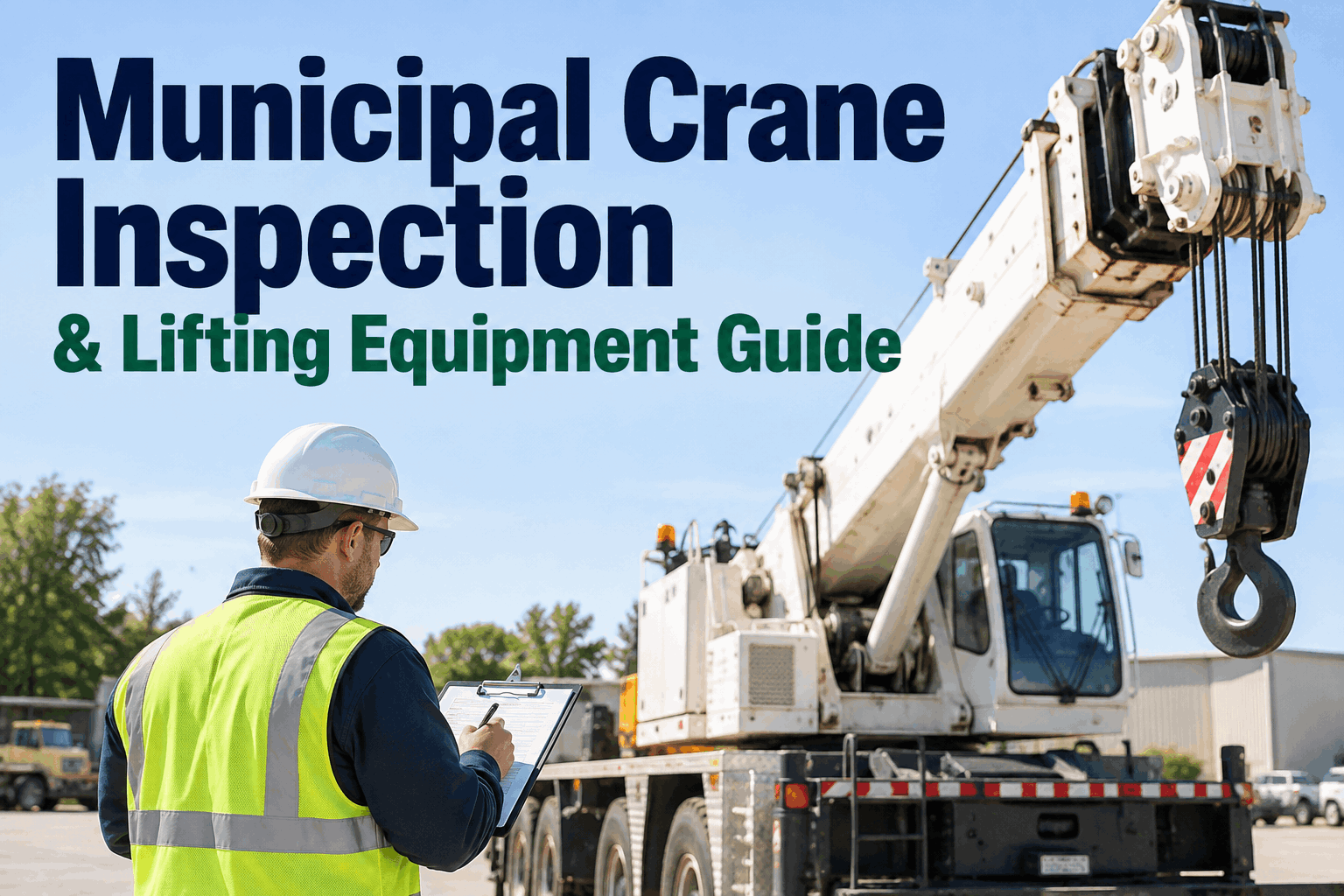
Municipal crane inspection is the one task on your fleet where "we meant to" is not a defense. When a public works crane drops a load or a boom truck tips, the first question isn't what failed — it's show me the inspection records. If those records live in a cab binder that's water-stained, three months behind, or missing the annual, your city is exposed. Here's how to run municipal crane and lifting equipment inspection as a defensible, digital program instead of a paper chase you hope holds up.
Every lift, inspected. Every record, ready.
Public works cranes and lifting equipment run on a fixed regulatory rhythm — pre-use, monthly, annual. Miss a tier or lose the paperwork and it's not a maintenance problem, it's a liability. Put the whole cadence on one digital system with records built to survive an audit.
Most municipal fleet teams already know the checklist — the hard part isn't knowing what to inspect, it's proving every inspection happened, on time, across a mixed fleet, year after year. HVI has detailed line-item guides for the checks themselves, like the mobile crane inspection checklist (ASME B30) and the full crane inspection checklist. This guide sits one level up: how a public works department turns those checks into a managed, auditable program across every machine that lifts — not just the one with "crane" in its name.
Municipal lifting is more than the crane truckwhy municipal lifting equipment inspection covers a wider fleet than you think
When an auditor or an insurer says "lifting equipment," they don't just mean the mobile crane. A surprising share of a city's lift-related risk sits on machines nobody files under "crane" — and every one of them carries inspection obligations.
Knuckle-boom & grapple trucks
Brush, debris and material handling on sanitation and streets crews.
Aerial & bucket lifts
Signals, lighting and tree work — people in the air, not just loads.
Digger-derricks
Utility poles, transformers and water infrastructure lifts.
Shop gantry & hoists
Overhead cranes pulling engines and components in the yard.
Trailer-mounted cranes
Shared units that move between crews and sites all season.
Slings, hooks & rigging
Below-the-hook gear with its own inspection and tag-out rules.
Asset management means each of these sits on the system with its own inspection schedule, history and certification status — so nothing lifts loads off the books. See every lifting asset on one inspection system.
The real exposure isn't the crane — it's the binderwhy paper municipal crane inspection records fail when it matters
The inspection usually gets done. The record is what goes missing. And in a municipality — where public-records requests, insurers and safety regulators all have a right to look — a missing or late record is its own finding, whether or not the equipment was fine.
- Annual cert expired six weeks ago — nobody got the reminder
- Three monthly inspections missing; the operator "did them"
- Handwriting illegible, pages water-stained, dates overwritten
- A flagged wire-rope defect never became a repair order
- Records for a trailer crane sitting in a different crew's truck
- Certification expiry flagged 30 days out, auto-reminded
- Every inspection time-stamped, by whom, with a signed PDF
- Photos of each defect attached to the exact unit
- Every flagged fault converted straight to a work order
- Full history per asset, pulled up in seconds for any auditor
That gap — inspection done, record lost — is the single biggest avoidable exposure in a public fleet. See inspection records built for an audit.
The inspection cadence, running itselfhow digital crane preventive maintenance keeps every tier on schedule
The regulatory rhythm doesn't change — what changes is whether it depends on someone remembering. Each required inspection maps to a feature that triggers it, records it, and acts on what it finds.
Operators run the shift walkaround on a mobile device at the machine — no form to lose, every check logged.
The documented monthly check is scheduled automatically and filed the moment it's completed.
The yearly qualified-person inspection is scheduled ahead and its certificate stored against the unit.
A failed item becomes a tracked repair with the crane tagged out of service until it's closed.
Annual certs, operator qualifications and rigging tags flag before they lapse — not after.
This is preventive maintenance and digital inspections doing the remembering, so a skipped tier can't quietly become next year's incident. See the inspection cadence run itself.
Records that survive an auditwhat every municipal crane inspection should capture
A defensible record isn't a checkmark — it's a complete, time-stamped account of who inspected what, when, what they found, and what was done about it. Here's what each digital inspection locks in automatically:
Inspector name, date and time stamp on every check
Signed PDF inspection report, stored against the unit
Photos of defects attached to the exact component
Meter/hour reading tied to the maintenance schedule
Pass/fail status with the resulting work order linked
Certification & qualification status for the asset
Pull any unit's full chain of records in seconds — the difference between a clean maintenance management review and a scramble through filing cabinets. Start a free asset list and see it build.
What changes for a public works team
Audit-ready records
Complete, time-stamped inspection history for every lifting asset, on demand.
No missed tiers
Pre-use, monthly and annual inspections scheduled and tracked automatically.
Defects don't slip
Every flagged fault becomes a work order and tags the unit out until closed.
Nothing lapses
Certifications and qualifications flag before they expire, not after.
It all runs from the field on a phone, so public works, utilities and shop crews inspect to one standard. Add your lifting equipment free and bring it onto one system.
From a public works safety manager
The inspections were never really the problem — my operators are good. It was the paper. We'd get a records request or an insurer's audit, and I'd be digging through three crews' binders trying to prove a monthly happened eight months ago. One annual cert lapsed because the reminder lived in my head. That's the kind of thing that ends up in an incident report if your luck runs out.
Now every pre-use, monthly and annual is logged with a signed report, the certs flag a month before they're due, and I can pull any crane's full history on my phone while I'm standing in the yard. When the auditor came through last quarter, it took me four minutes instead of two days. That's the whole value, right there.
Municipal crane inspection — FAQs
What inspections does a municipal crane legally require?
Under frameworks like OSHA 1926.1412 and the ASME B30 standards, mobile cranes generally require a pre-use (each-shift) check by the operator, a documented monthly inspection by a competent person, and a comprehensive annual inspection by a qualified person — plus inspections after modification, repair or assembly. Overhead and gantry cranes and below-the-hook rigging carry their own schedules. Always confirm the exact requirements for your equipment type and jurisdiction.
Does HVI certify cranes or replace the qualified-person inspection?
No — and that's an important distinction. HVI doesn't certify equipment or perform the inspection for you. Your qualified person, competent person and operators still do the actual inspections. What HVI does is digitize, schedule and document them: it captures each inspection as a signed, time-stamped record, stores the certificate your qualified person issues, and alerts you before anything expires. It's the record and scheduling system, not the certifying authority.
How does digital inspection help with a public-records or safety audit?
The weak point in most municipal programs isn't doing the inspection — it's proving it later. HVI keeps a complete, searchable history per asset: who inspected it, when, what they found, the signed report, defect photos, and the work order that followed. When an auditor, insurer or records request comes in, you pull the full chain in seconds instead of searching binders across multiple crews.
Can it track more than just the mobile crane?
Yes — that's the point of treating it as lifting-equipment inspection rather than just crane inspection. Knuckle-boom and grapple trucks, aerial and bucket lifts, digger-derricks, shop gantry hoists, trailer cranes and below-the-hook rigging can each sit on the system with their own inspection schedule, history and certification status, so your whole lifting fleet is covered under one standard.
What happens when an inspection flags a problem?
A failed or flagged item can be turned straight into a work order, with the defect, photos and the inspection it came from attached. You can tag the unit out of service until the repair is closed, so a known issue can't be lost between the inspection and the shop — the gap where paper processes most often fail and incidents happen.
Run municipal crane inspection as a program, not a paper chase
Every lifting asset on one system, every inspection tier on schedule, and every record signed, time-stamped and ready the moment someone asks. Replace the binder with a program your city can stand behind — see it on your own fleet in 30 minutes.
Pre-use · Monthly · Annual — all tracked · Audit-ready records · Built for public works