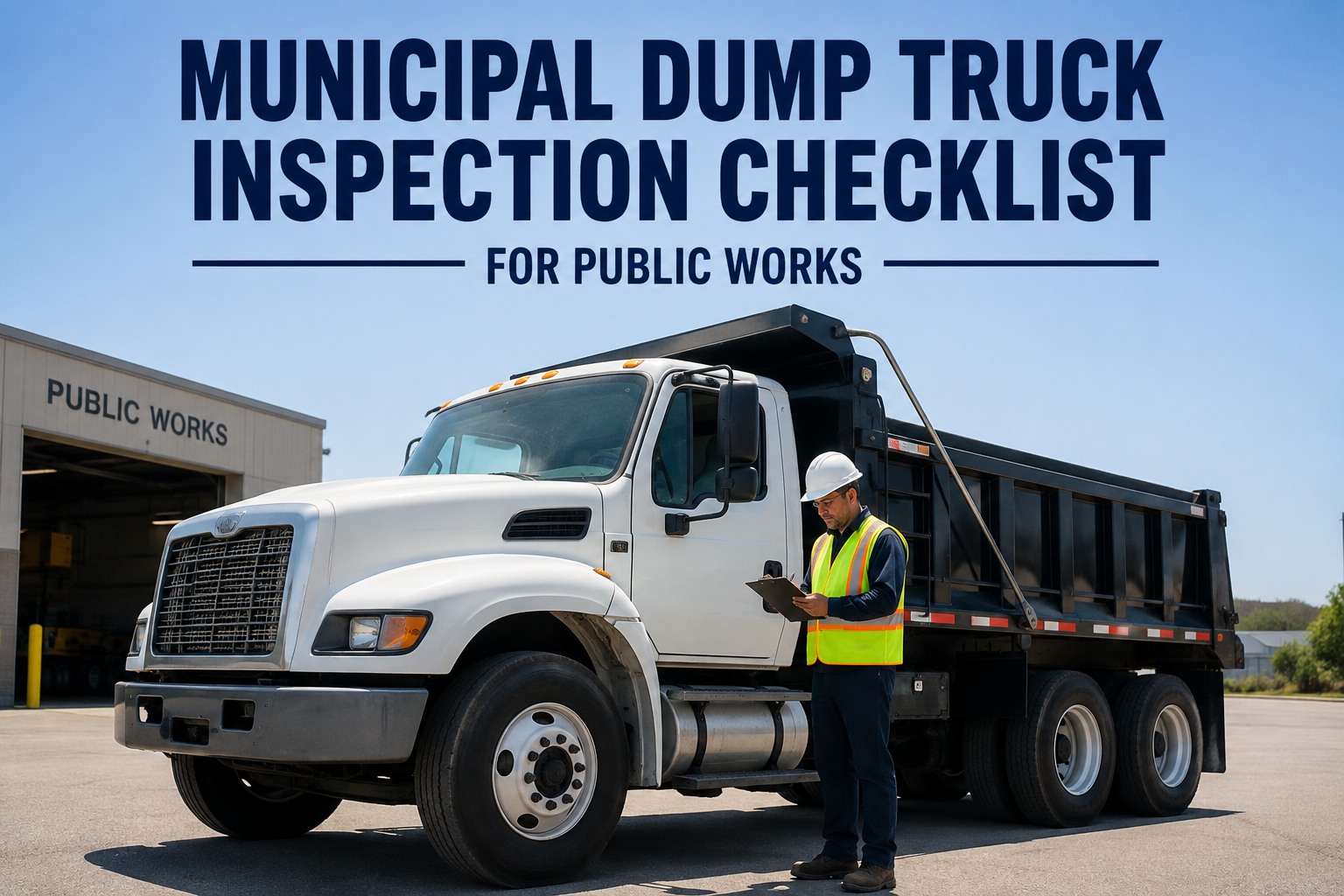
You know the call: a single-axle dump is on the shoulder of a county road with the bed stuck six inches off the frame because a hoist cylinder bled out overnight. The driver never caught it on the walkaround because the paper DVIR was in the cab, it was raining, and the checkboxes just said "bed — OK." A municipal dump truck inspection checklist has to go deeper than a tractor's general walkaround. Bed hinges, tailgate latches, hoist cylinders, pin locks, load lights, backup alarms and mud flaps take real abuse from aggregate, salt and asphalt work and missing a defect on those components is what puts a city truck out of service on a roadside inspection. Moving that 55-point check onto a phone or tablet, with photo capture and instant defect-to-work-order routing, is the fastest way to stop the roadside failures and the text-message repair requests. If you want to see how that actually looks on your own yard, you can walk through it on your own units in about 30 minutes.
The 55-Point Municipal Dump Truck Inspection Checklist Built for Public Works
Municipal dump trucks fail roadside inspections roughly 42% more often than line-haul tractors. The failures are rarely the engine — they are bed hinges, tailgate latches, hoist cylinders and pin locks. HVI digitizes the full 55-point muni dump DVIR on any phone, with photo defect capture and automatic work orders.
What a Missed Dump Body Defect Actually Costs You
Every unchecked box on a paper municipal dump truck DVIR has a price tag. It shows up as a roadside out-of-service order, a tow bill, a CSA point hit, or a cold-mix load that goes back to the plant while a crew stands around. These four numbers are what public works fleets actually live with.
Municipal dump trucks are cited out of service at a far higher rate than line-haul tractors, driven by dump-body components that never appear on a standard tractor DVIR.
A proper municipal dump truck checklist covers 55 distinct points, from bed hinges and hoist cylinders to backup alarms, far beyond a generic Class 8 walkaround.
A single out-of-service dump truck on a county route easily burns $1,200 in towing, lost crew time and delayed material delivery before the repair even begins.
Drivers using a mobile DVIR with pre-loaded 55-point templates finish inspections roughly 14 minutes faster than filling out and filing a paper binder sheet.
Municipal Dump Truck Inspection Checklist: The 55 Points
A public works dump truck DVIR has to satisfy FMCSA §396.11 for any truck operating on public roads, but it also has to cover the dump body hardware that a city or county inspector will flag in a yard audit. Below is the 55-point structure HVI loads into the app, split across five zones. The dump-body and hoist zone is where most muni-specific failures live.
Cab & Controls
- Dashboard warning lamps & gauges
- Air pressure build-up timing
- Parking & service brake function
- Steering play & column lock
- PTO engage / disengage switch
- Hoist raise / lower control
- Defroster, wipers & washer
- Headlights, high beams & markers
- Turn signals & 4-way flashers
- Load status indicator light
Chassis & Undercarriage
- Frame rails & crossmembers
- Suspension air bags / springs
- U-bolts & spring hangers
- Driveshaft & carrier bearing
- Slack adjusters & brake stroke
- Brake chambers & hoses
- Drums / rotors for cracks
- Tire tread depth & pressure
- Rims & wheel nuts
- Mud flaps & brackets
Dump Body & Hoist
- Bed hinges & hinge pins
- Hoist cylinder & seals
- Hoist hoses & fittings
- Tailgate hinges & bushings
- Tailgate latches & chains
- Pin locks & bed locks
- Safety prop / strut
- Bed floor & side cracks
- Tarp system & motor
- Backup alarm activation
Lights & Electrical
- Tail & stop lamps
- Backup lights
- Side marker & clearance
- License plate lamp
- Reflective tape condition
- 7-way wiring harness
- Battery box & tie-down
- Alternator output
- Horn function
- Glad hands & air lines
Fluids, Safety & Compliance
- Engine oil level
- Coolant level & condition
- Power steering fluid
- Transmission fluid
- DEF level
- Hydraulic tank level
- Fire extinguisher & tag
- Triangles / flares
- Spill kit (if hauling salt)
- Registration & insurance
Tandem & Axle Specific
- Tandem axle alignment
- Inter-axle differential lock
- Wheel seal leaks
- Lug nut torque indicators
- Single axle hub temp
Dump Body Inspection: Where Public Works Trucks Actually Fail
The components below are the ones that roadside inspectors and yard auditors flag most on municipal dump trucks. Each one has a specific failure mode and a specific cost when it goes unchecked on a paper DVIR. Use this as the risk-priority guide when you set up your dump truck safety inspection template in HVI.
| Component | Failure Mode | Roadside Risk | Check Method |
|---|---|---|---|
| Bed Hinges | Pin wear, elongation, cracked welds from overloading | Bed shifts during travel, fails frame inspection | Visual + pry-bar play check |
| Hoist Cylinder | Seal leak, bleed-down overnight, hose chafing | Bed drops unexpectedly, critical OOS | Raise, hold 5 min, check for drift |
| Tailgate Latches | Latch spring failure, chain stretch, bent pin | Aggregate spillage on roadway, fine risk | Latch engagement + chain tension |
| Pin Locks / Bed Locks | Missing, bent, or non-functioning locking pin | Bed raise during transit, fatal hazard | Drop bed onto locks, verify engagement |
| Backup Alarm | Wiring corrosion, relay failure, inaudible | Pedestrian / worker strike risk, OOS | Reverse gear, verify audible at 25 ft |
| Mud Flaps | Torn, missing, bracket corrosion | Debris strike citation, often grouped OOS | Visual + bracket tug test |
| Load Light | Burned out, corroded socket | Failure to identify oversize / load status | Cycle switch, verify illumination |
Paper DVIR vs Mobile App: The Real Difference
A paper binder sheet does not tell the shop what is broken until the driver walks it in. A mobile DVIR tells the shop foreman the moment the driver hits "defect." That time gap is the difference between a repair scheduled for the yard and a breakdown on a county route. You can start logging inspections free and see the shift in your own defect-routing times.
The Clipboard Approach
- Driver checks boxes in the cab, often after the trip
- No photo evidence of the defect
- Defect sits on paper until the sheet reaches the shop
- Shop has to transcribe the defect into a work order
- No timestamp proof for DOT or city audits
- Lost or damaged sheets mean no record at all
The Digital Approach
- Driver runs the full 55-point check on a phone or tablet
- Photo and note attached to any flagged defect
- Defect auto-creates a work order in the shop queue
- Shop foreman sees priority defects in real time
- Timestamped, audit-ready record for FMCSA §396.11
- Cloud-stored, searchable by unit, date or component
See HVI Run a 55-Point Dump Truck Inspection on Your Own Yard
Book a 30-minute demo and we will load your municipal dump truck template, your unit numbers and your defect list into HVI before the call.
What a Missed Hoist Cylinder Defect Costs vs HVI
Take a 40-truck public works fleet running tandem and single-axle dumps. If a hoist cylinder bleeds down overnight and the driver misses it on a paper DVIR, the truck goes out with a bad cylinder. It fails at a job site, the crew waits, the material cools or sets, and a tow truck is called. Here is how that single missed defect plays out financially against the cost of catching it with a mobile DVIR and photo evidence. If you want to map this to your own unit count, you can see the ROI on your own fleet numbers with a quick call.
- Roadside tow: $650
- Lost crew time (4 hrs × 3 crew): $520
- Rejected material load: $480
- Emergency cylinder seal repair: $890
- CSA / out-of-service admin: $300
- Planned repair in yard: $140
- Defect photo + work order auto-created
- Truck re-assigned, no crew downtime
- No tow, no rejected material
- Audit-ready timestamped record
On a 40-truck muni fleet averaging two missed dump-body defects per month, that is a $64,800 annual swing from moving a 55-point dump truck checklist onto a phone. That is before you count the safety, compliance and audit-time savings. You can walk through the exact calculation on your fleet in a live demo.
How HVI Maps to Your Muni Dump Truck Maintenance
HVI is built for fleet-heavy operations that run mixed assets. For a public works yard running single-axle dumps, tandem dumps, plows and service trucks, these are the four capabilities that directly cut downtime, kill paper and prove compliance during a DOT or city audit.
55-Point Digital DVIR
Load the full municipal dump truck checklist — bed hinges, hoist cylinder, tailgate latches, pin locks, load light, backup alarm, mud flaps — as a template. Drivers run it on any phone or tablet, with photo capture on every flagged defect. No more clipboard sheets left in the cab.
Instant Defect-to-Work-Order
When a driver flags a leaking hoist cylinder on the app, HVI auto-creates a work order in the shop queue before the truck is back in the yard. The shop foreman sees the photo, the unit number and the defect severity, and can schedule the repair without a phone call.
Preventive Maintenance Scheduling
Schedule tandem and single-axle dump truck PM by date, mileage or engine hours. HVI sends due and overdue alerts so a hoist cylinder grease interval or a brake stroke check never slips past a snow event or a paving season.
Audit-Ready Compliance Records
Every inspection is timestamped, geotagged and photo-backed. When a DOT auditor or a city safety officer asks for the last 90 days of dump truck DVIRs, you pull them from HVI in seconds instead of digging through a binder. You can review your audit-readiness gap on a live call before the next inspection cycle.
What a Municipal Dump Truck Checklist Should Do for You
A municipal dump truck inspection checklist is not just a compliance form. It is the tool that keeps a 33,000-pound truck with a raised bed from failing on a public road, keeps your crews productive, and keeps your yard audit-ready. Here is what the right checklist — and the right software to run it — actually delivers.
Cover the 55 muni-specific points
A generic tractor DVIR misses bed hinges, hoist cylinders, tailgate latches and pin locks. A true public works dump truck DVIR covers all 55 points, including city-specific items beyond FMCSA §396.11.
Route defects before the truck returns
Photo-backed digital defects auto-create work orders, so the shop is ready before the truck hits the yard. That kills the text-message repair request and the clipboard delay.
Prove every inspection in seconds
Timestamped, geotagged records mean a DOT or city audit takes minutes, not days. No more lost paper sheets or illegible driver handwriting.
Stop the roadside 42% gap
Municipal dumps fail roadside at a higher rate than tractors because the body components get missed. A component-level digital checklist closes that gap.
We were running paper DVIRs on 28 dump trucks and the shop never saw a defect until the driver walked the sheet in. Half the time the hoist cylinder had already leaked all over the yard by then. The number I track now is defect-to-work-order time — on paper it was a day, on HVI it is about four minutes. That is the whole game for us during paving season.
Municipal Dump Truck Inspection Checklist FAQs
What is a municipal dump truck inspection checklist?
How often should a municipal dump truck be inspected?
What is the difference between a single axle and tandem dump truck PM checklist?
Can a mobile DVIR app replace paper inspection sheets for DOT compliance?
How does HVI handle defect-to-work-order routing for dump trucks?
Move Your Muni Dump Truck DVIR Off Paper Today
See HVI running the full 55-point checklist on your own dump trucks. Book a 30-minute demo and we will load your template before the call.
Free to start — Works on any phone — No card needed