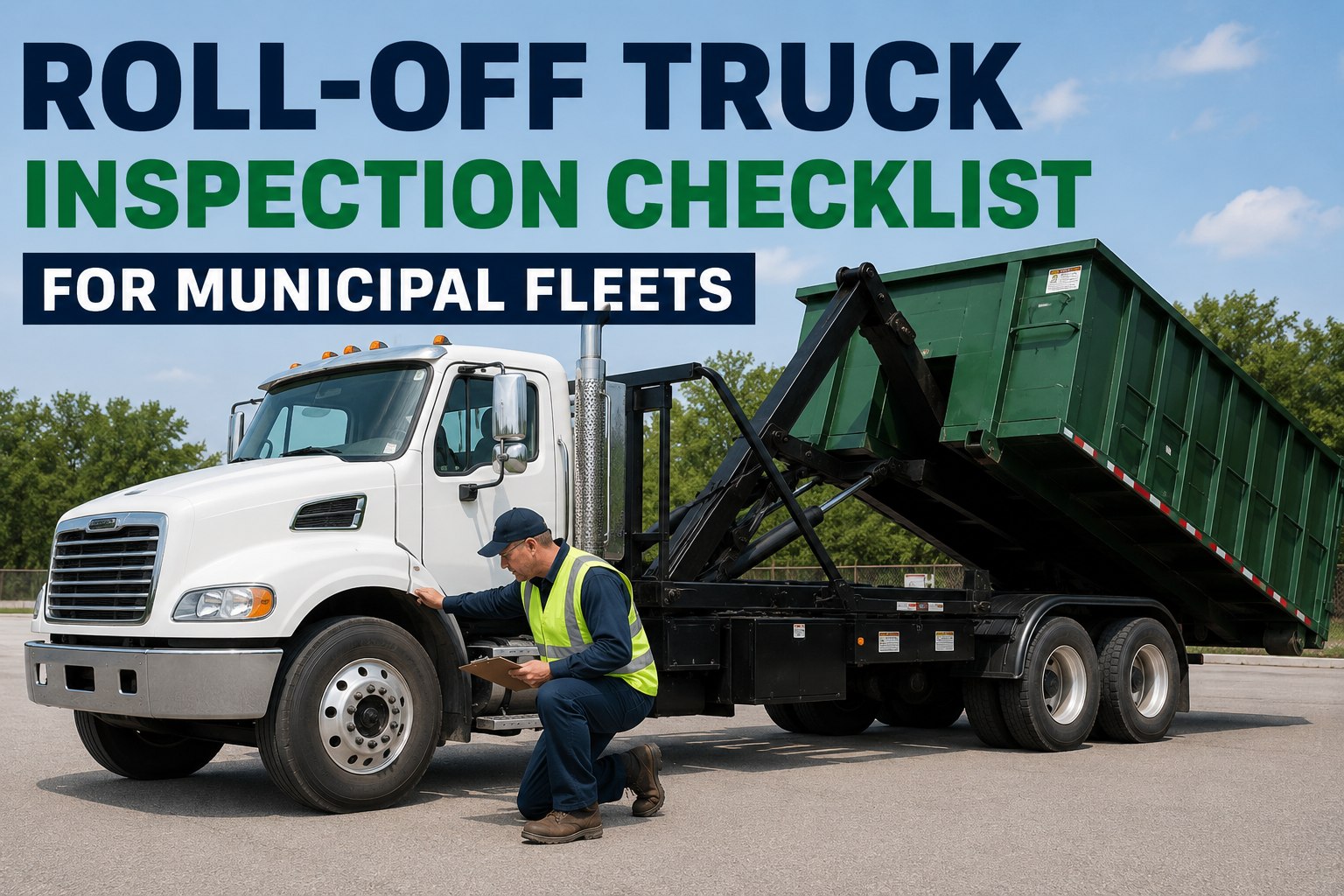
You can hear a worn winch brake before you see it — the cable slacks a half-second too long as a 30-yard container clears the truck body, and for that moment the whole load is hanging on friction and prayer. Roll-off truck inspection is not a generic Class 8 walkaround; cable, winch, hook lift, and hoist failure modes are unique to this equipment, and missing them turns a routine container pickup into a dropped-load event, a roadside OOS or a worker injury claim. Municipal roll-off fleets run Mack Pinnacle, Freightliner, and Peterbilt chassis fitted with cable hoist or hook-lift systems, and the shop that inspects them like they are just another straight truck is the shop that eventually has a cable snap on a public road. see the HVI roll-off template on your own trucks
Daily checks for cable, winch, hook lift & hoist — built for municipal fleets
A 30-ton container load will find every skipped inspection. HVI's OSHA-mapped roll-off truck inspection checklist covers wire rope, winch brake, hook-lift cylinder, and container pin lock — captured on any phone, timestamped and photo-backed, turned into a work order before the truck leaves the yard.
What a skipped roll-off inspection actually costs your fleet
Roll-off trucks carry concentrated 30-ton loads on a cable or hook system that fatigues with every cycle. When inspection slips, the bill shows up in dropped containers, hoist cylinder failure, and DOT violations — not in the maintenance budget where you can plan for it.
If your shop is still running paper DVIRs for roll-off trucks, you are carrying a visibility tax on every inspection. A driver circles "OK" on a clipboard, nobody photographs the cable, and three weeks later a broken strand becomes a dropped container on a municipal road. The fix is not more paperwork — it is a digital roll-off truck inspection checklist your drivers will actually use, with every defect timestamped and routed to a work order before the truck returns to the yard.
Roll-off truck inspection checklist: cable, winch, hook lift & hoist
Below is the tiered inspection structure HVI loads for municipal roll-off fleets. Daily items are driver and operator checks; periodic items are technician and PM-scheduled checks mapped to ASME B30.9, OSHA, and OEM intervals for Mack Pinnacle, Freightliner, and comparable cable-hoist and hook-lift trucks.
Tier 1 — Pre-Trip Driver Checks (Every Shift)
Wire rope & cable
- Visually inspect full length for broken wires, kinks, crushing, birdcaging
- Check cable spooling on drum — no cross-winding or slack loops
- Verify cable tension at rest and under load
- Confirm cable anchor at drum and container ring is secure
Winch & brake
- Test winch brake engagement under load — no creeping or slippage
- Listen for grinding, clicking, or unusual drag during cycle
- Check drum for wear grooves and oil contamination
- Confirm emergency stop / kill switch functions
Hook lift system
- Inspect hook for wear, cracks, and latch operation
- Cycle hook-lift cylinder — confirm smooth extension and retraction
- Check hydraulic lines for seepage at fittings
- Verify load-holding valve holds a raised container for 5 minutes
Container & pin lock
- Confirm container pin lock engages and locks fully
- Inspect guide rollers for wear and free rotation
- Check trip lever and release cable for binding
- Verify container is seated and latched before transit
Tier 2 — Periodic PM Checks (Monthly / Quarterly)
| Component | Inspection Point | Interval | Standard |
|---|---|---|---|
| Wire rope | Broken wire count per lay, diameter reduction, end termination | Monthly | ASME B30.9 |
| Winch brake | Brake lining thickness, drum bearing play, lubrication | Quarterly | OEM spec |
| Hook-lift cylinder | Piston rod scoring, seal leak-down test, pin & bushing wear | Quarterly | OEM spec |
| Hydraulic system | Hose condition, fitting torque, relief valve pressure test | Quarterly | OEM spec |
| Container lock | Pin wear tolerance, spring tension, roller diameter | Monthly | OEM spec |
| Sub-frame & mounts | U-bolt torque, weld cracks, chassis mount pad wear | Quarterly | OEM spec |
These intervals are the baseline. A fleet running containers to a landfill five days a week will wear cables and brakes faster than a contractor running two pickups a week. HVI lets you adjust PM intervals by mileage, engine hours, or cycle count so the checklist matches how hard each truck actually works.
Where roll-off inspections fail — and what breaks first
Roll-off trucks fail in predictable patterns. The cable fatigues from cyclic loading, the winch brake glazes from heat, the hook-lift cylinder seeps past the piston seal, and the container pin wears into an oval. Here is the breakdown of what fails, why, and what it costs if the inspection misses it.
Cable breakage
Root cause: Cyclic fatigue and abrasion on the drum. Broken strands accumulate until the rope can no longer hold rated load.
Winch brake slippage
Root cause: Glazed friction material from repeated heavy cycles without adjustment. Brake holds at idle but slips under full 30-ton load.
Hook-lift cylinder leak-down
Root cause: Piston seal wear allows hydraulic fluid to bypass. Cylinder drifts under load and cannot hold a raised container.
Container pin lock wear
Root cause: Repeated engagement cycles wear the pin and receiver oval. Pin no longer seats fully and can release under transit vibration.
Stop inspecting 30-ton loads on a clipboard
HVI's roll-off truck inspection checklist runs on any phone — drivers photograph cable wear and log winch brake tests in seconds, and every defect becomes a work order before the truck is back in the yard.
How HVI digitizes roll-off truck inspection & PM
HVI is built for fleet-heavy operations running mixed equipment — cable-hoist roll-offs, hook-lift trucks, refuse packers, dumps, and trailers — on one platform. Here is how the roll-off truck inspection checklist maps to concrete outcomes your shop will feel in the first month.
Digital DVIR with photo & defect capture
Drivers complete the roll-off inspection on their phone, photograph cable wear or hydraulic leaks, and submit. No paper, no "OK circle" with no detail. Every entry is timestamped and GPS-tagged.
Instant defect-to-work-order routing
When a driver logs a worn winch brake or leaking hook-lift cylinder, HVI auto-creates a work order and routes it to the shop with the photo attached. The shop foreman sees priority, parts, and labor estimate before the truck returns.
Preventive maintenance by date, mileage & engine hours
Schedule ASME B30.9 monthly cable inspections, quarterly winch brake checks, and OEM PM intervals on the same truck. HVI sends due and overdue alerts so no interval slips through a paper file.
Audit-ready, timestamped records
Every inspection, photo, signature, and work order is stored in the cloud and retrievable in seconds. DOT, OSHA, municipal safety, and insurance auditors see a clean trail — no binder hunting, no missing pages.
Whether your municipal fleet runs Mack Pinnacle roll-offs, Freightliner cable-hoist trucks, or a mixed hook-lift fleet, HVI adapts the inspection template to your equipment — not the other way around. You can walk through the roll-off template on your own units and see how the checklist, PM schedule, and work-order flow fit your shop in a 30-minute demo.
What a 12-truck municipal roll-off fleet saves in year one
A 12-truck municipal roll-off fleet running paper DVIRs typically loses six truck-days a month to unplanned hoist and winch failures, spends 90 minutes a day on paper processing, and fails one or two DOT or safety audits a year due to missing or illegible records. Here is what changes when those inspections move to HVI.
Before HVI — Paper & Spreadsheets
With HVI — Digital & Automated
That is roughly $41,000 recovered in year one on a 12-truck fleet — before you count the parts inventory leakage, tire tracking, and fuel management HVI includes. The roll-off truck CMMS that pays for itself is not a slogan; it is the math most municipal shops have never run because the paper process hides the cost. You can see the numbers on your own fleet before you commit.
Roll-off truck inspection: what to act on this week
Cable is your #1 risk. If your drivers are not checking wire rope every shift and your shop is not running ASME B30.9 monthly counts, a dropped container is a matter of when, not if.
Winch brake and hook-lift cylinders fail from fatigue, not age. Cycle-based PM matters more than calendar PM on a roll-off working a landfill route five days a week.
Paper DVIRs hide defects. A circle on a clipboard does not photograph a broken wire strand. If the record is not photo-backed, it will not hold up in a DOT, OSHA, or insurance audit.
HVI closes the gap. Digital inspection, instant defect-to-work-order, PM scheduling by hours and mileage, and audit-ready records — all on the phone your drivers already carry.
"I used to have a driver text me a photo of a frayed cable at 6 AM and by lunch I'd lost the photo in the group chat. Now HVI pins it to the truck's record with a timestamp and the work order is open before he's back at the yard. We haven't missed a B30.9 monthly cable check in eight months — before HVI, we were missing half of them."
Roll-off truck inspection checklist: common questions
What is included in a roll-off truck inspection checklist?
How often should roll-off truck wire rope be inspected?
What is the difference between a cable hoist and hook lift inspection?
Can HVI's inspection software handle a mixed municipal roll-off fleet?
How does HVI prove roll-off inspections during a DOT or safety audit?
See HVI running on your own roll-off fleet
Book a 30-minute demo and we'll load your roll-off truck inspection checklist — cable, winch, hook lift, hoist, and container pin lock — into HVI so you can see it on your own units.
Free to start — Works on any phone — No card needed