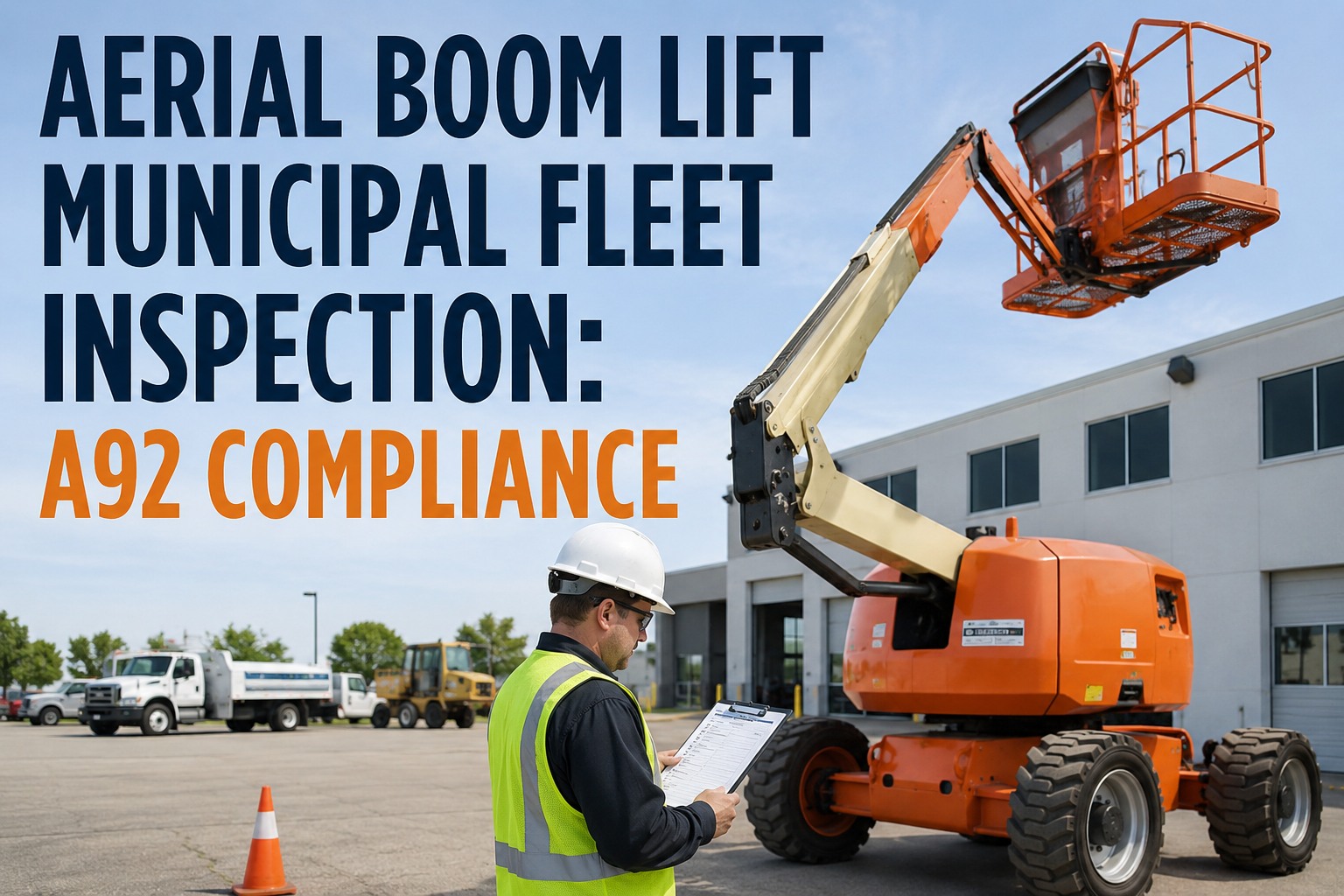
It's 6:40 on a Tuesday morning and your street light truck is parked behind a crew of three, an arrow board, and a cone taper on a live arterial — all because the bucket's upper controls started drifting and nobody logged it last week. A street light utility truck is one of the hardest-working assets in a municipal fleet: it is a bucket truck, a boom material handler and a crew truck rolled into one, and each of those three sub-systems carries its own inspection interval, its own failure modes and its own compliance paper trail. When one interval slips, the whole unit goes down and the streetlight outage list keeps growing. This page breaks down exactly what to inspect on units like the Altec L42 and Versalift LT62, how OSHA 1910.269 and ANSI A92.2 frame your obligations, and how a digital sub-system template keeps every interval on schedule. If you want to see it running on your own units first, you can book a 30-minute walkthrough with the HVI team and bring your toughest truck.
One truck, three machines, three inspection clocks — is your street light fleet tracking all of them?
A street light utility truck fails as a system: the aerial device, the material-handling jib and the chassis each run on different service intervals. Miss one and the whole unit — and the crew around it — sits idle.
The numbers behind a street light truck sitting in the yard
Every day a bucket unit is out of service, the cost is not just the repair invoice — it is the idle crew, the rented lift, and the growing backlog of outage tickets residents are calling about.
Why a street light utility truck is really three assets in one
Treat the unit as a single line item in your CMMS and you will always be behind on something. Split it into its three working systems and the inspection logic becomes obvious.
Aerial device & bucket
The insulated boom and platform that put your operator at the luminaire. Governed by ANSI A92.2: daily pre-use checks, frequent inspections, and an annual dielectric test to prove the boom still isolates the operator from energized lines. Hydraulic leaks, cracked fiberglass, worn leveling cables and sloppy rotation bearings all live here.
Material-handling jib & winch
The jib that lifts poles, transformers and luminaire heads. On units like the Altec L42 and Versalift LT62, the winch, wire rope, hook and load line carry a ~500-hour service interval plus documented rope inspections. A bird-caged cable or a worn sheave discovered mid-lift is a dropped load over a live roadway.
Chassis & crew truck
The Class 5–7 truck underneath: brakes, tires, outriggers, PTO, lighting and the standard DVIR items. It accumulates road miles and engine hours on its own schedule, and it is the system most likely to trigger a roadside out-of-service if daily walk-arounds are pencil-whipped.
OSHA 1910.269 and ANSI A92.2: what to inspect and what to record
OSHA 1910.269 requires that aerial lifts used near energized lines be inspected, tested and maintained per the manufacturer's instructions and ANSI A92.2 — and in an audit, an undocumented inspection is the same as a skipped one. Here is the requirement-to-record map your street light bucket truck program needs.
| Sub-system | Requirement | Interval | Record you must be able to produce |
|---|---|---|---|
| Insulated boom & bucket | Dielectric test (ANSI A92.2) | Every 12 months | Certified test report with pass/fail values, date, unit ID and tester |
| Aerial device | Frequent & periodic inspection per manufacturer | 3–12 months by use | Itemized checklist: structure, welds, leveling, hydraulics, decals |
| Upper controls | Function and emergency-stop check | Monthly | Timestamped function-test log signed by a qualified person |
| Jib, winch & wire rope | Rope inspection and material-handler service | ~500 hrs / monthly visual | Rope condition log, hook latch check, load chart verification |
| Chassis & outriggers | Pre-trip DVIR + PM by miles/hours | Daily / OEM schedule | Driver-signed DVIR with defect photos and repair closure |
| Operator qualification | Training & familiarization per 1910.269(c) | On assignment / refresh | Training record tied to the employee and the unit type |
When these six records live in one system instead of six binders, pulling an audit package takes minutes. Many municipal fleets see the full record trail in a live demo before they ever migrate a single truck.
A street light truck inspection checklist that covers all three clocks
A good daily-to-annual program layers four inspection depths. Each tier below is a card your crew can run on a phone at the truck — no clipboard, no scanning, no lost carbon copies.
Operator pre-use walk-around
- Boom, bucket and liners: cracks, damage, cleanliness, drain holes clear
- Hydraulic hoses and fittings: chafing, weeping cylinders, reservoir level
- Outriggers: pads, pins, full extension, interlock and alarm function
- Lower and upper controls: smooth operation, emergency stop at both stations
- Chassis DVIR: tires, brakes, lights, PTO engagement, fluid leaks
Upper control & safety function check
- Full function test from the platform: lift, slew, extend, jib raise/lower
- Override and emergency lowering systems verified working
- Wire rope visual: broken wires, kinks, corrosion, drum spooling
- Load chart and capacity decals legible and matched to configuration
- Bucket leveling through full range; no drift under static load
Material-handler jib service
- Winch service: brake test, gear oil, clutch and free-spool function
- Wire rope measured against discard criteria; sheaves and rollers checked
- Hook: throat opening, latch, swivel, deformation under magnification
- Jib structure: welds, pins, bushings, retaining hardware torqued
- Load-holding valve and counterbalance function verified
Dielectric & structural certification
- ANSI A92.2 dielectric test on the insulated boom by a qualified lab
- Acoustic emission or structural inspection per manufacturer
- Full hydraulic system test: pressures, holding, cylinder drift
- Stability and function re-verification after any boom repair
- Certification documents filed against the unit's permanent record
Building these four tiers as reusable digital templates — with photo capture on every defect — is exactly what fleets do when they start logging inspections free in HVI rather than re-typing OEM checklists into spreadsheets.
See your Altec or Versalift units on three separate clocks — in one dashboard
Book a 30-minute demo and we will load a street light truck template live: bucket, jib and chassis, each with its own due dates and alerts.
What one missed dielectric test actually costs a municipal fleet
Run the arithmetic on a single unit and the case for interval tracking writes itself. Here is a realistic, conservative scenario for a city running eight street light trucks.
That is one truck, one lapsed interval. Multiply it across a fleet where bucket certs, 500-hour jib services and monthly control checks are tracked on whiteboards, and the leak is structural. Fleets that walk through HVI's interval alerts on a demo call usually find at least one unit already past due.
HVI runs every sub-system of your street light truck on its own schedule
One platform, three clocks per unit, zero paper. These are the four capabilities municipal fleets lean on hardest.
Sub-system templates
Split each unit into bucket, jib and chassis with its own checklist and interval. Annual dielectric, 500-hour winch service and monthly control checks each fire their own due and overdue alerts — nothing hides inside a single generic PM.
Photo-backed digital inspections
Crews inspect on any phone at the truck. A cracked bucket liner or frayed rope is photographed, timestamped and converted into a work order in seconds — no texted photos, no lost carbon copies, no pencil-whipped DVIRs.
Audit-ready compliance records
Every inspection, test report and repair closes against the unit's permanent file. When OSHA, a client or an insurer asks for the dielectric history on unit 214, you export it in seconds instead of digging through binders.
Uptime and cost analytics
See cost per unit, repeat failures and compliance rate across the whole street light fleet. Spot the truck that eats hydraulic hoses every quarter and justify replacement with numbers, not anecdotes.
Where binder-based street light fleet maintenance breaks down
Most municipal shops do not have an inspection problem — they have a visibility problem. The checks happen; the proof, the scheduling and the follow-through are what fail.
The binder-and-whiteboard way
- Dielectric expiry dates live on a wall calendar nobody checks in June
- Winch hours estimated from memory because the hour meter feeds no system
- Defect photos buried in a foreman's phone, never tied to a work order
- Monthly control checks signed in advance to "save time"
- Audit prep means a week of photocopying and hoping nothing is missing
The HVI way
- Every interval — 12-month, 500-hour, monthly, daily — auto-tracks per unit
- Engine-hour and mileage triggers pull from the asset record, not memory
- Defect photo becomes a work order with one tap, closed with a repair photo
- Timestamped, GPS-stamped checks that cannot be back-filled
- Audit export in seconds: full history per unit, per sub-system
The gap between those two columns is not effort — your crews already work hard. It is tooling. You can compare both side by side on your own fleet data in a demo, or create a free account and digitize one truck this week to feel the difference.
Street light truck inspection, in four sentences
A street light utility truck is three assets — aerial device, material-handling jib and chassis — and each one fails, and is regulated, on its own clock.
The non-negotiables are the annual ANSI A92.2 dielectric test, the ~500-hour jib and winch service, the monthly upper-control check and the daily DVIR — all under the OSHA 1910.269 umbrella.
One lapsed interval can ground a unit for over a week and burn five figures in idle crew time and rentals — far more than the inspection ever cost.
A sub-system digital template turns four overlapping schedules into automatic alerts, photo-backed proof and audit exports — which is exactly what HVI was built to do for mixed municipal fleets.
"My gripe was never the inspections — my crews know these trucks inside out. It was the Friday afternoon panic when someone asked for a dielectric cert and we'd dig through three filing cabinets. Now I track one number: units with zero overdue intervals. It's been fourteen for fourteen for over a year, and audit requests take me about four minutes."
Dana Whitfield — Fleet Maintenance Manager, municipal public works fleet (60+ units, mixed aerial and vocational trucks)
Street light utility truck inspection: your questions answered
How often does a street light bucket truck need a dielectric test?
Does OSHA 1910.269 apply to municipal street light crews?
What is the service interval for the material-handling jib and winch?
Can one inspection template really cover bucket, boom and chassis?
How do I prove inspections during an OSHA or insurance audit?
Put every street light truck on three clocks — and never miss one again
Start free with one unit, or book a 30-minute demo and watch a full bucket, jib and chassis template run on your own fleet's schedule.
Free to start — Works on any phone — No card needed