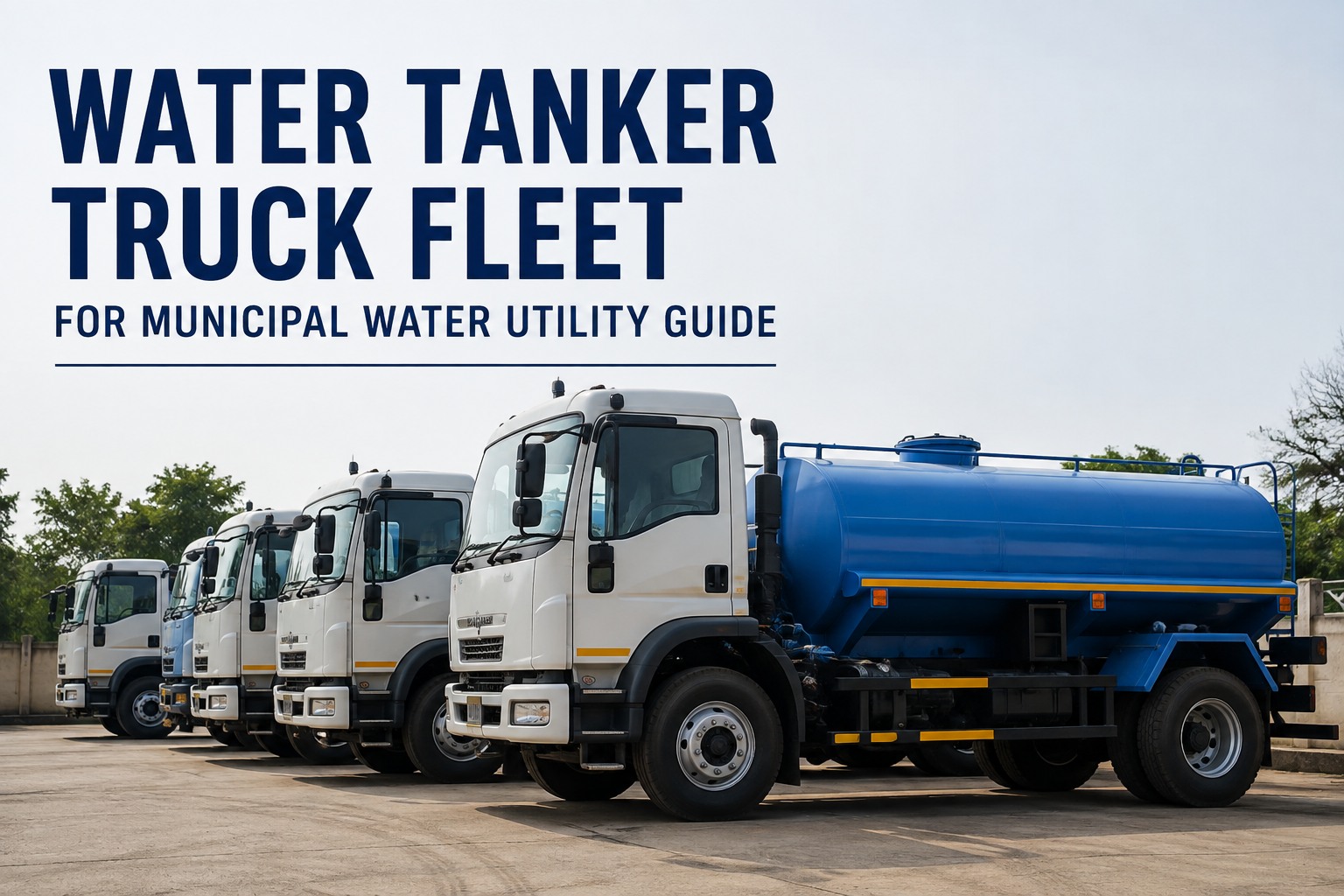
It is 2 a.m., a water main has burst three blocks from the depot, and your crew is filling a municipal water tanker truck that has to be potable-safe before it leaves the yard. In that moment, the question is never just "does the truck run" — it is "when was this tank last cleaned, chlorinated, and tested, and can you prove it?" A water tanker truck in municipal utility service carries drinking water, emergency supply, and public trust in the same steel shell, and the fleets that manage them well treat tank hygiene records with the same seriousness as brake inspections. This guide covers what SDWA-aligned potable water hauling actually demands, how baffle and tank inspections work, and how to keep a cleaning and certification history that survives any audit — the same records you could be managing digitally if you walk through it on your own tankers in a 30-minute demo.
Is your potable water tanker audit-ready at 2 a.m. — or just at 2 p.m. on a slow Tuesday?
Emergency water delivery does not wait for you to find the cleaning log. One contaminated load, one missing bacteriological test, one undocumented chlorine flush — and a routine main break becomes a public health incident with your fleet's name on it.
Four numbers every water utility fleet manager should know
Record types per tanker
Cleaning log, chlorine flush record, quarterly bacteriological result, and baffle inspection. Lose any one and the unit's potable status is unprovable.
Failed sample = full re-cert
A single positive bacteriological result typically triggers drain, re-clean, re-chlorinate, and re-test — days of downtime for a truck you may need tonight.
Cost of a grounded tanker day
Between contract water hauling, crew standby, and re-testing lab fees, an out-of-service potable tanker during a main break costs far more than the paperwork that would have prevented it.
Of audits ask for history
Health departments, state primacy agencies, and insurance reviewers all ask the same thing: show the cleaning and certification history for each tank, not just the latest page.
What regulations actually apply to a potable water tanker truck?
The Safe Drinking Water Act sets the quality standard for the water you deliver; state and provincial primacy agencies, health departments, and environmental regulators (DEC-style programs) set how your tanker proves it stayed clean in transit. The truck itself still answers to DOT for road worthiness — so every water hauling truck lives under two rulebooks at once.
| Requirement | What it means in practice | Record you must keep | Typical interval |
|---|---|---|---|
| Pre-service cleaning + chlorine flush | New, repaired, or contaminated tanks are cleaned and disinfected with a chlorine solution before potable use, then flushed | Dated cleaning log with chlorine concentration, contact time, and technician sign-off | Before first service, after repairs, after any non-potable load |
| Bacteriological testing | Water samples from the tank are lab-tested to confirm the tank is not contaminating the supply | Lab result tied to the specific tank ID and date | Quarterly under many utility SOPs; after any re-clean |
| Baffle and interior inspection | Interior walls, baffles, welds, manway gaskets, and coatings checked for corrosion, cracks, and biofilm | Photo-backed inspection report with defects and repairs | Annual or per SOP; after any impact or repair |
| Dedicated-service discipline | Potable tanks never haul non-potable or chemical loads without full re-certification | Load history log per tanker | Every load |
| DOT vehicle inspection | Brakes, tires, lights, tank mounts, and baffle integrity for safe road handling under slosh load | DVIR and annual inspection records | Daily DVIR; annual DOT inspection |
The pattern across all five rows is the same: the work only counts if the record exists. Fleets that start logging tanker inspections free stop losing certifications to missing paper.
The 6-step potable water tanker certification workflow
Whether you are commissioning a new tank, recovering one after a non-potable load, or clearing a failed sample, the sequence below is the backbone of most utility SOPs. Each step generates a record — and each record belongs in the unit's permanent history.
Drain and isolate
Empty the tank completely, lock out fill and discharge valves, and tag the unit out of service so nobody loads it mid-process.
Interior wash and sediment removal
Pressure-wash walls, floor, and baffles; remove sediment and any biofilm. Photograph the interior before and after — this is your baseline evidence.
Chlorine disinfection
Apply the chlorine solution at your SOP's concentration and hold the full contact time. Log concentration, contact time, water temperature, and the technician's name.
Flush and neutralize
Flush until residual chlorine returns to potable range. Record the residual reading — auditors ask for it.
Sample and lab test
Draw the bacteriological sample per your sampling SOP and send it to the lab. The unit stays out of potable service until results come back clear.
Certify and return to service
Attach the lab result to the unit's history, set the next quarterly test date, and release the tanker. In HVI this is one work order closing with the certificate attached — you can see that exact workflow in a live demo.
Why baffles decide both water quality and road safety
Baffles stop a half-full tanker from becoming a 4,000-gallon pendulum. They also create shadow zones where sediment and biofilm hide. A cracked baffle is a handling hazard; a corroded one is a water-quality hazard. Either way, you only find it by looking inside on a schedule.
What fails inside a tank
- Baffle welds cracking from years of slosh stress
- Coating breakdown exposing bare steel to chlorinated water
- Biofilm forming behind baffles where wash water never reaches
- Manway gaskets perishing and letting contaminants in
- Sediment beds building up in low-flow corners
What a good inspection catches
- Photo-documented baffle condition, tank ID, and date on every inspection
- Coating defects flagged as defects and converted straight into repair work orders
- Gasket replacement tracked as a recurring PM item, not a roadside surprise
- Interior photos archived so year-over-year corrosion is measurable
- Confined-space entry logged with attendant and air-test details
Interior tank entry is confined-space work — your inspection record should show the permit, the attendant, and the atmosphere test alongside the photos. That is exactly the kind of multi-part record a guided walkthrough of HVI's inspection builder will show you handling in one form.
How HVI keeps every water tanker certified, cleaned, and audit-ready
HVI (Heavy Vehicle Inspection & Maintenance, by JRS Innovation Inc.) is cloud + mobile CMMS software built for fleet-heavy operations. For a municipal water utility fleet, it turns tank hygiene from a binder nobody can find into a live record on every phone in the yard.
Digital cleaning and certification logs
Every chlorine flush, cleaning, and lab result is captured on a phone with photos, timestamps, and technician sign-off — attached permanently to that tanker's history. Audit answer time drops from days in a filing cabinet to seconds on a screen.
Preventive maintenance with due and overdue alerts
Quarterly bacteriological tests, annual baffle inspections, and gasket replacements are scheduled by date, mileage, or engine hours. HVI flags a tanker as coming due before it lapses — so no unit quietly loses its potable status.
Defect-to-work-order in one tap
A driver spots a weeping manway gasket on the morning DVIR; the defect becomes a work order with the photo attached before the truck leaves the yard. No paper DVIRs, no text-message photos, no lost defects.
Compliance analytics across the fleet
See certification rate, overdue PMs, and cost per asset across tankers, dump trucks, and vac trucks in one dashboard — the same numbers your director will ask for after the next incident review.
See your own tanker's certification history on a screen — not in a binder
Book a 30-minute demo and we will load one of your water tankers into HVI live: cleaning log, chlorine flush record, quarterly test schedule, and baffle inspection form included.
What one missed quarterly test really costs a muni water tanker fleet
Take a utility running six potable water hauling trucks. One unit's quarterly bacteriological test slips three weeks because the reminder lived in a spreadsheet nobody opened. Then a trunk main bursts and that truck is needed for emergency potable delivery.
That is roughly 30 times the cost of the test itself — and it assumes the lapsed unit was never used. If it had delivered water and the lapse surfaced later, you are into public notification, re-sampling of the distribution zone, and a very uncomfortable meeting with the health department. Fleets that set up due-date alerts with a free HVI account remove this failure mode entirely.
Running a compliant water tanker truck fleet comes down to five habits
Treat the tank as a food-grade asset
Potable tanks are dedicated-service equipment. Any non-potable load or repair triggers the full clean-chlorinate-test cycle before the next drinking water delivery.
Schedule the quarterly test like a PM
Bacteriological testing is preventive maintenance, not an annual afterthought. Put it on the same due-and-overdue alert system as your oil changes.
Photograph the inside of the tank
Baffle, coating, and gasket condition is only provable with dated photos tied to the unit ID. Year-over-year comparison is how you catch corrosion early.
Keep one history per unit
Cleaning logs, lab results, DVIRs, and work orders for each water tanker truck belong in one searchable record — not split across a binder, a spreadsheet, and a group chat.
Drill the 2 a.m. scenario
Your emergency response plan should include pulling any tanker's certification status from a phone in under a minute. If it takes longer, the system is the problem, not the crew.
Make the switch before the audit
The worst time to digitize records is after a regulator asks for them. A short demo booked this week shows you exactly how fast the move off paper can be.
"I used to keep the chlorine flush sheets in a ring binder in my office, and every main break turned into a scavenger hunt. The number I watch now is days since last lab test per tank — if any unit goes past 80, my phone tells me before the health department does. Last audit I pulled two years of tank history for four trucks while the inspector was still taking his coat off."
Dan Whitfield — Maintenance Manager, regional municipal water utility
Water tanker truck and potable water fleet FAQs
How often does a potable water tanker need to be cleaned and tested?
Most utility SOPs require a full clean and chlorine disinfection before first service, after any repair or non-potable load, and after any failed sample — plus a bacteriological lab test roughly every quarter to keep the tank certified. The exact interval comes from your state primacy agency or health department, so build your schedule around their requirement and set alerts a few weeks ahead of it.
What records do I need to prove a water tanker is potable-certified?
At minimum: dated cleaning logs with chlorine concentration and contact time, the lab's bacteriological results tied to the tank ID, baffle and interior inspection reports with photos, and a load history showing dedicated potable service. Digital systems like HVI keep all four attached to the unit permanently — you can book a demo to see a sample certification record built for a tanker.
Does the SDWA directly regulate water hauling trucks?
The Safe Drinking Water Act regulates the quality of the water delivered to the public, and enforcement on the hauling side flows through state primacy agencies, health departments, and environmental programs that set tank cleaning, disinfection, and testing rules. The vehicle itself separately answers to DOT for brakes, tires, tank mounting, and annual inspection — so a muni water tanker carries two compliance loads at once.
Why do tanker baffles matter for both safety and water quality?
Baffles control liquid surge so a partially loaded tanker stays stable in braking and cornering — a cracked baffle is a genuine rollover risk factor. They also create low-flow pockets where sediment and biofilm accumulate, so a baffle inspection is simultaneously a DOT-relevant structural check and a potable hygiene check, and it should be photo-documented on a fixed schedule.
Can fleet maintenance software handle tank hygiene records, not just vehicle PMs?
Yes — a flexible CMMS lets you build custom inspection forms for tank cleaning, chlorine flush, and baffle condition alongside standard DVIRs, and schedule quarterly lab tests as recurring PM items with overdue alerts. HVI does this on any phone or tablet, and you can sign up free and build your first tanker form in under an hour.
Make your next water emergency a logistics problem, not a paperwork crisis
Put every cleaning log, chlorine flush, lab result, and baffle inspection for your water tanker truck fleet in one audit-ready system — and pull any unit's full history from your phone in seconds.
Free to start — Works on any phone — No card needed