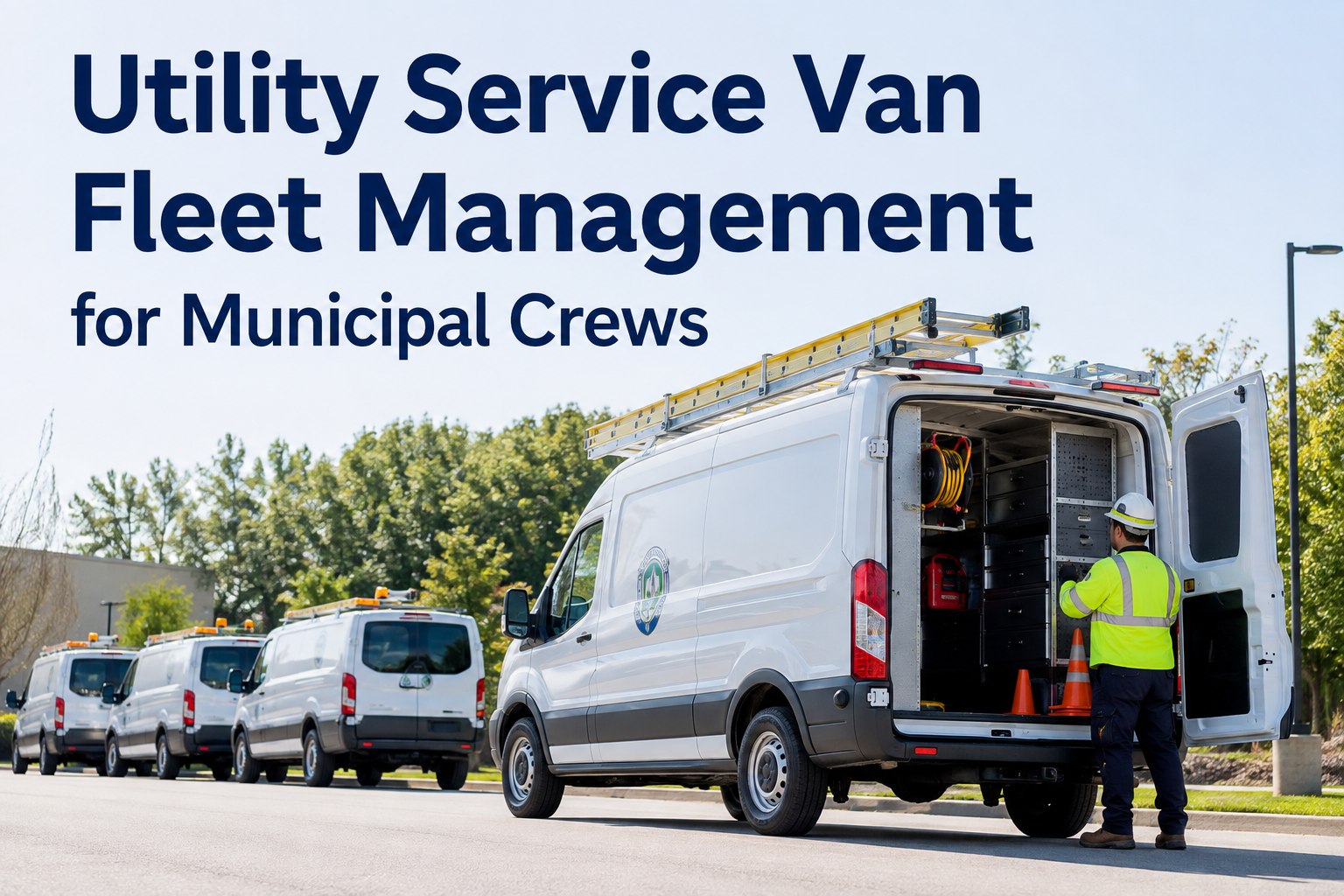
Monday, 6:40 a.m. A water department crew rolls a utility service van out of the yard, and by 9:15 the tech on site is calling the shop: the 3/4-inch impact wrench that lives in the curb-side cabinet is gone, along with two sets of crimping dies. That is the daily reality of running a utility service van fleet — every Ford Transit, Ram ProMaster and Chevy Express in a municipal operation is a rolling tool crib carrying $30,000 to $40,000 in tools, fittings and parts, and most fleets have no system that ties any of it to the vehicle itself. The van gets an oil change on schedule, but the shelving anchors, the sliding door track, the dual batteries and the inventory inside get attention only when something fails or walks off. This page shows you how to organize, inspect and track a muni utility van fleet so the $8,000 a year you are probably losing to tool shrinkage, repeat trips and van downtime stops leaking out of your budget — and how to see it running on your own vans in a 30-minute demo.
Municipal Fleet Series · Utility Service Vans
Your vans carry $40K in tools. Your tracking system is a clipboard.
Transit, ProMaster and Express cargo vans are the workhorses of water, streets, parks, and facilities crews. HVI ties van inspections, upfit PM schedules and tool inventory to each unit ID — so nothing disappears between shifts and nothing misses a service.
What the Leak Looks Like
The real cost of an unmanaged utility service van
A municipal service van is not a cheap asset to run blind. Between the upfit, the tools and the lost hours, the numbers add up fast — and almost none of it shows up on a standard vehicle maintenance report.
Platform-Specific PM
Utility service van PM by platform: Transit, ProMaster, Express
Each of the three big municipal cargo vans has its own failure points, and a generic 5,000-mile checklist misses all of them. Here is what your preventive maintenance schedule needs to catch per platform.
Ford Transit 350 — gov fleet favourite
- Dual battery service: test both batteries and the isolator every 6 months — a weak secondary battery kills inverters and liftgates first, then strands the van.
- Upfitter switch check: verify every upfitter circuit and its fused load quarterly; a chafed wire on an aftermarket circuit is a fire risk most PM sheets never touch.
- Shelving anchor pull test: annual torque check on every shelving and partition anchor — a loose steel shelf becomes a projectile in a panic stop.
- Rear door hinge & check-strap: 270-degree doors on high-roof Transits wear fast under daily crew use; inspect every PM.
Ram ProMaster — municipal cargo workhorse
- Sliding door track: clean and lubricate every 6 months without fail — grit in the lower channel grinds the rollers flat and the door seizes mid-route.
- Front-wheel-drive front end: ball joints and CV boots take the weight of the upfit; inspect at every oil service, not annually.
- Low load floor, high payload abuse: check rear spring sag and floor crossmembers yearly — crews overload the flat floor because it is easy to load.
- Roof rack & ladder rack mounts: torque-check annually; sealant cracks around mounts leak into the headliner and rust the roof from inside.
Chevy Express / GMC Savana — the legacy fleet
- Frame & body-mount rust: body-on-frame vans in salt-belt municipalities need an annual underbody inspection — body mounts and brake lines go first.
- Side cargo door hinges: swing-out doors sag with age; check hinge pins and strikers every PM or the door latch fails with a full load inside.
- Idle-hour tracking: older Express vans idle hard on job sites — schedule PM by engine hours, not just mileage, or you under-service by 30% or more.
- Aftermarket lighting & beacons: verify wiring at the upfitter harness annually; corroded splices on 15-year-old vans cause phantom electrical faults.
The Missing Half of the PM Sheet
Van interior organization and service van tool inventory
The engine gets serviced. The $40,000 rolling warehouse behind the seats usually does not. These four zones are where municipal fleets lose the most money — and what a tracked system looks like instead.
Shelving & anchors
Every shelf, bin rail and partition has anchor bolts with a torque spec. Add an annual anchor pull check to the van's PM in your CMMS, with a photo of the torque wrench reading stored against the unit. When a shelf tears loose in a collision, that record is the difference between a defended claim and a negligence finding.
Assigned tool kits
Give each van a master tool list tied to the unit ID — impact wrench, crimping dies, multimeter, torch kit, each with a bin location. Crews do a 3-minute end-of-shift count on their phone; a missing item flags instantly instead of surfacing three jobs later. Fleets that do this cut shrinkage from the typical $8K/yr toward near zero.
Consumable stock
Fittings, fuses, hose clamps, PPE — the small stuff that triggers the 2.5 extra parts runs a week. Set min/max levels per van and let the parts room see what each unit is low on before the crew leaves the yard. That is how you kill the mid-morning supply-house run that burns an hour of loaded labor.
Upfit electrical
Inverters, beacon lights, liftgates, compressors and dual-battery systems all live downstream of the upfitter switches. A quarterly upfit circuit check logged with photos catches chafed wiring and drained secondary batteries before the van dies on a water-main break at 11 p.m.
See your whole van fleet on one screen
Book a 30-minute demo and we will load one of your Transits or ProMasters into HVI — inspections, upfit PM, tool list and all.
Worked Example
What one untracked muni utility van actually costs you
Take a single Transit 350 on a water crew. Here is the annual math most public works departments never run — and where the money goes when nobody ties the van's contents to the van.
Run that across a 12-van municipal service fleet and you are looking at roughly $197,000 a year in preventable loss — against a CMMS subscription that costs a small fraction of one van's leak. Fleets that want to see this math on their own numbers can walk through it on a live demo with their own unit list.
How HVI Helps
How HVI runs your utility service van fleet
HVI is a cloud + mobile CMMS built for exactly this: mixed municipal fleets where every unit — van, truck, trailer, mower, generator — needs inspections, PM, parts and records in one place.
Digital van inspections & DVIR
Crew leads run the daily walk-around on any phone — door tracks, shelving anchors, lights, tires — with photo capture on every defect. A failed item converts to a work order instantly, so a cracked ProMaster door roller gets fixed this week instead of seizing next month.
PM by date, mileage or engine hours
Set the Transit dual-battery service at 6 months, the ProMaster door track at 6 months, the Express on engine hours — HVI tracks all three triggers per unit and pushes due and overdue alerts to the shop foreman. No more vans serviced 30% late because they idle instead of drive.
Tool & parts inventory tied to unit ID
Each van carries its master tool list and min/max stock levels inside HVI, linked to the vehicle record. End-of-shift counts flag missing tools the same day, and the parts room sees van-level demand across every shop — the direct fix for the $8K/yr shrinkage line.
Audit-ready records & cost-per-van analytics
Every inspection, anchor torque photo and work order is timestamped and stored against the unit — ready for a DOT review, an insurance claim or a council audit in seconds. Cost-per-asset reports show exactly which vans are earning their keep and which are bleeding.
You can start logging van inspections free with your first units today, or book a walkthrough for your whole fleet if you want the inventory and PM side configured with you.
Rollout
Getting a muni service van fleet onto a CMMS in 4 weeks
Municipal fleets do not have time for a six-month software project. This is the rollout cadence that works for shops running 10 to 60 utility crew vehicles.
Load units & build checklists
Import your van list — unit ID, plate, VIN, platform, upfit type. Clone HVI's cargo van inspection template, then add your platform items: Transit upfitter switches, ProMaster door track, Express hinge pins. Most shops finish this in two afternoons.
Set PM triggers & tool lists
Attach PM schedules per unit — date, mileage and engine-hour triggers — and build each van's master tool and stock list. Photograph shelving layouts so bin locations are unambiguous for every crew that rotates through the vehicle.
Train crews in the yard
One 20-minute toolbox talk per crew: open the app, run the inspection, photograph a defect, do the end-of-shift tool count. If a tech can send a text message, they can run HVI — that is the whole training bar for a gov service van crew.
Go live & watch the first month
Defect-to-work-order flow goes live, overdue PM alerts start landing with the foreman, and the first shrinkage flags appear within days. Most municipal shops recover the subscription cost inside the first quarter on parts runs alone — a short demo shows you the exact rollout for your shop.
Key Takeaways
The bottom line on utility service van fleet management
The van is two assets, not one
The vehicle needs PM; the $40K of tools and stock inside it needs inventory control. Managing only the first half is how municipal fleets lose $8K per van per year without noticing.
Platform-specific PM beats generic checklists
Transit dual batteries and shelving anchors, ProMaster door tracks, Express engine hours — the failures that sideline a muni utility van are predictable, scheduled and cheap to prevent.
Tie everything to the unit ID
Inspections, upfit PM, tool counts, parts and photos on one record per van gives you audit-ready proof and cost-per-asset truth. That is what a utility service van fleet looks like when it is actually managed — and it is exactly what HVI was built to do.
I used to find out a van was missing its torch kit when the crew was already standing in a trench. Now the tool count hits my phone at end of shift, and I know before they leave the yard. The number I watch is parts runs — we were burning nine or ten hours a week on supply-house trips across twelve vans. That alone paid for the system. My one gripe: I wish we'd photographed the shelving installs years ago, because the first anchor audit was embarrassing.
Dana Whitfield — Fleet & Maintenance Manager, municipal public works department
Common Questions
Utility service van fleet FAQs
How much tool inventory does a typical utility service van carry?
What PM items are unique to a Ford Transit gov fleet van?
How often should a Ram ProMaster sliding door track be serviced?
Can a CMMS really track tools inside each van?
How long does it take to move a municipal van fleet off paper?
Stop losing $8K a van. Start tracking it.
Put your Transits, ProMasters and Express vans on one platform — inspections, upfit PM, tool inventory and audit-ready records included.
Free to start · Works on any phone · No card needed