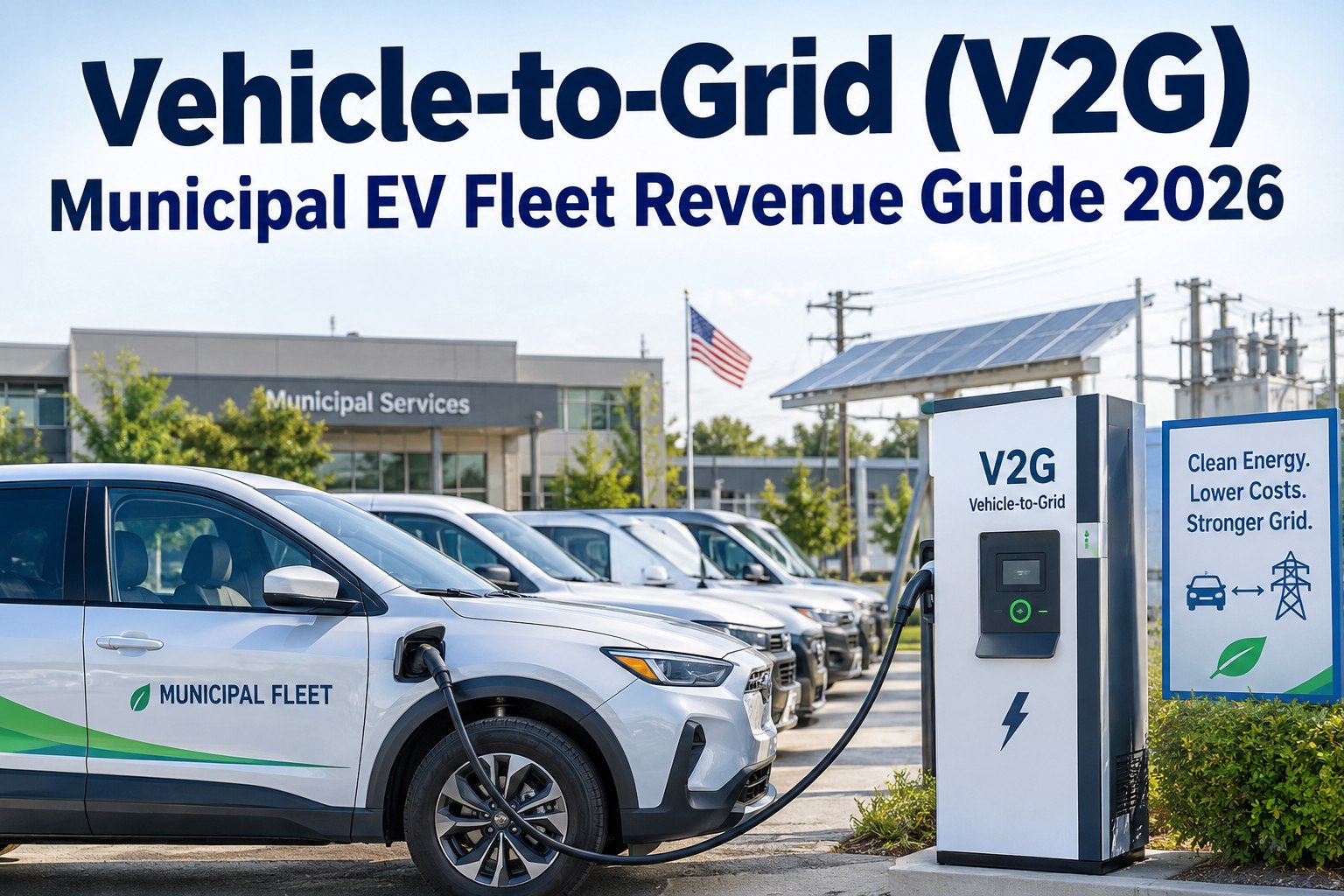
Your electric school buses sit in the depot from 2 p.m. until the next morning run. Your electric refuse trucks park overnight with 200-plus kWh of battery doing nothing. Meanwhile, the utility is paying real money for exactly that stored power during peak demand windows. That is the core of a V2G municipal fleet strategy: vehicle-to-grid programs let your parked EVs sell electricity back to the grid, typically earning $2,000 to $4,000 per vehicle per year in demand response revenue. But every discharge is a battery cycle, and battery cycles are what your warranty is counting. If you cannot prove how many cycles came from driving versus how many came from grid export, you are one warranty dispute away from a five-figure battery bill. This guide walks through how V2G revenue actually works for government fleets, what it does to your batteries, and how to walk through cycle tracking on your own units before you sign a utility agreement.
What if your parked buses paid for their own maintenance budget?
V2G turns idle fleet batteries into a demand response asset. The catch: every kilowatt you sell is a battery cycle your OEM warranty is watching. Here is the math, the risk, and the tracking that makes it work.
What V2G is worth to a municipal EV fleet
Four figures decide whether vehicle-to-grid is a revenue line or a battery liability. Each one maps to a cost you already manage.
A 20-bus fleet at the midpoint is roughly $60,000 a year — enough to fund a full-time PM technician.
GM Ultium and Ford IonBoost packs carry 8-year warranties — but cycle counts and state-of-health thresholds decide what is covered.
Grid discharge adds cycles on top of driving. Untracked, they quietly eat the warranty headroom you budgeted for route duty.
One denied warranty claim wipes out years of V2G revenue on that unit. Cycle documentation is your defense.
How vehicle-to-grid revenue actually works for government fleets
A V2G program is a four-step loop between your depot, the utility, and the battery. Miss the record-keeping on any step and the revenue story falls apart at audit or warranty time.
Enroll with the utility
You sign a demand response or capacity agreement. The utility tells you which hours and seasons it will call events — usually summer afternoons and winter mornings when grid load peaks.
Charge smart, discharge on call
Bidirectional chargers fill the batteries off-peak at cheap rates. During a called event, the chargers reverse flow and export power from your parked vehicles to the grid.
Protect the morning route
Every agreement needs a minimum state-of-charge floor — for example, buses never discharge below 70% so the 6 a.m. run is never at risk. That floor is an operations decision, not a utility one.
Log every cycle, get paid
The utility pays per kWh exported or per kW of capacity committed. Your side of the ledger is the cycle count and state-of-health trend per vehicle — the data that keeps the OEM warranty enforceable.
The fleets that make V2G work treat it like a maintenance program, not a side hustle. If you want to see what that logging looks like in practice, you can book a 30-minute walkthrough of HVI's EV battery tracking and map it to your own depot schedule.
Why V2G battery cycle tracking decides your warranty claim
Battery warranties are written around throughput and state of health. V2G changes both. Here is the split you need to document.
Route duty is what the warranty assumes: a predictable cycle pattern tied to mileage. OEMs like GM (Ultium) and Ford (IonBoost) warrant their packs for 8 years against defects and excessive capacity loss under normal use.
Grid export adds shallow but frequent cycles the OEM did not price in. If a pack degrades early and you cannot separate V2G throughput from driving throughput, the claim becomes an argument you will lose.
What the OEM wants to see
Per-vehicle cycle counts, depth of discharge, charge and export windows, and a state-of-health trend line. Timestamped, consistent, and exportable — not a spreadsheet rebuilt the week before the claim.
What kills a claim
A battery at 68% capacity in year five, a utility report showing heavy export, and no fleet-side records proving the vehicle stayed within agreed discharge floors. That gap is where five-figure denials live.
This is exactly the gap HVI closes: every V2G session, inspection, and battery reading lands on the vehicle's permanent record. Many fleets start logging battery data free the same week they sign the utility agreement, so the record exists before the first export event.
The V2G math on a 20-bus municipal fleet
Run the numbers the way a finance director will. Revenue is only half the equation — the protected warranty value is the other half.
| Line item | Assumption | Annual impact |
|---|---|---|
| V2G demand response revenue | $3,000 per bus (midpoint) | $60,000 earned |
| Added battery cycles | ~200 export cycles per bus | Tracked against 8-yr warranty |
| Warranty exposure without records | 1 pack denial at $25,000 | −$25,000 risk |
| Admin time on paper logs | 2 hrs/week compiling utility reports | ~100 staff hours |
| Net with cycle tracking in place | Revenue kept, claims defensible | $60,000 protected |
The pattern repeats across e-school-bus V2G pilots and islanded municipal microgrid programs: the revenue is real, but it only survives contact with the finance office and the OEM if the underlying battery data is clean. Fleets evaluating this can see the reporting side in a live demo before committing to a program.
How HVI tracks V2G cycles and protects your battery warranty
HVI is the cloud and mobile CMMS your fleet already uses for inspections and work orders — extended to the EV battery data V2G demands.
V2G cycle logging per vehicle
Every export session is recorded against the unit: date, duration, depth of discharge, kWh out. When the OEM asks, you export a complete history in seconds — the difference between a paid claim and a denied one.
State-of-health trend alerts
Log SOH readings at every inspection or PM service. HVI flags units trending toward warranty thresholds early, so you file claims while coverage applies — not after it lapses.
Digital inspections for EV assets
Charging cables, bidirectional chargers, connectors and thermal systems get the same photo-backed DVIR treatment as your diesel units. Defects convert to work orders instantly, so a damaged charge port never strands a morning route.
Audit-ready utility reporting
Timestamped, photo-backed records satisfy utility settlement audits, council oversight, and grant reporting in one export. No more rebuilding quarter-end spreadsheets from charger screenshots.
See your own fleet's V2G numbers in HVI
Book a 30-minute demo and we will map cycle tracking, SOH alerts and utility reporting to your actual vehicles and routes.
A 5-step rollout for your first muni utility V2G program
Most government fleets go from first utility conversation to first paid event in one to two quarters. The sequence matters more than the speed.
-
1
Audit your idle windows
Pull telematics or logbook data: which vehicles are parked, where, and for how long each day. E-school buses and refuse trucks with predictable overnight parking are the strongest candidates.
-
2
Confirm bidirectional hardware
V2G needs bidirectional chargers and vehicles that support export. Verify OEM approval in writing — some manufacturers require specific charger models to keep the battery warranty intact.
-
3
Set discharge floors in the agreement
Negotiate minimum state-of-charge limits and maximum annual export cycles per vehicle. These numbers become your maintenance policy, not just contract language.
-
4
Stand up cycle and SOH tracking first
Before the first export event, every enrolled vehicle needs a living record. Fleets that set up free asset records in HVI at this stage never face a data gap later.
-
5
Review quarterly against warranty terms
Compare export cycles, SOH trend and revenue per unit every quarter. If one vehicle is degrading faster than its peers, pull it from the program before it becomes a claim fight.
If you are weighing this against a mixed diesel-and-EV fleet, it helps to talk through the mixed-fleet setup in a demo — HVI runs both fuel types in one platform, so nothing lives in a separate system.
V2G municipal fleet revenue: what to remember
The revenue is real and recurring
$2,000 to $4,000 per vehicle per year is meaningful money for a government fleet — a 20-unit program can fund a technician position from parked buses alone.
The battery is the bill
Every export event is a cycle against an 8-year warranty from OEMs like GM and Ford. Untracked V2G use is how a revenue program turns into a denied $25,000 pack claim.
Records decide the outcome
Cycle counts, discharge floors and SOH trends — logged per vehicle from day one — are what make V2G municipal fleet revenue defensible to utilities, auditors and OEM warranty departments alike.
The fleets winning at vehicle-to-grid treat battery data with the same discipline they already apply to DVIRs and PM schedules. If that discipline still lives in binders and group chats at your depot, a short demo of HVI's EV tracking will show you what the digital version looks like.
"We enrolled twelve electric buses in the utility program and the first check was great — then I realized nobody could tell me how many export cycles bus number seven had taken. I keep a cycle budget per unit now, same as I keep an oil-change interval. If a bus is trending hot on cycles, it comes out of the program for a quarter. That one habit is why our first warranty conversation with the OEM was boring, and boring is exactly what you want."
Daniel Reyes — Fleet Maintenance Manager, mid-size municipal transit and public works fleet
V2G and EV battery warranty FAQs
How much can a municipal fleet actually earn from V2G?
Most utility demand response programs pay $2,000 to $4,000 per enrolled vehicle per year, depending on event frequency, export capacity and your region's peak pricing. School buses and refuse trucks with long, predictable parking windows earn at the top of that range because they can commit more capacity with zero route risk.
Does vehicle-to-grid void my EV battery warranty?
Not automatically — but it changes the conversation. Warranties like GM's Ultium and Ford's IonBoost 8-year coverage assume normal driving use. V2G adds export cycles the OEM will scrutinize if you file a degradation claim. Fleets that log every V2G session per vehicle, with depth of discharge and SOH trends, defend their claims; fleets without records often cannot.
What is the best way to track V2G battery cycles per vehicle?
Log each export session against the vehicle's permanent maintenance record: date, kWh exported, depth of discharge and a periodic state-of-health reading. A CMMS like HVI keeps this beside your inspections and work orders so nothing lives in a separate spreadsheet. You can create free asset records and start logging before your first utility event.
Which municipal vehicles are the best V2G candidates?
Electric school buses are the strongest fit — large batteries, fixed routes, and long overnight and weekend parking windows. Electric refuse trucks and pool vehicles with predictable schedules follow close behind. Any unit with irregular dispatch or tight range margins should stay out of the program until its duty cycle is proven.
Can V2G work during grid outages or islanded operations?
Yes — islanded V2G lets fleet batteries power a depot, shelter or critical facility during an outage, which several municipal resilience programs now fund. The tracking requirement is identical: every discharge event counts against the battery, so log it the same way. If you want to see how that logging fits your existing PM workflow, book a demo and walk through it on your own units.
Turn parked vehicles into revenue — without risking the warranty
HVI logs every V2G cycle, SOH reading and inspection on one audit-ready record per vehicle, so your utility revenue and your OEM coverage never collide.
Free to start — Works on any phone — No card needed