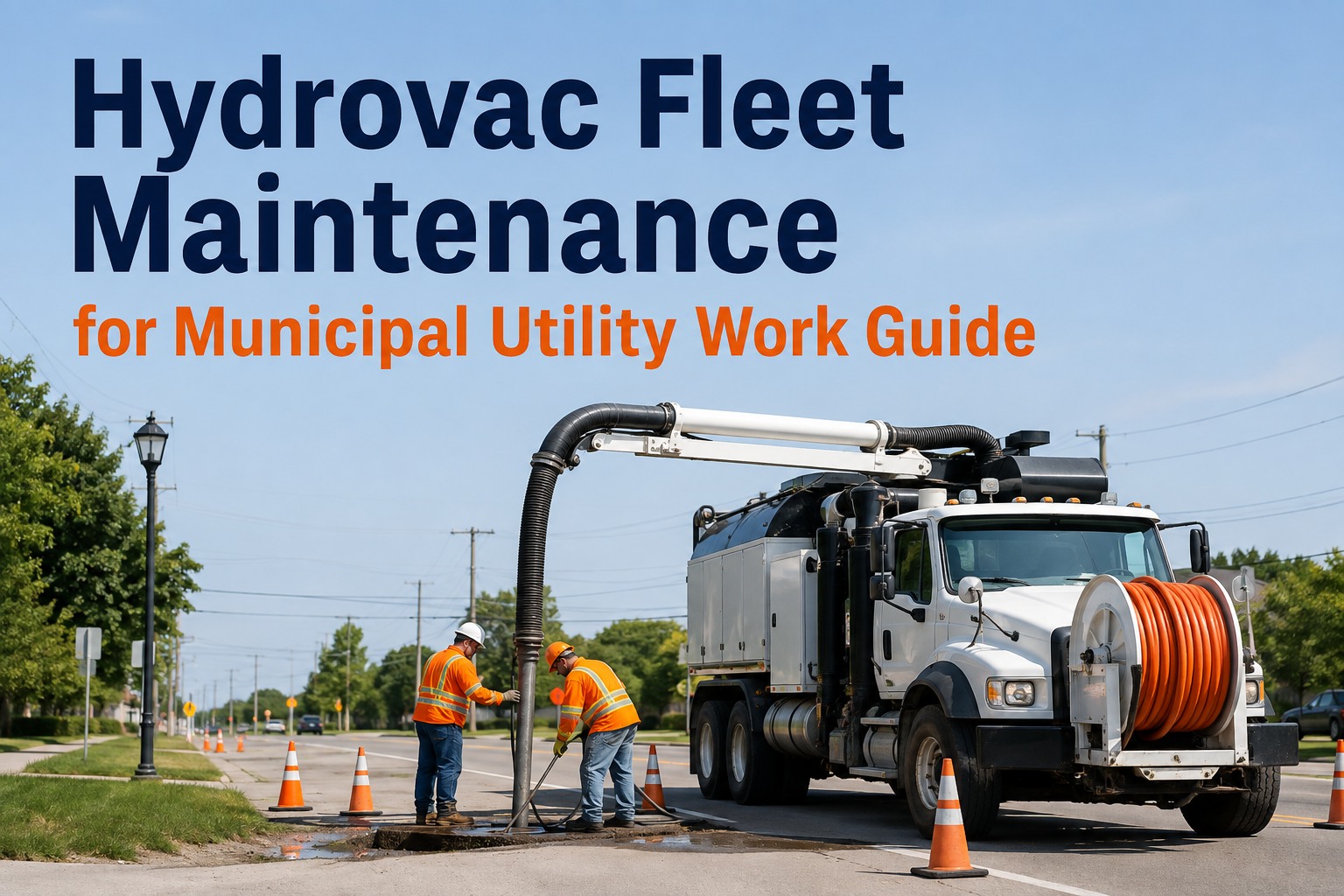
Hydrovac fleet maintenance is the discipline of keeping high-pressure water systems, vacuum blowers, booms and debris tanks alive on trucks that chew through 400 to 1,200 operating hours a year on municipal utility work. If you run Vac-Con, Vacall or Vactor units for a city, county or utility district, you already know the pattern: the truck leaves the yard fine, and by 2 p.m. the water pump is weeping, the boom sweep is sluggish and the operator is on the phone asking if he should finish the locates or limp back. A single fan bearing failure on a Vactor 2100 can run $18,000 once you add the teardown, the rental unit and the missed excavation windows. Most of those failures were scheduled to happen 250 hours earlier — on a PM interval nobody tracked because the hour meter lives in the cab and the spreadsheet lives in the office. This guide gives you the exact intervals, the inspection points and the record-keeping setup that municipal hydrovac fleets use to stay ahead of it, plus how to walk through the whole schedule on a live demo before your next blower service comes due.
What does a missed 250-hour blower service actually cost your crew?
Hydrovac trucks don't fail politely. The fan bearing seizes mid-dig, the water pump packing lets go under 3,000 PSI, and your crew stands around a half-open utility locate while the clock runs. The fix is boring: hour-based PM triggers that fire before the failure, not after.
Hydrovac maintenance costs by the hour, not the mile
The hydrovac PM schedule that prevents the $18K failure
Municipal hydrovac trucks accumulate hours fast — a unit on utility locates can log 6 to 8 auxiliary hours in a single shift without travelling 20 miles. That is why calendar-based PM fails these machines. Here is the hour-based schedule the major OEMs publish, mapped to what each interval protects.
| Interval | System | Service Item | What It Prevents |
|---|---|---|---|
| 250 hrs | Vacuum blower / fan | Fan bearing grease and inspection (Vactor 2100 HXX); blower oil change (Vac-Con V390) | Bearing seizure, blower shaft scoring, full blower replacement |
| 500 hrs | High-pressure water pump | Packing inspection and adjustment, seal replacement, valve check | Pressure loss, pump cavitation, cracked manifold from dry running |
| 1,000 hrs | Boom sweep hydraulics | Sweep cylinder seals, hydraulic fluid and filter change, hose chafe inspection | Boom drift, scarred cylinder rods, contaminated hydraulic system |
| 250 hrs | Hose reel and wand | Reel swivel seals, hose jacket inspection, nozzle wear check | High-pressure hose burst — a serious laceration and injection injury risk |
| 500 hrs | Debris tank and door | Tank interior coating check, door seal inspection, hinge and latch lubrication | Vacuum leaks that kill suction, door seal blowouts under load |
| Daily | Full unit walkaround | Operator pre-trip: fluid levels, hose condition, boom pins, water tank, PTO engagement, lights and backup camera | DOT out-of-service hits, roadside breakdowns, jobsite safety incidents |
The hard part is not knowing the intervals — it is catching them. Auxiliary hours and water-pump hours tick at different rates on every truck, so a single "next service" date is fiction. Fleets that set up dual hour-meter triggers in a demo typically find two or three units already past a blower interval on day one.
Five cost leaks in a municipal hydrovac fleet
Untracked auxiliary hours
The chassis odometer says 3,000 miles; the blower has 400 hours on it. If your PM triggers off mileage or calendar dates, the vacuum system is running unprotected most of its life. Track aux hours and water-pump hours as separate meters with their own due alerts.
Blower oil skipped "one more week"
A Vac-Con V390 blower oil change is a $200 service. The blower it protects is a five-figure assembly with weeks of lead time. Every skipped 250-hour interval compounds wear you cannot see until the vibration starts.
Water pump packing ignored
Weeping packing is a $40 part and 30 minutes. Left alone, the pump cavitates, pressure falls from 3,000 PSI to a weak stream, and the crew takes twice as long on every pothole — labour cost you never see on a work order.
Paper pre-trips nobody reads
A checkbox form in a binder does not stop a hose burst. Digital DVIRs with forced photo capture on hoses, boom pins and tank doors turn the daily walkaround into evidence — and push defects straight to a work order instead of a supervisor's voicemail.
No audit trail for council or insurers
When a high-pressure line injures someone or a boom fails over live utilities, the first question is "show me the maintenance records." Timestamped, photo-backed history per unit answers it in seconds; a filing cabinet answers it in weeks.
What one prevented blower failure pays for
Take a small municipal fleet running four hydrovac units on utility locates and storm drain work. The numbers below are conservative and typical for a fleet this size.
One caught interval pays for the entire year's PM program five times over. That is before you count the rental hydrovac at $1,500-plus per day while yours sits waiting on a blower. Fleets that start tracking these intervals free usually recover the effort in the first quarter.
See your own hydrovac PM schedule running in HVI
Book a 30-minute demo and we will build a Vactor 2100 or Vac-Con interval plan with dual hour-meter triggers on the call — your units, your intervals, your crew's phones.
The 12-point hydrovac pre-trip that catches failures early
Most catastrophic hydrovac failures announce themselves days in advance — a weeping seal, a chafed hose, a boom pin walking out. A structured daily inspection catches them while they are cheap. These are the twelve points municipal fleets build into their digital DVIR.
Vacuum System
- Blower oil level and sight glass condition
- Unusual blower vibration or noise at idle
- Cyclone and filter housing seals seated
- Debris tank door seal clean and undamaged
Water System
- Water pump packing for weeping or spray
- Hose reel swivel, wand and nozzle wear
- High-pressure hose jacket for chafe and bulges
- Water tank level, strainer and anti-siphon valve
Boom and Chassis
- Boom pins, bushings and sweep cylinder rods
- Hydraulic fluid level and hose chafe points
- PTO engagement and warning lights
- Chassis walkaround: tires, lights, camera, leaks
Each failed item on a digital inspection should create a work order automatically — not a text message to the shop that gets buried. That defect-to-work-order handoff is where paper programs quietly die, and it is the first thing most fleets ask to see in a live walkthrough.
Built for trucks with two hour meters and zero patience
HVI is cloud + mobile CMMS software for fleet-heavy operations — digital inspections, work orders, preventive maintenance, parts and reporting in one platform your crew runs from any phone in the yard or at the dig site.
Dual hour-meter PM triggers
Set the 250-hour blower service off auxiliary hours and the 500-hour packing service off water-pump hours — HVI fires due and overdue alerts off each meter independently, so the vacuum system never hides behind the odometer.
Digital DVIR with forced photos
Operators complete the 12-point walkaround on their phone with photo capture on hoses, seals and boom pins. A failed item opens a work order instantly — no paper, no group chat, no lost defect.
Work orders and parts in one place
Blower oil, packing kits and door seals are tracked in inventory with reorder points, so a 250-hour service never waits three days on a $40 part. Every work order carries labour, parts and photos against the unit.
Audit-ready history per unit
Every inspection, service and repair is timestamped and photo-backed. When council, an insurer or a safety auditor asks for a unit's records, you pull the full history in seconds — not a week of binder digging.
Hydrovac fleet maintenance, in four lines
Hours, not miles
Hydrovacs live on auxiliary and water-pump hours. Any PM plan triggered off the odometer or the calendar is leaving the blower and pump unprotected.
250 / 500 / 1,000
Fan bearing and blower oil at 250 hours, water pump packing at 500, boom sweep hydraulics at 1,000. These three intervals prevent the failures that cost real money.
Inspections that bite
A daily 12-point walkaround only works if a failed item becomes a work order the same minute. Photo-backed digital DVIRs make that the default, not the exception.
Records are revenue
Municipal fleets answer to councils, insurers and safety auditors. Timestamped per-unit history turns an audit from a scramble into a two-minute export.
If your current system is a whiteboard and a binder, you are one seized bearing away from rethinking it. You can set up your first hydrovac unit free and have the 250-hour alerts running before the next service is due.
I used to find out about blower hours when the operator called saying it sounded like a bag of bolts. Now my phone tells me at 230 hours and we book the service for the weekend. We run six vac trucks and I check one number every Monday: overdue PMs. It's been zero for eight months, and the one time a hose failed an inspection photo, the work order was sitting in the shop queue before the truck got back to the yard.
Dana Whitfield — Fleet Maintenance Manager, municipal public works contractor
Hydrovac fleet maintenance FAQs
How often should you service a hydrovac blower?
Every 250 auxiliary hours is the standard interval for fan bearing service on a Vactor 2100 HXX and blower oil on a Vac-Con V390. Because hydrovacs rack up hours standing still, track auxiliary hours — not mileage or calendar dates — and set due alerts ahead of the interval so the service is booked before it is overdue.
What is the difference between engine hours and water-pump hours on a hydrovac?
Engine hours cover the chassis and PTO drivetrain, while water-pump hours track only the high-pressure water system. The pump wears on its own clock, so its 500-hour packing and seal service should trigger off water-pump hours specifically. A CMMS that supports multiple meters per asset handles this automatically.
What does a hydrovac fan bearing failure cost?
Around $18,000 all-in on a Vactor 2100-class unit once you include the bearing and shaft work, teardown labour, a rental hydrovac at $1,500 or more per day, and the lost excavation windows. The 250-hour grease and inspection that prevents it costs a few hundred dollars — the math is not close.
Can software track hydrovac PM off two different hour meters?
Yes — HVI lets you attach multiple meters to one asset and build separate PM triggers off each: blower service off auxiliary hours, packing service off water-pump hours, chassis service off engine hours. Operators or telematics update the readings, and due and overdue alerts fire automatically. You can see the dual-meter setup in a 30-minute demo.
What should a daily hydrovac inspection include?
Twelve core points: blower oil and vibration, cyclone seals, tank door seal, pump packing, hose reel and wand, high-pressure hose jacket, water tank and strainer, boom pins and sweep cylinder, hydraulic level and hose chafe, PTO engagement, and the chassis walkaround. A digital DVIR with forced photos makes each point verifiable — sign up free and build the checklist in minutes.
Stop letting hour meters surprise you
Put every hydrovac on dual-meter PM triggers, digital DVIRs and instant defect-to-work-order — and walk into your next audit with the records already done.
Free to start - Works on any phone - No card needed