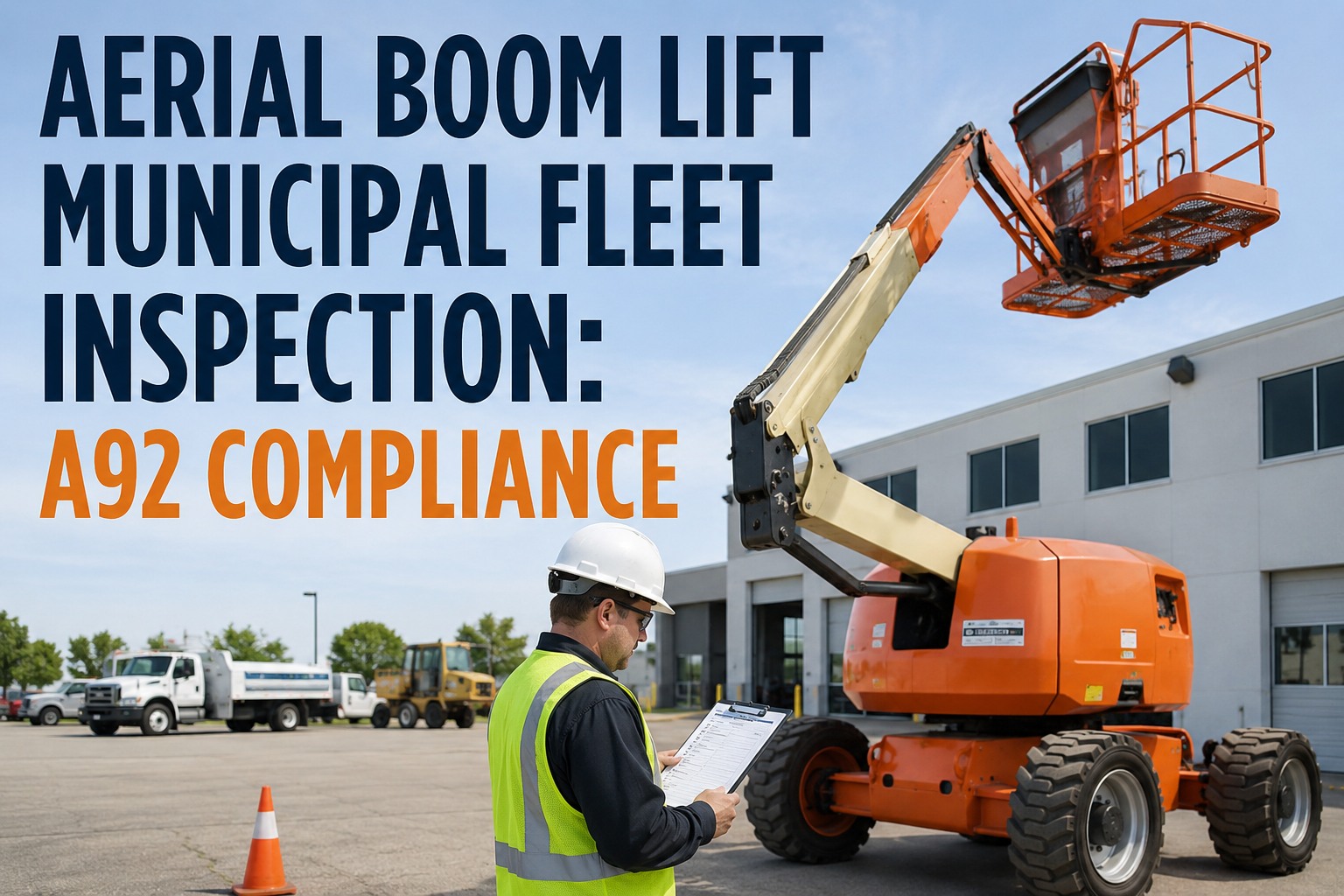
At 6 a.m. on a cold Monday, a boom lift operator pulls a JLG 800S out of the municipal yard to trim branches near a live intersection. He walks around the unit, signs a paper clipboard, and drives off. In the cab, the boom lift daily check sheet in his pocket is the same one he signed yesterday. The machine has 510 hours on it, which means the hydraulic filter was due 10 hours ago, and nobody flagged it. An hour later, the platform emergency descent kicks in mid-air because a fitting let go. The operator is safe, the bucket is on the ground, but the intersection is blocked and the compliance binder back at the yard has nothing in it that would hold up under an OSHA review. That is what happens when aerial boom lift inspection lives on paper. book a walk-through on your own units if this sounds like a Tuesday in your shop.
One missed boom lift inspection can shut down a worksite and open a liability case.
Municipal aerial fleets carry the same legal weight as any contractor — and the binder in the yard won't protect you. HVI locks every A92 inspection to a timestamp, a photo, and a work order.
What an untracked municipal aerial fleet actually costs you
The ANSI A92.20-2018 standard treats pre-use, frequent, and annual inspections as a chain. Break one link and the whole compliance picture falls apart. The numbers below are what we see when a fleet moves from paper to a tracked CMMS.
Three inspection tiers, zero room to skip
ANSI A92.20-2018 doesn't give municipal fleets a pass. Every aerial boom lift in your yard — whether it's a JLG, Genie, or Snorkel — runs on the same three-tier inspection schedule. Here's what each one actually demands.
Pre-Use / Daily Inspection
Operator-driven. Walk-around, function test, emergency descent check, platform controls, ground controls, tires, outriggers, decals, and fall protection anchorage. Required before every shift. Paper clipboards lose these within a week.
Frequent Inspection (3 Months)
Technician-driven. Structural fasteners, hydraulic lines, electrical harnesses, pins and bushings, slide pads, chain tension, brake function, limit switches, and emergency systems. This is the tier that drops off paper schedules first.
Annual Machine Inspection
Full teardown-level review. Load testing on the platform (Genie S-65 calls this out explicitly), boom wear-pad replacement, hydraulic pressure checks, ANSI decal audit, and a documented sign-off. No signed record = no proof of compliance.
JLG and Genie boom lift PM intervals you can't afford to miss
A municipal shop running a mixed MEWP fleet can't rely on memory or a wall calendar. Two of the most common units — the JLG 800S and the Genie S-65 — have hard service windows that paper PM systems miss by hundreds of hours.
| Machine & Task | Interval | What Happens When It's Missed | HVI Tracking Method |
|---|---|---|---|
| JLG 800S — Hydraulic Filter Change | 500 hours | Contamination in the boom valve stack; erratic elevation | Engine-hour trigger, auto work order |
| JLG 800S — JIB Lube | 50 hours | JIB pivot wear, warranty void, premature pin failure | Hourly PM alert, technician assignment |
| Genie S-65 — Platform Load Test | Annual | Load cell drift; failed ANSI audit; operator injury risk | Date-based annual PM, photo sign-off |
| Genie S-65 — Boom Wear Pad Inspection | 3 months | Boom chatter, structural side-load, cable damage | Frequent-inspection template, defect-to-work-order |
| All MEWPs — Emergency Descent Test | Daily + Frequent | Operator stranded at height; OSHA recordable | Mandatory DVIR field with photo proof |
If your current system can't show me the last time the JIB on unit 4 was greased, it's not a maintenance system — it's a hope system. see HVI track these intervals live and the gap becomes obvious in about ten minutes.
Boom lift daily check items your operators can't skip
The pre-use inspection is the one tier that happens every single day — and it's the one most likely to become a pencil-whip. HVI replaces the clipboard with a phone-based checklist that demands a photo at each critical point.
Structural & External
- Tires, wheels, and lug torque
- Outrigger pads and extension function
- Boom, JIB, and platform decals legibility
- Pins, retainers, and fasteners visible
- Hydraulic lines for seepage and chafing
Function & Safety
- Ground controls override platform controls
- Boom limit switch and audible alarm
- Emergency descent from full height
- Platform load capacity placard match
- Fall arrest anchorage point condition
Stop guessing. Start proving A92 compliance.
See how HVI turns every boom lift inspection into an audit-ready, photo-backed record in one mobile app. Book a 30-minute demo on your own fleet.
How HVI keeps your municipal aerial fleet audit-ready
Paper binders and group-chat photos are not a compliance system. HVI replaces them with a single mobile-first CMMS built for the realities of a municipal yard — mixed equipment, rotating operators, and zero tolerance for a missing record.
Digital DVIR with Photo Defect Capture
Every pre-use boom lift inspection runs on a phone or tablet. Operators can't submit without photographing the emergency descent test and the load placard. Defects auto-generate a work order before the unit leaves the yard.
Hour-Based PM Scheduling
HVI reads engine hours from telematics feeds and fires the JLG 800S hydraulic filter at 500 hours and the JIB lube at 50 hours. No calendar guesses, no missed intervals, no voided warranties.
Audit-Ready Timestamped Records
When an OSHA inspector or city auditor asks for the last annual Genie S-65 load test, you pull it up in seconds — date, technician, photo, and sign-off. No binder, no scramble, no liability gap.
Defect-to-Work-Order Automation
A leaking hydraulic fitting flagged at 6 a.m. becomes a work order with parts pulled from inventory by 6:15. The unit is grounded until the repair is signed off — no exceptions, no text-message approvals.
If you want to start logging inspections free on a couple of units this week, the signup takes about four minutes and you don't need IT to set it up.
What paper aerial fleet inspections are really costing your shop
A municipal fleet running 12 boom lifts on paper clipboards loses time, parts, and compliance every month. Here's a worked example based on what we see when a shop moves to HVI.
That number doesn't even include the liability of a single incident with no inspection record on file. walk through your own numbers in a live demo and you'll see the payback inside the first quarter.
Aerial boom lift inspection isn't a clipboard job anymore
ANSI A92.20-2018 requires pre-use, 3-month frequent, and annual inspections on every MEWP in your municipal fleet — JLG, Genie, or otherwise. Paper can't track the 500-hour hydraulic filter on a JLG 800S, can't prove the Genie S-65 annual load test, and can't survive an audit. HVI closes every one of those gaps with a mobile inspection app, hour-based PM scheduling, automatic defect-to-work-order conversion, and timestamped photo records that answer any inspector's question in seconds. The cost of staying on paper isn't just the time your technicians waste — it's the liability that lands on your desk when a boom fails and the binder is empty. let us map it to your fleet in a demo before the next audit cycle hits.
What a real municipal fleet manager sees on day one
"The first thing I did when we moved to HVI was pull up the JIB lube history on our 800S. It hadn't been done in 90 hours. That one catch paid for the software for the year. The clipboard never would've told me that — it just would've told me the guy signed it."
Aerial boom lift inspection and A92 compliance: what you're asking
What does ANSI A92.20 require for boom lift inspections?
How often does a JLG 800S boom lift need a hydraulic filter change?
Does a Genie S-65 boom lift require an annual platform load test?
Can HVI track aerial boom lift inspections for a mixed municipal fleet?
What happens if an operator finds a defect during a boom lift daily check?
See HVI running on your own boom lifts — book a 30-minute demo
We'll load your JLG and Genie units, map the A92.20 intervals, and show you the audit record before the call ends.
Free to start — Works on any phone — No card needed