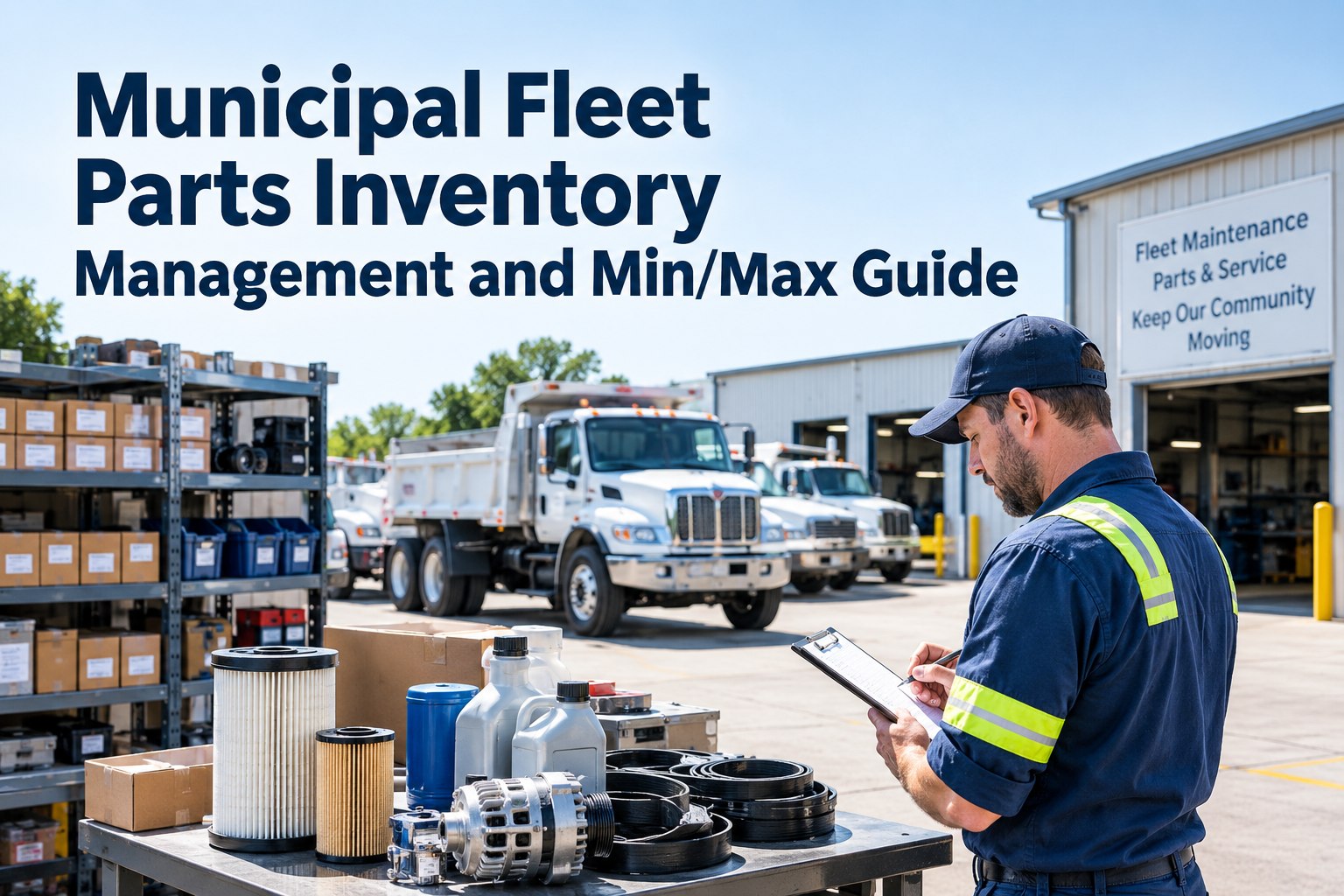
A technician needs a brake chamber, the bin is empty, and a refuse truck sits parked instead of running its route. Meanwhile there is $22,000 of body panels on a back shelf for a bus model the city retired two years ago. Municipal fleet parts inventory management is the discipline of never being in either situation — because both spend public money you can't get back. Book a demo to see min/max on your parts room.
Municipal Fleet Parts Inventory Fails in Two Directions — and Both Cost Taxpayers
Too little stock idles vehicles and forces rush orders. Too much ties up budget and rots into write-offs. Min/max is how you sit in the narrow band between them — and stay there.
A municipal parts room lives under a pressure a commercial shop doesn't: every dollar on the shelf is taxpayer money, open to audit and every dollar wasted is a line someone will ask about. The two failures — running out and over-buying — look like opposites, but they share one root cause: stock levels set by guesswork instead of data. This guide covers why both directions are so expensive for a public fleet, how min/max levels and reorder points actually work, how to classify parts so you stock the right ones, and the municipal-specific wrinkles that make it all harder.
Stockouts vs. dead stockthe two costs of poor municipal fleet parts inventory — and why both hurt
Fleet managers instinctively fear the stockout — it's visible, it grounds a vehicle, someone's shouting about it. Excess inventory is quieter, so it gets tolerated. But on a public budget, the silent failure is often the bigger one, because it never gets counted until an auditor counts it.
A $40 part isn't in the bin, so a service vehicle sits idle at hundreds of dollars a day.
Add emergency shipping at 3–5× standard, overtime for the rushed repair, and a disrupted service route. A single critical stockout can run into five figures of total impact — over a cheap part nobody reordered.Shelves fill with slow-movers and parts for vehicles already retired from the fleet.
Carrying cost — capital, space, insurance, obsolescence — runs 20–30% of the inventory's value every year. Eventually it's written off, and a write-off of public funds is an audit finding, not just a loss.Here's the insight that changes everything: these two goals are not in conflict. Fewer stockouts and lower carrying cost come from the same move — replacing guesswork with data-driven stock levels. Fleets that do this typically cut carrying costs 30–40% while eliminating most stockouts. You don't trade one risk for the other; you retire both. Book a demo to see your stockout and excess exposure in one view
Min/max & reorder pointshow min/max parts inventory levels actually work
Min/max is the engine at the heart of municipal fleet parts inventory management — it's what keeps you in the band. Every part gets two numbers: a minimum that triggers a reorder, and a maximum that caps how much you buy. When stock drops to the minimum, an order fires; it never fills past the maximum. The whole system rests on setting the minimum correctly — and there's a standard formula for that.
Read plainly: the minimum is what you'll burn through while waiting for a delivery, plus a cushion for hot-demand days or a late supplier. Safety stock is usually a couple of weeks of average consumption; an unreliable supplier or longer lead time pushes it up. But the formula only works with real numbers — it needs consumption history. Six months of usage produces meaningful reorder points; twelve captures full seasonal swing. Set levels from a storekeeper's memory instead and you're back to guessing. Start free and let consumption history set your reorder points automatically
The most common municipal mistake isn't the formula — it's that levels get set once when the storeroom is organised and never revisited. Reorder points that were right for a 50-vehicle fleet are wrong for a 200-vehicle fleet, and nobody updated them. Min/max is a living calculation, not a one-time setup.
ABC classificationthe core of fleet inventory optimization — classify parts before you stock them
Applying the same stocking logic to a $2,000 transmission control module and a box of cotter pins wastes money in both directions. The fix is ABC classification — the backbone of any serious fleet parts inventory management program — sorting the catalogue by how critical and how fast-moving each part is, then stocking each tier differently.
There's a shortcut that captures most of the value fast: your top 20 failure parts from the last 12 months typically account for around 80% of unplanned demand. Those parts should never be out of stock, full stop. Get that short list right and you've solved the majority of your stockout problem before touching anything else.
The two rules that keep ABC honest: never run a critical part lean to save a little carrying cost — the saving is nothing against the downtime it risks. And never build a careful forecast for a commodity part — it belongs in a bin, not a model. Get parts into the right tier and every other decision gets easier. Book a demo to see your catalogue classified automatically from work-order history
Government fleet parts managementthe public-sector wrinkles that make it harder than commercial
A commercial shop optimising inventory has one storeroom and a purchasing card. A municipal fleet has none of that simplicity. Three realities make government fleet parts management its own discipline.
Multiple depots & departments
Parts sit in a central yard, satellite depots, and separate shops for public works, sanitation and parks. Without shared visibility, one site rush-orders a part another site has on a shelf. Duplicate buying across departments wastes an estimated 20–30% of holding cost. Pooled, visible inventory is the fix.
Obsolete stock from aging fleets
Government vehicles run years past their optimal life, and when a model finally retires, its unique parts become dead stock overnight. Left unreviewed, it accumulates — one bus fleet found $22,000 in panels for a retired model, returnable for vendor credit once someone flagged it. Schedule an obsolete-stock review, don't wait for the audit to find it.
Procurement rules & lead times
Public purchasing means competitive-bid processes, approved vendors, and cost-center coding — all of which stretch lead times a commercial shop never sees. Longer, less flexible lead times mean safety stock has to absorb more, and every purchase needs a documented, auditable trail back to a work order.
None of these are reasons to abandon optimisation — they're reasons to run it on a system that handles multi-location stock, tracks consumption to the work order, and produces the audit trail public purchasing demands. That's the difference between a parts room that survives an audit and one that generates findings. Start free and see pooled inventory across every depot in one place
From a fleet stores supervisor
Our minimums were set the year we opened the second yard and never touched again. So we'd run out of brake chambers twice in a quarter — our supplier's lead time had gotten longer and nobody adjusted for it — while sitting on twenty grand of panels for a model we'd already sold off.
The thing that fixed it wasn't a bigger budget, it was visibility. Once every part deducted against a work order automatically, I finally had real consumption numbers. Minimums recalculated off actual usage, the system flagged the dead stock so we could send it back for credit, and both yards could see each other's shelves. Stockouts basically stopped, and I walked into the budget review with lower inventory and a cleaner count than I'd ever had.
The takeaway
Municipal fleet parts inventory fails in two expensive directions — stockouts that idle vehicles and excess stock that becomes an audit finding — and both trace to stock levels set by guesswork.
Min/max built on real consumption retires both risks at once — typically 30–40% lower carrying cost and far fewer stockouts. Classify with ABC and protect your top-20 failure parts first.
Public-sector realities — multi-depot stock, obsolete parts, procurement rules — demand pooled visibility, scheduled obsolete-stock reviews, and a work-order-linked audit trail.
The two goals every municipal parts room seems torn between — availability and cost control — were never really opposed. They're the same goal, reached by the same move: stop guessing at stock levels and let consumption data drive them. Do that on a system that pools inventory across depots and links every part to a work order, and both the empty brake-chamber bin and the shelf of dead panels disappear — along with the audit questions that follow. Book a demo to optimise your municipal fleet parts inventory with HVI
Frequently asked questions
What is min/max inventory management for fleet parts?
Min/max is a replenishment strategy where every part has two defined thresholds: a minimum level that triggers a reorder and a maximum level that caps how much is on hand. When stock drops to the minimum, a purchase request fires automatically; once stock reaches the maximum, no further orders are placed. This keeps parts available without over-buying. The minimum is set with a standard formula: average daily usage multiplied by supplier lead time, plus a safety-stock cushion for days when demand runs high or the supplier runs late. The maximum is the minimum plus an economic order quantity — the sensible amount to buy per order. The whole system depends on real consumption data rather than intuition; six months of usage history produces meaningful reorder points and twelve months captures full seasonal variation. For a municipal fleet, min/max is the core mechanism that keeps the parts room between the two expensive failures of stocking out and over-stocking, and it needs to be treated as a living calculation that updates as the fleet and suppliers change, not a one-time setup.
How do you calculate the reorder point for a fleet part?
The reorder point — the minimum level — is calculated as (average daily usage × lead time in days) + safety stock. In plain terms, it's how much of the part you'll consume while waiting for a delivery, plus a buffer for uncertainty. For example, if a part is used at two per day and the supplier takes ten days to deliver, base demand during lead time is 20 units; adding a safety-stock cushion of, say, another two weeks of average usage protects against demand spikes and late deliveries. Safety stock rises when demand is variable, when the supplier is unreliable, or when the part is mission-critical — a common approach adds a service-level factor so that, for instance, 95% availability uses a larger buffer than a non-critical item. The maximum level is then the reorder point plus an economic order quantity. Most fleets find their optimal minimum lands around two to three weeks of average consumption plus safety stock. The essential requirement is consumption history; without accurate usage data, the formula produces numbers no better than a guess, which is why linking parts issuance to work orders matters so much.
How much does a parts stockout actually cost a municipal fleet?
Far more than the price of the missing part. A common example: a $40 hydraulic fitting that isn't in the bin can idle a service vehicle at several hundred dollars a day until the part arrives. On top of that lost availability come emergency shipping premiums that typically run three to five times standard freight, overtime labour for the rushed repair, and cascading disruption to service routes and schedules. When those factors combine, a single critical stockout can reach five figures of total impact over a cheap, easily stocked part. For a public fleet the damage isn't only financial — a grounded refuse truck or snowplow is a missed public service, which draws scrutiny a private fleet never faces. This is why the top failure parts should never be allowed to stock out: the carrying cost of keeping a critical part on the shelf is trivial next to the total cost of not having it when a technician needs it.
How can a fleet reduce obsolete and excess parts inventory?
Excess and obsolete stock is the quiet, expensive failure — carrying costs of capital, storage, insurance and obsolescence run roughly 20 to 30% of the inventory's value every year, and dead stock eventually becomes a write-off, which on a public budget is an audit finding rather than just a loss. The controls are straightforward. First, set maximum levels so ordering stops once stock is adequate, preventing over-buying at the source. Second, schedule regular obsolete-stock reviews — review fast-moving parts monthly, standard parts quarterly, and slow-movers annually — and act on what they surface; parts for a retired vehicle model can often be returned to the vendor for credit if flagged promptly, as one bus fleet did with $22,000 of panels. Third, pool inventory across depots so one site isn't buying what another already has sitting idle, which alone can recover a large share of wasted holding cost. Doing this consistently requires visibility into consumption and stock across every location, which is difficult on spreadsheets but automatic on a parts-management platform that tracks usage against work orders.
What makes municipal parts inventory different from commercial fleets?
Three things set it apart. First, accountability: every part on the shelf is taxpayer money, open to audit and public-records scrutiny, so excess and obsolete stock isn't just a cost — it's a documented finding someone will have to answer for, and every purchase needs a defensible trail back to a work order. Second, structure: municipal fleets typically spread inventory across a central yard, satellite depots, and separate shops for public works, sanitation, parks and other departments, so without shared visibility one site rush-orders a part another has in stock, wasting an estimated 20 to 30% of holding cost on duplicate buying. Third, procurement and aging assets: public purchasing runs through competitive-bid processes and approved vendors that lengthen and stiffen lead times, meaning safety stock must absorb more; and because government vehicles run years past their optimal life, retiring a model turns its unique parts into dead stock overnight. Together these mean a municipal parts room needs pooled multi-location inventory, scheduled obsolete-stock reviews, and work-order-linked records — not just a basic min/max setup.
Stop stocking out and stop over-buying — at the same time
HVI deducts every part against its work order, sets and updates min/max levels from real consumption, fires reorders automatically at the minimum, flags obsolete stock before it's written off, and pools inventory across every depot in one view — with the work-order-linked trail public audits require. Lower carrying cost and fewer stockouts, together. Live on your parts room in under two weeks.
No credit card · Multi-location inventory · Audit-ready records