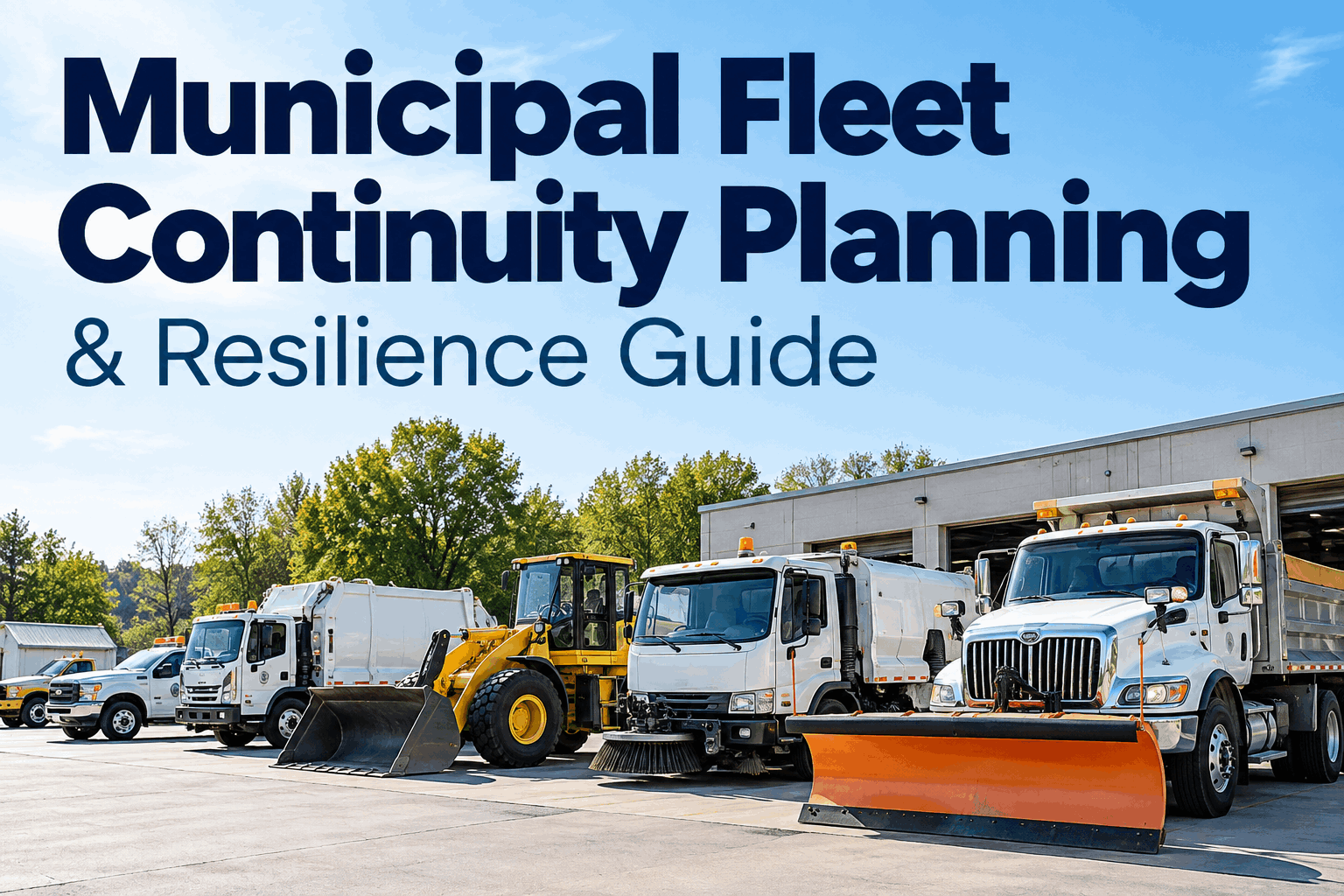
The storm warning lands at 3 p.m. By 5 a.m. you need every plow truck on the road, and the one with the 14-foot spreader body, the only one that covers the hospital route, has a hydraulic leak nobody logged. Good fleet continuity planning is what decides whether that truck has a backup, a mutual-aid call, or nothing at all. In public works, a down vehicle is a missed service, not just a repair bill. See how HVI tracks readiness per critical asset
Your Residents Don't Notice Vehicles. They Notice Services.
Continuity planning starts by working backwards from the service to the asset it depends on. Look at the chain below, then find your weakest link.
Unplanned downtime is one of the biggest recurring costs for fleet-heavy operations, and for a city it also lands on council agendas and social media. The rest of this guide is a practical plan: map the services, rank the assets, line up backups, stock the right parts, and test it all before the emergency does.
Step 1: Map essential services to critical fleet assets
Ask each department head one blunt question: "If this vehicle is down tomorrow, which service stops?" You'll get a different answer than the asset register gives you. A tandem-axle sander looks like one of 80 trucks on paper, but it may be the only way to treat your hill routes.
Snow & ice
Plows, spreaders, loaders
Water & wastewater
Vac trucks, pumps, valve trucks
Refuse collection
Packers, side loaders
Road maintenance
Dump trucks, graders, sweepers
Emergency support
Command, light towers, generators
Infrastructure repair
Backhoes, crane trucks, utility bodies
Mark every asset that is the only one able to do its job. Those are your single points of failure, and they get the first backup plan. Pull their maintenance history too: a unit with three repeat hydraulic repairs is a risk you can see coming.
Step 2: Rank criticality, then let it drive maintenance
When the shop is short-staffed in November, something has to wait. Criticality tiers make that decision in advance instead of in the middle of a crisis.
Service stops without it
- PM: first in the bay, never deferred
- Inspection: readiness check before each season or event
- Parts: higher min levels on long-lead items
- Backup: named spare or signed agreement
Service slows without it
- PM: on schedule, flexible by days
- Inspection: standard frequency
- Parts: normal min/max
- Backup: shared pool or substitute
Service can wait days
- PM: scheduled around Tier 1 and 2
- Inspection: standard frequency
- Parts: order on demand
- Backup: accept short interruption
This is where preventive maintenance scheduling earns its keep. Calendar and meter-based PMs keep Tier 1 units current, and a demo of HVI's priority work orders shows how critical vehicles move to the front of the queue.
Step 3: Build a fleet contingency plan for every Tier 1 asset
A backup that exists only in someone's head fails at 2 a.m. For each critical unit, choose the contingency in advance and write it down. Here is how the usual options compare.
| Option | Speed | Cost | Watch out for |
|---|---|---|---|
| Spare vehicle | Fastest | High (idle capital) | Spare itself must stay PM-current |
| Substitute equipment | Fast | Low | Operator licence and attachment fit |
| Mutual aid | Hours to days | Low | Neighbours need the same unit in the same storm |
| Standing rental contract | Hours | Medium | Availability during regional events |
| Contractor support | Hours | Medium to high | Pre-approved scope and rates |
| Accepted interruption | n/a | None upfront | Must be a documented, approved decision |
Then cover the practical gaps people forget: fuel on hand when pumps lose power, operators with the right licences for the substitute, and offline access to inspection and maintenance records when the network drops. Field crews using HVI can capture inspections offline and sync later, so records survive the disruption.
Step 4: Stock the parts that keep municipal fleet resilience real
The vehicle isn't down because it broke. It's down because the hydraulic pump has a six-week lead time. Stock by criticality plus lead time, not by what's cheap.
- Same min level for every part
- Long-lead items ordered after failure
- Tier 1 unit waits in the bay
- Higher min levels on Tier 1 components
- Reorder alerts before stock runs out
- Critical unit back in service in days
Parts min/max controls in HVI flag low stock on the items your critical fleet depends on, so shortages show up in a report, not a breakdown.
Step 5: Test your continuity of operations fleet plan
A plan nobody has tested is a theory. Run a short exercise each year, ideally before your peak season, and write down what breaks.
- 1Simulate a Tier 1 failure
- 2Deploy the backup and crew
- 3Time it and log the gaps
- 4Fix with assigned actions
- 5Review on a set schedule
Typical surprises: the spare's battery is dead, the rental yard needs a purchase order, the substitute operator has no endorsement. Each one becomes a tracked corrective action. Book a demo to see defect tracking and calendar-triggered readiness checks in action.
From a public works fleet supervisor
We had 90-odd units and I could tell you which ones I worried about, but not on paper. After a January storm where our only sewer jetter sat for nine days waiting on a pump, I ranked everything in three tiers, set higher minimums on a few long-lead parts and signed a rental agreement. Next winter the same unit threw a fault and we had a substitute rolling by lunch. Boring is the goal.
Fleet continuity planning: your readiness checklist
Use this to see where your plan stands today. Set up your critical-asset inspections free and these checks live against each vehicle.
Services mapped to assets
Every essential service links to named vehicles.Single points of failure flagged
Each one has a documented contingency.Criticality drives PM priority
Tier 1 units are served first when capacity is tight.Long-lead parts stocked
Minimums reflect lead time, not just price.Records work offline
Crews can inspect and log defects without signal.Plan exercised and reviewed
Gaps logged, owners assigned, dates set.Frequently asked questions
What is fleet continuity planning?
Fleet continuity planning is the process of identifying which vehicles and equipment your essential services depend on, then deciding in advance how those services continue if a critical asset fails. It covers backups, maintenance priorities, parts, people and testing.
How do I identify critical vehicles in a municipal fleet?
Start from the service, not the vehicle. For each essential service, list the assets it needs and ask what happens if each one is out for a day, a week or a month. Anything that stops or seriously degrades a service, especially if it has no equivalent unit, is critical.
Do I need spare vehicles for every critical asset?
No. A spare is only one option. Substitute equipment, mutual aid, standing rental agreements, contractor support or a documented, accepted level of temporary interruption can all be valid, as long as the choice is made and written down before failure.
How does asset criticality affect preventive maintenance?
Criticality sets priority. Tier 1 vehicles are scheduled first, inspected more often around peak seasons, and supported by higher minimum stock of long-lead parts. Lower tiers can flex when shop capacity is limited.
How often should we test our fleet continuity plan?
At least once a year, ideally ahead of your highest-risk season, and after major changes such as new equipment or contract updates. Document what failed, assign corrective actions and schedule a plan review.
Make fleet continuity planning a system, not a scramble
Good fleet continuity planning means the right vehicle is ready, the right part is on the shelf and the record is in your pocket when the call comes. HVI connects inspections, preventive maintenance, defect tracking, asset history and parts min/max in one platform, so municipal fleets keep essential equipment ready for service.
No credit card · Offline inspections · Parts min/max · Asset history