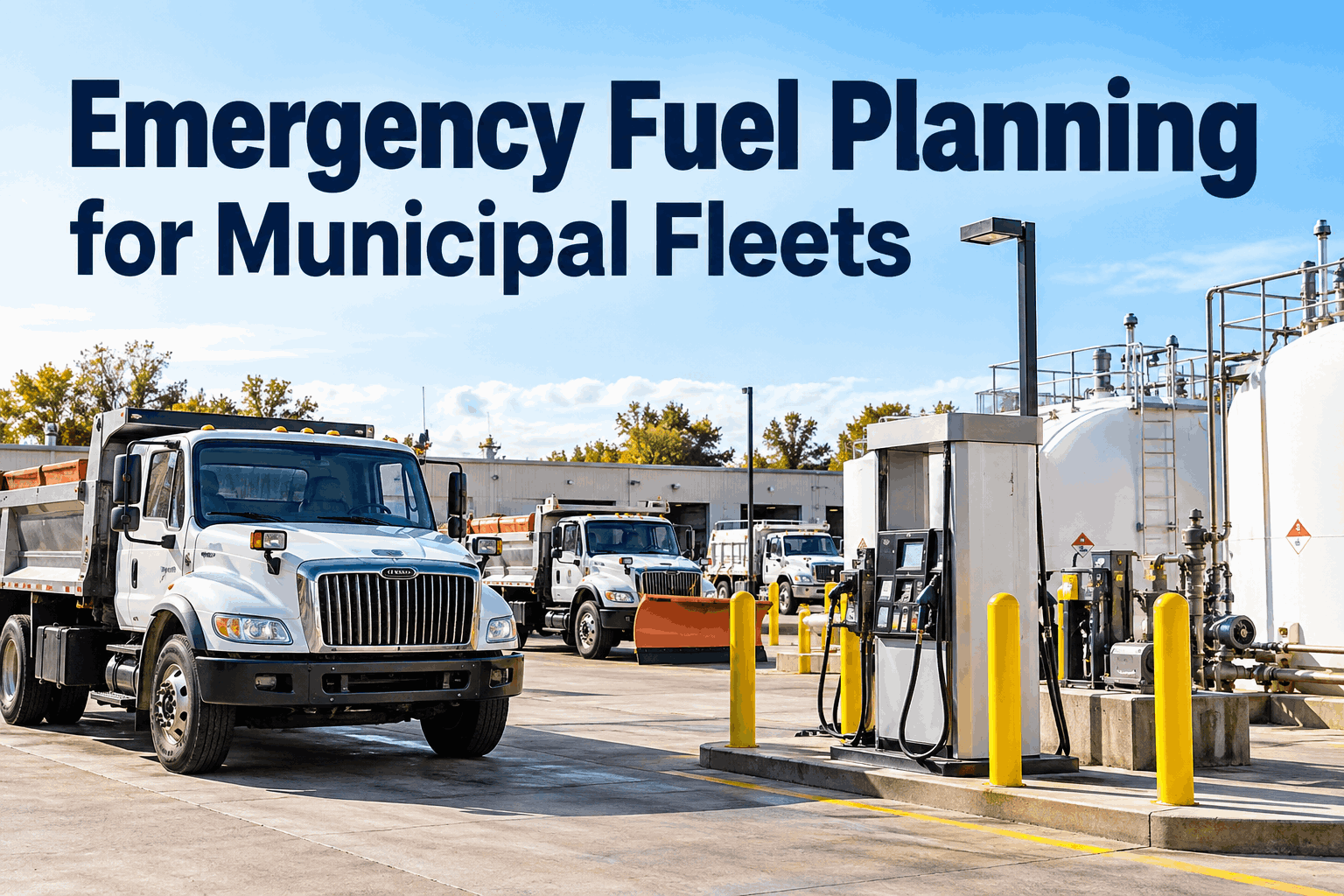
The ice storm takes out the grid at 2 a.m. Your plow trucks are serviced, your crews are on the way, and then the fuel site won't pump, because the dispensers run on grid power and nobody ever tested the generator hookup. Solid emergency fuel planning is what separates a fleet that keeps moving from a fleet of perfectly good vehicles parked at a dead pump. For municipal fleets, fuel isn't a line item. Itis the thing every other service runs on. See how HVI tracks fuel and readiness in one place
A Serviceable Vehicle With No Fuel Is Still Out of Service
Here is how a typical fuel disruption unfolds. Find the hour where your plan runs out.
- Hour 0Power dropsDispensers and transfer pumps stop unless backed up
- Hour 8Generator decisionSome city plans activate generator fueling after an outage this long
- Day 1–2Burn rate bitesGenerators and response vehicles drain tanks faster than normal
- Day 3+Supply is the problemSuppliers are stretched and roads may be blocked
Sources: Wisconsin Energy Innovation Office survey (62 respondents), presented to NASEO/NGA; NYC DCAS Fleet newsletter.
Those numbers point to the same gap: plans exist on paper, but the fuel details often don't. The rest of this guide covers how to close it, from the site audit to the after-action review.
Step 1: Audit your emergency fuel supply chain
Walk every fueling site and list what has to work for a truck to get fuel. One missing link is enough to stop the whole chain.
Storage tanks
Capacity, current level, inspection dates
Dispensers
Do they run on grid power only?
Transfer pumps
Tested under backup power?
Generators
Runtime, load, transfer switch
Suppliers
Delivery terms, contacts, priority
Access controls
Fuel cards, keys, emergency codes
The details matter. One city's published fuel contingency plan notes that its premium pump isn't connected to the backup generator, and warns that running too many pumps at once can overload and stall it. You only learn that kind of thing by testing under load. Book a demo to see recurring readiness tasks for fuel sites and generators.
Step 2: Calculate your emergency fuel supply runway
"We have plenty of diesel" isn't a number. Work out how many hours you can actually run, for each outage scenario you plan for.
Do it twice: once for generators at the fuel site and critical buildings, and once for the vehicles themselves. Then compare against what's in your tanks today. If the gap is bigger than your supplier can close in the first 24 hours, you've found your priority. Tracking fuel use by vehicle and asset gives you real burn rates to plan with instead of guesses.
Step 3: Set fuel triggers so nobody has to guess
When a hurricane track shifts at 9 p.m., the question "should we top off the tanks?" shouldn't be a debate. Write the triggers down, with an owner for each.
| Trigger | Action | Owner |
|---|---|---|
| Storm, wildfire or flood forecast | Top off tanks and critical vehicles; confirm supplier delivery slots | Fleet supervisor |
| Fuel stock below your minimum | Place a priority order and alert the emergency manager | Fuel coordinator |
| Outage passes your set threshold | Start generator fueling procedure and log runtime | Site lead |
| Supplier delay or road closure | Switch to mobile fueling, secondary site or mutual aid | Public works director |
Set your own minimum inventory levels based on the runway math above, and put supplier agreements in writing: emergency delivery steps, priority arrangements, contacts and alternate delivery locations. Ask your fuel vendor directly whether they've planned for a multi-day outage with you. According to the Wisconsin survey above, most hadn't. If you want to see how minimum thresholds and low-stock alerts work in practice, a short demo covers it.
Step 4: Line up backup fuel supply and contingency fueling
Your main site will fail eventually. Have at least two ways to fuel that don't depend on it.
| Option | Best for | Watch out for |
|---|---|---|
| Mobile fueling | Vehicles that can't leave the site | Truck availability, fuel handling safety |
| Secondary municipal site | Short outages at the main yard | Same grid, same outage |
| Commercial fueling network | Small groups of vehicles | Stations also lose power; card access |
| Mutual aid with neighbors | Regional events | Written terms and shared access rules |
| Priority supplier delivery | Refilling tanks and generators | Contract language and road access |
Don't forget the fuel itself. Stale or contaminated fuel is a common reason backup generators fail, so schedule fuel quality checks, tank inspections and transfer-pump tests as preventive maintenance tasks alongside your vehicles.
Step 5: Decide who fuels first when supply is tight
When fuel is limited, someone will ask for a truck to be filled "just this once." Agree on the order now, with your emergency manager, and write it into the plan.
- 1Life safety Police, fire, EMS support
- 2Critical infrastructure Water, wastewater, utilities, generators
- 3Access and recovery Snow response, debris, road crews
- 4Routine services Deferred until supply stabilizes
Then track consumption by vehicle during the incident. When you know how much each asset is drawing, you can estimate remaining operating time and decide where resupply goes first. Book a demo to see asset-level fuel records that support exactly this.
From a municipal fleet supervisor
We had a generator at the main fuel site and felt covered. Then the first real outage hit and the transfer switch tripped under load, and we spent four hours hand-pumping into plow trucks. Now we run the generator under load every quarter, we log burn rates by vehicle, and my supplier has our site details on file. The plan is two pages. The difference is the test.
Close the loop: review every emergency fuel plan after an event
Every incident is free data. Within a week of recovery, pull the records and ask four questions.
- 1Consumption What did each asset burn?
- 2Suppliers Did they deliver on terms?
- 3Equipment What failed or lagged?
- 4Update Revise the plan and triggers
Fleets that keep inspections, fuel logs and asset history together can do this review in an afternoon. Start free and keep your fuel and inspection records in one place.
Your emergency fuel readiness checklist
Fuel sites audited
Tanks, dispensers, pumps and generators documented.Backup power tested under load
Including transfer switch and every pump you need.Runway calculated
Hours of operation per scenario, vehicles and generators.Written triggers and owners
Stock-up actions tied to forecasts and thresholds.Supplier and mutual aid agreements
Contacts, priority terms, alternate delivery points.Priority order and access controls
Agreed in advance with your emergency manager.Frequently asked questions
What is emergency fuel planning for a municipal fleet?
Emergency fuel planning is a written plan that keeps vehicles, equipment and generators supplied with fuel when normal supply is disrupted. It covers fuel sites, backup power, minimum inventory, supplier agreements, contingency fueling and priority rules.
How much emergency fuel should we keep on hand?
There's no single figure. Estimate operating hours multiplied by fuel burn rate for each scenario, for both vehicles and generators, and set minimums that cover the time your supplier needs to resupply you. Real consumption data makes this far more accurate.
What happens to our fuel site during a power outage?
If dispensers and transfer pumps depend on grid power, they stop. You need backup generation connected through a tested transfer switch, a known runtime, and a manual fallback. Test it under realistic load before an emergency, not during one.
Who should get fuel first when supply is limited?
Decide in advance with your emergency manager. A common approach is to put life-safety vehicles first, then critical infrastructure, then access and recovery crews, with routine services last. Write the order into the plan so it isn't negotiated mid-incident.
How can fleet software support emergency fuel readiness?
Software like HVI records fuel activity by vehicle, schedules recurring readiness and preventive maintenance tasks, stores inspection and asset history, and supports offline field capture. That gives you the records to plan, respond and review.
Turn emergency fuel planning into a routine, not a scramble
Good emergency fuel planning means tested backup power, a known runway, written triggers and records you can trust. HVI brings fuel tracking, readiness checks, inspections, preventive maintenance and asset history into one platform so your municipal fleet is ready before the grid goes down.
No credit card · Fuel tracking · Offline inspections · Asset history